
| The essentials: On July 24, 2026, the FDA approved Lytenava (bevacizumab-vikg, Outlook Therapeutics) for the treatment of patients with neovascular (wet) age-related macular degeneration (nAMD). Lytenava is the first and only FDA-approved ophthalmic formulation of bevacizumab in the United States. It is administered as a 1.25 mg intravitreal injection once monthly. What bevacizumab is: a recombinant humanized monoclonal antibody that selectively binds with high affinity to all isoforms of VEGF-A, blocking VEGF from binding to its receptors on endothelial cells, preventing choroidal neovascularization and vascular leakage. Bevacizumab (Avastin) has been FDA-approved for cancer since 2004 and has been compounded and injected off-label into the eyes of patients with wet AMD by retina specialists for approximately 20 years. It has never, until now, been approved for ophthalmic use. What Lytenava is: bevacizumab reformulated specifically for ophthalmic intravitreal use, with a dedicated manufacturing process, sterility testing, FDA-approved labeling, and batch-to-batch consistency requirements. It is not Avastin repackaged in smaller vials. It is a distinct pharmaceutical product developed and validated specifically for intraocular administration. The regulatory story: the path to approval involved multiple CRLs, a Formal Dispute Resolution (FDR) with the FDA’s Office of New Drugs, and a Final Dispute Resolution process that concluded substantial evidence of effectiveness had been established. This is among the more complex regulatory histories for any approved ophthalmic product. The clinical basis: NORSE TWO (NCT03834753), a Phase 3 randomized, controlled, masked trial in 228 adults with nAMD; bevacizumab-vikg 1.25 mg monthly for 12 months versus ranibizumab 0.5 mg monthly for 3 months then every 3 months. Primary endpoint (proportion of patients gaining at least 15 BCVA letters at month 11): 41.7% (bevacizumab-vikg) versus 23% (ranibizumab); p=0.0052. Mean BCVA change: plus 11.2 letters (bevacizumab-vikg) versus plus 5.8 letters (ranibizumab); p=0.0043. NORSE EIGHT (NCT06190093), a confirmatory Phase 3 non-inferiority trial: at week 8, primary non-inferiority endpoint not met (difference minus 2.257 BCVA letters vs minus 3.5 letter NI margin); at week 12, non-inferiority to ranibizumab was demonstrated (BCVA difference minus 1.009 letters). The FDA, following FDR, concluded that NORSE TWO plus confirmatory mechanistic and natural history data established substantial evidence of effectiveness. Lytenava already holds marketing authorization in the European Union and the United Kingdom. Commercial launch in the United States expected before year-end 2026. For readers of prior HED posts: the wet AMD treatment landscape now includes Lytenava alongside ranibizumab (Lucentis, biosimilars), aflibercept (Eylea, Eylea HD, biosimilars), brolucizumab (Beovu), faricimab (Vabysmo), and port delivery system faricimab; for the related condition of geographic atrophy (dry AMD progression), see our earlier post on Izervay (avacincaptad pegol) for the treatment of geographic atrophy secondary to age-related macular degeneration. |
|---|
For approximately 20 years, one of the most widely used treatments for wet age-related macular degeneration in the United States has been a drug called bevacizumab, sold under the brand name Avastin, that the FDA approved in 2004 for colorectal cancer.
This is not a secret. It is not an underground practice. It is an open and well-documented aspect of retinal care that has been sanctioned by professional ophthalmology societies, studied in large head-to-head trials, recommended in clinical guidelines, and reimbursed by Medicare and commercial payers. Retina specialists across the country compounded or had pharmacies compound Avastin into small-volume intravitreal doses and injected it into eyes to block the abnormal blood vessel growth that destroys central vision in wet AMD, because it worked, it cost a fraction of approved alternatives, and there was no FDA-approved bevacizumab formulation for the eye.
That last fact changed on July 24, 2026.
Lytenava (bevacizumab-vikg, Outlook Therapeutics) is the first bevacizumab product ever approved by the FDA for ophthalmic use. The molecule is the same. The mechanism is the same. What changed, and what took a winding, four-year regulatory path with multiple rejections and a formal dispute resolution process to establish, is that an ophthalmic formulation developed specifically for intraocular administration, with dedicated manufacturing, sterility validation, FDA-approved labeling, and ongoing regulatory oversight, finally has the regulatory standing to back it.
What Wet AMD Is and Why VEGF Inhibition Is the Standard of Care
Age-related macular degeneration (AMD) is the leading cause of irreversible vision loss in adults over 60 in developed countries. The macula, the central portion of the retina responsible for high-resolution central vision, degenerates in two distinct forms.
Dry AMD, or atrophic AMD, is the more common form (approximately 85 to 90% of AMD cases) and involves the gradual degeneration of photoreceptors and the retinal pigment epithelium. It progresses slowly in most patients but can advance to geographic atrophy, in which large areas of retinal cells are lost permanently. For coverage of the first FDA-approved treatments for geographic atrophy, see our earlier HED post on Izervay (avacincaptad pegol), which covers the complement pathway and the first approved therapy to slow GA progression.
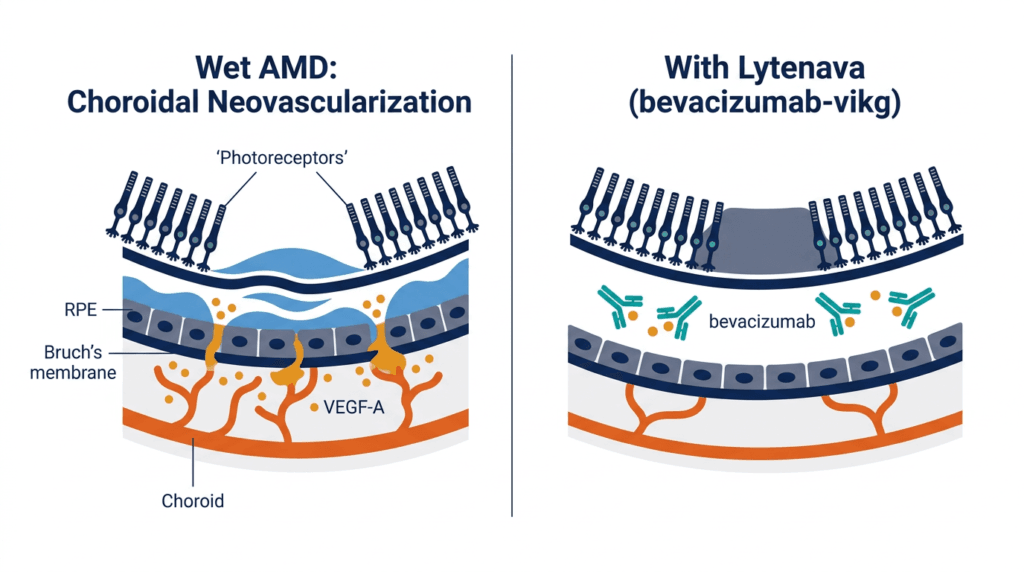
Wet AMD (neovascular AMD) is the less common but more rapidly vision-threatening form. In wet AMD, abnormal blood vessels grow beneath the retina (choroidal neovascularization, CNV) in response to elevated vascular endothelial growth factor (VEGF) expression. These abnormal vessels are fragile and leaky: they allow fluid to accumulate beneath and within the retina, distorting and ultimately destroying the photoreceptors of the macula. Without treatment, wet AMD can cause severe central vision loss within weeks to months.
Approximately 200,000 Americans are diagnosed with wet AMD each year. The condition is bilateral in approximately half of patients within five years of the first eye being affected. Its impact on quality of life is profound: the loss of central vision affects reading, driving, facial recognition, and independence, with consequences that extend well beyond visual function to depression, social isolation, and loss of daily living skills.
The VEGF-A mechanism of wet AMD
VEGF-A (vascular endothelial growth factor A) is a signaling protein produced by retinal pigment epithelial cells, Müller cells, and other retinal cells under conditions of hypoxia or oxidative stress. VEGF-A binds to VEGFR-1 and VEGFR-2 on the surface of endothelial cells, stimulating their proliferation, migration, and survival, which drives the formation of new blood vessels (angiogenesis). In the retinal context, VEGF-A also increases vascular permeability, contributing to the leakage of fluid and proteins from the abnormal choroidal vessels.
Anti-VEGF therapy, delivered directly into the vitreous cavity of the eye as an intravitreal injection, blocks VEGF-A from binding to its endothelial cell receptors, suppressing both the growth of new abnormal vessels and the leakage from existing ones. Regular anti-VEGF injections have transformed wet AMD from a condition that reliably caused severe vision loss within one to two years to one that can be managed with sustained vision preservation or improvement for years in most treated patients.
The Off-Label Bevacizumab Story: 20 Years of Using the Wrong Label
The off-label use of bevacizumab for wet AMD is one of the most consequential chapters in modern ophthalmic pharmacology, and understanding it is essential context for understanding why Lytenava’s approval matters even to the retina specialists who have been giving bevacizumab intravitreal injections for years.
Bevacizumab (Avastin, Roche/Genentech) was approved by the FDA in 2004 for first-line colorectal cancer as an intravenous anti-VEGF antibody. Ophthalmologists quickly recognized that its mechanism of blocking all VEGF-A isoforms was precisely what wet AMD treatment needed, and that the molecule was small enough to be injected into the eye in minute doses. By 2005, retinal specialists were compounding Avastin from its cancer-dose vials into small-volume ophthalmic doses and injecting it into eyes. By 2010, bevacizumab was the most commonly used anti-VEGF agent for wet AMD in the United States, despite never having been approved for this use.
The reasons for this widespread off-label adoption were straightforward:
Efficacy: Large randomized trials, including the landmark CATT (Comparison of AMD Treatments Trials) study, showed that intravitreal bevacizumab was non-inferior to ranibizumab (the approved anti-VEGF agent at the time) for vision outcomes in wet AMD.
Cost: Compounded bevacizumab cost approximately $50 to $80 per injection, compared with $2,000 or more per injection for ranibizumab (Lucentis). At a treatment frequency of 8 to 12 injections per year, the cost difference was $15,000 to $20,000 per eye per year versus $200 to $600 per eye per year.
Access: The cost advantage made bevacizumab accessible to patients who could not afford or were not adequately covered for branded anti-VEGF agents.
The off-label use was not without controversy. Compounded bevacizumab is not subject to the same manufacturing controls, sterility standards, or batch-to-batch consistency requirements as FDA-approved products. Several clusters of serious ocular infections (endophthalmitis) and inflammation events were reported in association with specific compounding pharmacy lots. The lack of FDA-approved labeling meant that prescribing information, dosing, and safety monitoring were not standardized across practices.
It is precisely this gap that Lytenava fills. Not by providing a drug that retina specialists could not already access, but by providing one with the standardized manufacturing, validated sterility, FDA-approved labeling, and regulatory oversight that compounded Avastin could never offer.
How Bevacizumab Works: The Full-Isoform VEGF-A Blockade
Lytenava’s active molecule, bevacizumab, is a recombinant humanized monoclonal antibody that binds with high affinity to all isoforms of human VEGF-A, including VEGF-A121, VEGF-A165, VEGF-A189, and VEGF-A206. By binding to the VEGF-A molecule itself rather than its receptors, bevacizumab prevents VEGF-A from engaging VEGFR-1 and VEGFR-2 on endothelial cells, blocking both receptor activation pathways simultaneously.
This pan-isoform VEGF-A blockade distinguishes bevacizumab from some other anti-VEGF agents in the wet AMD arsenal:
- Ranibizumab (Lucentis): an anti-VEGF-A Fab fragment (lacking the Fc region of full antibody)
- Aflibercept (Eylea): a VEGF trap that also captures VEGF-B and placental growth factor
- Brolucizumab (Beovu): a single-chain antibody fragment with high potency and penetration
- Faricimab (Vabysmo): a bispecific antibody targeting both VEGF-A and angiopoietin-2
Bevacizumab is the largest molecule among the intravitreal anti-VEGF agents (molecular weight approximately 149 kDa), which has historically been cited as a theoretical reason it might not penetrate the retina as effectively as smaller fragments. Clinical trial evidence has not supported this as a meaningful efficacy limitation in practice.
The NORSE Clinical Trial Program: What the Data Shows
The Lytenava approval is based on the NORSE (Non-Inferiority and Ophthalmic Randomized Study of Efficacy and Safety) clinical trial program, specifically NORSE TWO as the primary pivotal trial and NORSE EIGHT as the confirmatory study, together with mechanistic and natural history data.
NORSE TWO (NCT03834753): The pivotal efficacy trial
NORSE TWO was a Phase 3, randomized, controlled, parallel-group, masked trial enrolling 228 adults with newly diagnosed wet AMD at 39 sites across the United States. The median patient age was 79 years. Patients were randomized to:
- Bevacizumab-vikg 1.25 mg intravitreal injection once monthly for 12 months (n=113)
- Ranibizumab 0.5 mg intravitreal injection monthly for 3 months (days 0, 30, 60) then every 3 months (days 150 and 240) for 12 months (n=115)
The primary endpoint was the proportion of patients gaining at least 15 ETDRS letters of best corrected visual acuity (BCVA) from baseline at month 11.
| Endpoint | Bevacizumab-vikg (n=113) | Ranibizumab (n=115) | Result |
|---|---|---|---|
| Patients gaining at least 15 BCVA letters at month 11 (primary) | 41.7% | 23% | p=0.0052 |
| Patients gaining at least 15 BCVA letters at month 11 (per protocol) | 41% | 24% | p=0.04 |
| Mean BCVA change from baseline at month 11 (ITT, key secondary) | Plus 11.2 letters | Plus 5.8 letters | p=0.0043 |
| Mean BCVA change from baseline at month 11 (per protocol) | Plus 11.1 letters | Plus 7.0 letters | p=0.05 |
| Any adverse event | 75.2% | 73.9% | Similar |
| Serious adverse events | 12.4% | 13.9% | Similar |
| Ocular serious adverse events | 0.9% | 0.0% | Numerically higher with bevacizumab-vikg |
Source: NORSE TWO top-line data. Outlook Therapeutics. 2021. NCT03834753.
The NORSE TWO primary endpoint result, 41.7% of bevacizumab-vikg patients gaining 15 or more letters at month 11 versus 23% of ranibizumab patients (p=0.0052), is statistically significant and clinically meaningful. Gaining 15 or more ETDRS letters (3 lines on a standard eye chart) represents a substantial vision improvement in a disease where the natural history without treatment typically involves significant vision loss. The mean BCVA improvement of 11.2 letters with bevacizumab-vikg versus 5.8 letters with ranibizumab is a similarly substantial difference in the key secondary endpoint.
An important contextual note on the comparator design: ranibizumab in the control arm was given monthly for the first 3 months and then shifted to quarterly dosing. Ranibizumab given quarterly rather than monthly produces somewhat less vision gain than ranibizumab given monthly, which is how it performs in its own pivotal trials. The NORSE TWO comparator arm was based on a common real-world pro re nata approach rather than the optimal fixed monthly ranibizumab dosing used in MARINA and ANCHOR. This comparison design has been acknowledged as a limitation of interpreting the magnitude of difference between arms.
NORSE EIGHT (NCT06190093): The confirmatory trial
NORSE EIGHT was a Phase 3, randomized, controlled, masked, non-inferiority trial required by the FDA as a second adequate and well-controlled trial. Newly diagnosed wet AMD patients were randomized 1:1 to bevacizumab-vikg 1.25 mg or ranibizumab 0.5 mg at weeks 0, 4, and 8. The primary endpoint was mean change in BCVA from baseline to week 8, with a pre-specified non-inferiority margin of minus 3.5 letters.
NORSE EIGHT did not meet its pre-specified primary non-inferiority endpoint at week 8. The BCVA difference between arms was minus 2.257 letters (95% CI minus 4.044 to minus 0.470), and the lower bound of the confidence interval fell outside the minus 3.5 letter non-inferiority margin (p greater than 0.025).
However, at week 12 (3 injections per arm), bevacizumab-vikg was non-inferior to ranibizumab: the BCVA difference was minus 1.009 letters (95% CI within the non-inferiority bounds), demonstrating that by the third injection cycle, the drug produced outcomes comparable to ranibizumab.
The FDA’s Office of New Drugs initially issued a second CRL in December 2025, concluding that the NORSE EIGHT data did not establish a second adequate and well-controlled trial. Outlook Therapeutics pursued a Formal Dispute Resolution (FDR) with the Office of New Drugs. Following the FDR, the OND concluded that the totality of evidence, including NORSE TWO (which met its primary endpoint), the week 12 NORSE EIGHT data, and additional mechanistic and natural history data, collectively established substantial evidence of effectiveness for bevacizumab-vikg in nAMD. The BLA was resubmitted in June 2026 and approved five days before the PDUFA date of July 29, 2026.
The Regulatory Path: What Multiple CRLs and a Formal Dispute Resolution Mean
The Lytenava approval arrived after a regulatory journey that spanned several years and included:
- March 2022: Initial BLA submission
- May 2022: Voluntary BLA withdrawal to provide additional CMC information
- August 2022: BLA resubmission
- August 2023: First CRL, citing CMC issues, pre-approval inspection observations, and lack of substantial evidence of effectiveness
- NORSE EIGHT trial conducted under FDA-agreed Special Protocol Assessment (SPA)
- December 2025: Second CRL, citing NORSE EIGHT’s failure to meet primary non-inferiority endpoint at week 8
- Formal Dispute Resolution with Office of New Drugs
- June 2026: BLA resubmission following FDR conclusion supporting substantial evidence
- July 24, 2026: FDA approval
The FDR process is an administrative mechanism that allows sponsors to escalate a disagreement about scientific or regulatory standards to a higher level within the FDA hierarchy. The process involves submitting a formal written appeal with supporting scientific arguments, followed by FDA internal review and response. The fact that the FDR concluded in favor of approval, overriding the December 2025 CRL, reflects the FDA ultimately agreeing that the combination of NORSE TWO, NORSE EIGHT week 12 data, and mechanistic evidence was sufficient to establish effectiveness.
For prescribers and patients: this complicated regulatory history does not undermine the drug’s efficacy. NORSE TWO’s primary endpoint was statistically significant and clinically meaningful. The FDA approved the drug because the evidence supports its effectiveness in wet AMD. What the complex path illustrates is the regulatory challenge of applying standard two-trial efficacy requirements to a drug whose mechanism is molecularly identical to a product that has been used effectively in millions of eyes for two decades.
Where Lytenava Fits in the Current Wet AMD Treatment Landscape
Wet AMD now has multiple approved intravitreal anti-VEGF agents, each with distinct dosing regimens, administration frequency, and molecular targets. Lytenava joins a landscape that includes:
| Drug | Company | Molecule type | Standard dosing | Approval |
|---|---|---|---|---|
| Lucentis (ranibizumab) and biosimilars | Genentech/Novartis; multiple | Anti-VEGF-A Fab fragment | Monthly or PRN | June 2006 |
| Eylea (aflibercept 2 mg) and biosimilars | Regeneron; multiple | VEGF trap | Monthly x 3, then every 2 months | November 2011 |
| Beovu (brolucizumab) | Novartis | Anti-VEGF-A scFv | Monthly x 3, then every 2 to 3 months | October 2019 |
| Eylea HD (aflibercept 8 mg) | Regeneron | VEGF trap (higher dose) | Monthly x 3, then every 3 to 4 months | August 2023 |
| Vabysmo (faricimab) | Roche/Genentech | Anti-VEGF-A and anti-Ang-2 bispecific | Monthly x 4, then up to every 4 months | January 2022 |
| Lytenava (bevacizumab-vikg) | Outlook Therapeutics | Anti-VEGF-A full antibody | Monthly | July 24, 2026 |
Lytenava’s distinctive position in this landscape is not superior efficacy over the newest high-dose or extended-interval agents. It is the provision of an FDA-approved, standardized, ophthalmic bevacizumab for the first time, with the regulatory infrastructure that compounded Avastin cannot provide: approved labeling, batch consistency, sterility validation, pharmacovigilance reporting, and liability clarity for prescribers.
The Compounded Avastin Question: What This Approval Does and Does Not Change
The most practically complex question surrounding Lytenava’s approval is its relationship to the continued off-label use of compounded Avastin. In purely clinical terms, the molecules are identical. Compounded bevacizumab at 1.25 mg intravitreal is mechanistically the same as Lytenava at 1.25 mg intravitreal.
What Lytenava provides that compounded Avastin does not:
Standardized manufacturing: Lytenava is produced under cGMP conditions with lot-to-lot consistency requirements. Compounded bevacizumab is repackaged from cancer-dose vials by pharmacy compounders whose quality standards vary substantially.
Sterility validation: Lytenava’s sterility is validated to the FDA’s standards for ophthalmic injectables. Sterility failures in compounded bevacizumab have been associated with clusters of endophthalmitis and severe inflammation.
FDA-approved labeling: Lytenava has prescribing information approved by the FDA for ophthalmic use. Compounded Avastin is used under off-label conditions without a formally approved ophthalmic label.
Pharmacovigilance: Adverse events with Lytenava will be captured in the FDA’s MedWatch system with mandatory reporting requirements, building the post-marketing safety evidence base.
Regulatory clarity for prescribers: Prescribing an FDA-approved ophthalmic product is categorically different from the liability considerations of prescribing an off-label compounded cancer drug for an ophthalmic indication.
Whether Lytenava’s approval translates into a shift in prescribing patterns away from compounded bevacizumab will depend heavily on pricing and coverage. Outlook Therapeutics has not disclosed a list price at the time of writing. If Lytenava is priced significantly above compounded bevacizumab (which costs $50 to $80 per injection), payers who have historically covered compounded bevacizumab may face formulary decisions, and patient out-of-pocket considerations will differ depending on coverage structures. These commercial dynamics will determine whether the approval translates into meaningful uptake.
Safety: What the NORSE Program Shows
The safety profile of Lytenava in NORSE TWO was consistent with the established safety experience of intravitreal anti-VEGF injections in wet AMD. The most important safety considerations are those associated with the intravitreal injection procedure and with anti-VEGF pharmacology more broadly.
Procedure-related risks: All intravitreal injections carry risks of endophthalmitis (serious eye infection), retinal detachment, vitreous hemorrhage, and increased intraocular pressure. These risks are associated with the injection procedure rather than the specific anti-VEGF drug and occur at rates of approximately 1 in 1,000 to 1 in 3,000 injections in experienced hands.
Anti-VEGF class effects: Systemic absorption of bevacizumab following intravitreal injection is detectable but small. The systemic VEGF-A inhibition at the doses used intravitreally is substantially lower than at cancer-treatment doses. Arterial thromboembolic events (stroke, myocardial infarction) are a class-level concern for all anti-VEGF agents, with higher absolute risk in the older AMD patient population. Patients with recent arterial thromboembolic events should be evaluated carefully before initiating any intravitreal anti-VEGF therapy.
Ocular adverse events in NORSE TWO: The rate of any adverse event was similar between bevacizumab-vikg (75.2%) and ranibizumab (73.9%) arms. Serious adverse event rates were similar (12.4% versus 13.9%). One ocular serious adverse event was reported in the bevacizumab-vikg arm (0.9%) versus none in the ranibizumab arm. No cases of retinal vasculitis were reported in the NORSE EIGHT trial in either arm.
What This Means for Retina Specialists, Optometrists, and Patients
For retina specialists
Lytenava gives retina specialists who have been using compounded bevacizumab an FDA-approved, standardized option for the same molecular treatment they have been providing for decades. For practices that have moved away from compounded bevacizumab due to quality concerns, liability considerations, or payer requirements, Lytenava provides a path back to the bevacizumab molecule with the regulatory backing those decisions require.
The NORSE TWO data supporting Lytenava’s efficacy show robust vision gains: 41.7% of patients gaining 15 or more letters at month 11, and a mean BCVA gain of 11.2 letters. These are clinically meaningful outcomes, and the monthly dosing schedule provides a straightforward administration framework.
The NORSE TWO comparator design (ranibizumab given quarterly after the loading phase rather than monthly) means the NORSE TWO superiority over ranibizumab cannot be directly interpreted as superiority over monthly ranibizumab or over the newer high-dose or extended-interval agents. Clinical comparison to faricimab, high-dose aflibercept, or brolucizumab awaits real-world experience and potential future head-to-head trials.
For patients with wet AMD
Lytenava offers the first FDA-approved ophthalmic bevacizumab option. For patients whose retina specialists have been using compounded bevacizumab, this approval introduces an alternative backed by FDA-approved manufacturing standards. For patients who are newly diagnosed with wet AMD, Lytenava joins the range of intravitreal anti-VEGF options to discuss with a retina specialist.
The monthly dosing schedule (12 injections per year) is more frequent than the extended-interval options now available with faricimab and high-dose aflibercept, which can extend to every 3 to 4 months in patients with an adequate treatment response. Injection frequency is a meaningful quality-of-life consideration for patients who must arrange transportation to and from retina clinic visits.
For patients with geographic atrophy (dry AMD progression) who have been told there are now treatments available for that stage of the disease, see our earlier post on Izervay (avacincaptad pegol), which covered the first complement-targeting therapy approved to slow GA progression.
Sources
Outlook Therapeutics FDA approval press release: Outlook Therapeutics Announces LYTENAVA FDA Approval as the First and Only FDA-Approved Ophthalmic Bevacizumab for the Treatment of Wet AMD. GlobeNewswire. July 24, 2026.
Drugs.com approval news: FDA Approves Lytenava (bevacizumab-vikg) for the Treatment of Wet Age-Related Macular Degeneration. drugs.com. July 24, 2026.
Endocrinology Advisor (NORSE TWO comparator design, full trial summary): FDA Approves First Ophthalmic Bevacizumab Formulation for Wet AMD. endocrinologyadvisor.com. July 2026. Full article.
Optometry Times (FDR regulatory path, EC and MHRA approval, commercial launch timeline): FDA approves Outlook Therapeutics’ Lytenava for wet AMD. optometrytimes.com. July 2026.
Ophthalmology Times (BLA resubmission context, OND FDR conclusion): Outlook Therapeutics resubmits BLA for bevacizumab-vikg (ONS-5010/LYTENAVA). ophthalmologytimes.com.
Ophthalmology Advisor (NORSE EIGHT primary endpoint miss, week 12 non-inferiority): Ophthalmic Bevacizumab Denied Approval for Wet AMD Again. ophthalmologyadvisor.com. September 2025.
AJMC (CRL context, NORSE EIGHT data, exact BCVA numbers): FDA Issues CRL for Bevacizumab Used for Wet AMD. ajmc.com.
NORSE TWO top-line data (Outlook Therapeutics press release): Outlook Therapeutics Reports Positive Efficacy and Safety Data from Pivotal Phase 3 NORSE TWO Trial. 2021.
HCPLive NORSE TWO full data (11.2 vs 5.8 BCVA letters, statistical significance by month): Bevacizumab Formulation Significantly Improves wAMD Vision Versus Ranibizumab in NORSE 2. hcplive.com.
NORSE EIGHT preliminary topline (exact CI, NI margin): Outlook Therapeutics Announces Preliminary Topline Results of NORSE EIGHT Clinical Trial. ir.outlooktherapeutics.com.
Medscape (EU approval, 41.7% vs 23% primary endpoint in NORSE TWO): EMA Approves Ocular Formulation of Bevacizumab for Macular Degeneration. medscape.com.
NORSE TWO trial registration: NCT03834753. ClinicalTrials.gov.
NORSE EIGHT trial registration: NCT06190093. ClinicalTrials.gov.
CATT trial (off-label bevacizumab non-inferiority to ranibizumab): Martin DF et al. Ranibizumab and Bevacizumab for Neovascular Age-Related Macular Degeneration. NEJM. 2011;364(20):1897-1908.
AMD overview: Age-Related Macular Degeneration. StatPearls. NCBI.
Lytenava prescribing information: LYTENAVA (bevacizumab-vikg) Prescribing Information. Outlook Therapeutics. 2026.
Lytenava approval history: Lytenava FDA Approval History. drugs.com.
Patient resources: American Academy of Ophthalmology: aao.org | BrightFocus Foundation AMD resources | American Macular Degeneration Foundation | Outlook Therapeutics Lytenava patient support | Prevent Blindness: preventblindness.org
| Disclaimer: Health Evidence Digest provides general information about FDA approvals and health research for educational purposes. This content is not a substitute for professional medical advice. Lytenava (bevacizumab-vikg) requires intravitreal injection by a qualified retina specialist in a clinical setting. Intravitreal injections carry procedural risks including infection, retinal detachment, and increased intraocular pressure. All treatment decisions for wet AMD, including the choice among available anti-VEGF agents, should be made in consultation with a board-certified ophthalmologist or retina specialist experienced in the management of neovascular age-related macular degeneration. |
|---|