
| 📌 The essentials On June 26, 2026, the FDA approved the BESREMi Pen (ropeginterferon alfa-2b-njft, PharmaEssentia) as a new dosage form for the treatment of adult patients with polycythemia vera (PV). This is not a new drug, a new indication, or a new mechanism. The active molecule, the approved indication, and the dosing regimen are unchanged from the original Besremi pre-filled syringe approved in November 2021. What changed: the delivery device. The BESREMi Pen is a pre-filled pen injector supplied as 500 mcg in 0.5 mL solution, offering an alternative self-administration option to the pre-filled syringe. Both the pen and the pre-filled syringe remain commercially available. The pen does not require reconstitution, provides a simpler self-injection experience than a conventional syringe, and is expected to support treatment consistency and adherence in a disease that requires years of ongoing therapy. Dosing is unchanged: subcutaneous injection once every 2 weeks (with option to extend to every 4 weeks in maintenance). Injection sites: lower abdomen at least 2 inches from the navel, or upper thigh. The clinical case for Besremi itself rests on the Phase 3 PROUD-PV (NCT01949805) and Phase 3b extension CONTINUATION-PV (NCT02218047) trials, spanning more than 7 years of follow-up. Key long-term findings: 54.6% complete hematologic response (CHR) rate versus 34.9% for hydroxyurea or best available treatment at 3 years (rate ratio favoring ropeginterferon); 61% CHR at 7.5 years in the ropeginterferon arm; 80% hematologic response by laboratory criteria at extended follow-up; JAK2V617F allele burden reduced to less than 1% in 20.7% of ropeginterferon-treated patients versus 1.4% of controls at 6 years (p=0.0001); statistically significant advantage in event-free survival at maximum follow-up of 7.3 years (log-rank p=0.04). Besremi holds Orphan Drug Designation in the United States for PV. The BESREMi Pen commercial availability was expected in the weeks following the June 26 approval. |
|---|
Polycythemia vera is a cancer, but it does not behave the way most people think cancer behaves. It does not announce itself with a tumor. It does not typically cause pain or visible changes in the body in the early stages. It grows slowly, often over decades, in the bone marrow. What it does is overproduce blood cells, particularly red blood cells, at a pathological rate, thickening the blood and dramatically increasing the risk of life-threatening blood clots. And it does not go away. Once diagnosed, polycythemia vera requires management for life.
For most of the past several decades, management meant controlling the blood count with phlebotomy and hydroxyurea, the latter being an oral chemotherapy agent that reduces cell production but does not touch the underlying mutant clone driving the disease. Patients on hydroxyurea have lower blood counts, lower thrombosis risk, and better near-term outcomes. What they do not have is any realistic prospect of disease modification at the genetic level.
Besremi (ropeginterferon alfa-2b-njft, PharmaEssentia) changed that when it was approved in November 2021. It is the only FDA-approved therapy for PV with demonstrated ability to reduce the JAK2V617F mutant allele burden, the specific genetic driver of the disease in more than 95% of patients, in a sustained way over years of treatment. In a meaningful proportion of patients, the mutant clone approaches undetectable levels, a depth of molecular response that does not occur with hydroxyurea.
The June 26, 2026 BESREMi Pen approval does not change the molecule, the indication, or the evidence base. It changes how patients get the drug from the vial into their bodies, and in a disease that demands consistent subcutaneous self-injection every 2 weeks for years, that matters more than it might sound.
What Polycythemia Vera Is and Why It Is More Dangerous Than It Often Appears
Polycythemia vera is a clonal myeloproliferative neoplasm arising from a disease-initiating hematopoietic stem cell in the bone marrow. The word “myeloproliferative” means that it causes excess production of blood cells; “clonal” means that this excess production originates from a single abnormal stem cell whose progeny progressively outcompete normal hematopoietic cells. The result is a chronic elevation of red blood cells (erythrocytosis), and usually also white blood cells and platelets.
The elevated red cell mass increases blood viscosity, the thickness of the blood flowing through vessels. Thicker blood clots more readily, and the primary clinical consequence of untreated or inadequately controlled PV is thrombosis: blood clots that can cause strokes, heart attacks, deep vein thrombosis, pulmonary embolism, and abdominal vein thrombosis (Budd-Chiari syndrome), among others. These thromboembolic events are responsible for most of the early mortality in PV patients.
PV is rare but not as rare as it is sometimes perceived. The incidence is approximately 2 to 3 per 100,000 persons per year, with prevalence estimated at approximately 44 to 57 per 100,000. In the United States, this represents tens of thousands of people living with the diagnosis at any given time. The condition is more common in adults over 60, though it can occur at any age, and is slightly more common in men than women.
The JAK2V617F mutation: what it is and why it matters
More than 95% of PV patients carry a specific somatic mutation in the JAK2 gene: JAK2V617F, a single nucleotide substitution at codon 617 that converts valine to phenylalanine. This mutation causes constitutive activation of the JAK-STAT signaling pathway, which normally requires growth factor binding to drive blood cell production. With the mutation, JAK2 is permanently switched on, driving uncontrolled proliferation of erythroid, myeloid, and megakaryocytic cell lines without needing the normal growth factor signal.
The JAK2V617F mutation is the molecular diagnostic criterion for PV (alongside a markedly elevated erythropoietin threshold) and is also the therapeutic target for ropeginterferon. Measuring the JAK2V617F allele burden, the proportion of the patient’s hematopoietic cells carrying the mutant rather than normal JAK2, provides a quantitative measure of how much of the bone marrow has been taken over by the malignant clone. Reducing allele burden toward zero is the closest thing to remission that PV patients can currently achieve.
Disease progression: why control matters beyond blood counts
PV can transform over time to two more aggressive conditions: secondary myelofibrosis, in which the bone marrow becomes scarred and fibrotic and loses the ability to produce normal blood cells, and acute myeloid leukemia (AML), which carries a very poor prognosis. These transformations are more likely in patients with higher baseline JAK2V617F allele burden, longer disease duration, and inadequate control of the malignant clone.
This transformation risk is one of the most important arguments for pursuing disease-modifying therapy rather than count control alone. Hydroxyurea reduces blood counts effectively but does not reduce JAK2V617F allele burden meaningfully and does not appear to reduce transformation risk. Ropeginterferon does both.
How Ropeginterferon Works: The Interferon Mechanism in PV
Interferon alpha has been used to treat PV for more than 30 years. The early rationale was its ability to suppress abnormal blood cell production and reduce thrombosis risk. What emerged over time from clinical observation was that interferon also seemed to reduce the JAK2V617F allele burden, suggesting an effect on the malignant stem cell clone itself, not just its downstream progeny.
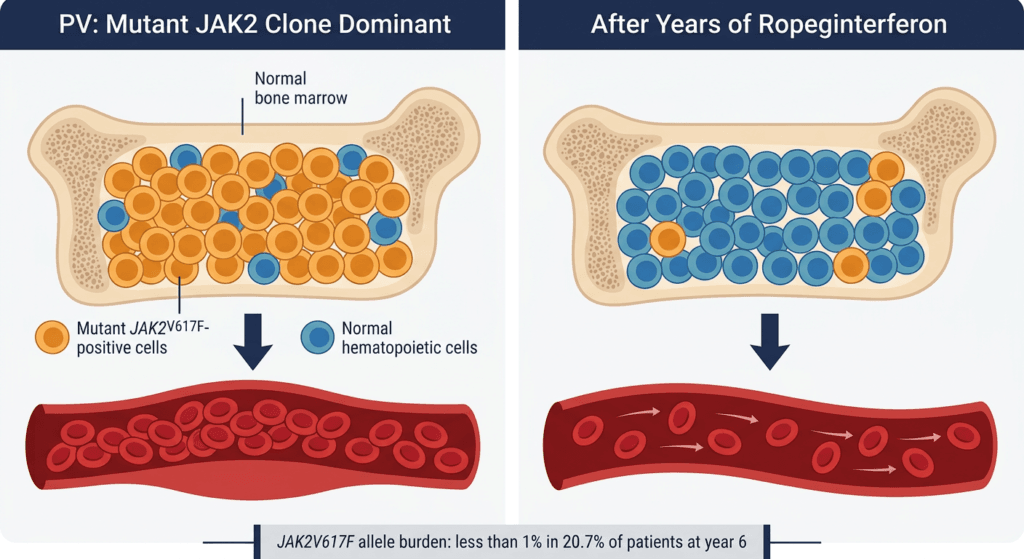
The molecular mechanism is not fully elucidated, but current evidence suggests interferon alpha activates interferon signaling pathways in hematopoietic stem cells that selectively impair JAK2V617F-mutant stem cell proliferation and survival while being better tolerated by normal (wild-type) stem cells. This relative selectivity creates a competitive advantage for the normal stem cell pool over time, allowing normal hematopoiesis to re-emerge as the mutant clone is progressively suppressed.
Ropeginterferon alfa-2b is a next-generation mono-pegylated interferon specifically engineered for PV. The “pegylation” refers to attachment of a polyethylene glycol (PEG) chain to the interferon molecule, which extends the drug’s half-life substantially by slowing its clearance. Earlier pegylated interferons used multi-branched PEG chains (polyethylene glycol branched). Ropeginterferon uses a single linear PEG chain attached specifically at the proline amino acid, producing a more uniform molecular structure with improved pharmacokinetics and a longer half-life.
The practical consequence: ropeginterferon achieves therapeutic interferon exposure with dosing every 2 weeks rather than the 2 to 3 times weekly dosing of conventional interferon alpha, and can extend to every 4 weeks in maintenance for well-controlled patients. This dramatically reduces the injection burden compared to older interferon formulations and makes long-term treatment feasible in a way that 3-times-weekly interferon injections were not.
The Clinical Evidence: PROUD-PV and CONTINUATION-PV
The FDA approval of Besremi in 2021 was supported primarily by data from the Phase 3 PROUD-PV trial (NCT01949805) and its Phase 3b extension, CONTINUATION-PV (NCT02218047). Together, these studies provide the most comprehensive long-term dataset for any cytoreductive treatment in PV, with follow-up extending to more than 7 years.
PROUD-PV: Phase 3 randomized trial (12 months)
PROUD-PV enrolled 254 adults with JAK2V617F-positive PV who were either hydroxyurea-naive or had received hydroxyurea for less than 3 years without achieving complete response, or with resistance or intolerance. Patients were randomized 1:1 to ropeginterferon alfa-2b or hydroxyurea for 12 months. The primary endpoint was complete hematologic response without progressive disease at 12 months.
At 12 months, the response rates were similar between arms (non-inferiority met), consistent with the design intent of demonstrating that ropeginterferon was at least as effective as the established standard of care at 1 year while providing the potential for greater benefit over longer-term follow-up.
CONTINUATION-PV: Long-term extension data
Patients completing PROUD-PV were offered enrollment in CONTINUATION-PV, where ropeginterferon-treated patients continued the same drug and hydroxyurea-treated patients received best available treatment (hydroxyurea or other standard first-line therapy). This design allowed prospective observation of outcomes over years of ongoing treatment.
| Outcome | Ropeginterferon alfa-2b | Hydroxyurea / best available treatment | Follow-up |
|---|---|---|---|
| Complete hematologic response | 54.6% | 34.9% | Year 3 |
| Complete hematologic response | 61% | Not specified at this timepoint | 7.5 years |
| Hematologic response by lab criteria | 80% | Not separately reported | Extended follow-up |
| JAK2V617F allele burden less than 1% | 20.7% | 1.4% | Year 6; p=0.0001 |
| Event-free survival advantage | Yes | Reference | Maximum 7.3 years; log-rank p=0.04 |
Sources: Gisslinger H et al. Leukemia. 2022. Gisslinger H et al. Leukemia. 2023. PROUD-PV NCT01949805. CONTINUATION-PV NCT02218047.
The 7.5-year data represent one of the longest prospective follow-up datasets for any treatment in PV. The CHR rate of 61% at 7.5 years in the ropeginterferon arm, combined with 80% achieving hematologic response by laboratory criteria, reflects durable disease control maintained over nearly a decade of treatment in many patients.
The JAK2V617F allele burden finding is the most scientifically significant result in this dataset. At 6 years, 20.7% of ropeginterferon-treated patients had reduced their mutant allele burden to below 1%, essentially undetectable by standard assays, compared with only 1.4% of patients on hydroxyurea or best available treatment (p=0.0001). In a small subset of patients whose allele burden fell below 10% during treatment, discontinuation of ropeginterferon has been followed by persistent hematologic response, a degree of treatment-free remission that is not achievable with any other currently approved PV therapy.
The event-free survival advantage, defined as time to disease transformation, thromboembolic events, or death, reached statistical significance at a maximum follow-up of 7.3 years (log-rank p=0.04), providing the first prospective evidence that ropeginterferon may alter the natural course of PV beyond blood count control.
The BESREMi Pen: What It Is and Why the Delivery Change Matters
The BESREMi Pen does not change anything about the drug, its indication, its mechanism, or its dosing schedule. What it changes is the physical experience of self-injection, and for patients with PV who will need subcutaneous injections every 2 to 4 weeks for years or decades, that experience matters.
What the pen is
The BESREMi Pen is a pre-filled single-dose pen injector containing 500 mcg of ropeginterferon alfa-2b-njft in 0.5 mL solution, the same concentration and dose as the existing pre-filled syringe. It is administered subcutaneously into the lower abdomen (at least 2 inches from the navel) or the upper thigh, rotating injection sites.
A pre-filled pen injector differs from a conventional pre-filled syringe in several practically meaningful ways:
The pen conceals the needle until the moment of injection. For patients with needle anxiety, not seeing the needle before and during injection reduces psychological distress and may reduce injection-related avoidance or delay.
The pen delivers the injection with a single button press or cap removal mechanism rather than requiring the patient to manually depress a plunger. This reduces the manual dexterity required, which is relevant for older patients or patients with arthritis or hand tremor who may find syringe plunger depression difficult.
The pen holds a consistent dose with less opportunity for dosing error than manual syringe loading. Because Besremi is supplied as a pre-filled device in both formats, dose accuracy is already well-controlled with the syringe; the pen adds a layer of simplicity in the injection step itself.
The pen format is familiar to many patients with chronic conditions who have used insulin pens, growth hormone pens, or other biologic pens, and the learning curve for patients already familiar with pen injectors is lower than for patients switching from the syringe.
Why adherence is the central clinical issue in PV
Dr. John Mascarenhas, Director of the Center of Excellence for Blood Cancers and Myeloid Disorders at Mount Sinai, noted: “Treatment consistency is critical for managing PV, and this device has the potential to make a meaningful positive impact on patients’ lives by simplifying self-administration and supporting better adherence.”
That statement identifies the core clinical problem the BESREMi Pen addresses. The PROUD-PV and CONTINUATION-PV long-term data show that the molecular and hematologic benefits of ropeginterferon deepen progressively over years of treatment. The JAK2V617F allele burden reduction that reaches near-undetectable levels at 6 years did not appear at 1 year or 2 years. These results required patients to continue injecting consistently for many years to accumulate.
A patient who finds the injection process burdensome, painful, anxiety-provoking, or technically difficult is more likely to delay, skip, or discontinue injections. In PV, where the standard treatment is indefinite and the disease-modifying benefit is cumulative, every missed injection is a missed opportunity for allele burden reduction. Device improvements that reduce injection barriers directly serve the clinical goals of the treatment.
Dosing: What Patients and Prescribers Need to Know
The dosing regimen for Besremi is the same regardless of whether the pen or the syringe is used. The FDA approval of the BESREMi Pen does not introduce a new titration scheme; it provides the same drug in a different delivery format.
The standard starting and maintenance approach for Besremi depends on whether the patient is receiving concomitant hydroxyurea at treatment initiation:
Patients not on hydroxyurea: Start at 100 mcg subcutaneously every 2 weeks. Titrate the dose every 2 weeks based on hematologic response, targeting normalization of hematocrit below 45%, platelet count, and white blood cell count. Once stable control is achieved, dosing interval may be extended to every 4 weeks in some patients.
Patients transitioning from hydroxyurea: Initiate Besremi alongside hydroxyurea, then taper hydroxyurea gradually as ropeginterferon takes effect, ultimately discontinuing hydroxyurea when blood counts are well-controlled on ropeginterferon alone.
Target dose: The optimal maintenance dose varies by patient; in CONTINUATION-PV, the median cumulative 4-weekly dose in the sixth year of treatment was 499 mcg (IQR 268 to 782 mcg), with 61.9% of patients receiving doses at an extended 3- or 4-week interval.
The dose titration of ropeginterferon is individualized, which means the prescribing clinician should be experienced in managing PV and comfortable with the titration process. The full prescribing information from PharmaEssentia should be reviewed for dose modification guidance related to hematologic toxicity, transaminase elevations, and other adverse events.
Safety: The Established Besremi Profile
The BESREMi Pen carries the same safety profile and the same boxed warning as the pre-filled syringe formulation. No new safety signals are associated with the pen device itself.
Boxed warning: risk of serious disorders
The Besremi prescribing information carries a boxed warning, the FDA’s strongest safety alert, for the risk of serious disorders including neuropsychiatric, autoimmune, ischemic, and infectious disorders. These risks are associated with the interferon alpha class broadly and have been observed at the doses used in therapeutic applications.
Neuropsychiatric: Depression, suicidal ideation, and psychosis have been reported with interferon alfa therapy. Patients should be monitored closely for new or worsening psychiatric symptoms. Besremi should not be used in patients with a history of severe psychiatric disorders that are not well-controlled. Patients should be counseled to report any mood changes, sleep disturbances, or behavioral changes to their healthcare provider.
Autoimmune disorders: Interferon alfa can exacerbate or trigger autoimmune conditions including thyroid disease, psoriasis, systemic lupus erythematosus, and rheumatoid arthritis. Thyroid function should be monitored before and periodically during treatment.
Ischemic disorders: Ischemic events including cerebrovascular accidents, myocardial infarction, and peripheral vascular disease have been reported. Patients with pre-existing cardiovascular risk factors should be monitored appropriately.
Infectious disorders: Immunosuppressive effects of interferon increase infection susceptibility. Serious and potentially fatal infections have been reported.
Additional warnings and precautions:
| Safety item | Clinical guidance |
|---|---|
| Hepatotoxicity | Monitor liver function tests at baseline and during treatment; reduce or discontinue dose for significant transaminase elevation |
| Myelosuppression | CBC monitoring at baseline and periodically; dose modification for significant cytopenias |
| Pulmonary disorders | Monitor for new or worsening pulmonary symptoms; rare but serious pulmonary adverse events reported with interferon class |
| Ophthalmologic disorders | Retinal disorders have been reported; ophthalmologic evaluation if new visual symptoms develop |
| Driving and machinery | Advise patients to avoid driving or operating machinery if they experience dizziness, somnolence, or hallucination |
| Embryo-fetal toxicity | Interferon alfa can cause fetal harm; effective contraception required during treatment; women of childbearing potential should be counseled |
Common adverse reactions in PROUD-PV and CONTINUATION-PV included fatigue, arthralgia, influenza-like illness, pruritus, elevated liver enzymes, and injection site reactions. These are consistent with the interferon class profile. Most adverse events were mild to moderate and managed through dose adjustment or supportive care. The improved dosing schedule (every 2 to 4 weeks versus the 3-times-weekly schedule of older interferons) contributes substantially to the better tolerability profile compared to earlier interferon formulations used in PV.
Where Besremi Fits in the Current PV Treatment Landscape
PV management in 2026 centers on risk stratification based on age and prior thrombotic events, then selection among cytoreductive options for moderate-to-high-risk patients:
| Treatment | Mechanism | Role in PV | Molecular effect |
|---|---|---|---|
| Phlebotomy | Reduces red cell mass directly | Universal; used to control hematocrit | None |
| Low-dose aspirin | Antiplatelet | Universal (absent specific contraindications) | None |
| Hydroxyurea | Cytoreductive (oral chemotherapy) | First-line cytoreduction for most patients | Minimal to no JAK2 allele burden reduction |
| Besremi (ropeginterferon alfa-2b) | Interferon-mediated suppression of mutant JAK2 clone | First-line or second-line cytoreduction; preferred for younger patients, women of childbearing age, patients desiring disease modification | Sustained reduction in JAK2V617F allele burden; potential for treatment-free remission in deep molecular responders |
| Ruxolitinib (Jakafi) | JAK1/2 inhibitor | Second-line for hydroxyurea-intolerant or resistant patients | Reduces inflammation and splenomegaly; limited molecular effect |
Besremi is particularly favored in the 2025 KDIGO clinical practice guidelines and NCCN guidelines for younger patients who will live with PV for decades and for whom disease modification at the clonal level is the most important long-term goal. It is also preferred in women of childbearing potential because hydroxyurea is teratogenic and cannot be used safely during pregnancy, while interferon alfa does not cross the placenta and has a more acceptable safety profile in this context.
The choice between Besremi and hydroxyurea as initial cytoreductive therapy involves a careful discussion with the patient about self-injection every 2 to 4 weeks, the side effect profile of interferon versus hydroxyurea, the long-term molecular benefits of ropeginterferon, and the patient’s own goals for treatment. The BESREMi Pen makes the self-injection component of that discussion easier to navigate positively.
What This Means for Patients and Hematologists
For patients currently on Besremi pre-filled syringe
The pen is an alternative option, not a mandatory switch. Patients who are comfortable and adherent with the pre-filled syringe can continue using it; the syringe remains commercially available. Patients who would benefit from a simpler injection experience, who have needle anxiety, or who have dexterity concerns should discuss transitioning to the pen with their hematologist or their specialty pharmacy.
For patients newly starting Besremi
The pen and the syringe contain the same drug at the same concentration and dose. The choice between them at treatment initiation is a patient preference and clinical discussion decision, not a clinical efficacy decision. For patients new to subcutaneous self-injection, the pen format may represent a lower-anxiety starting point.
For hematologists
The BESREMi Pen approval is administratively simple: same drug, same indication, same prescribing requirements. The clinical value is in supporting the treatment adherence that the long-term evidence base requires. PharmaEssentia’s patient support program, Aspire, provides injection training and support for both the syringe and pen formulations.
As Dr. Mascarenhas’ comment indicates, the hematology community has long recognized that ropeginterferon’s clinical benefits are proportional to treatment duration and consistency. A device that reduces barriers to consistent self-injection is aligned with achieving the molecular depth of response that the PROUD-PV and CONTINUATION-PV long-term data demonstrate is achievable.
For related HED coverage on myeloproliferative neoplasms and hematologic malignancy drug approvals, see our post on Tregzi (marnetegragene autotemcel) as the first precision-engineered cell therapy for allogeneic stem cell transplantation in blood cancers and our coverage of Sarclisa Escena as the first anticancer drug delivered via an on-body injector.
For patients and families navigating a polycythemia vera diagnosis, the MPN Research Foundation (mpnresearchfoundation.org) and the MPN Advocacy and Education International maintain current patient resources, treatment information, and connection to the MPN specialist community.
Sources
PharmaEssentia FDA approval press release: PharmaEssentia Announces FDA Approval and U.S. Launch of BESREMi Pen (ropeginterferon alfa-2b-njft) for Polycythemia Vera. BusinessWire. June 26, 2026.
PharmaEssentia newsroom: BESREMi Pen FDA approval and U.S. launch. us.pharmaessentia.com. June 26, 2026.
Drugs.com approval news: PharmaEssentia Announces FDA Approval and U.S. Launch of BESREMi Pen. drugs.com. June 26, 2026.
OncLive (dosing schedule, long-term data, Dr. Mascarenhas quote): FDA Approves Prefilled Pen for Ropeginterferon Alfa-2b in Polycythemia Vera. onclive.com. June 2026.
Oncology Nurse Advisor (pen specifications and dosing): New Pen Formulation of Besremi Approved for Polycythemia Vera. oncologynurseadvisor.com. June 2026.
Oncology Nursing News (nursing practice context): FDA Approves BESREMi Pen for Self-Administration in Polycythemia Vera. oncnursingnews.com. June 2026.
Healio (device details): Prefilled pen device gains FDA approval for adults with polycythemia vera. healio.com. June 2026.
PROUD-PV primary publication: Gisslinger H et al. Ropeginterferon alfa-2b versus standard therapy for polycythemia vera (PROUD-PV and CONTINUATION-PV): a randomised, non-inferiority, phase 3 trial and its extension study. Lancet Haematol. 2020;7(3):e196-e208.
CONTINUATION-PV long-term outcomes (Leukemia 2022): Gisslinger H et al. Long-term outcomes of polycythemia vera patients treated with ropeginterferon alfa-2b. Leukemia. 2022.
Event-free survival data (Leukemia 2023): Gisslinger H et al. Event-free survival in patients with polycythemia vera treated with ropeginterferon alfa-2b versus best available treatment. Leukemia. 2023.
7.5-year QOL and long-term response data (OncLive EHA 2022 coverage): Ropeginterferon Alfa-2b Demonstrates Long-Term QOL Improvements in Polycythemia Vera. onclive.com.
Long-term outcomes PMC publication: Long-term outcomes of polycythemia vera patients treated with ropeginterferon alfa-2b. PMC9061291.
PROUD-PV trial registration: NCT01949805. ClinicalTrials.gov.
CONTINUATION-PV trial registration: NCT02218047. ClinicalTrials.gov.
Original Besremi FDA approval (2021): FDA approves ropeginterferon alfa-2b-njft for polycythemia vera. FDA.gov. November 12, 2021.
Polycythemia vera StatPearls overview: Polycythemia Vera. StatPearls. NCBI.
JAK2V617F molecular biology and long-term outcomes: Long-term outcomes of PV patients treated with ropeginterferon. PMC10539163.
Besremi prescribing information: BESREMi (ropeginterferon alfa-2b-njft) Prescribing Information. PharmaEssentia. 2026.
Besremi approval history: Besremi FDA Approval History. drugs.com.
Patient resources: MPN Research Foundation | MPN Advocacy and Education International | PharmaEssentia Aspire patient support program | Leukemia and Lymphoma Society MPN resources
| Disclaimer: Health Evidence Digest provides general information about FDA approvals and health research for educational purposes. This content is not a substitute for professional medical advice. The BESREMi Pen approval does not change the approved indication, dosing, or safety profile of ropeginterferon alfa-2b-njft. Besremi carries a boxed warning for the risk of serious disorders including neuropsychiatric, autoimmune, ischemic, and infectious conditions. All treatment decisions for polycythemia vera, including initiation and dose titration of ropeginterferon, should be made in close collaboration with a board-certified hematologist experienced in the management of myeloproliferative neoplasms. |
|---|