
| The essentials: On July 22, 2026, the FDA approved Jideytro (zidesamtinib, GSK/Nuvalent) for adults with locally advanced or metastatic ROS1-positive non-small cell lung cancer (NSCLC) who have received at least one prior ROS1 tyrosine kinase inhibitor (TKI). The approval came approximately two months ahead of the original PDUFA target action date of September 18, 2026. Jideytro received Breakthrough Therapy Designation and Orphan Drug Designation from the FDA. It is GSK’s first approved lung cancer medicine, developed by Nuvalent Inc., which GSK acquired in 2025. Regulatory context: this is an accelerated approval based on overall response rate and duration of response. What zidesamtinib is: a next-generation, brain-penetrant, ROS1-selective kinase inhibitor engineered to address the two primary failure modes of earlier ROS1 TKIs: acquired resistance mutations (particularly the G2032R solvent front mutation) and inadequate central nervous system (CNS) penetration. Importantly, zidesamtinib avoids inhibition of the structurally related TRK family kinases, which is expected to reduce TRK-related CNS adverse events (cognitive effects, dizziness, ataxia) that limit tolerability of some dual TRK/ROS1 inhibitors. The clinical basis: Phase 1/2 ARROS-1 (NCT05118789), global, multicenter, single-arm, open-label, multi-cohort. Efficacy population: 117 adults with previously treated ROS1-positive NSCLC who had received at least one prior ROS1 TKI. ORR: 44% (95% CI not reported in early sources; durable). Durability: 78% of responders remained in response at 12 months; 62% at 18 months. Subgroup ORR after one prior ROS1 TKI: 51%. Subgroup ORR in G2032R resistance mutation: 54%. Intracranial ORR in patients with measurable brain metastases: 48%; complete intracranial responses: 20%. Tolerability: adverse event-related dose reductions in 10%; discontinuations due to AEs in 2%. The comparison context: the most commonly used first-line ROS1 TKIs are crizotinib (approved, but older generation), entrectinib (Rozlytrek, brain-penetrant dual ROS1/TRK inhibitor), and lorlatinib (approved for ROS1-positive NSCLC). Repotrectinib (Augtyro) and taletrectinib are later-generation options. ARROS-1 included patients who had received lorlatinib, repotrectinib, and taletrectinib as prior therapy, meaning zidesamtinib demonstrated activity even after the most potent existing ROS1 inhibitors had been used. Population context: approximately 50,000 people worldwide are diagnosed with ROS1-positive NSCLC each year; in the United States, 1 to 2% of NSCLC cases carry ROS1 rearrangements. The population is characterized by younger median age, female predominance, and a high proportion of never-smokers. |
|---|
Lung cancer is the leading cause of cancer death in the United States. But within lung cancer, the approximately 1 to 2% of patients whose tumors carry a ROS1 gene rearrangement face a distinct clinical experience from most of the other 98 to 99%. They tend to be younger. Many have never smoked. Their tumors are often adenocarcinomas with a predilection for brain metastases. And when they receive a matched ROS1 tyrosine kinase inhibitor, they frequently respond dramatically.
The problem, as with essentially every other targeted oncology therapy, is that the response eventually ends. Resistance mutations develop. The cancer finds molecular workarounds. Brain metastases progress. And until July 22, 2026, there was no FDA-approved therapy specifically designed for this post-first-line moment.
Jideytro (zidesamtinib, GSK/Nuvalent) is the first. Approved two months ahead of its PDUFA date, zidesamtinib was engineered from the ground up to address the specific failure modes of earlier ROS1 inhibitors: the resistance mutations that drive progression, the inadequate brain penetration that allows CNS disease to advance, and the off-target TRK inhibition that compromises tolerability of some existing brain-penetrant options.
The ARROS-1 trial enrolled 117 patients with previously treated ROS1-positive NSCLC, including patients who had already received the newest and most potent ROS1 inhibitors available: lorlatinib, repotrectinib, and taletrectinib. In this heavily pretreated population, zidesamtinib produced a 44% overall response rate, with 78% of responders still in response at one year. In patients with the most common resistance mutation (G2032R), the response rate was 54%. And in patients with brain metastases, nearly half achieved an intracranial response, with one in five achieving complete intracranial clearance.
What ROS1-Positive NSCLC Is and Who Gets It
Non-small cell lung cancer accounts for approximately 85% of all lung cancers. Within NSCLC, molecular profiling has identified multiple distinct oncogenic driver subtypes, each with its own therapeutic vulnerabilities and clinical characteristics. EGFR mutations, ALK rearrangements, KRAS mutations, MET amplifications, BRAF mutations, HER2 alterations, and RET fusions each define patient populations for whom specific targeted therapies have transformed the treatment landscape over the past two decades.
ROS1 gene rearrangements are present in approximately 1 to 2% of NSCLC cases. In the United States, where approximately 250,000 new lung cancer cases are diagnosed annually, this translates to approximately 2,500 to 5,000 new ROS1-positive NSCLC diagnoses per year. Globally, Nuvalent and GSK estimate approximately 50,000 new diagnoses annually.
The ROS1-positive NSCLC population has several distinguishing epidemiological features. The median age at diagnosis is younger than for other NSCLC subtypes, often in the 40s to 50s. Women are represented at higher rates than in unselected NSCLC. Most patients are never-smokers or former light smokers. The tumors are predominantly adenocarcinoma histology, and brain metastases are common both at initial presentation and during the course of treatment, occurring in 30 to 45% of patients at some point in their disease course.
These epidemiological features matter clinically. A younger, otherwise healthy patient diagnosed with ROS1-positive NSCLC has a long potential treatment horizon ahead of them, which means the durability of each line of therapy matters more than in a frailer, older patient. It also means that CNS disease management is a central concern across the treatment timeline, not a late-stage complication.
The ROS1 Kinase and Why It Drives Lung Cancer
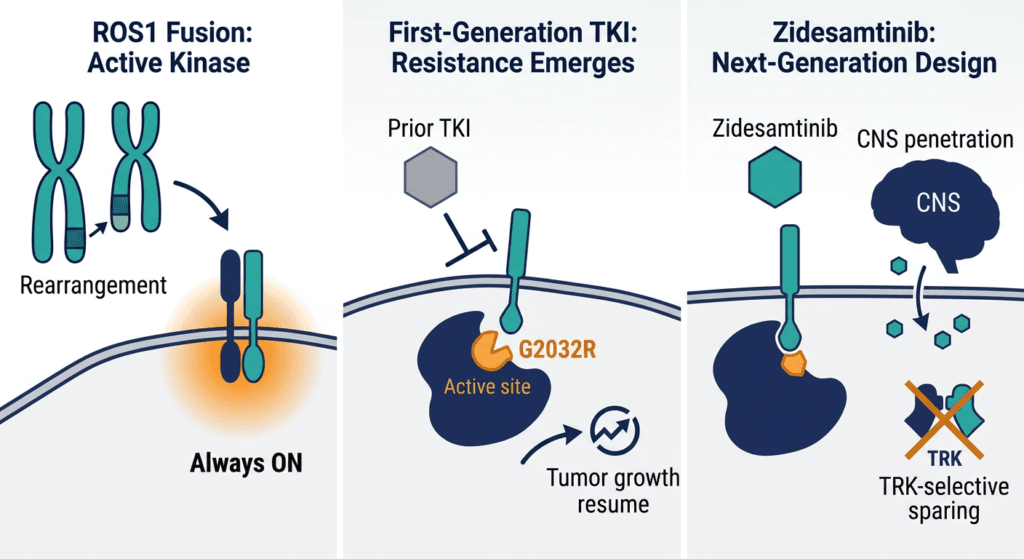
ROS1 (ROS proto-oncogene 1) is a receptor tyrosine kinase expressed in multiple tissues during development but with limited expression in most normal adult tissues. Its natural ligand and physiological signaling functions are not fully characterized. What is known is that chromosomal rearrangements involving ROS1, in which the ROS1 kinase domain fuses to the promoter and partial coding sequence of a partner gene, create constitutively active chimeric oncoproteins that drive uncontrolled cell proliferation.
Over 20 ROS1 fusion partners have been identified in NSCLC, with CD74-ROS1 being among the most common. All fusion partners produce the same functional consequence: constitutive activation of the ROS1 kinase domain, which signals continuously through the same downstream pathways as the RET and ALK kinases (RAS/MAPK, PI3K/AKT, JAK/STAT), driving tumor growth and survival.
The structural similarity between ROS1 and ALK (approximately 77% kinase domain amino acid identity) is clinically relevant: several ALK inhibitors, particularly crizotinib and lorlatinib, have significant ROS1 inhibitory activity and are approved for ROS1-positive NSCLC alongside their ALK indications. This shared structural profile was the historical basis for applying ALK inhibitors to ROS1-positive disease, before ROS1-specific and ROS1/RET co-targeting inhibitors were developed.
The structural similarity between ROS1 and the TRK family (TRKA, TRKB, TRKC) is the source of a distinct tolerability challenge. Earlier-generation brain-penetrant dual inhibitors that cover both ROS1 and TRK kinases (particularly entrectinib and repotrectinib) produce neurological adverse events from CNS TRK inhibition: cognitive effects, dizziness, paresthesias, and ataxia. These toxicities are often dose-limiting and have been a meaningful contributor to treatment discontinuation in clinical practice.
What Makes Zidesamtinib a Next-Generation Approach
Zidesamtinib was engineered by Nuvalent with three specific design objectives aimed at the clinical shortcomings of existing ROS1 inhibitors:
1. Activity against resistance mutations, particularly G2032R
The most common acquired resistance mutation in ROS1-positive NSCLC is G2032R, a “solvent front” mutation in the ROS1 kinase domain at amino acid position 2032. This mutation alters the geometry of the kinase active site in a way that physically impedes the binding of many first- and second-generation ROS1 inhibitors. G2032R resistance is observed in a significant proportion of patients who progress on crizotinib, entrectinib, and other earlier-generation agents.
Zidesamtinib was designed with a molecular conformation that maintains potent binding to the G2032R-mutant kinase despite the altered active site geometry. The ARROS-1 data confirmed this pharmacological design goal: patients with G2032R-mutant ROS1-positive NSCLC achieved a 54% ORR, comparable to the overall 44% ORR in the full efficacy population, demonstrating that the drug maintains activity at the resistance mutation that has historically been the most difficult to address.
2. CNS penetration
Brain metastases in ROS1-positive NSCLC are common and clinically significant. In patients with CNS disease, the drug’s ability to penetrate the blood-brain barrier determines whether brain metastases are addressed alongside systemic disease or whether the CNS becomes a sanctuary site for disease progression.
Zidesamtinib was designed with molecular properties optimized for blood-brain barrier penetration: molecular weight, lipophilicity, and efflux transporter (P-glycoprotein) substrate profile were all considered in the drug’s structure. In ARROS-1, among patients with measurable brain metastases, the intracranial ORR was 48%, with complete intracranial responses in 20% of evaluable patients. A 20% complete intracranial response rate in a previously treated population is a strong CNS efficacy signal.
3. ROS1 selectivity over TRK kinases
The structural similarity between ROS1 and TRK kinases creates a design challenge: inhibitors that are potent against ROS1 often have collateral TRK inhibitory activity. In the CNS, where TRK signaling supports neuronal function, this TRK inhibition produces the neurological adverse events (cognitive effects, dizziness, ataxia) that characterize some existing brain-penetrant options.
Zidesamtinib was designed with selectivity favoring ROS1 over TRK kinases, exploiting subtle structural differences in the ROS1 versus TRK active sites. In the ARROS-1 safety data, adverse event-related dose reductions occurred in only 10% of patients and treatment discontinuations due to adverse events in only 2%, a very favorable tolerability profile for an oncology drug in a previously treated population. The avoidance of TRK-related CNS adverse events is a key contributor to this favorable tolerability.
The ARROS-1 Trial: Full Data
Design
ARROS-1 (NCT05118789) is a global, multicenter, Phase 1/2, single-arm, open-label, multi-cohort basket trial evaluating zidesamtinib in patients with advanced ROS1-positive NSCLC and other ROS1-positive solid tumors. The trial is ongoing; the approval was based on a prespecified interim analysis of the previously-treated ROS1-positive NSCLC cohort.
The efficacy population included 117 adult patients with locally advanced or metastatic ROS1-positive NSCLC who had received at least one prior ROS1 TKI, with or without prior platinum-based chemotherapy or immunotherapy. The cohort was split:
- 59 patients with one prior ROS1 TKI (less heavily pretreated)
- 58 patients with two or more prior ROS1 TKIs, including patients who had specifically received lorlatinib, repotrectinib, and/or taletrectinib (the most potent existing options)
Efficacy results
| Endpoint | Full efficacy population (n=117) | One prior ROS1 TKI (n=59) | Two or more prior ROS1 TKIs (n=58) |
|---|---|---|---|
| Overall response rate | 44% | 51% | 38% |
| Responders in response at 6 months | Favorable (reported consistent with 12- and 18-month data) | — | — |
| Responders in response at 12 months | 78% | — | — |
| Responders in response at 18 months | 62% | — | — |
| ORR in G2032R resistance mutation subgroup | 54% | — | — |
| Intracranial ORR (patients with measurable brain metastases) | 48% | — | — |
| Complete intracranial response rate | 20% | — | — |
Source: ARROS-1 FDA approval summary. FDA.gov. July 22, 2026. AJMC July 2026 clinical data. NCT05118789.
The 44% ORR in 117 previously treated patients spanning one to more than two prior ROS1 TKIs is a clinically meaningful result for a post-TKI setting where available cytotoxic alternatives typically produce response rates of 15 to 25%. The durability finding, that 78% of responders remained in response at one year, distinguishes zidesamtinib from conventional chemotherapy in this setting and is consistent with the deep, durable responses that characterize well-matched targeted oncology therapies.
The 51% ORR after one prior ROS1 TKI versus 38% after two or more prior TKIs reflects the expected gradient of response with increasing prior therapy, but the 38% rate in heavily pretreated patients who have already received lorlatinib, repotrectinib, or taletrectinib is itself notable. These are the most potent currently available ROS1 inhibitors, and maintaining a meaningful response rate after them is a meaningful demonstration of zidesamtinib’s differentiated activity.
The G2032R subgroup ORR of 54% is the most important resistance mutation-specific finding, confirming that the drug’s pharmacological design goal of maintaining activity against the most common ROS1 resistance mutation was achieved in the clinic.
Dr. Alexander Drilon of Memorial Sloan Kettering Cancer Center, a principal investigator of ARROS-1, noted that despite advances in treatment, resistance mutations, disease progression in the brain, and treatment-related adverse events continue to create challenges for patients, and that the responses observed in ARROS-1, including in heavily pretreated patients, represent meaningful progress for people living with this disease.
Tolerability
The tolerability profile from ARROS-1 is among the most favorable observed for any ROS1-targeted therapy in this treatment setting:
- Adverse event-related dose reductions: 10%
- Treatment discontinuations due to adverse events: 2%
The most common adverse reactions occurring in at least 15% of patients in the pooled safety population of 446 patients (which includes the full ARROS-1 treated population beyond the 117-patient efficacy population) were not individually reported in the available press release and will be detailed in the full prescribing information. The generally favorable tolerability reflects the ROS1-selective design and the absence of significant TRK off-target activity.
The ROS1-Positive NSCLC Treatment Landscape After July 2026
ROS1-positive NSCLC now has an increasingly complex treatment landscape, with multiple approved options across lines of therapy:
| Drug | Company | ROS1 indication | FDA approval | CNS activity | Resistance coverage |
|---|---|---|---|---|---|
| Xalkori (crizotinib) | Pfizer | ROS1-positive NSCLC, first-line | March 2016 | Limited (poor CNS penetration) | Limited |
| Rozlytrek (entrectinib) | Roche/Genentech | ROS1-positive NSCLC with or without CNS involvement | August 2019 | Good (CNS activity) | Limited G2032R activity; TRK off-target CNS effects |
| Lorlatinib (Lorbrena) | Pfizer | ROS1-positive NSCLC, any line | January 2022 | Good (brain-penetrant) | Some resistance mutation coverage; TRK off-target effects |
| Augtyro (repotrectinib) | BMS | ROS1-positive NSCLC, any line | November 2023 | Good | Improved G2032R coverage; TRK off-target effects possible |
| Taletrectinib (Enhertu) | AnHeart/Eli Lilly | ROS1-positive NSCLC | Approved | Moderate CNS activity | Some resistance coverage |
| Jideytro (zidesamtinib) | GSK/Nuvalent | ROS1-positive NSCLC, after prior ROS1 TKI | July 22, 2026 | Good (engineered CNS penetration) | G2032R: 54% ORR; TRK-selective sparing |
Zidesamtinib is the only approved agent specifically indicated for the post-prior-ROS1-TKI setting. All other approved ROS1 inhibitors are first-line options or are approved regardless of prior therapy. The approved indication for zidesamtinib is specifically patients who have received at least one prior ROS1 TKI, positioning it as the designated second-line-and-beyond option.
ARROS-1 is also evaluating zidesamtinib in the first-line setting for patients who have not yet received a ROS1 TKI. If that cohort produces compelling results, a first-line indication could follow, potentially positioning zidesamtinib across the full treatment continuum.
Safety: What the Prescribing Information Covers
The full adverse reaction profile will be detailed in the complete prescribing information for Jideytro. Based on available data from ARROS-1 and the pooled safety population of 446 patients:
Most common adverse reactions (at least 15%): The specific adverse reactions and their frequencies were not individually listed in the available press releases and will be published in the full prescribing information. The favorable overall tolerability profile (dose reductions 10%, discontinuations 2%) indicates that the adverse reaction profile is manageable.
Warnings and precautions from the prescribing information (based on FDA summary):
| Warning | Details | Clinical guidance |
|---|---|---|
| Interstitial lung disease/pneumonitis | Reported with ROS1 inhibitor class; potentially serious | Monitor for new or worsening respiratory symptoms; hold for suspected pneumonitis; permanently discontinue for confirmed severe events |
| Hepatotoxicity | Liver enzyme elevations observed | Monitor liver function tests at baseline and periodically; dose modification for significant elevation |
| Hypertension | Observed with kinase inhibitors | Monitor blood pressure; antihypertensive therapy as needed |
| QT interval prolongation | Kinase inhibitor class effect | ECG monitoring in patients with risk factors; electrolyte monitoring and correction |
| Hemorrhagic events | Monitor | Withhold for significant hemorrhage |
| Hypersensitivity | Reported | Manage per prescribing information |
| Tumor lysis syndrome | Risk in rapidly proliferating tumors | Hydration and laboratory monitoring |
| Impaired wound healing | Kinase inhibitor class effect | Withhold before and after elective surgery per prescribing information timing guidance |
| Hypothyroidism | Monitor thyroid function | Replace thyroid hormone as clinically indicated |
| Embryo-fetal toxicity | Zidesamtinib can cause fetal harm | Effective contraception during treatment and for specified period after last dose |
Required Testing: ROS1 Positivity Must Be Confirmed
The approved indication requires ROS1-positive disease detected by an FDA-approved test. ROS1 testing should be part of the standard comprehensive molecular profiling that is now recommended for all newly diagnosed advanced NSCLC patients.
Fluorescence in situ hybridization (FISH) and next-generation sequencing (NGS)-based RNA and DNA panels are the most commonly used ROS1 detection methods. RNA-based sequencing is particularly important for ROS1 fusion detection because the diverse range of fusion partners and intronic breakpoints can be missed by DNA-only sequencing approaches. Major approved NGS platforms including FoundationOne CDx are validated for ROS1 fusion detection.
At disease progression on a prior ROS1 TKI, molecular re-testing can characterize acquired resistance mechanisms including specific resistance mutations (such as G2032R), which may guide selection among available post-progression options. Liquid biopsy (cell-free DNA) can detect some resistance mutations from blood with a less invasive approach than repeat tissue biopsy and is available through several approved platforms.
Corporate Context: Nuvalent, GSK, and What Comes Next
Jideytro is GSK’s first approved lung cancer medicine, and its approval reflects the strategic acquisition of Nuvalent Inc., the biotech that developed zidesamtinib. Nuvalent was founded on the premise that existing targeted kinase inhibitors for thoracic oncology left significant clinical gaps related to CNS penetration, resistance mutations, and off-target tolerability challenges, and that next-generation selective inhibitors engineered to address these specific failure modes could meaningfully improve outcomes.
GSK’s acquisition of Nuvalent brought not only zidesamtinib but also:
- Neladalkib (NVL-655): an ALK-selective inhibitor under FDA review with a target action date of November 27, 2026, for ALK-altered NSCLC
- NVL-330: an investigational HER2-selective inhibitor for HER2-altered NSCLC, in earlier-stage development
If neladalkib receives approval in November 2026 as expected, GSK will hold two next-generation precision oncology approvals in NSCLC within six months, establishing a meaningful footprint in thoracic oncology that did not exist before the Nuvalent acquisition.
Janet Freeman-Daily, Co-Founder and President of The ROS1ders, the leading patient advocacy organization for ROS1-positive cancer patients, noted that the ROS1-positive community is deeply invested in advancing care with treatments that are effective and tolerable, and that this approval represents an important advance for people in need.
For related HED coverage on targeted kinase inhibitor approvals in lung cancer and related precision oncology, see our post on Retevmo (selpercatinib) converting from accelerated to traditional approval for RET fusion-positive solid tumors and our post on Padcev (enfortumab vedotin) receiving its first perioperative MIBC approval regardless of cisplatin eligibility.
For patients and families navigating a ROS1-positive NSCLC diagnosis, The ROS1ders (theROS1ders.org) is the leading patient-founded organization dedicated specifically to this molecular subtype. The LUNGevity Foundation (lungevity.org; 1-800-LUNG-USA) and the GO2 Foundation for Lung Cancer maintain current resources on molecular testing, treatment options, and clinical trials.
Sources
FDA approval announcement: FDA approves zidesamtinib for ROS1-positive non-small cell lung cancer. FDA.gov. July 22, 2026. Full announcement at FDA.gov. Wikipedia
GSK approval press release: GSK announces the US FDA approval of Jideytro (zidesamtinib) for previously treated ROS1-positive non-small cell lung cancer. PRNewswire. July 22, 2026. Full press release.
GSK news release (first lung cancer approval, ahead of PDUFA): Jideytro (zidesamtinib) approved in the US for previously treated ROS1-positive non-small cell lung cancer. gsk.com. July 22, 2026.
Drugs.com approval news: FDA Approves Jideytro (zidesamtinib) for Previously Treated ROS1-Positive Non-Small Cell Lung Cancer. drugs.com. July 22, 2026.
AJMC (full ORR/DOR breakdown, subgroup data, tolerability rates): FDA Approves Zidesamtinib as New Option for Resistant ROS1+ NSCLC. ajmc.com. July 2026. Full article.
Oncology News Central (ARROS-1 data, Dr. Drilon quote): FDA Approves Zidesamtinib (Jideytro) for ROS1-Positive Non-Small Cell Lung Cancer. oncologynewscentral.com. July 2026. Full article.
HMP Global Oncology (ORR 44%, durability at 12 and 18 months, first-line investigation context): FDA Approves Zidesamtinib for Previously Treated ROS1-Positive Non-Small Cell Lung Cancer. hmpgloballearningnetwork.com. July 2026. Full article.
OncoDaily (GSK first lung cancer approval, neladalkib pipeline, ROS1ders quote, 50,000 global cases): FDA Approves Zidesamtinib (Jideytro) for ROS1-Positive NSCLC. oncodaily.com. July 2026. Full article. Oncology News Central
Cancer Therapy Advisor (ARROS-1 population detail, trial support summary): FDA Approves Jideytro for Previously Treated ROS1+ NSCLC. cancertherapyadvisor.com. July 2026.
ARROS-1 trial registration: NCT05118789. ClinicalTrials.gov.
Jideytro prescribing information (full PI): JIDEYTRO (zidesamtinib) Prescribing Information. Nuvalent/GSK. 2026.
Jideytro approval history: Jideytro FDA Approval History. drugs.com.
NSCLC and molecular oncology overview: Non-Small Cell Lung Cancer. StatPearls. NCBI.
Crizotinib ROS1 approval: FDA approves crizotinib for ROS1-positive NSCLC. FDA.gov.
Entrectinib ROS1 approval: FDA approves entrectinib for ROS1-positive NSCLC. FDA.gov.
Patient resources: The ROS1ders: theROS1ders.org | LUNGevity Foundation: 1-800-LUNG-USA | GO2 Foundation for Lung Cancer | Free to Breathe | GSK Jideytro patient support
| Disclaimer: Health Evidence Digest provides general information about FDA approvals and health research for educational purposes. This content is not a substitute for professional medical advice. Jideytro (zidesamtinib) received accelerated approval based on overall response rate and duration of response; continued approval may depend on verification and description of clinical benefit in a confirmatory trial. ROS1-positive status must be confirmed by an FDA-approved test before initiating treatment. Treatment decisions for ROS1-positive NSCLC following prior TKI therapy should be made in close collaboration with a board-certified medical oncologist with expertise in thoracic oncology and molecular-targeted therapy. |
|---|