
| The essentials: On July 10, 2026, the FDA approved Padcev (enfortumab vedotin-ejfv, Astellas Pharma/Pfizer) plus Keytruda (pembrolizumab, Merck) or Keytruda Qlex (pembrolizumab and berahyaluronidase alfa-pmph, Merck) as neoadjuvant treatment followed by adjuvant treatment after cystectomy for adults with muscle-invasive bladder cancer (MIBC), regardless of cisplatin eligibility. This is the first platinum-free perioperative regimen approved for all adults with MIBC who are candidates for cystectomy. Two trials supported this combined label coverage. For cisplatin-ineligible patients: Phase 3 KEYNOTE-905/EV-303 (NCT03924895), which supported the November 21, 2025 approval in the cisplatin-ineligible population. pCR 57.1% versus 8.6% (surgery alone; p less than 0.001); statistically significant EFS and OS improvement. For cisplatin-eligible patients: Phase 3 KEYNOTE-B15/EV-304 (NCT04700124), n=808, presented at ASCO GU 2026 and published in JCO, supporting the July 10, 2026 expansion. Primary endpoint: event-free survival (EFS) by BICR. Median EFS: not reached (EV plus pembro) versus 48.5 months (gemcitabine plus cisplatin); HR 0.53 (95% CI 0.41 to 0.70). 47% reduction in risk of an EFS event. pCR: 55.8% versus 32.5%; estimated difference 23.4 percentage points (95% CI 16.7 to 29.8; p less than 0.0001). OS: HR 0.65 (95% CI 0.48 to 0.89; p=0.0029). All three endpoints met. This is the first regimen to beat standard cisplatin-based neoadjuvant chemotherapy in cisplatin-eligible MIBC since platinum-based neoadjuvant therapy was established as standard nearly 25 years ago. The regimen covers the full treatment sequence: 4 cycles of neoadjuvant EV plus pembrolizumab, radical cystectomy with pelvic lymph node dissection, then 5 additional adjuvant cycles of EV plus continued pembrolizumab. Grade 3 or higher adverse events: 75.7% (EV plus pembro) versus 67.2% (gemcitabine plus cisplatin). No new safety signals; consistent with established profile. Key context: approximately half of all MIBC patients are cisplatin-ineligible. The November 2025 approval addressed them. The July 2026 approval addresses the other half, who are eligible for cisplatin but now have a superior platinum-free alternative. |
|---|
Bladder cancer is the fourth most common cancer in men in the United States and is diagnosed in approximately 84,000 Americans per year. The majority of bladder cancers are non-muscle-invasive at diagnosis and are managed with local resection and intravesical therapy. But when cancer invades the muscular wall of the bladder, the clinical calculus changes fundamentally. Muscle-invasive bladder cancer (MIBC) carries a 5-year overall survival rate of approximately 50 to 60% with optimal treatment, meaning that even with the best available care, roughly half of patients will die of the disease within five years.
For nearly 25 years, the best available care in the neoadjuvant setting meant one thing: cisplatin-based chemotherapy before surgery. The combination of gemcitabine plus cisplatin administered before radical cystectomy produces pathologic complete response (pCR, meaning no residual tumor at surgery) in approximately 30 to 40% of patients and improves survival compared to surgery alone. That survival benefit, established in meta-analyses and multiple randomized trials, made neoadjuvant cisplatin the standard of care and kept it there for more than two decades.
The problem: approximately half of patients with MIBC cannot receive cisplatin. Kidney function decline, hearing loss, neuropathy, and performance status limitations all contribute to cisplatin ineligibility in a patient population that skews older and commonly has significant comorbidities. For these patients, surgery alone had been the standard, with all the survival disadvantage that comes from not having neoadjuvant systemic therapy.
Padcev (enfortumab vedotin-ejfv) plus Keytruda (pembrolizumab) has now closed both gaps. The November 2025 approval for cisplatin-ineligible patients, based on KEYNOTE-905/EV-303, gave that neglected population their first perioperative systemic therapy option. The July 10, 2026 approval, based on KEYNOTE-B15/EV-304, extends the same regimen to cisplatin-eligible patients, where it did not just match cisplatin but surpassed it: median EFS not reached with EV plus pembrolizumab versus 48.5 months with gemcitabine plus cisplatin, pCR rate 55.8% versus 32.5%, and an overall survival advantage. All three primary and key secondary endpoints met in a 808-patient randomized Phase 3 trial.
As Dr. Matthew Galsky of the Icahn School of Medicine at Mount Sinai, who presented the KEYNOTE-B15 data at ASCO GU 2026, put it: this is a pivotal moment. For the first time since cisplatin-based neoadjuvant therapy was shown to improve outcomes in patients with MIBC almost 25 years ago, a non-platinum-based regimen has surpassed it.
What Muscle-Invasive Bladder Cancer Is and Why Surgery Alone Is Not Enough
Bladder cancer originates in the urothelium, the transitional epithelial lining of the urinary tract. Non-muscle-invasive bladder cancer (stages Ta, T1, and carcinoma in situ) involves only the superficial layers and can be managed with transurethral resection and intravesical agents. Muscle-invasive disease (stage T2 or higher) has penetrated the detrusor muscle of the bladder wall, dramatically increasing metastatic risk and fundamentally changing treatment strategy.
MIBC is staged using the TNM system. Stage T2 invades the inner half of the muscle; T3 extends through the muscle into perivesical fat; T4 invades adjacent structures including the prostate, uterus, or pelvic wall. Lymph node status (N0/N1) is assessed at surgery. All patients with resectable MIBC without distant metastasis are candidates for radical cystectomy with pelvic lymph node dissection as the definitive surgical approach.
Radical cystectomy is curative in approximately 60 to 70% of patients with organ-confined (T2) disease but in only about 25 to 35% of patients with T3 to T4 or node-positive disease. The primary driver of recurrence and death is occult micrometastatic disease that is present but not detectable at the time of surgery. Systemic therapy before surgery (neoadjuvant) attacks this micrometastatic burden while the tumor is still accessible and the patient has not yet undergone the physiological stress of a major operation.
The concept of pathologic complete response is important in MIBC: patients who have no residual tumor at the time of cystectomy (pCR, or ypT0N0) after neoadjuvant therapy have substantially better long-term outcomes than those with residual disease. A pCR rate of 55.8% in KEYNOTE-B15 means that more than half of cisplatin-eligible MIBC patients treated with perioperative EV plus pembrolizumab had no viable tumor left at surgery, compared with approximately 1 in 3 patients on standard cisplatin-based chemotherapy.
What Enfortumab Vedotin Is: The Nectin-4 ADC Mechanism
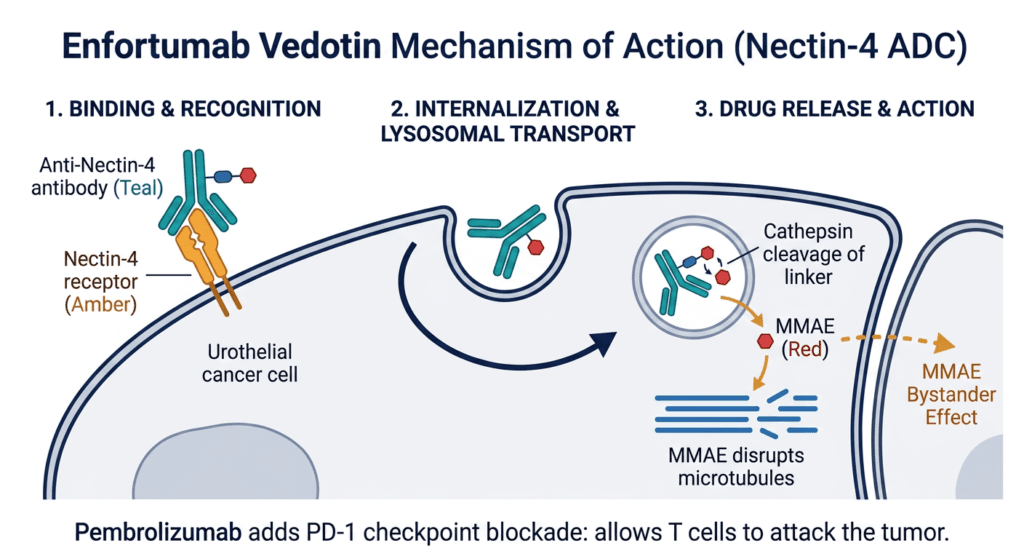
Enfortumab vedotin-ejfv (Padcev) is an antibody-drug conjugate (ADC) that targets Nectin-4, a cell adhesion molecule that is highly expressed in urothelial carcinoma and in a variety of other cancer types, while having more limited expression in normal adult tissues. This differential expression creates a therapeutic window for tumor-directed drug delivery.
The three components of enfortumab vedotin:
The antibody: anti-Nectin-4. A fully human monoclonal antibody that binds with high affinity to Nectin-4 on the surface of urothelial cancer cells and is internalized through receptor-mediated endocytosis.
The linker: protease-cleavable. A maleimide-based linker that is cleaved by cathepsins in the acidic lysosomal environment of the internalized cell, releasing the cytotoxic payload selectively inside the tumor cell. The linker also allows a bystander killing effect: free payload diffuses from the targeted cell to adjacent cancer cells, even those with lower Nectin-4 expression.
The payload: MMAE (monomethyl auristatin E). A potent microtubule-disrupting agent that binds to tubulin and prevents polymerization, triggering G2/M cell cycle arrest and apoptosis. MMAE is approximately 100 to 1,000 times more potent than conventional chemotherapy on a per-molecule basis, which is why the ADC delivery format can produce activity at relatively low doses compared to systemic MMAE administration.
Nectin-4 is expressed in more than 97% of urothelial carcinomas at moderate to high levels, making it one of the most broadly applicable ADC targets in any solid tumor type. This near-universal expression means that patient selection by Nectin-4 testing is not currently required: essentially all urothelial cancer patients are likely to have Nectin-4-expressing tumors.
The Two-Trial Evidence Base: KEYNOTE-905 and KEYNOTE-B15
The July 10, 2026 approval covers all MIBC patients regardless of cisplatin eligibility, resting on two separate Phase 3 trials that together cover the complete MIBC population.
KEYNOTE-905/EV-303: The cisplatin-ineligible population (November 2025 approval)
KEYNOTE-905/EV-303 (NCT03924895) enrolled 344 patients with MIBC who were ineligible for or declined cisplatin-based chemotherapy, randomized 1:1 to neoadjuvant EV plus pembrolizumab followed by cystectomy followed by adjuvant EV plus pembrolizumab, or immediate cystectomy alone.
| Endpoint | EV plus pembrolizumab | Surgery alone | Result |
|---|---|---|---|
| pCR (ypT0N0) | 57.1% | 8.6% | p less than 0.001 |
| EFS | Statistically significant improvement | Reference | Prespecified threshold met |
| OS | Statistically significant improvement | Reference | Prespecified threshold met |
Source: KEYNOTE-905/EV-303. NCT03924895.
The 57.1% pCR rate in a cisplatin-ineligible population that had no approved perioperative systemic therapy option before this trial was the most striking finding from KEYNOTE-905. The November 2025 FDA approval made EV plus pembrolizumab the first perioperative regimen available to this half of the MIBC population.
KEYNOTE-B15/EV-304: The cisplatin-eligible population (July 2026 approval)
KEYNOTE-B15/EV-304 (NCT04700124) enrolled 808 patients with previously untreated MIBC who were eligible for cisplatin-based therapy and candidates for radical cystectomy with pelvic lymph node dissection. Patients required central pathology and imaging confirmation of clinical stage cT2 to T4aN0M0 or T1 to T4aN1M0 disease. They were randomized 1:1 to:
EV plus pembrolizumab arm (n=405): 4 cycles of neoadjuvant EV 1.25 mg/kg on days 1 and 8 plus pembrolizumab 200 mg on day 1, every 3 weeks, followed by radical cystectomy plus PLND, then 5 additional cycles of adjuvant EV plus 13 additional cycles of adjuvant pembrolizumab (or pembrolizumab dosed 400 mg every 6 weeks for 7 cycles).
Gemcitabine plus cisplatin arm (n=403): 4 cycles of neoadjuvant gemcitabine 1,000 mg/m2 on days 1 and 8 plus cisplatin 70 mg/m2 on day 1, every 3 weeks, followed by radical cystectomy plus PLND, then observation.
The primary endpoint was EFS by blinded independent central review. Key secondary endpoints included pCR by central pathologist review and OS. The data were presented at the 2026 ASCO GU Symposium in San Francisco and published in the Journal of Clinical Oncology.
| Endpoint | EV plus pembrolizumab | Gemcitabine plus cisplatin | Result |
|---|---|---|---|
| Median EFS (primary, BICR) | Not reached | 48.5 months | HR 0.53 (95% CI 0.41 to 0.70) |
| EFS risk reduction | 47% | Reference | — |
| pCR rate (ypT0N0) | 55.8% | 32.5% | Difference 23.4 pp (95% CI 16.7 to 29.8); p less than 0.0001 |
| OS (key secondary) | Improvement | Reference | HR 0.65 (95% CI 0.48 to 0.89); p=0.0029 |
| Grade 3 or higher AEs | 75.7% | 67.2% | Numerically higher with EV plus pembro |
Source: Galsky MD et al. KEYNOTE-B15/EV-304, JCO ASCO 2026 LBA630. doi:10.1200/JCO.2026.44.7_suppl.LBA630. NCT04700124.
The primary endpoint finding of a 47% reduction in EFS risk, with median EFS not yet reached in the EV plus pembrolizumab arm versus 48.5 months in the cisplatin-based chemotherapy arm, is one of the most compelling perioperative oncology datasets in bladder cancer history. The EFS result was statistically significant and clinically substantial, meeting the primary endpoint convincingly.
The pCR data further anchors the magnitude of the benefit: 55.8% of cisplatin-eligible patients treated with EV plus pembrolizumab had no residual viable tumor at cystectomy, compared with 32.5% on standard gemcitabine plus cisplatin. A 23-percentage-point improvement in pCR is a large absolute difference in a surgically curable disease where pCR is strongly associated with long-term disease-free survival.
The OS benefit (HR 0.65, p=0.0029) is particularly significant. Overall survival advantages in the neoadjuvant setting in bladder cancer have historically required large meta-analyses to establish with the available single-trial data. Demonstrating a statistically significant OS advantage in a single 808-patient trial reflects the genuine magnitude of the EV plus pembrolizumab benefit over cisplatin-based standard of care.
The Complete Treatment Sequence: What Perioperative Means in Practice
The approved regimen covers three sequential phases for patients eligible for cystectomy, and understanding the full treatment timeline is essential for patient counseling and multidisciplinary care coordination.
Phase 1 — Neoadjuvant (before surgery), 4 cycles (12 weeks):
- Enfortumab vedotin 1.25 mg/kg (maximum 125 mg for patients at or above 100 kg) IV on days 1 and 8 of each 21-day cycle
- Pembrolizumab 200 mg IV on day 1 every 3 weeks, or 400 mg IV every 6 weeks; or Keytruda Qlex subcutaneous on corresponding schedule
- 4 total neoadjuvant cycles
Surgery: Radical cystectomy with pelvic lymph node dissection, performed after completing the 4 neoadjuvant cycles.
Phase 2 — Adjuvant (after surgery), continuation:
- Enfortumab vedotin continues for 5 additional cycles (same dosing as neoadjuvant)
- Pembrolizumab continues: 200 mg IV every 3 weeks for 13 total adjuvant cycles (approximately 39 weeks), or 400 mg every 6 weeks for 7 adjuvant cycles; or Keytruda Qlex equivalents
The total treatment duration is approximately 12 weeks neoadjuvant plus the adjuvant phase, which extends approximately a year post-surgery for the full pembrolizumab course. This is a longer treatment commitment than neoadjuvant chemotherapy alone (which has no adjuvant component beyond surveillance), and the logistics of 18 months of combined therapy require careful coordination between the medical oncologist, urologic oncologist, and the patient’s support systems.
A notable feature of the EV-304 trial is that 262 of 405 EV-plus-pembrolizumab patients started the adjuvant phase and 208 completed it, reflecting real-world dropout rates from the surgical pathway and treatment tolerance over a prolonged regimen. Understanding that not all patients who start neoadjuvant treatment will complete the full intended adjuvant course is important for setting expectations in clinical practice.
The Cisplatin-Ineligibility Problem This Approval Resolves
Understanding why “regardless of cisplatin eligibility” matters requires understanding why approximately half of MIBC patients cannot receive cisplatin to begin with.
Cisplatin nephrotoxicity is the primary limiting factor. Standard cisplatin eligibility criteria require GFR at or above 50 to 60 mL/min/1.73m2 depending on the institutional protocol. Bladder cancer skews toward older adults and is associated with smoking-related comorbidities including cardiovascular and renal disease; many patients have renal function below this threshold at diagnosis. Other cisplatin eligibility barriers include hearing loss (cisplatin is ototoxic), peripheral neuropathy, Eastern Cooperative Oncology Group performance status of 2 or higher, and New York Heart Association class 3 or 4 heart failure.
Before KEYNOTE-905, cisplatin-ineligible patients with MIBC had no approved perioperative systemic therapy option at all. They went directly to surgery without neoadjuvant treatment, accepting the survival disadvantage that came from operating on disease that neoadjuvant therapy might have downstaged or eliminated. KEYNOTE-905 gave this population their first approved option. KEYNOTE-B15 then went further, demonstrating that even patients who are eligible for cisplatin are better served by the ADC plus checkpoint inhibitor combination.
The combined impact of both trials and both approvals means that MIBC patients in 2026 have a single effective perioperative regimen that is appropriate regardless of their renal function, hearing status, or other cisplatin eligibility criteria. The treatment algorithm has simplified: if a patient is a candidate for cystectomy, EV plus pembrolizumab is an appropriate perioperative treatment. The question of whether they can tolerate cisplatin is no longer the gating question for neoadjuvant therapy access.
Safety: What the KEYNOTE-B15 Profile Shows
The safety profile of EV plus pembrolizumab in KEYNOTE-B15 was consistent with the established safety experience from prior trials, with no new safety signals identified. The grade 3 or higher adverse event rate was 75.7% in the EV plus pembrolizumab arm versus 67.2% in the gemcitabine plus cisplatin arm, a numerically higher rate that requires clinical context.
Enfortumab vedotin’s adverse event profile reflects both the MMAE payload and on-target skin effects from Nectin-4 expression in the epidermis:
Boxed warnings for Padcev (enfortumab vedotin-ejfv):
Skin reactions: Severe skin reactions including Stevens-Johnson syndrome and toxic epidermal necrolysis have been reported, some with fatal outcomes. Skin reactions are one of the most clinically significant toxicities unique to enfortumab vedotin. Patients should be monitored for new or worsening skin reactions. Grade 3 skin reactions require treatment interruption; Stevens-Johnson syndrome or TEN require permanent discontinuation.
Hyperglycemia: Clinically significant hyperglycemia, including new-onset diabetes and diabetic ketoacidosis, has occurred. Monitor blood glucose before each infusion. Withhold for glucose greater than 250 mg/dL.
Additional warnings and precautions:
| Safety item | Details | Clinical guidance |
|---|---|---|
| Peripheral neuropathy | Sensory and motor neuropathy from MMAE mechanism; grade 3 or higher in approximately 5 to 10% in trials | Monitor for neuropathy symptoms before each cycle; dose modification for grade 2 or higher |
| Pneumonitis | Interstitial lung disease reported; potentially fatal | Monitor for respiratory symptoms; grade 2 or higher requires treatment interruption |
| Ocular toxicity | Dry eye, blurred vision, keratitis | Ophthalmologic evaluation if symptomatic |
| Embryo-fetal toxicity | MMAE can cause fetal harm | Effective contraception required during treatment and for specified periods after last dose |
| Pembrolizumab immune-mediated adverse events | Full immune-related AE profile (pneumonitis, colitis, hepatitis, endocrinopathies, nephritis) | Standard pembrolizumab immune-related AE monitoring and management applies |
The safety profile across the neoadjuvant and adjuvant EV plus pembrolizumab combination represents the superimposition of the two drugs’ individual toxicity profiles. Oncology teams experienced in managing ADC skin and neuropathy toxicities, and in managing checkpoint inhibitor immune-mediated adverse events, will find the combination manageable with established protocols. Teams less experienced with either drug class may benefit from multidisciplinary support, particularly for severe skin reactions and immune-mediated toxicities.
Padcev’s Complete Indication Picture After July 2026
| Indication | Setting | Approval date |
|---|---|---|
| Locally advanced or metastatic urothelial cancer (with pembrolizumab) | First-line, cisplatin-ineligible | December 2023 |
| Locally advanced or metastatic urothelial cancer (with pembrolizumab) | First-line, regardless of cisplatin eligibility | April 2024 |
| Locally advanced or metastatic urothelial cancer (monotherapy) | Previously treated with platinum and PD-1/L1 inhibitor | December 2019/2021 |
| MIBC, neoadjuvant plus adjuvant (with pembrolizumab) | Perioperative, cisplatin-ineligible | November 21, 2025 |
| MIBC, neoadjuvant plus adjuvant (with pembrolizumab) | Perioperative, regardless of cisplatin eligibility | July 10, 2026 |
What This Means for Patients and Multidisciplinary Bladder Cancer Teams
For patients with newly diagnosed MIBC who are candidates for cystectomy
This approval means that for the first time, a single perioperative treatment regimen is appropriate and approved for all MIBC patients regardless of cisplatin eligibility. Patients who were previously told they could not receive chemotherapy before surgery because of kidney function, hearing, or other cisplatin barriers now have an effective neoadjuvant option.
For patients who are cisplatin-eligible, the KEYNOTE-B15 data make a compelling case that EV plus pembrolizumab should be considered as the preferred perioperative approach over gemcitabine plus cisplatin, based on superior EFS, pCR, and OS. Clinical practice changes of this magnitude take time to be incorporated into guidelines and routine care, and the conversation with patients should honestly present the KEYNOTE-B15 data alongside the established cisplatin-based evidence. The higher grade 3 or higher AE rate with EV plus pembrolizumab (75.7% versus 67.2%) and the specific skin and neuropathy toxicity profile are relevant factors for shared decision-making.
For patients whose surgeons and medical oncologists are now coordinating a perioperative regimen: the critical addition to the care pathway is pre-surgical integration of the neoadjuvant cycles, which now include 12 weeks of combination therapy before cystectomy, followed by surgical planning, and then the adjuvant phase. Patients should understand the full duration of treatment commitment before beginning.
For urologic oncologists and medical oncologists
KEYNOTE-B15 establishes EV plus pembrolizumab as a perioperative option that is superior to the standard gemcitabine plus cisplatin regimen in cisplatin-eligible MIBC on all three key endpoints: EFS, pCR, and OS. Dr. Christopher Hoimes of Duke Cancer Institute, a principal investigator for EV-304, described the data as supporting EV plus pembrolizumab as a novel treatment option and potential standard of care for MIBC patients regardless of cisplatin eligibility.
Incorporating this into multidisciplinary tumor board discussions and treatment protocols requires coordination between urology, medical oncology, and supportive care teams, particularly given the skin reaction boxed warning and the monitoring requirements for neuropathy, hyperglycemia, and immune-mediated adverse events. Subspecialty dermatology access and ophthalmology evaluation pathways should be integrated into the perioperative care plan for patients starting EV.
For related HED coverage on bladder cancer and checkpoint inhibitor combination approvals, see our post on Keytruda Qlex receiving its new first-line TNBC indication alongside Trodelvy and our post on Revtorpyk (gedatolisib) becoming the first targeted therapy for PIK3CA wild-type HR+/HER2- breast cancer.
For patients and families navigating a muscle-invasive bladder cancer diagnosis, the Bladder Cancer Advocacy Network (bcan.org; 1-888-901-BCAN) and the American Cancer Society’s Bladder Cancer resource page maintain current treatment information and patient support resources.
Sources
FDA approval announcement: FDA approves pembrolizumab or pembrolizumab and berahyaluronidase alfa-pmph each with enfortumab vedotin-ejfv for muscle invasive bladder cancer. FDA.gov. July 10, 2026.
Pfizer/Astellas press release: U.S. FDA Approves PADCEV plus Keytruda as Neoadjuvant and Adjuvant Treatment for Muscle-Invasive Bladder Cancer Regardless of Cisplatin Eligibility. Pfizer Inc. July 10, 2026.
Astellas press release: U.S. FDA Approves PADCEV plus Keytruda as Neoadjuvant and Adjuvant Treatment for Muscle-Invasive Bladder Cancer Regardless of Cisplatin Eligibility. newsroom.astellas.com. July 10, 2026.
Drugs.com approval news: U.S. FDA Approves Padcev plus Keytruda or Keytruda Qlex as Neoadjuvant and Adjuvant Treatment for Muscle-Invasive Bladder Cancer Regardless of Cisplatin Eligibility. drugs.com. July 10, 2026.
KEYNOTE-B15/EV-304 JCO ASCO 2026 primary abstract: Galsky MD et al. Neoadjuvant and adjuvant enfortumab vedotin plus pembrolizumab for participants with MIBC who are eligible for cisplatin: randomized, open-label, phase 3 KEYNOTE-B15 study. JCO ASCO 2026 LBA630. doi:10.1200/JCO.2026.44.7_suppl.LBA630.
KEYNOTE-B15 trial registration: NCT04700124. ClinicalTrials.gov.
OncLive (EFS primary endpoint data, all three endpoints met): Perioperative Enfortumab Vedotin/Pembrolizumab Meets EFS, OS, pCR End Points in Cisplatin-Eligible MIBC. onclive.com. July 2026.
Targeted Oncology (median EFS not reached versus 48.5 months): Enfortumab Vedotin/Pembrolizumab Redefines Neoadjuvant Therapy for MIBC. targetedonc.com. June 2026.
GU Oncology Now (HR 0.53 EFS, Dr. Galsky quote): EV/Pembro Improved EFS, OS in Cisplatin-Eligible MIBC. guoncologynow.com. March 2026.
Cancer Therapy Advisor (pCR 55.8% vs 32.5%, OS HR 0.65 exact data): ASCO GU 2026: Are Combinatorial Therapies the Future Standard of Care in RCC and MIBC? cancertherapyadvisor.com. February 2026.
Urology Times (full trial design detail, Dr. Galsky presentation context): KEYNOTE-B15: EV/pembro sets new benchmark before cystectomy in MIBC. urologytimes.com. 2026.
Pharmacy Times (cisplatin ineligibility context, global MIBC epidemiology): Phase 3 Data Back a New Perioperative Standard for Cisplatin-Eligible Muscle-Invasive Bladder Cancer. pharmacytimes.com. June 2026.
UroToday (Dr. Hoimes investigator quote, Pfizer/Astellas/Merck collaboration context): U.S. FDA Approves PADCEV plus Keytruda as Neoadjuvant and Adjuvant Treatment for MIBC Regardless of Cisplatin Eligibility. urotoday.com. July 2026.
KEYNOTE-905/EV-303 prior approval (November 2025): FDA approves pembrolizumab with enfortumab vedotin-ejfv for muscle invasive bladder cancer (cisplatin-ineligible). FDA.gov. November 21, 2025.
KEYNOTE-905 trial registration: NCT03924895. ClinicalTrials.gov.
Bladder cancer overview: Bladder Cancer. StatPearls. NCBI.
Padcev prescribing information: PADCEV (enfortumab vedotin-ejfv) Prescribing Information. Astellas Pharma US, Inc. 2026.
Padcev approval history: Padcev FDA Approval History. drugs.com.
Patient resources: Bladder Cancer Advocacy Network: 1-888-901-BCAN | American Cancer Society Bladder Cancer resources | Pfizer Padcev patient support | ClinicalTrials.gov: search bladder cancer enfortumab
| Disclaimer: Health Evidence Digest provides general information about FDA approvals and health research for educational purposes. This content is not a substitute for professional medical advice. Padcev (enfortumab vedotin-ejfv) carries a boxed warning for severe skin reactions including Stevens-Johnson syndrome and toxic epidermal necrolysis, and for hyperglycemia. The perioperative regimen combining Padcev and Keytruda requires coordinated care across medical oncology and urologic oncology, with monitoring for enfortumab vedotin-specific toxicities and pembrolizumab immune-mediated adverse events. Treatment decisions for muscle-invasive bladder cancer, including the choice of perioperative regimen and surgical approach, should be made through a multidisciplinary team including a urologic oncologist and a medical oncologist experienced in urothelial carcinoma. |
|---|
Leave a Reply