
| 📌 The essentials On April 20, 2026, the FDA approved Idvynso (doravirine/islatravir, Merck) as a once-daily, two-drug complete HIV-1 treatment regimen for adults who are already virologically suppressed. Available in pharmacies from May 11, 2026. Who qualifies: adults with HIV-1 RNA less than 50 copies/mL on a stable regimen, with no history of virologic treatment failure and no known resistance to doravirine. What makes it clinically distinctive: it is the first non-INSTI, tenofovir-free, complete two-drug regimen to demonstrate non-inferior efficacy versus Biktarvy (bictegravir/emtricitabine/tenofovir alafenamide), the most widely prescribed HIV regimen in the world, in a double-blind head-to-head Phase 3 trial. It also introduces islatravir, the first approved drug in a new antiretroviral class called NRTTIs, into clinical practice. What it is not: a treatment-initiation option for people starting HIV therapy for the first time. It is a switch regimen only. Key contraindications: must not be co-administered with lamivudine (3TC) or emtricitabine (FTC), or strong CYP3A4 inducers including rifampin, carbamazepine, phenytoin, and St. John’s Wort. |
|---|
For anyone living with HIV who is currently well-controlled on antiretroviral therapy, the treatment goal is not just viral suppression. It is viral suppression with the least cumulative burden on the body, the fewest side effects, and the simplest possible regimen. Decades of HIV drug development have been moving steadily in that direction: from multiple daily doses of multiple drugs in the 1990s, to once-daily combinations, to single-tablet regimens, to now, two-drug regimens that can maintain suppression without some of the drug classes that current three-drug standards rely on.
On April 20, 2026, the FDA approved Idvynso (doravirine/islatravir, pronounced ihd-VIHN-so), a once-daily tablet from Merck combining two drugs with distinct mechanisms. It is indicated as a complete treatment regimen to replace current antiretroviral therapy in adults with HIV-1 who are already virologically suppressed. Available in pharmacies from May 11, 2026.
Idvynso is the first non-INSTI, tenofovir-free, once-daily, two-drug complete regimen to demonstrate non-inferior efficacy versus the current three-drug gold standard, Biktarvy (bictegravir/emtricitabine/tenofovir alafenamide), in a head-to-head Phase 3 trial. It also introduces islatravir, the first drug in a new antiretroviral class, into approved clinical practice.
Why the Non-INSTI, Tenofovir-Free Distinction Matters
Most people living with HIV in the United States are on a regimen that includes either an integrase strand transfer inhibitor (INSTI), tenofovir, or both. INSTIs (bictegravir, dolutegravir, cabotegravir) are highly effective and well tolerated by most patients, but they carry a well-documented association with weight gain and metabolic effects in some people. Tenofovir, particularly the older tenofovir disoproxil fumarate (TDF), carries renal and bone density concerns with long-term use, though the newer tenofovir alafenamide (TAF) formulation substantially reduced those risks.
Idvynso contains neither. Doravirine is a non-nucleoside reverse transcriptase inhibitor (NNRTI) with a clean metabolic profile, established since its approval in 2018 as Pifeltro. Islatravir is an NRTTI, a distinct class that works differently from both NRTIs and INSTIs. For patients who experience weight gain, lipid changes, or bone effects on current regimens, or who have renal concerns that make tenofovir management complex, a non-INSTI, tenofovir-free option backed by head-to-head Phase 3 data represents a meaningful new clinical choice.
| Who qualifies to switch to Idvynso Idvynso is a switch regimen, not a treatment-initiation option. It is approved for adults with HIV-1 who meet all of the following criteria: Currently virologically suppressed, meaning HIV-1 RNA less than 50 copies/mL on a stable antiretroviral regimen; no history of virologic treatment failure; no known resistance substitutions associated with resistance to doravirine. Idvynso is not approved for treatment-naive patients (those starting HIV treatment for the first time) or for patients with prior virologic failure on any regimen. The doravirine resistance requirement specifically means patients with documented NNRTI resistance mutations affecting doravirine are not candidates. |
|---|
How Idvynso Works: Two Drugs, Two Distinct Mechanisms
Doravirine: the established NNRTI
Doravirine (100 mg) is an NNRTI that noncompetitively binds to and inhibits HIV-1 reverse transcriptase. It has been FDA-approved since 2018, first as Pifeltro (standalone single agent) and then in the three-drug combination Delstrigo (doravirine/lamivudine/tenofovir disoproxil fumarate). Its established safety profile in approved use includes a notably clean metabolic record: minimal effects on fasting lipids, insulin resistance, and body weight in clinical trials, in contrast to some other antiretrovirals.
Islatravir: the first-in-class NRTTI
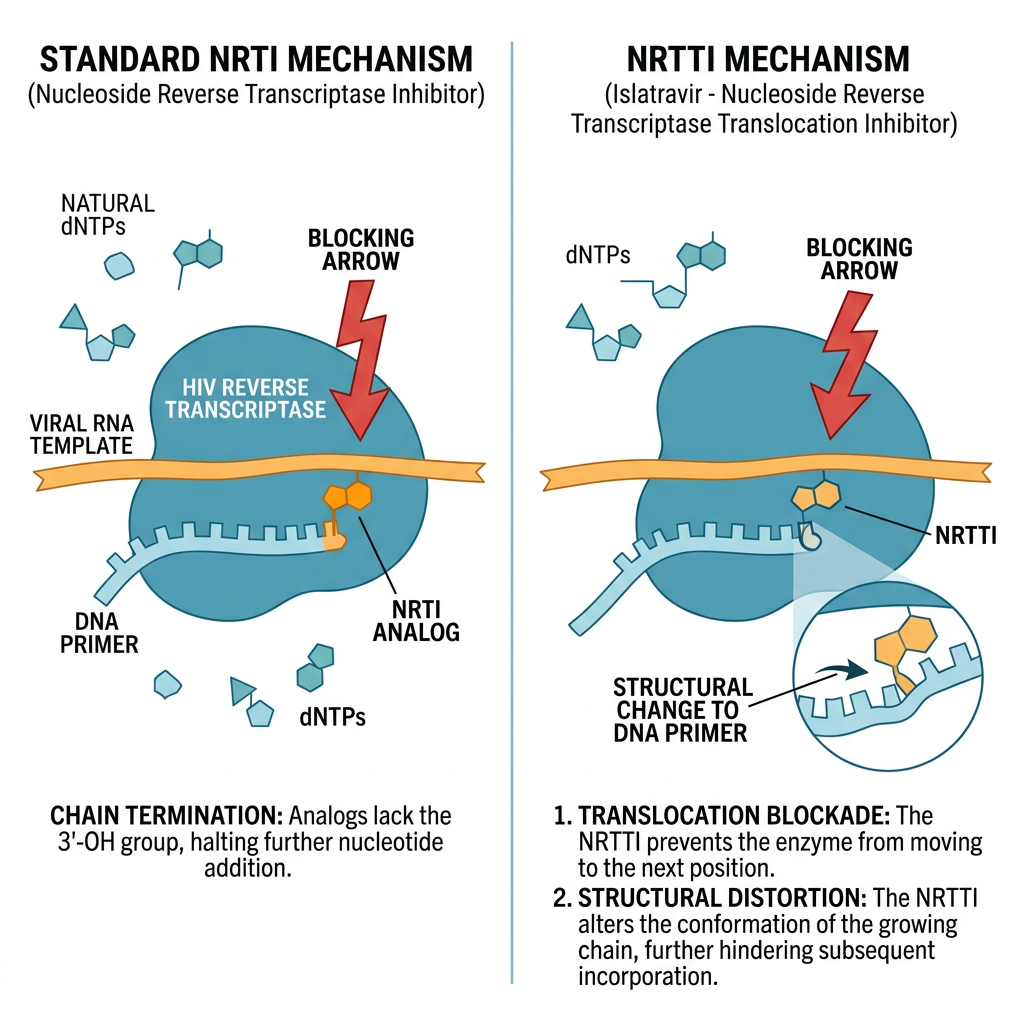
Islatravir (0.25 mg) is a nucleoside reverse transcriptase translocation inhibitor (NRTTI), a new mechanistic class. Like older nucleoside reverse transcriptase inhibitors (NRTIs) such as emtricitabine or tenofovir, islatravir targets the reverse transcriptase enzyme that HIV uses to convert its RNA into DNA. But it works through a different mechanism.
Older NRTIs work by getting incorporated into the growing viral DNA chain and acting as a chain terminator, stopping DNA synthesis. Islatravir uses this same incorporation mechanism but adds a second layer: after incorporation, its unique 4-ethynyl chemical group physically blocks the reverse transcriptase enzyme from translocating along the template, preventing it from reading the next nucleotide. This dual mechanism, immediate chain termination plus translocation blocking, gives islatravir a higher barrier to resistance than most older NRTIs and a potency-to-dose ratio higher than any currently approved NRTI at comparable concentrations.
An additional pharmacokinetic advantage: islatravir’s active intracellular form (islatravir-triphosphate) has a long intracellular half-life, meaning drug concentrations remain therapeutic even with once-daily dosing and support the possibility of longer-interval formulations now in development.
The Phase 3 Trial Data: What Both Studies Showed
The FDA approval is supported by data from two pivotal Phase 3 trials, both presented at CROI 2025 and CROI 2026, with Week 96 data also available.
| Trial 052 (NCT05630755) | Trial 051 (NCT05631093) | |
|---|---|---|
| Design | Double-blind, randomized, active-controlled | Open-label, randomized, active-controlled |
| Comparator | Biktarvy (BIC/FTC/TAF) | Baseline antiretroviral therapy (bART) of any class |
| Participants (n) | 513 adults on Biktarvy | 551 adults on various ART regimens |
| Age 65 or older in combined trials | 11% (81 of 708 on Idvynso) | Reflects real-world older patient population |
| HIV-1 RNA less than 50 copies/mL at Week 48 | 92% (Idvynso) vs. 94% (BIC/FTC/TAF) | 96% (Idvynso) vs. 92% (bART) |
| Virologic failure (RNA 50 c/mL or higher) | Non-inferior; difference within 4% margin | Idvynso numerically superior; difference 3.6% favoring Idvynso |
| CD4+ T-cell counts | Stable; no clinically meaningful decline at 0.25 mg dose | Stable in both arms |
| Weight change at Week 48 | 0.03 kg decrease (Idvynso) vs. 0.28 kg increase (BIC/FTC/TAF) | 0.94 kg increase (Idvynso) vs. 0.15 kg decrease (bART) |
| Fasting lipids | No clinically meaningful changes vs. comparator | No clinically meaningful changes vs. comparator |
| HOMA-IR (insulin resistance) | No clinically meaningful effect | No clinically meaningful effect |
Source: Merck press release April 21, 2026. CROI 2025 and CROI 2026 late-breaking presentations. NCT05630755, NCT05631093.
The Trial 052 result against Biktarvy is the headline finding. Biktarvy is the most widely prescribed HIV regimen in the world, and demonstrating non-inferiority in a blinded head-to-head trial against it is the most rigorous efficacy test Idvynso could have faced. The 92% vs. 94% suppression rates fall within the pre-specified 4% non-inferiority margin.
The weight data from Trial 052 is particularly notable. In a trial where the comparator is Biktarvy, a minimal weight change with Idvynso (0.03 kg decrease) compared with a slight weight gain with Biktarvy (0.28 kg increase) is a metabolically favorable result, even if the absolute difference is small. For patients already concerned about INSTI-associated weight gain on existing regimens, this data point may influence switching conversations.
Merck presented these results across multiple scientific conferences including CROI 2026 and the European AIDS Conference 2025. The lead investigator characterization of the results at those conferences emphasized the combination of non-inferior virologic suppression and favorable metabolic outcomes as the primary clinical value of the regimen.
| The CD4 count history: why the 0.25 mg dose matters Islatravir’s development path was not straightforward. In 2021, the FDA placed clinical holds on several studies of islatravir after decreases in total lymphocyte and CD4+ T-cell counts were observed in some participants. CD4 cells are the immune cells HIV targets, and their count is the primary measure of immune health in people living with HIV. Any drug that reduces CD4 counts independently of HIV control would be clinically unacceptable. Merck’s response was to identify that the CD4 declines occurred at higher doses. The company reformulated the development program around the lower 0.25 mg daily dose used in Idvynso, which in both pivotal trials showed stable CD4 counts comparable to comparator arms. The FDA lifted the holds and the 0.25 mg dose progressed to approval. This history means clinicians prescribing Idvynso should monitor CD4 counts as part of routine follow-up, as specified in the prescribing information. The clinical trial data is reassuring at the approved dose, but ongoing monitoring is appropriate given the earlier signal at higher doses. |
|---|
Safety Profile: What Patients and Providers Need to Know
Skin reaction warning
Idvynso carries an important precautionary warning regarding severe skin reactions, including Stevens-Johnson syndrome (SJS), toxic epidermal necrolysis (TEN), and DRESS syndrome, based on post-marketing experience with doravirine-containing regimens. This is a standard precautionary warning in the prescribing information, not a boxed warning. These reactions are rare but potentially life-threatening. Patients should contact their provider immediately if any rash develops, and stop taking Idvynso if the rash affects mucous membranes (mouth, eyes, genitals) or is accompanied by fever, fatigue, or body aches.
Common side effects
The most common adverse reactions reported in clinical trials are diarrhea, dizziness, fatigue, bloating, headache, and weight gain. Most are low-grade and manageable. The dizziness signal with doravirine is established from prior approvals and is typically mild, occurring most often in the first few weeks of use.
Key drug interactions and contraindications
Strong CYP3A4 inducers: Contraindicated because they significantly decrease doravirine plasma concentrations, which could compromise viral suppression. Common examples include rifampin, carbamazepine, phenytoin, and St. John’s Wort. If a strong CYP3A4 inducer must be used, Idvynso cannot be co-administered.
Lamivudine (3TC) and emtricitabine (FTC): Contraindicated because they significantly decrease islatravir-triphosphate concentrations, directly reducing the antiviral efficacy of the islatravir component. This is a mechanistic interaction: 3TC and FTC compete with islatravir for intracellular phosphorylation.
Rifabutin: Use with caution. May decrease doravirine concentrations; monitor closely if co-administration is necessary.
The lamivudine/emtricitabine contraindication has a practical implication: patients currently on any regimen containing 3TC or FTC (which includes most first-line combinations) need to fully switch to Idvynso as their complete regimen, not add it on top of existing therapy. This is the intended use, but it is worth confirming explicitly in clinical practice.
Dosing, Availability, and Practical Use
| Feature | Details |
|---|---|
| Dose | One tablet (doravirine 100 mg / islatravir 0.25 mg) once daily |
| Food requirement | Can be taken with or without food |
| Formulation | Single-tablet; no generic available |
| Available in pharmacies | From May 11, 2026 |
| Manufacturer | Merck (MSD outside US/Canada) |
| Indication | Switch regimen for virologically suppressed adults only; not for treatment initiation |
| Renal impairment | No dose adjustment required (unlike tenofovir-containing regimens) |
| Hepatic impairment | Use with caution in severe hepatic impairment; see full prescribing information |
| Pregnancy | Enroll in the Antiretroviral Pregnancy Registry; weigh risks and benefits with provider |
Where Idvynso Fits in the HIV Treatment Landscape
Current two-drug HIV regimens approved in the US include dolutegravir/rilpivirine (Juluca) and dolutegravir/lamivudine (Dovato). Both are INSTI-containing. Idvynso is the first two-drug option for virologically suppressed adults that contains neither an INSTI nor tenofovir.
For clinicians managing patients with INSTI-associated weight gain or metabolic concerns, or patients with renal considerations where tenofovir management is complex, Idvynso adds a new conversation to the switching discussion. For patients, the availability of a single tablet, taken with or without food, with no tenofovir and no INSTI, backed by head-to-head data against the most widely prescribed HIV regimen in the world, is a meaningful new option.
Islatravir’s approval as part of Idvynso also opens clinical experience with the NRTTI class that will inform the development of longer-interval formulations. Merck has a monthly oral islatravir program in development and a long-acting injectable combination in earlier stages. The twice-yearly injectable lenacapavir (Sunlenca), approved for heavily treatment-experienced patients, has already demonstrated that very long dosing intervals are achievable in HIV treatment. The trajectory for people with HIV is toward fewer doses, fewer pills, and longer intervals, and Idvynso is one step on that path.
For context on how the FDA’s CNPV program has been used to accelerate approvals for other conditions in 2026, see our post on the FDA’s fast-tracking of psychedelic drug programs for mental illness and our coverage of the first gene therapy for deafness approved under the same program.
Are you living with HIV and considering a switch?
Whether Idvynso is right for you depends on your full treatment history, current regimen, resistance testing results, and individual health considerations. This conversation belongs with an HIV specialist or an infectious disease provider experienced in antiretroviral therapy. The Ryan White HIV/AIDS Program site finder can help connect patients to specialized HIV care. HIV.gov also maintains a testing and care site locator. For complete prescribing information, Merck’s full prescribing information is available here.
Sources
FDA approval / Merck press release: FDA Approves Merck’s Once-Daily IDVYNSO (doravirine/islatravir). April 21, 2026.
Pharmacy Times: FDA Approves Once-Daily HIV Regimen Combining Doravirine and Islatravir. pharmacytimes.com. April 2026.
Drugs.com approval history: Idvynso (doravirine and islatravir) FDA Approval History. drugs.com.
Drugs.com drug information: Idvynso: Uses, Dosage, Side Effects and Warnings. drugs.com.
Merck CROI 2026 data: Merck Announces Late-Breaking Data from Three Phase 3 Trials at CROI 2026. merck.com. February 25, 2026.
Merck European AIDS Conference data (weight/metabolic): Merck Announces New Data from Phase 3 Trials at European AIDS Conference. merck.com. October 2025.
PharmExec: FDA Approves Idvynso for Treatment of HIV-1 Infection in Adults. pharmexec.com.
EATG press release summary: FDA approves Merck’s Once-Daily IDVYNSO (doravirine/islatravir). eatg.org. April 2026.
Islatravir mechanism (PubMed): Islatravir has a high barrier to resistance and exhibits a differentiated resistance profile. PubMed PMID 35546110.
Idvynso prescribing information: IDVYNSO (doravirine/islatravir) Full Prescribing Information. Merck. April 2026.
Trial 052 registration: NCT05630755. A Switch to Doravirine/Islatravir in Participants Virologically Suppressed on BIC/FTC/TAF. ClinicalTrials.gov.
Trial 051 registration: NCT05631093. A Switch to Doravirine/Islatravir in Participants Virologically Suppressed on ART. ClinicalTrials.gov.
| Disclaimer: Health Evidence Digest provides general information about FDA approvals and health research for educational purposes. This content is not a substitute for professional medical advice. HIV treatment decisions, including switching antiretroviral regimens, should be made in close consultation with a qualified HIV specialist or infectious disease provider familiar with your full treatment history and resistance profile. |
|---|
Leave a Reply