| The essentials: On July 9 to 10, 2026, the FDA approved Sarclisa Escena (isatuximab-irfc, Sanofi-Aventis) for subcutaneous injection across all currently approved multiple myeloma indications for IV Sarclisa. Sarclisa Escena is the same isatuximab molecule as IV Sarclisa, delivered subcutaneously rather than intravenously. It is the first anticancer treatment approved for administration via an on-body injector (OBI). The approved indications (matching existing IV Sarclisa indications): in combination with pomalidomide and dexamethasone (Pd) for adults with multiple myeloma who have received at least one prior line of therapy including lenalidomide and a proteasome inhibitor; in combination with carfilzomib and dexamethasone (Kd) for adults with relapsed or refractory multiple myeloma after 1 to 3 prior lines of therapy; in combination with bortezomib, lenalidomide, and dexamethasone (VRd) for adults with newly diagnosed multiple myeloma not eligible for autologous stem cell transplantation. Administration: 1,400 mg fixed dose subcutaneous injection using the CirCLIQ on-body delivery system (OBDS) made by Enable Injections, or manual subcutaneous injection with a syringe and infusion set. The OBI is a wearable device with a concealed, retractable 30-gauge needle that delivers the drug hands-free via low-pressure interstitial flow. No hyaluronidase required. Weight-independent flat dosing replaces the weight-based IV dosing (10 mg/kg). The clinical basis: Phase 3 IRAKLIA (NCT05405166), 531 patients randomized 1:1 to subcutaneous OBI isatuximab plus Pd or IV isatuximab plus Pd. Published in Journal of Clinical Oncology. Co-primary endpoints: ORR and steady-state trough concentration. ORR 71.1% (SC-OBI) versus 70.5% (IV); relative risk 1.008 (95% CI 0.903 to 1.126); p=0.0006, meeting non-inferiority. Mean trough Ctrough at cycle 6 day 1: 499 μg/mL (SC-OBI) versus 340 μg/mL (IV); geometric mean ratio 1.532 (90% CI 1.316 to 1.784), also non-inferior and in fact higher with SC. Systemic infusion reactions: 1.5% (SC-OBI) versus 25.0% (IV). Injection site reactions: 0.4% of all OBI injections, all grade 1 or 2. 99.9% of injections completed without interruption. Patient satisfaction: 70% satisfied or very satisfied with SC-OBI versus 53.4% with IV (OR 2.036; 95% CI 1.425 to 2.908; p=0.0001). Additional supporting studies: IZALCO (NCT05704049, Phase 2, Kd combination); IsaSocut/ISASCOUT (NCT05889221, Phase 2, VRd combination, transplant-ineligible NDMM). European Commission approved Sarclisa Escena on June 8, 2026, across all indications. |
|---|
Multiple myeloma is a cancer that requires years of treatment. Not months. Years. Patients who achieve remission on first-line therapy eventually relapse and begin second-line treatment. Then third-line. Then fourth. The treatment calendar for a myeloma patient who responds well can span a decade or more of clinic visits, drug combinations, and ongoing monitoring. During that time, every hour spent sitting in an infusion chair is an hour that is not spent at work, with family, or simply living without the constant reminder that cancer still defines the schedule.
Anti-CD38 antibodies, which include daratumumab (Darzalex) and isatuximab (Sarclisa), are among the most effective drugs in the myeloma armamentarium. They are also, in their intravenous form, among the most time-intensive. The first IV infusion of an anti-CD38 antibody typically takes 4 to 6 hours due to pre-medication requirements and slow infusion rates to manage infusion reactions. Subsequent infusions are faster but still take 1 to 3 hours. For a drug given weekly in cycle 1 and then every 2 weeks for relapsed disease, this adds up quickly.
Daratumumab solved this with its subcutaneous formulation Darzalex Faspro, approved in 2020, which uses hyaluronidase to deliver the drug subcutaneously in a few minutes. Sarclisa Escena, approved July 9, 2026, solves the same problem for isatuximab, but takes the approach in a genuinely novel direction: it is the first anticancer drug in history approved for delivery via an on-body injector, a wearable device that administers the injection hands-free without the patient needing to hold a syringe, without requiring hyaluronidase, and with a concealed retractable needle that eliminates needle-stick risk for both patient and provider.
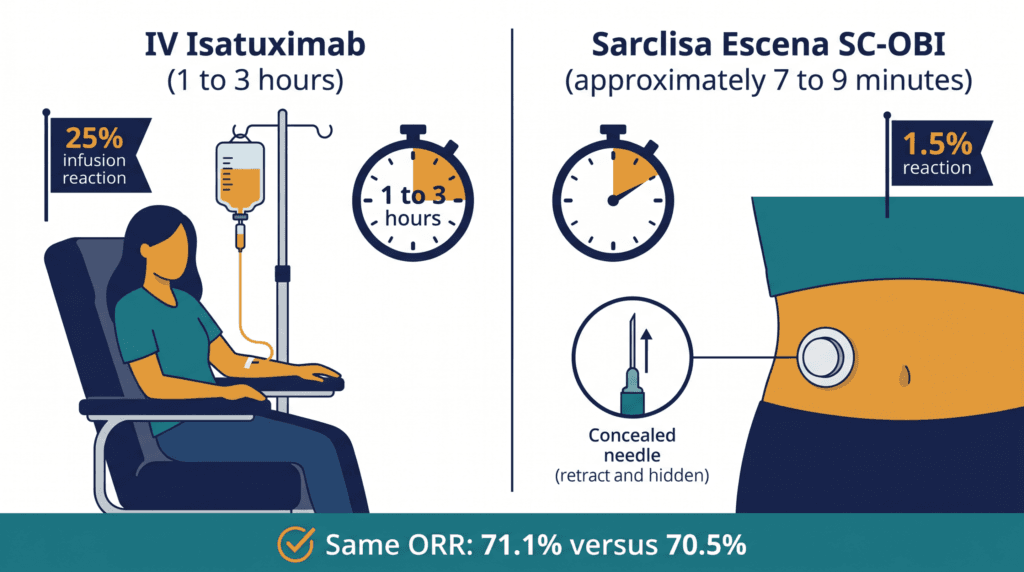
The Phase 3 IRAKLIA trial showed that the SC-OBI approach is not merely convenient. It is clinically equivalent to IV isatuximab on every meaningful efficacy measure, produces higher steady-state drug concentrations, and reduces systemic infusion reactions from 25% with IV to 1.5% with the on-body approach.
What Multiple Myeloma Is and Why CD38 Is Such an Important Target
Multiple myeloma is a cancer of plasma cells, the antibody-producing cells of the immune system that reside in the bone marrow. In myeloma, malignant plasma cells proliferate uncontrollably, crowd out normal blood cell production, and produce large quantities of a dysfunctional monoclonal protein (M-protein) that serves as a disease biomarker but can also damage the kidneys. The resulting clinical picture includes anemia, bone lesions, kidney damage, immunosuppression, and hypercalcemia.
Multiple myeloma is the second most common blood cancer in the United States, with approximately 36,000 new diagnoses and 12,000 deaths annually. It remains incurable for most patients, though effective modern treatments have extended median survival from approximately 3 years in the 1990s to 6 to 8 years or more for many patients today. Patients cycle through treatment regimens, entering remission, eventually relapsing, and then requiring a new regimen that typically includes drugs from different mechanistic classes.
CD38 is a transmembrane glycoprotein expressed at very high levels on myeloma plasma cells, making it an ideal therapeutic target. CD38 is expressed on normal lymphoid and myeloid cells as well, but at much lower levels than on myeloma cells, providing a therapeutic window for anti-CD38 antibodies to selectively target the malignant population.
Anti-CD38 antibodies kill myeloma cells through multiple mechanisms: antibody-dependent cellular cytotoxicity (ADCC), antibody-dependent cellular phagocytosis (ADCP), complement-dependent cytotoxicity (CDC), and direct apoptosis induction. They also deplete immunosuppressive CD38-positive regulatory T cells and regulatory B cells, which may additionally improve the anti-tumor immune response. This multi-mechanism killing is one reason CD38-directed antibodies are effective even in heavily pretreated myeloma and why they have become a backbone of therapy across multiple lines of treatment.
What Isatuximab Is and How Sarclisa Escena Relates to IV Sarclisa
Isatuximab (Sarclisa) is a CD38-directed IgG1 monoclonal antibody that differs from daratumumab in the specific epitope on CD38 it binds and in its mechanism of triggering apoptosis (daratumumab requires cross-linking for apoptotic signaling; isatuximab induces apoptosis through receptor clustering independent of cross-linking). In clinical practice, both are effective CD38-targeting antibodies used in complementary regimens in the myeloma treatment landscape.
IV Sarclisa was approved by the FDA in:
- March 2020 for relapsed/refractory myeloma in combination with pomalidomide and dexamethasone (ICARIA-MM trial)
- March 2021 in combination with carfilzomib and dexamethasone (IKEMA trial)
- March 2024 in combination with VRd for transplant-ineligible newly diagnosed myeloma (IMROZ trial)
Sarclisa Escena is not a new drug. It is the same isatuximab-irfc molecule delivered by a different route. The “Escena” suffix distinguishes the subcutaneous formulation from the IV formulation for prescribing, dispensing, and packaging purposes. All three indications approved for IV Sarclisa are now equally approved for Sarclisa Escena SC, with the same combination regimen partners and the same patient eligibility criteria.
The dose change is meaningful: IV isatuximab is dosed at 10 mg/kg, meaning the volume infused varies by patient weight. Sarclisa Escena uses a fixed flat dose of 1,400 mg regardless of patient weight. This simplifies preparation and administration, reduces the potential for weight-based dosing errors, and enables the on-body injector to deliver a predetermined fixed volume to every patient.
The CirCLIQ On-Body Delivery System: What It Is and How It Works
The CirCLIQ on-body delivery system (OBDS), manufactured by Enable Injections of Cincinnati, Ohio, is the central innovation of the Sarclisa Escena approval. Understanding what it does requires understanding why subcutaneous delivery of large-volume biologics has historically required either hyaluronidase or a slow infusion.
The subcutaneous space has limited capacity. Subcutaneous tissues resist high-pressure injection of large volumes because the dense extracellular matrix of hyaluronan and collagen creates physical resistance. Conventional subcutaneous injections of most drugs deliver volumes under 1 to 2 mL. Biologics like anti-CD38 antibodies at therapeutic doses require much larger volumes.
There are two established solutions. Hyaluronidase (used in Darzalex Faspro and Keytruda Qlex) temporarily breaks down the hyaluronan matrix, allowing larger volumes to be injected rapidly by dispersing through the loosened tissue. The CirCLIQ approach takes a different path: it uses low-pressure, interstitial-rate delivery, meaning it delivers the drug slowly enough that the subcutaneous tissue can accommodate the volume without requiring enzymatic disruption of the matrix.
Concretely, the CirCLIQ device:
- Is worn on the body surface (typically the abdomen) and attached by the patient or healthcare provider before administration begins
- Contains a single-use, concealed, retractable 30-gauge needle that inserts automatically when activated, eliminating visible needle exposure and reducing sharps anxiety for needle-phobic patients
- Delivers the drug hands-free once activated, freeing the patient and provider from holding a syringe during the infusion period
- Uses flow rates calibrated to the patient’s interstitial pressure rather than a fixed pump rate, individualized delivery based on how the specific tissue responds
- Does not require hyaluronidase as a co-formulation or co-injection
- Completes drug delivery in approximately 7 to 9 minutes per the IRAKLIA experience, far shorter than IV infusions but longer than the 1 to 2 minutes for Keytruda Qlex’s conventional SC injection
A critical safety feature: the needle retracts automatically after injection completion, preventing accidental needle-stick injuries. In IRAKLIA, 99.9% of all OBI injections (5,145 total injections analyzed) completed without interruption, demonstrating exceptional mechanical reliability across a large real-world operational dataset.
For oncology practices, this also means nursing workload is different. Rather than manually maintaining an IV line and titrating infusion rates through an infusion pump, a nurse or medical assistant attaches the OBI device and activates it. The patient then waits, wearing the device, until delivery completes. The hands-free nature means nursing attention can be allocated elsewhere during the delivery period.
The IRAKLIA Trial: Full Data
Design
IRAKLIA (NCT05405166) was an international, multicenter, open-label, randomized, Phase 3 non-inferiority trial. It enrolled 531 adults (age 18 or older) with relapsed/refractory multiple myeloma who had received at least one prior line of therapy. Patients were randomized 1:1 to:
- Sarclisa Escena 1,400 mg SC via CirCLIQ OBI plus pomalidomide plus dexamethasone (n=263)
- IV isatuximab 10 mg/kg plus pomalidomide plus dexamethasone (n=268)
Both arms received isatuximab weekly in cycle 1, then every 2 weeks. Pomalidomide 4 mg daily on days 1 to 21 and dexamethasone 40 mg weekly (20 mg for patients aged 75 or older) were the standard partner regimen.
Co-primary endpoints were ORR (by Independent Review Committee using 2016 IMWG criteria) and isatuximab trough plasma concentration at steady state (Ctrough at cycle 6, day 1 predose). Non-inferiority was declared if both primary endpoints met their prespecified non-inferiority margins. The trial was published in the Journal of Clinical Oncology (JCO) with a 12-month median follow-up.
Efficacy results
| Endpoint | SC-OBI isatuximab (n=263) | IV isatuximab (n=268) | Result |
|---|---|---|---|
| ORR (co-primary) | 71.1% | 70.5% | Relative risk 1.008 (95% CI 0.903 to 1.126); p=0.0006; non-inferior |
| Mean Ctrough at C6D1 (co-primary) | 499 μg/mL (SD 259) | 340 μg/mL (SD 169) | Geometric mean ratio 1.532 (90% CI 1.316 to 1.784); non-inferior |
| VGPR or better rate | Similar between arms | Similar between arms | Comparable depth of response |
| Patient satisfaction (satisfied or very satisfied) | 70% | 53.4% | OR 2.036 (95% CI 1.425 to 2.908); p=0.0001 |
| Median follow-up | 12 months | 12 months | — |
Source: Richardson PG et al. IRAKLIA: Isatuximab Subcutaneous by On-Body Injector Versus Isatuximab Intravenous Plus Pd in R/R MM. JCO. 2025. doi:10.1200/JCO-25-00744. NCT05405166.
The ORR non-inferiority result is the core efficacy finding: 71.1% versus 70.5%, a difference of 0.6 percentage points in a trial that randomized 531 patients, establishes that the SC-OBI route delivers identical anti-tumor activity to IV administration. The non-inferiority margin was met with high statistical confidence (p=0.0006).
The Ctrough finding is particularly notable: the SC route actually achieved a higher mean steady-state trough concentration (499 μg/mL) than the IV route (340 μg/mL). This is not a paradox. With subcutaneous administration, drug is absorbed gradually from the subcutaneous depot over time, producing a flatter pharmacokinetic curve with higher trough levels compared to the sharp peak and faster decline seen with IV infusion. Higher troughs are generally associated with better sustained target coverage and may contribute to at least comparable or potentially superior outcomes with the SC formulation over longer follow-up periods.
The patient satisfaction finding (70% satisfied or very satisfied with SC-OBI versus 53.4% with IV, p=0.0001) is a patient-reported outcome that the trial was specifically designed to capture and the FDA considered in its evaluation. A statistically significant, nearly 17-percentage-point improvement in patient satisfaction with the same clinical efficacy is a meaningful clinical finding, not a marketing data point.
Safety results
| Safety item | SC-OBI | IV | Clinical relevance |
|---|---|---|---|
| Systemic infusion-related reactions | 1.5% | 25.0% | Dramatic reduction; one of the most important safety differences |
| Local injection site reactions | 0.4% of injections (all grade 1 or 2) | — | Rare, mild, and self-limiting |
| Grade 3 or higher treatment-emergent adverse events | 81.7% | 76.1% | Numerically higher with SC; reflects complex relapsed/refractory myeloma population; no unexpected signals |
| Treatment discontinuation due to injection reactions | 0 | Not reported | No discontinuations from injection site events with SC |
| Injections completed without interruption | 99.9% (5,144 of 5,145) | — | Exceptional device reliability |
Source: JCO IRAKLIA publication; Applied Clinical Trials Online IRAKLIA/IZALCO data summary.
The infusion reaction reduction from 25% to 1.5% is the most clinically impactful safety finding. Infusion-related reactions (IRRs) with IV anti-CD38 antibodies are a well-established class effect: daratumumab and isatuximab both require premedication with antihistamines, corticosteroids, and antipyretics before each IV infusion, and the first infusion is typically given slowly over 4 to 6 hours precisely because of IRR risk. These reactions, while usually manageable, add time, require nursing monitoring, and occasionally require interruption or rate adjustment. Some patients experience reactions severe enough to require treatment delays.
The 1.5% systemic reaction rate with SC-OBI means the premedication burden and the nursing monitoring for systemic reactions are dramatically reduced, not eliminated but reduced to an extent that meaningfully changes the clinical experience of receiving isatuximab.
The numerically higher grade 3 or higher TEAE rate with SC (81.7% versus 76.1%) reflects the overall adverse event burden of treating relapsed/refractory myeloma rather than a SC-specific safety concern. These events are consistent with the established IV isatuximab safety profile and reflect the toxicity of the full triplet regimen (isatuximab plus pomalidomide plus dexamethasone) in a population who has already received multiple prior therapies.
Supporting studies: IZALCO and ISASCOUT
Beyond IRAKLIA, the FDA’s approval across all three indications was further supported by:
IZALCO (NCT05704049): Phase 2 study evaluating SC isatuximab via OBI in combination with carfilzomib and dexamethasone (Kd) in relapsed/refractory myeloma. In IZALCO, approximately 75% of patients preferred the OBI approach over manual subcutaneous injection, with high efficacy and minimal injection site reactions, providing patient preference data for the Kd combination regimen.
IsaSocut/ISASCOUT (NCT05889221): Phase 2 study evaluating SC isatuximab in combination with VRd in transplant-ineligible newly diagnosed myeloma, providing supportive data for the NDMM indication.
Sarclisa Escena’s Complete Indication Coverage
| Indication | Partners | Patient population | Approval basis |
|---|---|---|---|
| Relapsed/refractory MM, at least 1 prior line including lenalidomide and a PI | Pomalidomide plus dexamethasone (Pd) | Adults | IRAKLIA Phase 3 (primary pivotal) |
| Relapsed/refractory MM, 1 to 3 prior lines | Carfilzomib plus dexamethasone (Kd) | Adults | IZALCO Phase 2 plus IV IKEMA extrapolation |
| Newly diagnosed MM, transplant-ineligible | Bortezomib plus lenalidomide plus dexamethasone (VRd) | Adults | ISASCOUT Phase 2 plus IV IMROZ extrapolation |
Safety: What the Full Prescribing Information Covers
The safety profile of Sarclisa Escena follows the established profile of IV isatuximab with the key modification of substantially reduced systemic infusion reactions and the addition of local injection site reaction monitoring.
Warnings and precautions from the Sarclisa Escena prescribing information:
Hypersensitivity and administration reactions: Serious hypersensitivity reactions, including anaphylaxis, have been reported with isatuximab. For SC administration, systemic reactions occur at a dramatically lower rate than with IV (1.5% versus 25% in IRAKLIA), but monitoring for hypersensitivity remains required. Premedication with corticosteroids, antihistamines, and antipyretics is still recommended before administration, though the required observation period post-administration may differ from IV protocols. Clinicians should follow the Sarclisa Escena prescribing information specifically for SC premedication and monitoring guidance.
Neutropenia: Neutropenia is one of the most common and serious adverse events with isatuximab-containing regimens. Grade 3 or higher neutropenia is expected in a substantial proportion of patients, particularly when combined with pomalidomide. CBC monitoring before each cycle is standard. G-CSF support may be required. Dose modifications for neutropenia follow the regimen-specific guidance in the prescribing information.
Infections: Isatuximab causes immunosuppression through depletion of CD38-positive immune cells. Serious infections including pneumonia, upper respiratory tract infections, and opportunistic infections have been reported. Prophylactic antimicrobial coverage consistent with institutional protocols for myeloma regimens should be considered.
Secondary primary malignancies: As with other myeloma regimens involving immunomodulatory drugs (IMiDs), secondary primary malignancies have been reported. Routine monitoring is recommended.
Laboratory test interference: Isatuximab, as an IgG kappa monoclonal antibody, may be detected by serum protein electrophoresis and immunofixation assays used to monitor M-protein, potentially interfering with disease response assessment. This is a known class effect of anti-CD38 antibodies, and the prescribing information addresses how to distinguish isatuximab signal from M-protein response.
Embryo-fetal toxicity: Isatuximab can cause fetal harm. Females of reproductive potential should use effective contraception during treatment and for 5 months after the last dose. Males with female partners of reproductive potential should use effective contraception during treatment and for 3 months after the last dose.
What This Means for Patients and Oncology Practices
For patients
For a patient with relapsed myeloma starting isatuximab-Pd in the second or later line, Sarclisa Escena offers the same clinical activity as IV Sarclisa with three meaningful practical advantages: substantially fewer systemic infusion reactions (1.5% versus 25%), no IV line required, and a device-based administration that eliminates the need to sit connected to an IV drip for an extended period.
The administration time with the OBI, approximately 7 to 9 minutes for the drug delivery itself plus setup and monitoring time, is not as fast as a 1- to 2-minute SC push injection. But it is substantially shorter than a 1- to 3-hour IV infusion on subsequent cycles, and the fact that it is hands-free changes the character of the clinical visit. The patient wears the device and waits; the nurse does not need to maintain a drip line throughout.
For patients receiving isatuximab as part of the VRd regimen for newly diagnosed transplant-ineligible disease, where therapy may continue for years, the cumulative reduction in infusion chair time and in systemic IRR events is substantial over a full treatment course.
The question of whether home administration of Sarclisa Escena is possible in the future is a natural one given the on-body injector format. The current approval specifies administration with a healthcare provider present. Sanofi has indicated that home administration is a future potential that the technology enables, but it is not part of the current label or commercial rollout.
For oncology practices
The CirCLIQ OBI changes the nursing workflow for isatuximab administration in ways that vary by practice setting. Setup, patient education on wearing the device, and post-administration monitoring remain required. But the hands-free delivery frees nursing time during the actual drug administration period compared to IV management. For infusion centers operating at capacity with long chair times, the shift from 1 to 3 hours of IV infusion to a shorter SC OBI session could increase throughput.
The absence of hyaluronidase in the Sarclisa Escena formulation is also a practical supply chain point: no separate co-formulation is required, and the flat 1,400 mg dose eliminates weight-based calculation and the preparation variability that comes with it.
As Dr. Mohamad Mohty, Professor of Hematology at Sorbonne University and Head of Clinical Hematology and Cellular Therapy at Saint-Antoine Hospital in Paris, noted: “The ability to administer a therapy through an on-body injector, particularly an anti-CD38 monoclonal antibody with well-established efficacy, either in the clinic or at home, represents a meaningful step forward.”
For related HED coverage on multiple myeloma therapeutics, see our posts on Pomalyst (pomalidomide) losing exclusivity and what generic pomalidomide means for myeloma access in the 2026 LOE series, and on the Tregzi (marnetegragene autotemcel) approval for allogeneic stem cell transplantation in blood cancers.
For patients and families navigating a multiple myeloma diagnosis, the Multiple Myeloma Research Foundation (themmrf.org; 1-888-841-6673) and the International Myeloma Foundation (myeloma.org; 1-800-452-CURE) maintain current patient resources, treatment information, and clinical trial directories.
Sources
FDA approval announcement: FDA approves isatuximab-irfc for subcutaneous injection for multiple myeloma indications. FDA.gov. July 9, 2026.
Sanofi FDA approval press release: Sanofi’s subcutaneous Sarclisa Escena approved in the US as first anticancer treatment administered via on-body injector. GlobeNewswire. July 10, 2026.
Drugs.com approval news: FDA Approves Sarclisa Escena (isatuximab-irfc) Subcutaneous Injection for the Treatment of Multiple Myeloma. drugs.com. July 10, 2026.
IRAKLIA primary JCO publication: Richardson PG et al. Isatuximab Subcutaneous by On-Body Injector Versus Isatuximab Intravenous Plus Pomalidomide and Dexamethasone in Relapsed/Refractory Multiple Myeloma: Phase III IRAKLIA Study. Journal of Clinical Oncology. 2025. doi:10.1200/JCO-25-00744.
IRAKLIA trial registration: NCT05405166. ClinicalTrials.gov.
ASCO Post clinical summary: FDA Approves Isatuximab-irfc for Subcutaneous Injection for Multiple Myeloma Indications. ascopost.com. July 2026.
OncLive (OBI mechanism, safety data, IZALCO preference data): FDA Approves Subcutaneous Isatuximab Delivered Via On-Body Delivery System for Multiple Myeloma. onclive.com. July 2026.
CancerNetwork (patient satisfaction OR data): FDA Approves Subcutaneous Isatuximab in Multiple Myeloma. cancernetwork.com. July 2026.
Targeted Oncology (full indications and supporting studies): FDA Approves Subcutaneous Isatuximab for Multiple Myeloma. targetedonc.com. July 2026.
PharmExec (CirCLIQ mechanism detail and competitive context): FDA Approves Subcutaneous Sarclisa Escena for Multiple Myeloma. pharmexec.com. July 2026.
BioPharm International (IRAKLIA full data table, EC approval context): EC Approves Sanofi’s Subcutaneous Isatuximab for Multiple Myeloma Across All Existing Indications. biopharminternational.com. June 2026.
Applied Clinical Trials (IRAKLIA/IZALCO combined data summary): Phase III IRAKLIA and Phase II IZALCO Trials Support Sarclisa On-Body Delivery. appliedclinicaltrialsonline.com. October 2025.
International Myeloma Foundation approval news: Subcutaneous Sarclisa (isatuximab-irfc) FDA Approved for Myeloma. myeloma.org. July 2026.
OncoDaily clinical overview: FDA Approved Subcutaneous Isatuximab: Advancing Anti-CD38 Therapy Delivery in Multiple Myeloma. oncodaily.com. July 2026.
ASH 2025 body weight PK sub-analysis: Isatuximab Subcutaneous by On-Body Injector in R/R MM: Effect of Body Weight on Pharmacokinetics. Blood. 2025;146(Supplement 1):5812.
IZALCO trial registration: NCT05704049. ClinicalTrials.gov.
ISASCOUT trial registration: NCT05889221. ClinicalTrials.gov.
IV Sarclisa original FDA approval: FDA approves isatuximab-irfc for multiple myeloma. FDA.gov.
CD38 biology: CD38 in Multiple Myeloma. PMC7734386.
Multiple myeloma overview: Multiple Myeloma. StatPearls. NCBI.
Sarclisa Escena prescribing information: SARCLISA ESCENA (isatuximab-irfc) Prescribing Information. Sanofi-Aventis. 2026.
Sarclisa Escena approval history: Sarclisa Escena FDA Approval History. drugs.com.
Enable Injections (CirCLIQ manufacturer): Enable Injections. enableinjections.com.
Patient resources: Multiple Myeloma Research Foundation: 1-888-841-6673 | International Myeloma Foundation: 1-800-452-CURE | Leukemia and Lymphoma Society | Sanofi Sarclisa patient support
| Disclaimer: Health Evidence Digest provides general information about FDA approvals and health research for educational purposes. This content is not a substitute for professional medical advice. Sarclisa Escena (isatuximab-irfc) is approved for subcutaneous administration and currently requires administration with a healthcare provider present. Treatment decisions for multiple myeloma, including regimen selection and the choice between IV Sarclisa and Sarclisa Escena SC, should be made in close collaboration with a board-certified hematologist or medical oncologist experienced in myeloma management. |
|---|