| 📌 The essentials On March 26, 2026, the FDA approved Awiqli (insulin icodec-abae, Novo Nordisk), the first and only once-weekly basal insulin in history, for adults with type 2 diabetes. 52 injections per year instead of 365. The clinical basis: four randomized, treat-to-target ONWARDS Phase 3 trials enrolling approximately 2,900 adults with T2D. Three of the four trials showed statistically superior HbA1c reduction with icodec versus daily basal insulin. The fourth met non-inferiority. A meta-analysis across five ONWARDS trials showed a mean incremental HbA1c benefit of 0.17% (95% CI 0.06 to 0.28; p=0.003). The mechanism: insulin icodec binds reversibly to albumin via fatty acid side chains, creating a circulating reservoir that releases active insulin continuously over approximately 8 days (half-life approximately 196 hours). Why the T1D indication is absent: an earlier FDA Complete Response Letter cited the higher hypoglycemia rate in ONWARDS 6 (the type 1 trial). The March 2026 approval covers type 2 diabetes only. Critical clinical consideration: icodec’s 196-hour half-life means dose adjustments take 3 to 4 weeks to reach new steady state. Titrate conservatively, no more frequently than every 1 to 2 weeks. |
|---|
Basal insulin has been a cornerstone of type 2 diabetes management for decades. It works by providing a slow, steady background level of insulin that covers overnight glucose production by the liver and keeps blood sugar from rising between meals. For millions of people with type 2 diabetes who cannot achieve adequate glycemic control with oral medications alone, basal insulin is not optional. It is what keeps them safe.
But daily injections are a burden. Not a small one. A patient starting daily basal insulin at age 60 faces 365 injections per year for the rest of their life. Studies consistently show that fear of injection, injection fatigue, and the daily management burden contribute to insulin omission, dose skipping, and delayed treatment initiation, all of which translate into worse glycemic control and worse outcomes.
On March 26, 2026, the FDA approved Awiqli (insulin icodec-abae), the first once-weekly basal insulin in history, 52 injections a year instead of 365. The clinical data behind it spans five randomized trials and approximately 4,000 patients. It shows not just non-inferiority to daily basal insulin, but in several studies, superior HbA1c reduction. Understanding how that is possible, and what the trade-offs are, requires going inside the chemistry.
How Awiqli Actually Works: The Albumin-Binding Depot Mechanism
Existing basal insulins, glargine (Lantus, Toujeo, Basaglar) and degludec (Tresiba), achieve their extended duration through different mechanisms. Glargine precipitates at physiological pH, forming microcrystals that dissolve slowly. Degludec forms multi-hexameric chains that dissociate gradually from the injection site. Both produce half-lives of 12 to 25 hours, sufficient for once-daily dosing.
Insulin icodec takes a fundamentally different approach. The molecule is engineered with two fatty acid side chains that allow it to bind reversibly to albumin, the most abundant protein in blood plasma. When injected, icodec does not just sit at the injection site waiting to dissolve. It enters the bloodstream and binds to circulating albumin, which acts as a reservoir. Only a small fraction of icodec is free and active at any given time; the rest is temporarily sequestered in the albumin-bound depot. As free icodec is cleared by the body, more is released from albumin to replace it.
The result is a half-life of approximately 196 hours, about 8 days. This is long enough that a single injection provides stable, continuous insulin coverage for an entire week, with a flat pharmacodynamic profile that avoids the peak-and-trough pattern that can contribute to hypoglycemia with shorter-acting insulins.
| Why the long half-life creates a specific clinical consideration The same pharmacokinetic property that enables once-weekly dosing also means that any dose adjustment takes longer to reach a new steady state. With daily insulin, a dose increase or decrease produces a measurable effect within 1 to 2 days. With icodec’s 196-hour half-life, it takes approximately 3 to 4 weeks to reach a new steady state after a dose change. This has a practical implication for titration: icodec should be titrated conservatively, with dose adjustments made no more frequently than every 1 to 2 weeks based on fasting blood glucose. Aggressive titration, adjusting every few days as some patients do with daily insulins, risks overshoot and delayed hypoglycemia. The prescribing information provides specific titration guidance that clinicians should review carefully. Similarly, if a patient is transitioning off icodec to another insulin, the insulin effect persists for several days after the last dose. Overlap with a new insulin must be carefully managed to avoid hypoglycemia during the transition period. |
|---|
Why This Is a Resubmission and Why Type 1 Diabetes Is Not on the Label
The March 2026 approval is not the first time Awiqli went through FDA review. In July 2024, the FDA issued a Complete Response Letter citing two issues: concerns about the manufacturing process, and concerns about the safety of insulin icodec specifically in patients with type 1 diabetes.
The type 1 concern is worth understanding. ONWARDS 6, the Phase 3 trial evaluating insulin icodec in T1D, showed that icodec was non-inferior to degludec for HbA1c reduction. But in T1D patients, the rate of clinically significant or severe hypoglycemia was meaningfully higher in the icodec arm than in the degludec arm. The FDA’s advisory committee voted against approval for T1D, and the agency’s concerns were reflected in the CRL.
Novo Nordisk’s response was pragmatic: rather than try to address the T1D concerns in the resubmission, which would have required additional clinical data and further delayed approval, the company resubmitted in September 2025 for the T2D indication only, where the efficacy and safety data were consistently robust. That resubmission was approved in March 2026.
Novo Nordisk has stated that it remains committed to exploring icodec for type 1 diabetes and plans to conduct a new clinical trial in this population. The T1D indication is not closed; it is deferred. For now, Awiqli is approved for adults with type 2 diabetes only.
The ONWARDS Trials: What the Clinical Evidence Shows
The FDA approval is based on four trials from the ONWARDS Phase 3a clinical program, all randomized, active-controlled, and treat-to-target in design. “Treat-to-target” means that insulin doses in both arms were titrated to achieve the same blood sugar goals, a rigorous design that tests whether the drugs perform equivalently under optimized conditions.
| Trial | Population | Comparator | HbA1c reduction (icodec) | HbA1c reduction (comparator) |
|---|---|---|---|---|
| ONWARDS 1 (78 wk, n=984) | Insulin-naive T2D on non-insulin agents | Glargine U100 (once daily) | −1.55% | −1.35%* |
| ONWARDS 2 (26 wk, n=526) | T2D switching from daily basal insulin | Degludec (once daily) | −0.93% | −0.71%† |
| ONWARDS 3 (26 wk, n=588) | Insulin-naive T2D on non-insulin agents | Degludec (once daily) | −1.57% | −1.36%† |
| ONWARDS 4 (26 wk, n=582) | T2D on basal-bolus regimen | Glargine U100 (once daily) | −1.16% | −1.18% (NI met) |
* Superior (p less than 0.001) vs. glargine U100. † Superior (p less than 0.003 to p less than 0.0007) vs. degludec. NI = non-inferiority. Source: Published ONWARDS trials in NEJM, Lancet, JAMA, Lancet Diabetes Endocrinology.
Three of the four trials showed statistically superior HbA1c reduction with icodec compared to daily basal insulin. The fourth (ONWARDS 4, in patients already on basal-bolus regimens) met the pre-specified non-inferiority margin. A meta-analysis across all five ONWARDS trials showed a mean incremental HbA1c benefit of 0.17% (95% CI 0.06 to 0.28; p=0.003) and an odds ratio of 1.51 (95% CI 1.14 to 1.99) for achieving HbA1c below 7% with icodec versus comparators.
ONWARDS 1 also demonstrated a secondary endpoint of superior Time in Range (blood glucose 70 to 180 mg/dL) with icodec compared to glargine U100, a clinically meaningful finding given the growing emphasis on TIR as an outcome measure alongside HbA1c. Additionally, in ONWARDS 1 and 3, a higher proportion of insulin-naive patients achieved an HbA1c target below 7% without clinically significant or severe hypoglycemia with icodec versus comparators, suggesting that the once-weekly drug can deliver better glycemic control without proportionally increasing hypoglycemia burden in this population.
Dr. Julio Rosenstock, MD, Clinical Professor at UT Southwestern Medical Center and Principal Investigator of the ONWARDS trial program, characterized the approval at the time of the FDA decision as underscoring the need for new alternative insulin options that may help patients work with their healthcare providers to determine what treatment works best for them.
The Hypoglycemia Picture: Nuanced, Not Alarming
Hypoglycemia is the most important safety consideration in any insulin therapy, and the icodec data requires careful interpretation rather than a headline summary.
In insulin-naive patients (ONWARDS 1 and 3), the picture is favorable: despite achieving better HbA1c control, icodec did not generate significantly more hypoglycemia than comparators, and more patients reached target HbA1c without experiencing level 2 or level 3 hypoglycemia.
The nuance comes in the switching studies (ONWARDS 2 and 3 for patients already on insulin). Here, numerically higher rates of clinically significant (level 2) or severe (level 3) hypoglycemia were observed with icodec compared to degludec. In ONWARDS 3, rates were 0.31 versus 0.15 events per patient-year. This difference reflects a specific pharmacokinetic challenge: when patients switch from daily to weekly insulin, there is an initial period during which the full icodec depot is being established. The prescribing information recommends initiating icodec at 20% higher than the previous total daily dose for patients switching from daily basal insulin, specifically to manage this titration period.
| The clinical alert on hypoglycemia in T2D Patients treated with Awiqli tended to have a greater incidence of hypoglycemia than daily comparators in some study arms, while in insulin-naive patients the rates were comparable or favorable. The key implication is that icodec requires more careful patient selection and titration guidance when used as a switch therapy versus a treatment initiation therapy. In T2D specifically, the clinical concern about hypoglycemia is lower than in T1D: T2D patients retain some endogenous insulin secretion and have counterregulatory responses that protect against severe hypoglycemia. The T1D population, where hypoglycemia was more concerning and drove the CRL, is not included in the current U.S. approval. For T2D, the FDA and the ONWARDS investigators judged the benefit-risk profile favorable. |
|---|
Practical Use: Dosing, Switching, and Missed Doses
The U-700 concentration: what this means practically
Awiqli is a U-700 formulation, 700 units per mL, compared to the U-100 (100 units per mL) that most daily basal insulins use. This higher concentration is what allows a full week’s worth of insulin to be administered in a single manageable injection volume. It means that icodec is not substitutable unit-for-unit with daily insulins: a week’s dose of icodec is roughly equivalent to 7 days of the total daily dose, not a single daily dose. Careful dose calculation is required at initiation and when switching.
Starting doses and switching guidance
| Patient situation | Starting approach |
|---|---|
| Insulin-naive | Start at 70 units once weekly. Titrate based on fasting blood glucose, adjusting no more than every 2 weeks. |
| Switching from daily basal insulin | Start at 20% higher than previous total daily basal dose, given once weekly. This accounts for the accumulation phase. |
| Adding to GLP-1 or oral agents | Start at 70 units weekly (same as insulin-naive). Be alert to enhanced glucose-lowering from the combination. |
| Patients on basal-bolus regimens | Switch based on individual assessment; the ONWARDS 4 data supports the transition in this population. |
Missed dose flexibility: a genuine practical advantage
One underappreciated benefit of icodec’s long half-life is missed-dose forgiveness. Because the drug accumulates in the albumin depot and releases continuously, a missed or shifted dose is less clinically consequential than with daily insulin. The prescribing information states that if a dose is missed, it can be administered up to 3 days (72 hours) before or after the scheduled day. After administration, resume the original once-weekly schedule. This flexibility directly addresses one of the practical frustrations of daily insulin, the anxiety around a forgotten or delayed dose.
Administration
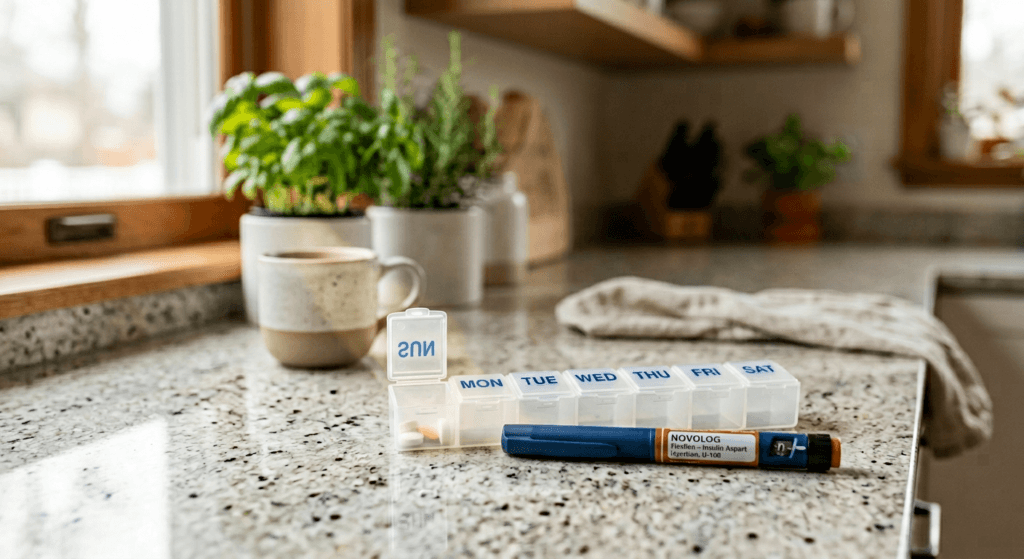
Awiqli is administered subcutaneously once weekly on the same day each week, using the Novo Nordisk FlexTouch prefilled pen. It is available in three pen sizes: 700 units per 1 mL, 1050 units per 1.5 mL, and 2100 units per 3 mL. It must not be administered intravenously, intramuscularly, or via insulin pump, and must not be mixed with other insulin products.
Safety: What the Prescribing Information Covers
The safety profile of Awiqli is broadly consistent with the basal insulin class, with the nuances around hypoglycemia and titration already discussed above.
Common adverse reactions: hypoglycemia, injection site reactions (redness, swelling, itching), lipodystrophy (skin thickening or pitting at injection sites), pruritus, rash, peripheral edema, weight gain.
Serious risks:
- Severe hypoglycemia
- Serious hypersensitivity reactions including anaphylaxis, angioedema, urticaria, and swelling of face and lips
- Hypokalemia (low potassium, which may affect heart rhythm)
Thiazolidinediones (TZDs): Use with pioglitazone or rosiglitazone increases the risk of fluid retention and potential heart failure exacerbation. Monitor for signs of heart failure when co-prescribing.
Acute illness and fasting: During illness or significant changes in eating, blood glucose monitoring frequency should increase and dose adjustments may be needed. The long half-life means that missed or delayed doses are tolerated, but significant metabolic stress (surgery, serious illness) requires closer glucose monitoring.
Not indicated for: ketoacidosis treatment, diabetic ketoacidosis, use via intravenous or intramuscular routes, or use with insulin infusion pumps.
Why Injection Frequency Matters More Than It Might Seem
The clinical significance of moving from daily to weekly injections goes beyond convenience. The diabetes literature on insulin adherence is consistent: injection burden is one of the leading modifiable barriers to insulin initiation and continuation. “Psychological insulin resistance,” the phenomenon in which patients delay or avoid starting insulin despite clinical need, is documented in 20 to 30% of people with T2D who are recommended insulin.
Insulin omission is also common among those already on therapy: studies estimate that 20 to 50% of patients on daily basal insulin skip doses at least occasionally, with higher rates among those with greater injection frequency or complex regimens. Each omitted dose represents a period of inadequate glycemic coverage. Sustained omission accelerates the development of diabetes complications.
Once-weekly dosing does not eliminate these barriers, but it substantially reduces the number of opportunities for omission and lowers the daily psychological overhead of managing insulin therapy. Whether this translates into measurably better real-world outcomes beyond what the controlled trials demonstrated will only be known from post-marketing evidence. But the mechanistic argument is sound.
Availability and Global Status
Novo Nordisk has indicated Awiqli will be available at U.S. pharmacies in the second half of 2026. The drug has already been approved in the European Union, Canada, Australia, Japan, Switzerland, and more than a dozen other countries, in many of those markets for both type 1 and type 2 diabetes. The U.S. approval is limited to type 2 diabetes.
Pricing and formulary coverage have not been announced for the U.S. market at time of writing. Patients and clinicians should check with their insurance provider and Novo Nordisk’s patient support resources as the launch approaches. For patients on insulin experiencing cost barriers, the Novo Nordisk patient assistance program and the NeedyMeds database are useful starting points.
For related HED coverage on diabetes treatment advances and access, see our posts on the FDA approval of the first generic dapagliflozin tablets and the approval of Foundayo (orforglipron), the first oral GLP-1 pill for weight management without food or water restrictions.
Sources
FDA approval and Novo Nordisk press release: FDA approves Novo Nordisk’s Awiqli (insulin icodec-abae), the first and only once-weekly basal insulin treatment for adults with T2D. March 26, 2026. prnewswire.com.
HCPLive coverage: FDA Approves Insulin Icodec (Awiqli) as First Once-Weekly Basal Insulin for Type 2 Diabetes. hcplive.com. March 2026.
Patient Care Online coverage: FDA Approves Once-Weekly Basal Insulin for Adults With Type 2 Diabetes. patientcareonline.com. March 2026.
Consultant360: FDA Approves Awiqli (Insulin Icodec-Abae) as Once-Weekly Basal Insulin. consultant360.com. March 2026.
ONWARDS 1 (NEJM): Rosenstock J et al. Weekly icodec versus daily glargine U100 in type 2 diabetes without previous insulin. NEJM. 2023;389(16):1533. doi:10.1056/NEJMoa2310221
ONWARDS 2 (Lancet Diabetes Endocrinol): Philis-Tsimikas A et al. Switching to once-weekly insulin icodec versus once-daily insulin degludec in basal insulin-treated T2D (ONWARDS 2). Lancet Diabetes Endocrinol. 2023.
ONWARDS 3 (JAMA): Lingvay I et al. Once-weekly insulin icodec vs once-daily insulin degludec in adults with insulin-naive T2D: ONWARDS 3. JAMA. 2023;330(3):228-237.
ONWARDS 4 (Lancet): Mathieu C et al. Switching to once-weekly icodec vs once-daily glargine U100 in basal-bolus insulin-treated T2D (ONWARDS 4). Lancet. 2023.
ONWARDS 1 trial registration: NCT04508660. ClinicalTrials.gov.
ONWARDS 2 trial registration: NCT04771052. ClinicalTrials.gov.
ONWARDS 3 trial registration: NCT04832711. ClinicalTrials.gov.
ONWARDS 4 trial registration: NCT04835493. ClinicalTrials.gov.
Awiqli prescribing information: Awiqli (insulin icodec-abae) injection 700 units/mL. Novo Nordisk. 2026.
ADA Standards 2026: American Diabetes Association Professional Practice Committee. Standards of Care in Diabetes, 2026. Diabetes Care. 2026;49(suppl 1).
Time in Range reference: Battelino T et al. Clinical targets for CGM data interpretation: recommendations from the international consensus on time in range. PMC6240448.
Insulin adherence literature: Insulin Adherence and Injection Burden in T2D. PMC7716091.
Basal insulin overview: Basal Insulin. StatPearls. NCBI.
Albumin physiology: Albumin. StatPearls. NCBI.
Hypoglycemia: Hypoglycemia. StatPearls. NCBI.
Hypokalemia: Hypokalemia. StatPearls. NCBI.
Diabetic ketoacidosis: Diabetic Ketoacidosis. StatPearls. NCBI.
Diabetes complications: Preventing Diabetes Complications. NIDDK.
Patient resources: Novo Nordisk patient support | NeedyMeds | ADA Standards of Care | CDC Diabetes
| Disclaimer: Health Evidence Digest provides general information about FDA approvals and health research for educational purposes. This content is not a substitute for professional medical advice. Insulin therapy requires individualized dosing and monitoring. Any changes to insulin regimen should be made in close consultation with your diabetes care provider. |
|---|
Leave a Reply