
| 📌 The essentials On May 22, 2026, the FDA approved Differin Epiduo Acne Gel (adapalene 0.1% and benzoyl peroxide 2.5%, Galderma) for over-the-counter (OTC) use in adults and adolescents aged 12 years and older for the treatment of acne. This is a prescription-to-OTC switch. The product was previously available only with a dermatologist prescription. Retail availability: most major retailers including Walmart, Ulta, Target, and Amazon, beginning summer 2026. The clinical basis: more than 10 randomized, controlled Phase 3 clinical trials involving over 3,200 patients, plus more than 15 years of real-world prescription use. The combination gel consistently outperformed adapalene alone, benzoyl peroxide alone, and vehicle gel across inflammatory lesions, noninflammatory lesions, total lesion counts, and Investigator Global Assessment success rates. Inflammatory lesion reductions observed as early as week 1; up to 70.3% reduction in inflammatory lesions by week 12. Sustained efficacy demonstrated through 12 months of use. What makes this a meaningful access change: adapalene 0.1% plus benzoyl peroxide 2.5% is a guideline-recommended, first-line acne combination. Access was previously limited to patients with insurance coverage or the ability to afford a dermatology visit. This switch removes that barrier. |
|---|
Acne vulgaris is not a minor skin concern. It affects approximately 85% of people between ages 12 and 24 in the United States and persists into adulthood for a significant proportion. Beyond the physical manifestations, acne carries a well-documented psychological burden: studies consistently link moderate to severe acne with depression, anxiety, and reduced quality of life, particularly in adolescents and young adults. And yet, first-line prescription acne treatments have historically required an appointment with a dermatologist, a specialist with a median wait time of more than 30 days in many U.S. markets.
The gap between when patients want treatment and when they can access effective treatment has been one of the persistent frustrations of acne care.
On May 22, 2026, the FDA addressed one piece of that gap: it approved Differin Epiduo Acne Gel (adapalene 0.1% and benzoyl peroxide 2.5%) for over-the-counter use in patients aged 12 and older, making a combination that dermatologists have been prescribing for more than 15 years available at the drugstore without a visit to a clinic.
This is not a watered-down consumer version of an effective drug. It is the same formulation, the same concentrations, and the same once-daily application that generated more than 10 randomized controlled trials and millions of prescriptions. The only thing that changed is that you no longer need a prescription to buy it.
What Makes This Combination Different From Standard OTC Acne Products
The drugstore acne aisle is full of products. Most of them contain one of three active ingredients: benzoyl peroxide, salicylic acid, or adapalene 0.1% (which became OTC in the United States in 2016). Understanding why the combination of adapalene and benzoyl peroxide is a step above either alone requires understanding what causes acne and what each ingredient addresses.
The four drivers of acne vulgaris
Acne is a multifactorial disease driven by four interconnected processes:
Excess sebum production: The sebaceous glands produce more oil than the skin can manage, creating an environment that supports the growth of acne-causing bacteria.
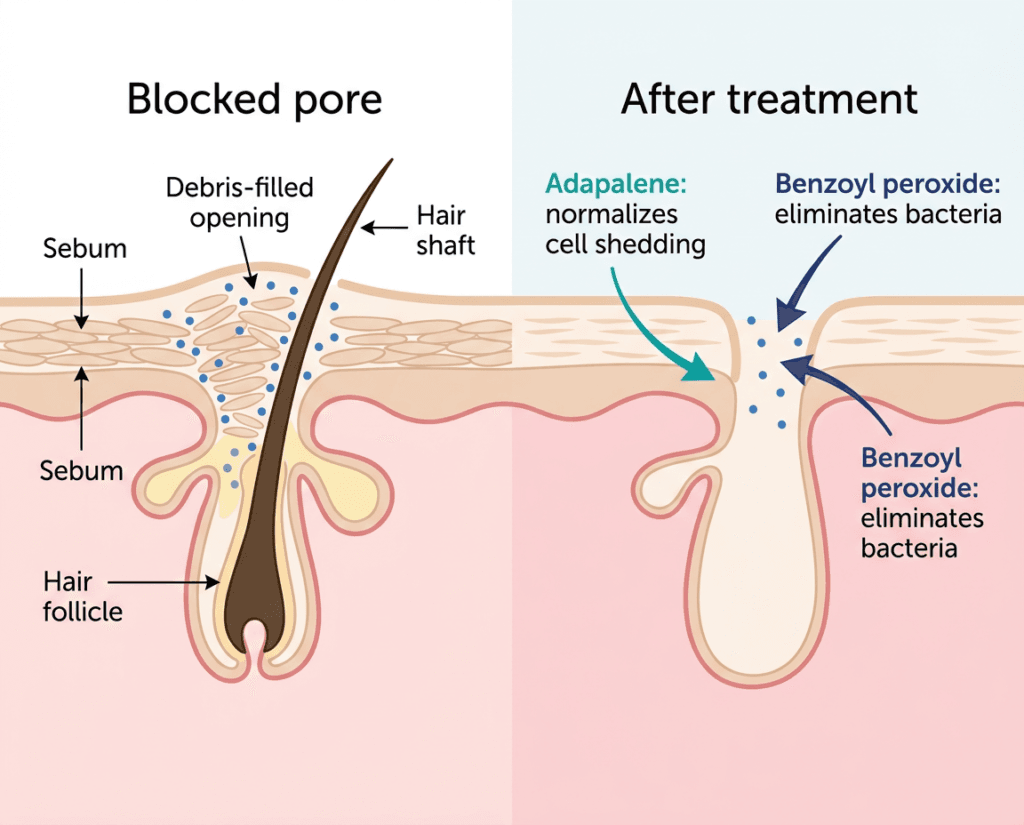
Follicular hyperkeratinization: Dead skin cells inside the hair follicle do not shed normally, causing the cells to accumulate and block the pore. This is what produces a comedone (clogged pore), which is the precursor to both whiteheads (closed comedones) and blackheads (open comedones).
Propionibacterium acnes (now reclassified as Cutibacterium acnes) overgrowth: The bacteria that live on skin and inside follicles proliferate in the sebum-rich, low-oxygen environment of a blocked pore, triggering inflammatory responses.
Inflammation: The immune system’s response to bacterial antigens inside the follicle produces the characteristic redness, swelling, and pain of inflammatory acne lesions (papules, pustules, nodules).
No single-ingredient product addresses all four of these processes. This is precisely why dermatology guidelines have long recommended combination therapy as the standard of care.
What adapalene does
Adapalene is a third-generation synthetic retinoid developed by Galderma specifically to address the stability and tolerability limitations of earlier topical retinoids like tretinoin. Unlike tretinoin, adapalene is photostable and chemically stable, which matters for formulation: it can be combined with other active ingredients (including benzoyl peroxide) in a single product without degrading.
Adapalene works at the cellular level by binding to specific retinoic acid receptors (RARs) in skin cells. By modulating gene expression in keratinocytes (the cells that line follicles), it normalizes the keratinization process, preventing the follicular plugging that leads to comedones. It also has direct anti-inflammatory activity. Adapalene is widely regarded as the best-tolerated topical retinoid available: it causes significantly less dryness, peeling, and redness than tretinoin at comparable efficacy, particularly early in treatment.
What benzoyl peroxide does
Benzoyl peroxide (BPO) is an oxidizing agent that releases free radicals in the skin, directly killing Cutibacterium acnes bacteria by degrading their cell membranes. It has been a cornerstone of acne therapy for decades. Critically, BPO does not cause bacterial resistance, unlike topical antibiotics such as clindamycin, where resistance has become a significant clinical problem. At 2.5%, the concentration in Differin Epiduo, research has shown comparable antibacterial efficacy to higher concentrations (5% and 10%) with a substantially better tolerability profile.
Why the combination outperforms either ingredient alone
The synergy between adapalene and BPO is mechanistic and well-documented. Adapalene normalizes follicular keratinization and reduces inflammation, creating a less obstructed skin environment. BPO eliminates the bacteria that drive inflammatory lesion development. Together, they address both the comedonal (non-inflammatory) and inflammatory components of acne through independent and complementary pathways.
In multiple randomized controlled trials comparing adapalene/BPO gel to adapalene monotherapy, BPO monotherapy, and vehicle gel, the combination consistently outperformed all three comparators on every efficacy measure: inflammatory lesions, noninflammatory lesions, total lesions, and IGA success rates. The combination also produced faster onset, with lesion reductions detectable as early as week 1 of treatment.
| What the Investigator Global Assessment (IGA) measures The Investigator Global Assessment is the standard five-point scale used in acne clinical trials to assess overall acne severity: 0 = clear, 1 = almost clear, 2 = mild, 3 = moderate, 4 = severe. In clinical trials, an “IGA success” is typically defined as achieving a score of 0 (clear) or 1 (almost clear) with at least a 2-grade improvement from baseline. For most patients entering trials at IGA 3 (moderate), IGA success means moving from moderate acne to clear or almost-clear skin. This endpoint captures what patients actually care about: overall appearance, not just lesion counts. The combination adapalene/BPO gel achieved higher IGA success rates in pivotal trials than adapalene or BPO alone. |
|---|
The Clinical Evidence: More Than 10 Trials and 3,200 Patients
The FDA’s approval of Differin Epiduo for OTC use is supported by one of the most extensive clinical evidence packages ever assembled for an acne product. Galderma cited more than ten Galderma-sponsored randomized controlled Phase 3 studies involving more than 3,200 patients, plus substantial third-party research, covering a wide range of ages, skin tones, and acne severity levels.
The core efficacy story from that dataset:
| Outcome | Result (adapalene/BPO vs. vehicle) |
|---|---|
| Inflammatory lesion reduction by week 12 | Up to 70.3% with combination vs. substantially lower with vehicle |
| Noninflammatory lesion reduction by week 12 | Significant superiority over both monotherapies and vehicle |
| IGA success rate (clear or almost clear) | Higher with combination than adapalene alone, BPO alone, or vehicle |
| Onset of efficacy | Detectable as early as week 1 |
| Durability | Sustained efficacy demonstrated through 12 months |
| Combination vs. adapalene alone | Superior on inflammatory lesions, IGA success, total lesion count |
| Combination vs. BPO alone | Superior on noninflammatory lesions, IGA success, total lesion count |
Source: Galderma Phase 3 clinical program. Thiboutot DM et al. J Am Acad Dermatol. 2007. Multiple published trials. Presented by Galderma at FDA NDA and OTC switch submissions.
The 70.3% reduction in inflammatory lesions at week 12 is a clinically significant number. Inflammatory lesions (papules, pustules) are the acne manifestations that cause pain, scarring risk, and the greatest psychosocial impact. Reducing them by nearly three-quarters over 12 weeks of once-daily application, at a concentration that is well tolerated, is what established this product as a first-line agent in dermatology practice.
The long-term data through 12 months is particularly relevant for the OTC setting, where sustained use without continued prescriber oversight is the norm. The evidence indicates that the efficacy is maintained over months of use, not just in the initial weeks.
Why Guideline-Concordant Acne Treatment Has Been Inaccessible
The American Academy of Dermatology (AAD) guidelines for acne and the Global Alliance to Improve Outcomes in Acne both recommend topical retinoid plus benzoyl peroxide combinations as a first-line, guideline-preferred approach for mild to moderate acne. Adapalene/BPO is specifically named in clinical guidelines as a preferred dual-active regimen.
Despite this guideline support, the combination has been behind the prescription barrier until now. This matters for several overlapping reasons.
Dermatologist access: An estimated one-third of Americans lack access to a dermatologist within a reasonable distance from their home. Rural and underserved urban areas are particularly affected. Patients in these areas have historically been limited to products available OTC, which until this approval did not include a retinoid/BPO combination at guideline-recommended concentrations.
Cost of care: A dermatology visit for acne, without insurance coverage, typically runs $100 to $250 for an initial consultation. For uninsured or underinsured adolescents and young adults, this is a significant barrier. Prescription co-pays for Epiduo with insurance have historically ranged widely, and without insurance, the prescription price could run over $200 per tube.
Prescription gap for patients who improve: Even patients who see a dermatologist and get a prescription face ongoing friction: refill appointments, pharmacy trips, and the possibility of insurance changes affecting coverage. OTC availability removes these recurring barriers for sustained use.
The skin tone gap in acne care: Post-inflammatory hyperpigmentation (PIH), the dark marks left after acne lesions resolve, is more prevalent and more severe in patients with darker skin tones. Adapalene has documented evidence of reducing PIH as part of its normalization of cell turnover, making consistent access to a retinoid-containing product particularly meaningful for patients with skin of color who experience this complication disproportionately.
The Prescription-to-OTC Switch Process: What the FDA Reviews
A prescription-to-OTC switch is not simply a label change. It requires a separate FDA regulatory review demonstrating that:
- The drug can be used safely and effectively by consumers without physician supervision
- The indication, dosing instructions, and labeling are understandable to lay consumers
- The drug’s benefits outweigh its risks in the self-use context
- Long-term safety data support unsupervised use
The FDA’s review of the Differin Epiduo OTC switch drew on more than 15 years of prescription use safety data, a global safety database including millions of prescriptions, and the consumer use clinical program. The approval for ages 12 and older reflects confidence that the product can be used safely and effectively by adolescents as well as adults in a self-directed context.
How to Use Differin Epiduo: What the Label Covers
Differin Epiduo Acne Gel is intended for once-daily use, applied as a thin layer to the entire acne-affected area, not just to individual spots. This is an important and commonly misunderstood instruction: spot-treating active lesions misses the comedonal component of acne developing just below the surface.
Key application instructions:
- Apply a thin layer to the affected area once daily in the evening, after washing and gently drying the skin
- Use your fingertips to apply a pea-sized amount for the entire face; a larger amount for the back, chest, or other areas
- Wash hands immediately after applying
- Allow to dry completely before applying moisturizer or other products on top
- Avoid contact with eyes, lips, and mucous membranes; if contact occurs, rinse thoroughly with water
What to expect:
Weeks 1 to 4 often bring a temporary “adjustment period” of mild skin dryness, redness, or peeling as the skin adapts to retinoid use. This is normal and typically resolves with continued use. Starting with every-other-day application for the first 1 to 2 weeks can reduce early irritation.
Sun protection: Adapalene-containing products increase photosensitivity. Use broad-spectrum SPF 30 or higher sunscreen daily during treatment and limit sun exposure. Do not apply immediately before sun exposure.
Moisturizer: Using a non-comedogenic moisturizer daily helps manage dryness and improve tolerability, especially during the adjustment period.
Warnings and who should not use it
- Do not use if you are allergic to adapalene or benzoyl peroxide
- Avoid contact with bleachable fabrics (towels, pillowcases, clothing): benzoyl peroxide bleaches fabric
- Discontinue and consult a healthcare provider if severe irritation, allergic reaction, or significant worsening occurs
- Pregnancy: adapalene is in FDA pregnancy category C for topical use. Animal data suggests potential risk. The systemic absorption from topical application is minimal, but out of an abundance of caution, consult a healthcare provider before use during pregnancy or breastfeeding
- For the youngest eligible users (ages 12 to 15): a parent or guardian should supervise initial use to ensure correct application technique and sun protection compliance
Where Differin Epiduo Fits in the OTC Acne Landscape
Until this approval, the OTC landscape for combination acne therapy was limited. Here is how Differin Epiduo compares to what was already available:
| OTC product type | Active ingredients | Mechanism | Guideline status |
|---|---|---|---|
| Benzoyl peroxide alone (2.5%, 5%, 10%) | BPO | Antimicrobial | Guideline-recommended; available OTC for decades |
| Salicylic acid (0.5% to 2%) | Beta-hydroxy acid | Mild keratolytic | Useful for mild comedonal acne; less evidence for inflammatory lesions |
| Adapalene 0.1% gel (Differin) | Adapalene | Retinoid | Guideline-recommended; OTC since 2016 |
| Differin Epiduo Acne Gel (new) | Adapalene 0.1% plus BPO 2.5% | Retinoid plus antimicrobial | Guideline-recommended first-line combination; now OTC |
The arrival of the combination gel completes the adapalene-based OTC acne care ladder: monotherapy adapalene 0.1% for mild comedonal acne, combination adapalene/BPO 0.1/2.5% for mild to moderate inflammatory and mixed acne, and a dermatologist pathway for severe, nodular, or treatment-resistant disease.
For Patients: Practical Guidance
This product is appropriate for:
- Adults and adolescents aged 12 and older with mild to moderate acne, including both inflammatory (red, swollen pimples) and non-inflammatory (blackheads, whiteheads) lesions
- People who have not had success with single-ingredient products
- People who previously used Epiduo by prescription and want to continue without the prescription barrier
- People who want a guideline-concordant first-line treatment without a clinic visit
This product is not appropriate as a standalone treatment for:
- Nodular or cystic acne (large, deep, painful lesions), which requires dermatologist care
- Severe acne with significant scarring risk
- Acne unresponsive to OTC treatment after 12 weeks of consistent use
When to see a dermatologist: If your acne has not improved after 12 weeks of consistent daily use, if you develop nodules or cysts, if you have significant post-inflammatory dark marks (hyperpigmentation) that are not improving, or if your acne is causing significant psychological distress, a dermatology consultation is appropriate. The AAD’s Find a Dermatologist tool can help locate a board-certified dermatologist. For those with limited access to in-person care, several telehealth dermatology platforms provide prescription acne treatment via video or asynchronous consultation.
For a related HED post covering the icotrokinra (ICOTYDE) approval as another step toward effective skin condition treatment options, see our post on the first oral IL-23 receptor blocker for psoriasis.
Sources
FDA approval news: FDA Approves Differin Epiduo Acne Gel (adapalene/benzoyl peroxide) for Nonprescription Use in the Treatment of Acne. Drugs.com. May 24, 2026.
Galderma press release: Galderma Receives U.S. FDA Approval for Differin Epiduo Acne Gel Prescription-to-OTC Switch. businesswire.com. May 22, 2026.
Galderma website announcement: Galderma Receives U.S. FDA Approval for Differin Epiduo Acne Gel Prescription-to-OTC Switch. galderma.com. May 22, 2026.
Practical Dermatology clinical coverage: FDA Approves OTC Switch for Galderma’s Differin Epiduo Acne Gel. practicaldermatology.com. May 2026.
The Dermatology Digest clinical coverage: US FDA Approves Prescription-to-OTC Switch for Differin Epiduo Acne Gel. thedermdigest.com. May 2026.
Drugs.com approval history: Differin Epiduo Acne Gel FDA Approval History. drugs.com.
Pivotal combination trial (JAAD 2007): Thiboutot DM et al. Adapalene-benzoyl peroxide, a fixed-dose combination for the treatment of acne vulgaris: Results of a multicenter, randomized double-blind, controlled study. J Am Acad Dermatol. 2007.
AAD acne guidelines: American Academy of Dermatology. Guidelines of care for the management of acne vulgaris. aad.org.
Acne biology and pathophysiology: Acne Vulgaris. StatPearls. NCBI.
Adapalene mechanism: Adapalene. StatPearls. NCBI.
Benzoyl peroxide mechanism: Benzoyl Peroxide. StatPearls. NCBI.
Retinoid receptor biology: Retinoids in Dermatology. PMC4756869.
IGA scale validation: Investigator Global Assessment in Acne. PMC5300780.
Global Alliance acne guidelines: Global Alliance to Improve Outcomes in Acne. PMC7374761.
Patient resources: AAD: What Is Acne? | AAD Find a Dermatologist | National Eczema Association (for skin barrier support)
| Disclaimer: Health Evidence Digest provides general information about FDA approvals and health research for educational purposes. This content is not a substitute for professional medical advice, diagnosis, or treatment. Patients with severe, nodular, or cystic acne, those who are pregnant or breastfeeding, and those whose acne does not respond to OTC treatment after 12 weeks should consult a board-certified dermatologist. |
|---|
Leave a Reply