
| The essentials: On September 11, 2026, the FDA approved Isembyld (apitegromab-mstn, Scholar Rock) for the treatment of spinal muscular atrophy (SMA) in adults and pediatric patients aged 2 years and older who are currently receiving a survival motor neuron 2 (SMN2)-targeted treatment. The approval came 19 days before the PDUFA action date of September 30, 2026. Isembyld is the first and only FDA-approved therapy designed to directly target muscle loss in SMA, complementing the existing neuron-directed standard of care. Prior SMA-approved therapies (nusinersen, onasemnogene abeparvovec, risdiplam) all address the underlying SMN protein deficiency or the motor neuron defect. Isembyld works at a completely different level: it inhibits myostatin, a natural suppressor of muscle growth, allowing surviving muscle to grow stronger and function better despite the ongoing motor neuron disease. What apitegromab is: a fully human monoclonal IgG4 antibody that selectively binds promyostatin and latent myostatin and inhibits their activation, preventing myostatin from suppressing muscle growth. Dosing: 20 mg/kg IV infusion once every 4 weeks. The clinical basis: Phase 3 SAPPHIRE trial (NCT05156320), 188 patients with nonambulatory SMA types 2 and 3, aged 2 to 21 years, all receiving background SMN-targeted therapy (nusinersen or risdiplam). Randomized to apitegromab 10 or 20 mg/kg or placebo IV every 4 weeks for 52 weeks. Primary endpoint: change from baseline in Hammersmith Functional Motor Scale Expanded (HFMSE) at week 52. Result: mean difference in HFMSE of 1.8 points (p=0.0192) in favor of combined apitegromab groups versus placebo (n=50). Early effect observed at 8 weeks. 30.4% of apitegromab patients had at least 3-point HFMSE improvement versus 12.5% on placebo (p=0.0156). Published in The Lancet Neurology, August 2025. ONYX open-label extension: 98% of SAPPHIRE patients (185 of 188) enrolled; 48-month data show sustained HFMSE improvement. Regulatory path: original PDUFA September 22, 2025. FDA issued a Complete Response Letter in September 2025 due to manufacturing deficiencies at the fill-finish facility (Catalent Indiana), not due to efficacy or safety concerns. Scholar Rock resubmitted in March 2026 using a second fill-finish facility. Regulatory designations: Breakthrough Therapy Designation; Orphan Drug Designation; Priority Review. |
|---|
SMA is a disease of two simultaneous failures. The first is well understood and has been addressed: motor neurons in the spinal cord degenerate because of insufficient survival motor neuron (SMN) protein production, caused by loss-of-function mutations in the SMN1 gene. Three approved therapies directly address this failure, and they have fundamentally changed what SMA means for children diagnosed today.
The second failure is less well-known outside specialist circles but is equally real: even in patients receiving effective SMN-directed therapy, the muscles that have been denervated or weakened by years of motor neuron disease cannot fully recover on their own. The motor neuron problem can be corrected; the muscle problem remains. Patients on nusinersen, risdiplam, or onasemnogene abeparvovec still frequently experience residual weakness and functional limitations because the surviving muscle is not growing and strengthening as it should.
Isembyld (apitegromab-mstn, Scholar Rock) addresses the second failure. By inhibiting myostatin, the body’s natural brake on muscle growth, it unlocks the potential of the surviving muscle that SMN-directed therapies have preserved. This is not a replacement for nusinersen or risdiplam. It is a complementary layer of therapy that addresses what those drugs, by design, cannot.
The SAPPHIRE trial enrolled patients already receiving SMN-targeted therapy and asked whether adding apitegromab on top produces additional motor function benefit. The primary endpoint showed a statistically significant 1.8-point HFMSE improvement over placebo. The trial result is not dramatic in its raw score, but the clinical context is: it was achieved in patients already on effective background therapy, in whom further improvement without additional intervention would not be expected.
What Spinal Muscular Atrophy Is: The Neuron Problem and the Muscle Problem
Spinal muscular atrophy is caused by biallelic loss-of-function variants in the SMN1 gene, which encodes survival motor neuron protein. SMN protein is critical for the survival and function of lower motor neurons in the anterior horn of the spinal cord. Without adequate SMN, these neurons degenerate progressively, severing the connection between the nervous system and the skeletal muscles they innervate.
The clinical result is progressive muscle weakness and wasting. SMA presents across a wide spectrum of severity, historically classified by the age of onset and the highest motor milestone achieved:
SMA type 1 (Werdnig-Hoffmann disease) is the most severe form, presenting before 6 months of age. Without treatment, most affected infants never achieve the ability to sit and die before age 2 from respiratory failure. Type 2 (Dubowitz disease) presents between 6 and 18 months; children can sit independently but never walk. Type 3 (Kugelberg-Welander disease) presents after 18 months; children walk but may lose that ability over time. Type 4 is adult-onset and milder.
The human genome contains a near-identical backup gene, SMN2, which produces a small amount of functional SMN protein (approximately 10 to 15%). The number of SMN2 copies a patient carries correlates with disease severity. The three approved SMN-directed therapies work by increasing SMN protein production from SMN2 (nusinersen via antisense oligonucleotide, risdiplam via splicing modifier) or by replacing the defective SMN1 gene entirely (onasemnogene abeparvovec via AAV9-delivered gene replacement).
These therapies have been transformative. Children diagnosed today with the most severe SMA types, who would previously have died or been severely disabled by age 2, are now surviving and achieving motor milestones that were unimaginable before 2016. Yet many patients receiving these therapies continue to experience meaningful motor limitations, because the muscles that were denervated before treatment began, or that have been partially maintained but not fully innervated, cannot recover strength and function through neuronal therapy alone. Muscle atrophy, once established, does not reverse with SMN restoration. It requires its own therapeutic intervention.
What Myostatin Is and Why Inhibiting It Helps SMA
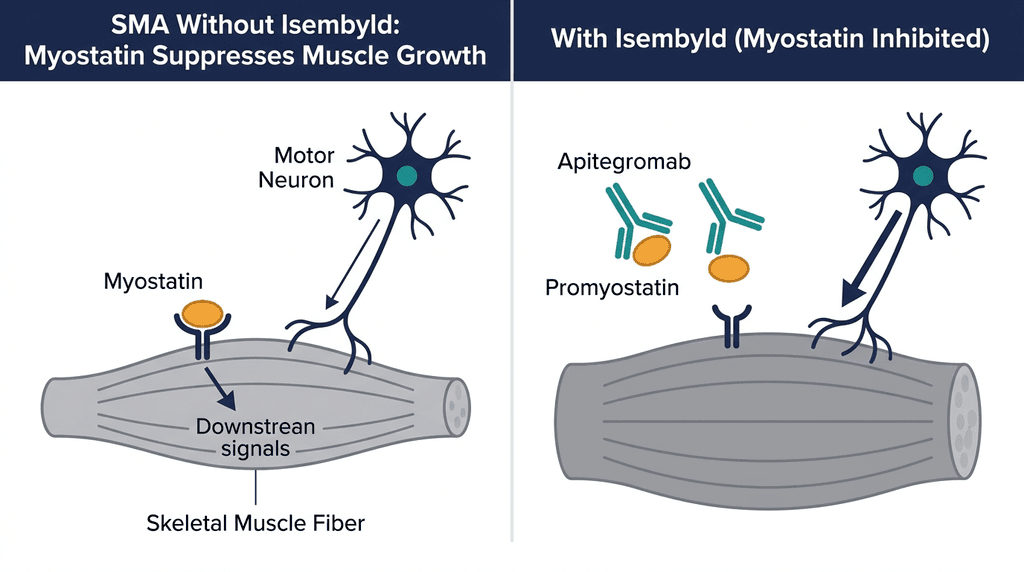
Myostatin (GDF-8) is a member of the TGF-beta superfamily produced primarily by skeletal muscle. Its physiological role is to limit muscle growth: it acts as a negative regulator that prevents muscles from growing too large. Myostatin exerts this effect by binding to activin receptor type IIB (ActRIIB) on muscle cells and activating downstream signaling that suppresses satellite cell proliferation and differentiation, the processes by which muscle repairs and grows.
In healthy individuals, myostatin sets an upper limit on muscle mass. In patients with SMA, where muscles are already weakened and atrophied from denervation, this upper limit becomes a barrier: myostatin is actively suppressing the growth potential of muscles that are already fighting to maintain function with reduced motor neuron input. Inhibiting myostatin in this context removes that brake, allowing the remaining viable muscle tissue to grow stronger and to sustain greater functional output.
Apitegromab binds specifically to promyostatin and latent myostatin, the inactive precursor forms of the protein, rather than to activated mature myostatin or to the activin receptor. This selectivity is pharmacologically important. By intercepting myostatin before it becomes active, apitegromab prevents the activation step that would otherwise engage the ActRIIB receptor and initiate the downstream suppression cascade. Because it targets the precursor forms rather than the receptor, it avoids the off-target effects on other TGF-beta family members (including activin A, GDF-11, and others that also signal through ActRIIB) that have been associated with non-selective ActRIIB inhibitors.
This selectivity for proforms of myostatin specifically is the pharmacological rationale for apitegromab’s favorable safety profile. The mechanism is muscle-directed, it is targeted to the upstream step before activation, and it spares the broader TGF-beta signaling that non-selective receptor blockers affect.
The SAPPHIRE Trial: Complete Data
Design
SAPPHIRE (NCT05156320) was a Phase 3, randomized, double-blind, global, placebo-controlled trial enrolling 188 patients with nonambulatory SMA types 2 and 3 aged 2 to 21 years, all receiving ongoing background SMN-targeted therapy (nusinersen or risdiplam). The trial had two age cohorts with different randomization ratios: patients aged 2 to 12 years were randomized 1:1:1 to apitegromab 10 mg/kg, 20 mg/kg, or placebo IV every 4 weeks; patients aged 13 to 21 years were randomized 2:1 to apitegromab 20 mg/kg or placebo. The primary analysis pooled the nonambulatory cohorts and compared combined apitegromab groups versus placebo.
The primary endpoint was change from baseline in HFMSE at 52 weeks. The HFMSE is the gold-standard validated scale for measuring motor function in nonambulatory SMA patients, covering gross motor abilities such as sitting, rolling, and upper limb function. A clinically meaningful change is generally considered to be 3 or more points.
Published in The Lancet Neurology in August 2025, the full trial data support the FDA approval.
Results at week 52
| Endpoint | Apitegromab | Placebo (n=50) | Result |
|---|---|---|---|
| Mean change in HFMSE from baseline (primary) | Combined groups | Reference | Mean difference 1.8 points; p=0.0192 |
| Patients with at least 3-point HFMSE improvement | 30.4% | 12.5% | p=0.0156 |
| Patients with at least 4-point HFMSE improvement | 19.6% | 6.3% | Favored apitegromab |
| Earliest significant effect | Week 8 | — | Earliest time point measured |
| RULM (upper limb function) | Consistent improvement | Reference | Positive trend |
| WHO motor development milestones | Positive trends | Reference | Consistent with HFMSE |
| Patients enrolling in ONYX extension | 185 of 188 (98%) | — | High continuation rate |
Sources: Scholar Rock SAPPHIRE topline press release. October 2024. Lancet Neurology publication. August 2025. MDA Conference 2026 poster. NCT05156320.
The 1.8-point mean HFMSE difference at 52 weeks is the primary result and requires context to be properly understood. In a patient already receiving effective SMN-directed therapy, a placebo group on the same background therapy represents the best available standard of care at the time of the trial. Any improvement in the apitegromab arm represents benefit above and beyond what the current standard of care provides. Given that patients were already suppressing disease progression through SMN therapy, adding additional motor function gain on top of that is clinically meaningful.
The responder analysis sharpens the picture: 30.4% of apitegromab patients achieved a clinically meaningful 3-point or greater HFMSE improvement, compared with 12.5% in the placebo group. Nearly 1 in 5 apitegromab patients achieved a 4-point or greater improvement versus fewer than 1 in 14 on placebo. These are patients who gained meaningful functional ability they did not have before treatment.
The effect appeared at week 8, the first assessed time point, and was sustained and expanded through week 52. The 48-month ONYX open-label extension data further demonstrate durability: for the 2-to-21 age group with nonambulatory SMA receiving apitegromab 20 mg/kg plus nusinersen, mean HFMSE change was 5.3 points (95% CI 1.5 to 9.2) at 48 months. For children aged 2 to 12, the effect was 6.4 points (95% CI 1.8 to 11.0). These are sustained, clinically meaningful gains over 4 years of treatment.
The Regulatory Path: CRL, Resubmission, and Early Approval
The Isembyld approval arrived after a significant and frustrating detour. The original PDUFA action date was September 22, 2025. In September 2025, the FDA issued a Complete Response Letter citing manufacturing deficiencies at Scholar Rock’s fill-finish contractor, Catalent Indiana (subsequently acquired by Novo Nordisk). The CRL was not related to efficacy or safety concerns. No new clinical data were requested. The drug worked; the manufacturing site had issues.
This kind of manufacturing CRL, while clinically frustrating, is not uncommon for complex biologic therapies. Scholar Rock responded by qualifying a second fill-finish facility, resubmitting the BLA in March 2026, and ultimately withdrawing from the Catalent Indiana site following additional inspection complications in spring 2026. The resubmission used the new facility for commercial supply, which was fully prepared before approval. Scholar Rock announced that product shipments would begin within days of the September 11, 2026 approval.
The European application was separately withdrawn in August 2026 due to the same manufacturing complications, with plans to refile using the backup facility. The U.S. approval therefore precedes European approval, which is expected to follow once the European filing is completed.
Isembyld in the Full SMA Treatment Landscape
SMA treatment has been transformed over the past decade. Understanding where Isembyld fits requires understanding what the existing approved therapies do and what they do not.
| Therapy | Mechanism | Target | Route | Age approved |
|---|---|---|---|---|
| Spinraza (nusinersen) | ASO splicing modifier; increases SMN2-derived full-length SMN protein | Motor neuron (SMN protein) | Intrathecal injection every 4 months (maintenance) | All ages |
| Zolgensma (onasemnogene abeparvovec) | AAV9 gene replacement; delivers functional SMN1 gene | Motor neuron (gene level) | Single IV infusion | Under 2 years |
| Evrysdi (risdiplam) | Small molecule SMN2 splicing modifier | Motor neuron (SMN protein) | Oral daily | 2 months and older |
| Isembyld (apitegromab) | Myostatin inhibitor; reduces suppression of muscle growth | Skeletal muscle | IV infusion every 4 weeks | 2 years and older, on SMN therapy |
Each of the first three addresses the neuronal defect at different levels. Isembyld addresses the muscle defect. The key phrase in its indication is “who are currently receiving a survival motor neuron 2 (SMN2)-targeted treatment.” It is not approved as a standalone therapy. It is approved as an add-on to nusinersen or risdiplam, specifically to address the muscle component that those drugs cannot reach.
This complementary positioning reflects the biological rationale: fixing the SMN protein deficiency stabilizes or slows motor neuron loss, but does not restore the atrophied muscle. Inhibiting myostatin provides the muscle environment with greater capacity to grow and recover, maximizing the functional benefit of whatever motor neuron signaling remains or has been restored by SMN therapy.
For related HED coverage on SMA and antisense oligonucleotide therapy, see our post on Zanvastro (zilganersen) receiving FDA approval as the first treatment for Alexander disease, which covers the ASO platform used in both nusinersen and zilganersen in detail. For a parallel story of a first-ever rare pediatric disease approval, see our post on Genglycos (pariglasgene brecaparvovec) for glycogen storage disease type Ia.
Safety: What the SAPPHIRE Data Shows
The safety profile of apitegromab in SAPPHIRE was favorable and consistent with its mechanism. Treatment was well tolerated across all age groups, with no clinically relevant differences in the adverse event profile between the 10 mg/kg and 20 mg/kg doses.
Treatment-emergent adverse events in the trial were mild to moderate in severity and were generally consistent with the underlying patient population receiving chronic SMA therapy and IV infusions. No serious adverse events were linked to the drug itself in the pivotal trial.
The most common adverse reactions in SAPPHIRE included nasopharyngitis, upper respiratory tract infections, pyrexia, and injection-related reactions. These are predominantly consistent with the patient population’s general health profile and the IV infusion route rather than being drug-specific toxicities.
Because apitegromab targets the promyostatin and latent myostatin forms selectively rather than blocking the activin receptor broadly, the theoretical off-target effects that have affected non-selective myostatin pathway inhibitors (including reproductive effects, cardiovascular effects, and effects on other TGF-beta family members) were not observed. The selectivity of the mechanism appears to translate into a clean safety profile consistent with the muscle-specific pharmacology.
Isembyld is administered as a 20 mg/kg IV infusion once every 4 weeks by a healthcare provider. Each infusion visit requires standard monitoring for infusion reactions, but the drug does not require the intrathecal injection procedures associated with nusinersen, and it is compatible with concurrent oral risdiplam therapy.
What This Means for Neuromuscular Specialists and SMA Families
For neuromuscular disease specialists and pediatric neurologists
Isembyld provides the first approved option to address the muscle component of SMA in patients who are already on optimal SMN-directed therapy. For the many patients on nusinersen or risdiplam who continue to experience residual weakness and functional limitation, adding apitegromab every 4 weeks now has FDA-approved evidence behind it.
The SAPPHIRE population was specifically nonambulatory SMA types 2 and 3, aged 2 to 21. The approved indication extends to adults as well, reflecting the inclusion of the 13-to-21 age cohort in the trial and the expectation that the muscle-targeting mechanism is relevant across the lifespan. Whether the benefit extends to ambulatory type 3 patients or to very young patients newly starting SMN therapy is not yet established from the pivotal data but represents an area of active investigation.
The intravenous every-4-week dosing adds a clinic visit burden on top of whatever background SMN therapy schedule the patient is already following. For patients on nusinersen (quarterly intrathecal injections) combined with monthly Isembyld infusions, the visit frequency is substantial. For patients on oral risdiplam, the IV infusion schedule is the primary clinic commitment. This practical consideration belongs in the shared decision-making conversation.
For SMA families
If your child is 2 years or older and is currently receiving nusinersen or risdiplam for SMA, Isembyld is now an FDA-approved option to discuss with your neuromuscular disease specialist. It is given as an IV infusion once a month and is designed to help the muscles that remain stronger despite the underlying neurological disease.
The SAPPHIRE data showed that patients on apitegromab plus their existing SMA therapy gained measurable motor function improvement beyond what their existing therapy alone provided. More than 30% of apitegromab-treated patients achieved clinically meaningful functional gains (at least 3 points on the motor scale used in the trial) compared with 12.5% of those on background therapy alone.
Scholar Rock has established a patient support program and commercial supply is available immediately following the September 11 approval. Information is available through the Isembyld website.
The Cure SMA (curesma.org; 1-800-886-1762) and Muscular Dystrophy Association (mda.org; 1-800-572-1717) are the primary patient advocacy organizations for SMA and maintain current resources on treatment options, clinical trials, and family support.
Sources
FDA approval announcement: FDA approves apitegromab for spinal muscular atrophy. FDA.gov. September 11, 2026.
Scholar Rock approval press release: Scholar Rock Announces FDA Approval of ISEMBYLD (apitegromab-mstn), the First and Only Muscle-Targeted Treatment for Children and Adults with SMA. BusinessWire. September 11, 2026.
Drugs.com approval news: FDA Approves Isembyld (apitegromab-mstn) for Spinal Muscular Atrophy. drugs.com. September 11, 2026.
STAT News (first muscle-targeted SMA therapy framing, manufacturing CRL context, Catalent Indiana drop): Scholar Rock wins FDA approval for first drug to target SMA muscle loss. statnews.com. September 11, 2026.
NeurologyLive (mechanism, SAPPHIRE data, approval details, selectivity for proforms): FDA Approves Apitegromab for Spinal Muscular Atrophy. neurologylive.com. September 11, 2026.
Muscular Dystrophy Association (MDA) statement: FDA Approves Isembyld, First and Only Muscle-Targeted Therapy for SMA. mda.org. September 11, 2026.
Scholar Rock SAPPHIRE primary endpoint announcement: Scholar Rock Reports Apitegromab Meets Primary Endpoint in Phase 3 SAPPHIRE Study. investors.scholarrock.com. October 2024.
SAPPHIRE Lancet Neurology publication announcement: Pivotal SAPPHIRE Trial Data Published in The Lancet Neurology. businesswire.com. August 2025.
AJMC SAPPHIRE clinical data summary: Muscle-Directed Therapy Apitegromab Meets Primary End Point in Phase 3 SAPPHIRE Trial. ajmc.com.
NeurologyLive SAPPHIRE 48-month TOPAZ data (RULM ONYX extension): Newly Published Phase 3 SAPPHIRE Study Highlights Therapeutic Potential of Apitegromab in SMA. neurologylive.com.
MDA 2026 Clinical Conference abstract (Type 2/3 subgroup, HFMSE 1.8 points exact, full endpoint table): Efficacy and safety of apitegromab in individuals with Type 2 and Type 3 SMA evaluated in the SAPPHIRE trial. mdaconference.org. 2026.
MDA 2025 Conference data (30.4% vs 12.5% responder analysis; RULM; WHO milestones): Scholar Rock Presents New Phase 3 SAPPHIRE Data at the 2025 MDA Clinical and Scientific Conference. investors.scholarrock.com.
CRL context (September 2025, Catalent Indiana manufacturing): Apitegromab history and CRL background. drugs.com.
Archyde (CRL detail, resubmission March 2026, EU withdrawal August 2026, immediate shipment): FDA Approves Isembyld: First Therapy to Target Muscle Loss in SMA. archyde.com. September 2026.
Myostatin biology: Myostatin and Skeletal Muscle Growth Regulation. PMC4535665.
SMA overview: Spinal Muscular Atrophy. GeneReviews. NCBI.
SAPPHIRE trial registration: NCT05156320. ClinicalTrials.gov.
Isembyld prescribing information: ISEMBYLD (apitegromab-mstn) Prescribing Information. Scholar Rock. 2026.
Isembyld approval history: Isembyld FDA Approval History. drugs.com.
Patient resources: Cure SMA: 1-800-886-1762 | Muscular Dystrophy Association: 1-800-572-1717 | Scholar Rock Isembyld patient support
| Disclaimer: Health Evidence Digest provides general information about FDA approvals and health research for educational purposes. This content is not a substitute for professional medical advice. Isembyld (apitegromab-mstn) is indicated for patients 2 years and older who are currently receiving an SMN2-targeted treatment; it is not approved as a standalone SMA therapy. Treatment decisions for SMA should be made in close collaboration with a board-certified pediatric neurologist or neuromuscular disease specialist with expertise in SMA management. |
|---|
Leave a Reply