
| The essentials: On September 3, 2026, the FDA approved Zanvastro (zilganersen, Ionis Pharmaceuticals) for the treatment of Alexander disease (AxD) in pediatric and adult patients. The approval came more than two weeks before the September 22, 2026 PDUFA target date. Zanvastro is the first and only FDA-approved disease-modifying treatment for Alexander disease, a condition for which management had been limited exclusively to symptom control. It is also the first therapy to directly target the protein buildup that drives the disease. What Alexander disease is: an ultra-rare, progressive, and often fatal neurological disorder caused by gain-of-function mutations in the GFAP gene, which encodes glial fibrillary acidic protein. The abnormal GFAP protein misfolds and accumulates in astrocytes in the brain and spinal cord, forming protein aggregates called Rosenthal fibers that destroy white matter and progressively impair neurological function. The disease affects motor function, cognition, autonomic function, and the gastrointestinal system. What zilganersen is: an antisense oligonucleotide (ASO) that reduces the production of GFAP protein by targeting GFAP messenger RNA before it can be translated into protein. With less GFAP being produced, accumulation slows and further damage is reduced. It is administered by intrathecal injection (injection into the spinal canal) by a trained healthcare professional every 3 months. Dose: 50 mg intrathecally every 12 weeks. The clinical basis: Phase 3 portion of a multicenter, randomized, controlled pivotal study (NCT04849741), 49 pediatric and adult patients aged 2 years and older, plus an open-label substudy of 4 patients under age 2. In patients aged 5 and older with measurable difficulty walking at baseline: statistically significant stabilization of gait speed on the 10-Meter Walk Test at week 61 versus untreated controls; least squares mean difference of approximately 33.3% in favor of zilganersen (p=0.041). The control group showed a 33% decline in gait speed over the same period. In children aged 2 to 4: broader motor skills assessment used; treated children improved while the control group declined. Under age 2: direct controlled data limited; pharmacokinetic modeling supports expected drug levels similar to older children at the same dose; 4 patients treated in the study without new safety signals. Blood biomarker data confirmed target engagement: GFAP levels in blood were reduced in treated patients, providing objective evidence of drug activity. Regulatory designations: Priority Review; Fast Track Designation; Orphan Drug Designation (FDA and EMA); Rare Pediatric Disease Designation. A Rare Pediatric Disease Priority Review Voucher was awarded in conjunction with this approval. Ionis has licensed ex-U.S. rights to Recordati. U.S. commercial launch expected within weeks of approval. U.S. patient population estimate: approximately 300. |
|---|
Alexander disease is named for William Stuart Alexander, the New Zealand pathologist who described it in 1949. For the 77 years that followed, the name was essentially a prognosis: progressive neurological deterioration, no therapy, no path except toward disability and, in most patients, premature death. The disease is rare enough that most physicians never see a case. But for the families who live with it, the rarity is not a comfort.
Now there is a treatment.
Zanvastro (zilganersen, Ionis Pharmaceuticals) is the first FDA-approved therapy for Alexander disease. It does not cure the condition. It does not dissolve the protein aggregates already present in the brain. What it does is reduce the production of the abnormal GFAP protein that drives the disease, slowing the accumulation of damage and, in the Phase 3 trial, stabilizing walking ability in patients who were already showing motor decline.
The pivotal data are striking in their clinical clarity. In patients aged 5 and older with measurable gait difficulty at baseline, the control group lost 33% of their walking speed over 61 weeks. Patients receiving zilganersen held steady. For children aged 2 to 4, the treated group improved while controls declined. These are not subtle statistical signals in a large population. They are directionally unambiguous results in one of the smallest possible patient groups, and they were enough to earn FDA approval more than two weeks ahead of schedule.
What Alexander Disease Is: GFAP, Astrocytes, and the Collapse of White Matter
Alexander disease is a leukodystrophy, a class of disorders characterized by progressive destruction of myelin and white matter in the brain. It is caused by heterozygous gain-of-function mutations in the GFAP gene, which encodes glial fibrillary acidic protein, a structural protein expressed primarily in astrocytes.
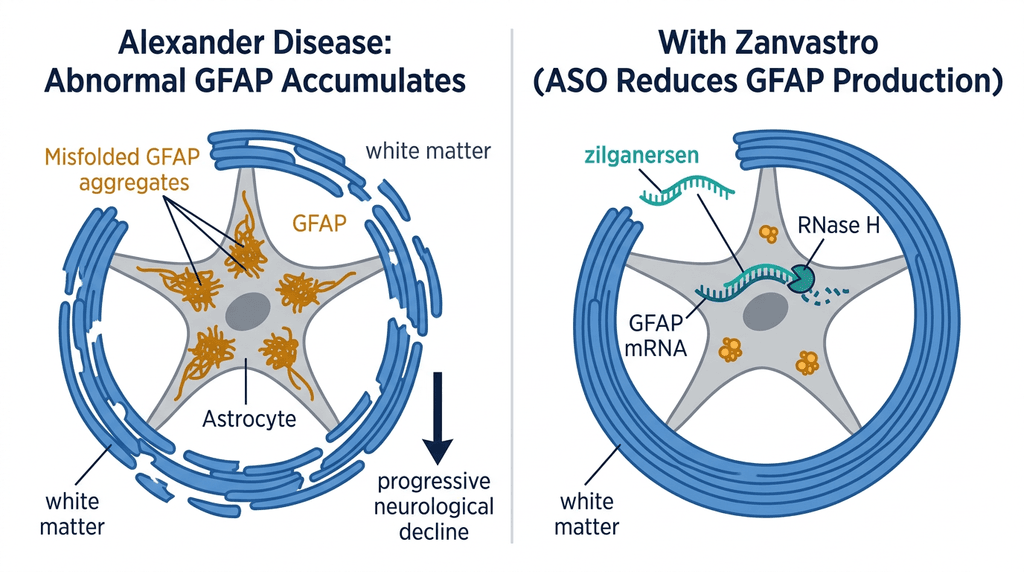
Astrocytes are the most abundant cells in the central nervous system. They perform a wide range of critical functions: they maintain the blood-brain barrier, regulate synaptic neurotransmission, support neuronal metabolism, and play a central role in the structural integrity of white matter. In Alexander disease, the mutant GFAP protein cannot fold correctly. Rather than functioning normally, it misfolds and aggregates inside astrocytes, forming the protein inclusions known as Rosenthal fibers, the pathological hallmark of the disease.
Rosenthal fibers progressively overwhelm and destroy the astrocytes that contain them. As those astrocytes die, the white matter loses the support structure it needs to maintain myelin. White matter volume falls. Axonal connectivity breaks down. The clinical consequences reflect which brain regions are most affected at any given stage.
The disease most commonly presents in two forms. The infantile and juvenile forms typically involve a mutation that causes early, aggressive white matter loss concentrated in the frontal lobes, producing macrocephaly (abnormally large head circumference, from the accumulating pathology), seizures, progressive spasticity, and intellectual disability. This form is often fatal in childhood. The adolescent and adult forms tend to follow a slower progression, with more prominent involvement of the brainstem and spinal cord, producing ataxia, bulbar symptoms (difficulty swallowing and speaking), progressive limb weakness, and autonomic dysfunction including bowel and bladder problems. Gastroesophageal symptoms, including reflux and vomiting, are also common and significantly affect quality of life.
GFAP mutations are autosomal dominant but almost always arise de novo, meaning they are new mutations in the child rather than inherited from a parent. This is why Alexander disease occurs across all ethnic and racial groups without clustering in specific family lines.
Ionis estimates approximately 300 people in the United States have Alexander disease. Globally, case series suggest a few thousand affected individuals, but because the diagnosis requires genetic testing or brain MRI with specific features, many cases go undiagnosed or are misattributed to other neurological conditions.
Why GFAP Is the Right Target and How ASO Therapy Reaches It
The rationale for targeting GFAP in Alexander disease is straightforward. The disease is caused by too much abnormal GFAP protein accumulating in astrocytes. Reducing how much GFAP protein is produced reduces the rate of accumulation, slowing disease progression.
Antisense oligonucleotide (ASO) therapy uses short synthetic strands of nucleic acid designed to bind to specific messenger RNA sequences in a complementary fashion. When an ASO binds to its target mRNA, it recruits the enzyme RNase H, which degrades the mRNA before it can be translated into protein. Less mRNA survives to produce protein, so total protein output falls.
Zilganersen is a chemically modified ASO designed to bind specifically to GFAP mRNA. After administration, it enters the astrocytes of the CNS, binds to GFAP mRNA, triggers its degradation, and reduces GFAP protein production. With less mutant GFAP being made, the rate at which Rosenthal fibers form and accumulate in astrocytes decreases. The progression of white matter destruction slows.
The administration route, intrathecal injection into the spinal canal, is essential to the drug’s mechanism. Because the blood-brain barrier prevents most large molecules from entering the brain from the circulation, zilganersen must be delivered directly to the cerebrospinal fluid, from which it distributes throughout the CNS and reaches the astrocytes that express GFAP. The quarterly injection schedule reflects the long duration of action of ASO molecules in the CNS, where they remain pharmacologically active for weeks to months after a single dose.
The same ASO platform that Ionis used for zilganersen has produced approved therapies for other rare neurological diseases, including nusinersen (Spinraza) for spinal muscular atrophy and tofersen (Qalsody) for ALS with SOD1 mutations. The platform’s track record in rare neurological disease informed the regulatory approach to Alexander disease, where the small patient population makes large-scale randomized trials impossible.
The Pivotal Trial: What the Data Shows
Design
The pivotal study (NCT04849741) was a multicenter, randomized, controlled trial evaluating zilganersen 50 mg by intrathecal injection every 12 weeks in patients with Alexander disease aged 2 years and older. The main randomized controlled portion enrolled 49 patients. An additional open-label substudy enrolled 4 patients under the age of 2. The trial was conducted across multiple sites given the extreme rarity of the patient population.
Efficacy was assessed differently by age group, reflecting developmental stage and the availability of validated measurement tools:
Patients aged 5 and older with measurable difficulty walking at baseline: the primary endpoint was change in gait speed on the 10-Meter Walk Test at week 61.
Children aged 2 to 4: motor skills were assessed using a broader motor function scale appropriate for this age group.
Patients under 2: controlled efficacy data were not available given the rarity and the small numbers; pharmacokinetic modeling and safety data were used to characterize this group.
Efficacy results
| Population | Outcome | Result |
|---|---|---|
| Ages 5 and older with measurable gait difficulty (primary endpoint population) | 10-Meter Walk Test gait speed change at week 61 | LS mean difference approximately 33.3% in favor of zilganersen versus untreated controls; p=0.041 |
| Control group (ages 5 and older) | Gait speed change | 33% decline over 61 weeks |
| Zilganersen group (ages 5 and older) | Gait speed change | Stabilized (no meaningful decline) |
| Children aged 2 to 4 | Motor skills assessment at week 61 | Treated children improved; control group declined |
| Under age 2 (open-label, n=4) | Safety assessment | No new safety signals; PK modeling supports expected similar drug levels to older children |
| Blood GFAP biomarker | Target engagement | GFAP levels reduced in treated patients versus controls; objective evidence of drug activity |
Sources: Ionis Pharmaceuticals approval press release. September 3, 2026. NeurologyLive FDA approval coverage. Pharmacy Times full data summary. MedCity News STAT reporting. NCT04849741.
The primary endpoint result requires its clinical context to be understood properly. A 33% decline in gait speed over 61 weeks means the control group was walking substantially slower at the end of the study than at the beginning. For a patient who is already struggling to walk, that trajectory points toward loss of independent ambulation within a predictable timeframe. Stabilization of gait speed in the zilganersen group means those patients maintained the walking ability they had at baseline while their untreated counterparts declined. In the context of a progressive, previously untreatable disease, stabilization is a clinically meaningful outcome.
The finding in younger children (ages 2 to 4) is arguably even more encouraging. Improvement in motor skills while the control group declined suggests that earlier treatment, before significant neurological damage has accumulated, may allow functional recovery rather than merely preventing further loss. The STAT News report specifically noted that the trial “contained hints that treating young children can improve motor function, not just stabilize it.” This observation will drive early diagnosis and treatment initiation conversations in clinical practice going forward.
The blood GFAP biomarker reduction provides an important confirmatory layer. Beyond the clinical walking test, treated patients showed measurable reductions in circulating GFAP levels, confirming that the ASO is reaching its target and reducing protein production in the CNS. This pharmacodynamic evidence supports the mechanism and provides an objective measure of treatment response that clinicians and researchers can use for monitoring.
The Trial Population and What Small Numbers Mean
Forty-nine patients in the main randomized trial is, by any standard, an extremely small clinical dataset. This is not a limitation of the trial design. It reflects a fundamental reality: approximately 300 people in the United States have Alexander disease. Running a large randomized controlled trial in a population of this size is not feasible, even with global enrollment.
The FDA regularly approves drugs for ultra-rare diseases based on small but rigorously conducted trials, provided the effect size is meaningful, the trial design is sound, and the disease natural history is well enough understood to make the comparison credible. All three conditions were met here. The 33% gait decline in the control group provides a clear natural history reference that makes the stabilization in the treated group interpretable. The blood GFAP biomarker provides mechanistic confirmation. The results in younger children are directionally consistent with disease-modifying activity.
The FDA’s approach to rare disease evidence reflects the accumulated policy development of the past two decades: the question is not whether the trial is as large as a diabetes study, but whether the evidence is sufficient to establish that the drug does what it claims to do in the population that needs it. Here, the answer was yes.
The Ionis ASO Platform: What It Brings to Rare Neurological Disease
Ionis Pharmaceuticals has built the most extensive approved ASO drug portfolio in the world. Among the company’s approved CNS therapies, nusinersen (Spinraza) for spinal muscular atrophy and tofersen (Qalsody) for ALS with SOD1 mutations both reached patients through the same intrathecal delivery approach. Zanvastro builds on this established infrastructure: the manufacturing, the clinical pharmacology, the regulatory precedent, and the clinical experience with intrathecal ASOs that Ionis has accumulated over more than a decade of rare neurological disease development.
For related HED coverage on gene therapy and RNA-targeted medicine for rare neurological and genetic diseases, see our posts on Casgevy (exagamglogene autotemcel) expanding to children as young as age 2 with sickle cell disease and transfusion-dependent beta thalassemia and Genglycos (pariglasgene brecaparvovec), the first FDA-approved treatment for glycogen storage disease type Ia.
Safety: What the Prescribing Information Covers
The safety profile of zilganersen in the pivotal trial was characterized by adverse events that are consistent with the intrathecal injection procedure and with the mechanism of action.
The most common adverse reactions occurring in the trial included vomiting, back pain, cough, headache, and post-lumbar puncture syndrome. These are predominantly procedure-related and reflect the clinical experience with intrathecal injections broadly, including from the nusinersen and tofersen programs. Most adverse reactions were classified as mild or moderate.
Aseptic meningitis has occurred with zilganersen and represents the most clinically significant safety concern. The prescribing information requires healthcare providers to monitor for meningeal symptoms (severe headache, fever, stiff neck, photophobia) after each injection and to escalate promptly if these develop. Aseptic meningitis associated with intrathecal ASO therapy is a recognized class effect that is typically manageable with temporary treatment interruption and supportive care, but it requires vigilance.
No treatment-related deaths occurred in the pivotal trial.
Because Zanvastro is administered by a trained healthcare provider in a clinical setting every 3 months, each administration can be accompanied by appropriate monitoring for both procedural and drug-related adverse events.
What This Means for Neurologists and Families Living With Alexander Disease
For neurologists managing AxD patients
Zanvastro is approved for pediatric and adult patients with Alexander disease, covering the full spectrum of ages seen in clinical practice. The quarterly intrathecal injection requires a lumbar puncture procedure at each visit, which will typically be performed at specialized neurology centers experienced with intrathecal drug administration.
The primary endpoint results favor early treatment. If the improvement signal in the 2-to-4-year-old cohort reflects genuine disease modification, there is a strong rationale for initiating therapy before significant neurological damage has accumulated, particularly given the irreversibility of white matter loss once established. As the treated cohort in the trial matures and follow-up extends beyond 61 weeks, the long-term trajectory of treatment versus no treatment will become clearer.
Blood GFAP monitoring provides a biomarker for treatment response monitoring over time, something that was not available before this therapy existed. Tracking GFAP levels in treated patients may eventually help guide treatment decisions and identify patients who are and are not achieving adequate target engagement.
Ionis’s patient support program, Ionis Every Step, provides access assistance, insurance navigation, and disease education for patients and families prescribed Zanvastro.
For families
If your child or family member has been diagnosed with Alexander disease, Zanvastro is now an FDA-approved treatment option. It is the first treatment ever shown to slow the neurological decline that defines this disease, and it requires an injection into the spinal canal by a doctor every three months.
The therapy is not a cure, and it does not reverse damage that has already occurred. But the trial showed that patients receiving treatment were able to maintain their walking ability while untreated patients continued to decline. For younger children, the data suggested the possibility of actual motor improvement.
Access to treatment will involve working with a neurologist at a center experienced in Alexander disease management and intrathecal drug delivery. Ionis’s patient support program at ZANVASTRO.com provides assistance navigating insurance coverage and treatment access.
The United Leukodystrophy Foundation (ulf.org; 1-800-728-5483) and Alexander Disease Support Group maintain current resources, clinical trial information, and peer support networks for affected families.
Sources
FDA approval announcement: FDA approves first treatment for Alexander disease. FDA.gov. September 3, 2026.
Ionis Pharmaceuticals approval press release: ZANVASTRO (zilganersen) approved by the FDA as the first and only disease modifying treatment for Alexander disease. BusinessWire. September 3, 2026.
Drugs.com approval news: FDA Approves Zanvastro (zilganersen) to Treat Alexander Disease. drugs.com. September 3, 2026.
STAT News (walking speed 33% decline in control, improvement in young children signal, PDUFA ahead of schedule): FDA approves Zanvastro from Ionis, first drug for Alexander disease. statnews.com. September 3, 2026.
NeurologyLive (mechanism, intrathecal dosing detail, age-stratified efficacy breakdown): FDA Approves Zilganersen, First Treatment for Alexander Disease. neurologylive.com. September 2026.
Pharmacy Times (exact 33.3% LS mean difference, p=0.041, blood GFAP biomarker, full safety profile, aseptic meningitis warning): FDA Approves Zilganersen Injection, First Drug for Alexander Disease. pharmacytimes.com. September 2026.
PharmExec (first disease-modifying treatment framing, Recordati ex-U.S. license, AxD multisystem burden): FDA Approves Zanvastro for Alexander Disease in Pediatrics and Adults. pharmexec.com. September 2026.
MedCity News (300 U.S. patient estimate, Kyle Jenne quote, 10-meter walk test primary endpoint, blood biomarker confirmation): FDA Approves Ionis Pharma Drug, the First for Ultra-Rare Alexander Disease. medcitynews.com. September 2026.
BioSpace (first targeted therapy framing, ahead of PDUFA date): FDA approves Ionis’ antisense drug as first targeted therapy for Alexander disease. biospace.com. September 2026.
Pivotal trial registration: NCT04849741. ClinicalTrials.gov.
Alexander disease overview: Alexander Disease. GeneReviews. NCBI.
ASO mechanism overview: Antisense Oligonucleotide Therapy. PMC7197811.
Zanvastro prescribing information: ZANVASTRO (zilganersen) Prescribing Information. Ionis Pharmaceuticals. 2026.
Zanvastro approval history: Zanvastro FDA Approval History. drugs.com.
Patient resources: United Leukodystrophy Foundation: 1-800-728-5483 | Alexander Disease Support Group | Ionis Every Step patient support program | NORD (National Organization for Rare Disorders) Alexander disease resources
| Disclaimer: Health Evidence Digest provides general information about FDA approvals and health research for educational purposes. This content is not a substitute for professional medical advice. Zanvastro (zilganersen) requires intrathecal administration by a trained healthcare professional every 3 months. Monitor for symptoms of aseptic meningitis after each injection. Controlled efficacy data in patients under 2 years of age are limited; pharmacokinetic modeling supports dosing in this group, but direct clinical trial data are forthcoming. All treatment decisions for Alexander disease should be made in close collaboration with a board-certified neurologist or child neurologist with expertise in leukodystrophies and rare neurological diseases. |
|---|
Leave a Reply