
| The essentials: On September 4, 2026, the FDA granted accelerated approval to Etcamah (camizestrant 75 mg, AstraZeneca) in combination with a CDK4/6 inhibitor (abemaciclib, palbociclib, or ribociclib) for adults with hormone receptor-positive, HER2-negative locally advanced or metastatic breast cancer upon detection of an ESR1 mutation during aromatase inhibitor and CDK4/6 inhibitor therapy, based on an FDA-authorized test. Companion diagnostic: the Guardant360 CDx liquid biopsy assay was simultaneously approved to identify ESR1 mutations in circulating tumor DNA (ctDNA) for patient selection. Camizestrant is a next-generation oral selective estrogen receptor degrader (SERD) and complete ER antagonist. The clinical basis: Phase 3 SERENA-6 trial (NCT04964934), 315 adults with HR-positive, HER2-negative advanced breast cancer on first-line aromatase inhibitor plus CDK4/6 inhibitor for at least 6 months, randomized 1:1 upon ctDNA detection of an ESR1 mutation to switch to camizestrant 75 mg once daily plus current CDK4/6 inhibitor, or continue aromatase inhibitor plus CDK4/6 inhibitor. Primary endpoint: investigator-assessed PFS. Interim analysis result (DCO1, November 2024): median PFS 16.0 months (camizestrant) versus 9.2 months (AI arm); HR 0.44 (95% CI 0.31 to 0.60). Updated analysis (DCO3, January 2026; ASCO 2026): median PFS 16.8 versus 9.2 months; HR 0.45 (95% CI 0.34 to 0.59; p less than 0.00001). PFS2 (time to second progression): HR 0.63 (37% reduction in risk). Chemotherapy/ADC-free survival: 22.6 versus 18.7 months (HR 0.64). Patient-reported outcomes: delayed deterioration in pain, fatigue, and dyspnea. OS: immature at time of approval; final OS analysis pending. ctDNA clearance: 51.0% versus 1.9% in control arm. Treatment discontinuation due to adverse events: approximately 1%. The regulatory story: ODAC voted 6 to 3 against recommending approval on April 30, 2026. The FDA extended its review and then approved over the advisory committee’s recommendation on September 4, 2026. This is the first approval based on a ctDNA-guided treatment switch strategy — changing therapy when a molecular resistance signal is detected in the blood before radiographic progression occurs. Approved indication covers approximately 1 in 3 patients receiving first-line AI plus CDK4/6 therapy who develop an ESR1 mutation during treatment. Boxed warning: risk of irregular heart rhythm (QTc prolongation) with certain drug combinations. |
|---|
The standard approach to managing metastatic breast cancer has always been reactive: treat, monitor scans, and when imaging shows the tumor growing again, change therapy. The approval of Etcamah challenges that framework at its most basic level. Rather than waiting for radiographic progression, SERENA-6 asked whether detecting a resistance signal in a blood test, weeks to months before scans would show any change, and switching therapy at that molecular moment could produce better outcomes.
The answer from the trial was a statistically significant and clinically meaningful yes. Patients who switched to camizestrant upon detection of an ESR1 mutation in their circulating tumor DNA nearly doubled their median progression-free survival compared to those who stayed on the aromatase inhibitor until standard progression. The question the ODAC struggled with, and that the FDA ultimately resolved differently from its advisory committee, was whether the trial design created a statistical artifact or a genuine clinical benefit.
Etcamah (camizestrant, AstraZeneca) is approved, the debate is settled for now at the regulatory level, and the clinical community is working out how to incorporate ctDNA-guided therapy switching into practice. This post covers the biology of ESR1 mutations and why they matter, how camizestrant works and how it differs from earlier SERDs, what the SERENA-6 data shows in full, the ODAC debate and FDA’s decision to approve despite it, and what this means for patients and oncologists.
ESR1 Mutations: Why They Develop and Why They Matter
HR-positive, HER2-negative breast cancer is driven by estrogen receptor signaling. The standard treatment paradigm, which has produced substantial survival improvements over the past decade, is aromatase inhibitor therapy combined with a CDK4/6 inhibitor in the first-line metastatic setting. Aromatase inhibitors block the peripheral conversion of androgens to estrogen, depriving the ER of its ligand. CDK4/6 inhibitors block cell cycle progression by inhibiting the cyclin-dependent kinases that drive G1-to-S phase transition. Together, they produce median PFS approaching 24 to 28 months in landmark trials.
The tumor’s response to this pressure is to evolve. A subpopulation of cancer cells acquires mutations in ESR1, the gene encoding the estrogen receptor alpha. These mutations, most commonly in the ligand-binding domain at positions Y537 and D538, produce a constitutively active estrogen receptor that no longer requires estrogen to signal. An ER that is permanently switched on regardless of estrogen levels is no longer suppressed by an aromatase inhibitor that works by reducing estrogen.
At the time of initial diagnosis of HR-positive metastatic breast cancer, fewer than 5% of patients carry ESR1 mutations. The figure that changes the clinical picture is what happens during treatment. After disease progression on an aromatase inhibitor, nearly 40% of patients carry ESR1 mutations. Treatment with an AI selects for ESR1-mutant clones because those clones are resistant to aromatase inhibition. They grow while the AI suppresses everything else.
The ESR1 mutation does not appear suddenly at progression. It develops gradually in a subclone and can be detected in circulating tumor DNA weeks to months before scans show any radiographic change. This is the molecular window that SERENA-6 exploited.
How Camizestrant Works: Next-Generation SERD Versus Earlier Approaches
Understanding why camizestrant is differentiated from earlier approaches requires some context on how the ER has been targeted therapeutically.
Aromatase inhibitors suppress estrogen production but leave the receptor itself intact. In ESR1-mutant disease, the constitutively active receptor signals without needing estrogen, so aromatase inhibition loses effectiveness.
Fulvestrant was the first selective estrogen receptor degrader, binding to ER, blocking its activity, and targeting it for degradation. It has activity in ESR1-mutant disease. Its limitation is that it is given as a monthly intramuscular injection and achieves incomplete receptor occupancy at standard doses due to pharmacokinetic constraints.
Elacestrant was the first oral SERD approved in the U.S. (2023), for ESR1-mutated HR-positive HER2-negative advanced breast cancer after prior endocrine therapy. It works in the post-progression setting.
Camizestrant is a next-generation oral SERD designed for more complete ER antagonism. Its key pharmacological characteristics:
Complete ER antagonism: Camizestrant blocks ER transcriptional activity both by competing with estrogen at the ligand-binding domain and by inducing ER degradation through proteasomal pathways. The completeness of antagonism is important because partial agonists can paradoxically stimulate growth in some contexts.
Activity against ESR1 mutants: Camizestrant retains binding affinity and degradation activity against the most common ESR1 mutations (Y537S, D538G), making it effective in both wild-type and mutant ESR1 settings.
Oral once-daily dosing at 75 mg: Convenient administration that supports chronic use in the first-line maintenance setting where SERENA-6 positions it.
SERD plus degrader: The combination of ER blockade and ER protein degradation provides a dual mechanism to suppress estrogen receptor-driven signaling, which may be more durable than either mechanism alone.
The SERENA-6 Trial: The Most Important Design Detail
Before presenting the numbers, understanding the trial design is essential, because the design is at the center of both the clinical debate and the regulatory controversy.
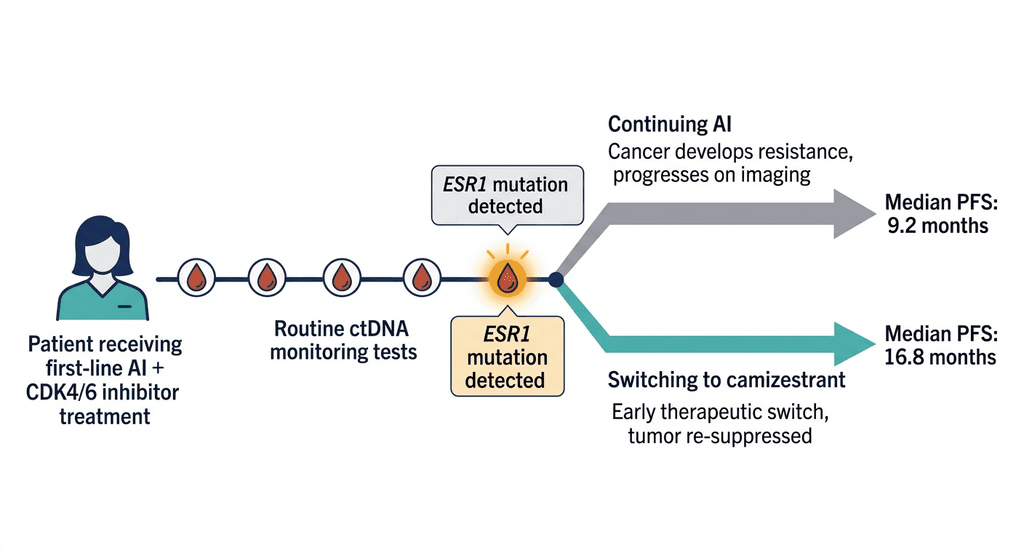
SERENA-6 did not enroll patients at diagnosis or at progression. It enrolled patients who were already receiving first-line aromatase inhibitor plus CDK4/6 inhibitor therapy for at least 6 months, had not yet progressed by imaging, and were undergoing routine blood-based ctDNA monitoring every 2 to 3 months. When the Guardant360 CDx assay detected an ESR1 mutation in the blood, those patients were randomized 1:1 to either switch to camizestrant (while continuing the same CDK4/6 inhibitor) or stay on the aromatase inhibitor (while continuing the same CDK4/6 inhibitor).
The primary endpoint was PFS measured from the time of randomization, that is, from the moment of ESR1 mutation detection. The study was double-blind: patients and investigators did not know whether they received camizestrant or continued AI until the end of the trial.
This design is what makes SERENA-6 genuinely novel and what makes interpreting the PFS result complex. Patients in the camizestrant arm benefited from switching to a more effective agent at the moment a resistance mutation was detected. Patients in the control arm continued an agent to which their tumor was already developing resistance. The PFS advantage for the camizestrant arm reflects both the efficacy of camizestrant and the disadvantage of continuing an agent in the face of emerging resistance.
Efficacy results
Updated ASCO 2026 data with median follow-up of 23.5 months showed camizestrant plus CDK4/6 inhibitor reduced the risk of disease progression or death by 55% versus continuing aromatase inhibitor plus CDK4/6 inhibitor, with a hazard ratio of 0.45 (95% CI 0.34 to 0.59; p less than 0.00001).
| Endpoint | Camizestrant plus CDK4/6i | AI plus CDK4/6i | Result |
|---|---|---|---|
| Median PFS (updated DCO3, ASCO 2026) | 16.8 months (95% CI 14.7 to 19.4) | 9.2 months (95% CI 7.2 to 9.7) | HR 0.45 (95% CI 0.34 to 0.59); p less than 0.00001 |
| Median PFS (interim analysis, DCO1) | 16.0 months | 9.2 months | HR 0.44 (95% CI 0.31 to 0.60) |
| PFS2 (time to second progression) | — | — | HR 0.63; 37% reduction in risk |
| Chemotherapy/ADC-free survival | 22.6 months | 18.7 months | HR 0.64 |
| ctDNA clearance | 51.0% | 1.9% | — |
| OS | Immature | — | Final analysis pending |
| Discontinuation due to AEs | Approximately 1% | — | — |
Sources: AstraZeneca ASCO 2026 press release. OncLive SERENA-6 updated data. FDA approval announcement. NCT04964934.
The PFS2 finding is particularly meaningful. SERENA-6 met its PFS2 endpoint, with a preemptive endocrine switch to camizestrant delivering a 6.6-month median PFS2 gain versus maintaining aromatase inhibitor with CDK4/6 inhibition. This matters because one concern about the trial design was that an early switch would simply frontload PFS in the first line without any net benefit in total time until the cancer became harder to treat. The PFS2 benefit, sustained through the second line of therapy, argues against that concern.
Patient-reported outcomes also favored camizestrant: the study showed delayed deterioration in pain, fatigue, and dyspnea, reducing risk of clinically meaningful symptom and function decline compared with continued aromatase inhibitor plus CDK4/6 inhibitor.
The Regulatory Story: ODAC 6-3 Against, FDA Approves Anyway
The ODAC voted 6 to 3 against recommending approval on April 30, 2026. Understanding why the committee was skeptical, and why the FDA ultimately disagreed, requires distinguishing two separate questions.
The first question is whether camizestrant has activity in ESR1-mutated HR-positive breast cancer. The answer from the data is clearly yes. The PFS hazard ratio of 0.44 to 0.45, consistent across multiple data cuts, is statistically robust and clinically meaningful.
The second question, which was the one ODAC wrestled with, is whether the way PFS was measured in SERENA-6 accurately represents a clinical benefit that patients will experience. The FDA communicated to AstraZeneca that PFS2 would not be acceptable as an efficacy endpoint to support potential approval, since the switch to camizestrant in the experimental arm was initiated at the time of the detection of an ESR1 mutation. The concern was that the PFS clock started ticking when a molecular event was detected, not when patients were actually at a comparable clinical stage.
The FDA ultimately concluded that PFS measured from detection of an ESR1 mutation is a valid surrogate endpoint for accelerated approval, particularly given the PFS2 benefit and the patient-reported outcome data. The approved indication specifically references “PFS as measured from detection of ESR1 mutation,” an unusual and precise labeling choice that acknowledges the novelty of the measurement approach. The approval is contingent on verification of clinical benefit in a confirmatory trial, as with all accelerated approvals.
As Dr. Kevin Kalinsky, Division Director of Medical Oncology at Winship Cancer Institute, Emory University and a SERENA-6 investigator, noted: “This combination provides an important new option for the one in three patients with this form of advanced breast cancer whose tumors develop an ESR1 mutation.”
The Companion Diagnostic: Guardant360 CDx and the ctDNA Monitoring Framework
The simultaneous approval of the Guardant360 CDx liquid biopsy assay is as clinically significant as the drug approval. Implementing SERENA-6’s strategy in practice requires routine ctDNA monitoring, not just a one-time diagnostic test.
In SERENA-6, patients receiving first-line aromatase inhibitor plus CDK4/6 inhibitor underwent ctDNA surveillance using the Guardant360 CDx test at routine tumor scan intervals, every 2 to 3 months, to identify early signs of endocrine resistance through the emergence of ESR1 mutations.
This is different from how molecular testing is typically used in breast cancer. Standard practice involves tumor biopsy or ctDNA testing at specific clinical decision points, primarily at initial diagnosis or at progression. SERENA-6 used serial liquid biopsies on a scheduled basis as a surveillance tool, integrating molecular monitoring into the routine imaging visit schedule.
Implementing this in clinical practice has real-world implications. Patients need to understand they will have routine blood tests for molecular surveillance, and that a positive result (ESR1 mutation detected) triggers a therapy change even if they feel well and scans are stable. That conversation requires careful framing. A positive ctDNA result is not a sign the patient is getting sicker in the traditional sense. It is a signal that the tumor is beginning to develop resistance, and the evidence from SERENA-6 supports acting on it early.
At the diagnosis of HR-positive metastatic breast cancer, fewer than 5% of patients will have this tumor mutation. After disease progression on an aromatase inhibitor, nearly 40% of patients will have this tumor mutation. That trajectory is exactly what ctDNA monitoring is designed to intercept.
Safety: What the Prescribing Information Covers
The safety profile of camizestrant in SERENA-6 was generally manageable, with most adverse events driven by the CDK4/6 inhibitor backbone rather than by camizestrant itself.
Boxed warning: QTc prolongation. The prescribing information includes a boxed warning for irregular heart rhythm risk when camizestrant is taken with certain medications that also prolong the QTc interval. Clinicians must review concurrent medications for QTc-prolonging potential before initiating Etcamah, and the label provides specific guidance on monitoring and contraindicated combinations.
Bradycardia warning. An abnormally slow heart rate is listed as a warning in the prescribing information. Heart rate monitoring may be appropriate during therapy.
Embryo-fetal toxicity. Etcamah can cause fetal harm. Women of reproductive potential must use effective contraception during treatment and for a defined period after the last dose.
Common adverse events. Safety was broadly consistent with CDK4/6 inhibitor backbones; neutropenia and cytopenias predominated. Ocular adverse events including photopsia and dry eye were more frequent with camizestrant than with aromatase inhibitor, and camizestrant discontinuation was approximately 1%. Photopsia (seeing flashes of light) is a class effect of some SERD agents and is typically grade 1 to 2. Patients should be counseled about this before starting therapy and advised to report significant or worsening visual symptoms.
Where Etcamah Fits in the HR-Positive Breast Cancer Landscape
Etcamah is positioned at a specific and novel point in the treatment timeline: first-line therapy, after ESR1 mutation detection but before radiographic progression. This distinguishes it from all other approved breast cancer agents.
For patients whose disease progresses on first-line AI plus CDK4/6 inhibitor without an ESR1 mutation detected during treatment, or who progress without prior ctDNA monitoring, different second-line options apply. Elacestrant is approved for ESR1-mutated HR-positive breast cancer after progression on endocrine therapy. Standard second-line options including CDK4/6 inhibitor switching, everolimus-based therapy, and chemotherapy continue to apply in contexts where Etcamah is not indicated.
For related HED coverage on the HR-positive breast cancer treatment landscape, including the biology of estrogen receptor signaling and CDK4/6 inhibition, see our post on Revtorpyk (gedatolisib) receiving FDA approval as the first PIK3CA wild-type HR-positive breast cancer targeted therapy, which covers the PI3K/AKT/mTOR resistance pathway in depth.
What This Means for Oncologists and Patients
For breast oncologists
The Etcamah approval requires a new clinical workflow that most practices do not currently have in place: routine serial ctDNA monitoring using the Guardant360 CDx assay during first-line AI plus CDK4/6 inhibitor therapy. Implementing this workflow means integrating liquid biopsy ordering into the routine imaging visit schedule, establishing a protocol for communicating ESR1 mutation results to patients, and having a consent and education framework for the concept of treatment switching before progression.
The approval covers all three approved CDK4/6 inhibitors: abemaciclib, palbociclib, and ribociclib. Patients continue their current CDK4/6 inhibitor when switching from aromatase inhibitor to camizestrant, minimizing disruption to the treatment backbone.
The ODAC vote and the regulatory complexity of this approval are appropriate to discuss with patients. The PFS benefit is real and substantial. The OS benefit is not yet mature. Treating physicians and patients should make shared decisions in full awareness of what the trial showed and what it did not.
For patients with HR-positive, HER2-negative advanced breast cancer
If you are receiving first-line treatment with an aromatase inhibitor (anastrozole, letrozole, or exemestane) combined with a CDK4/6 inhibitor, your oncologist may now discuss adding regular blood tests to monitor for ESR1 mutations in your circulating tumor DNA. If such a mutation is detected, switching to Etcamah while continuing your CDK4/6 inhibitor is now an FDA-approved option. The trial showed that patients who made this switch nearly doubled their median time before their cancer progressed.
The key practical point is that this switch happens before you feel worse and before scans show growth. A positive ctDNA result means a molecular change has been detected, not that the treatment is failing in the way you might normally expect.
The Susan G. Komen Breast Cancer Helpline (1-877-GO-KOMEN) and the Metastatic Breast Cancer Alliance maintain current resources on advanced breast cancer treatment options and clinical trials.
Sources
FDA accelerated approval announcement: FDA grants accelerated approval to camizestrant with a CDK4/6 inhibitor for ESR1-Mutated HR-positive, HER2-negative locally advanced or metastatic breast cancer. FDA.gov. September 4, 2026.
FDA press announcement: FDA Grants Accelerated Approval to a New Breast Cancer Treatment. FDA.gov. September 4, 2026.
AstraZeneca US approval press release: ETCAMAH (camizestrant) in combination with a CDK4/6 inhibitor approved in the US for 1st-line advanced HR-positive breast cancer. astrazeneca-us.com. September 4, 2026.
AstraZeneca global press release: Etcamah in combination with a CDK4/6 inhibitor approved in the US for 1st-line advanced HR-positive breast cancer. astrazeneca.com. September 4, 2026.
Drugs.com approval news: FDA Grants Accelerated Approval to Etcamah (camizestrant) for Advanced HR-Positive Breast Cancer. drugs.com. September 4, 2026.
AstraZeneca ASCO 2026 updated PFS data press release (HR 0.45, PFS2, chemo-free survival): Camizestrant combination delayed time to first progression by 55% and to second progression by 37%. astrazeneca-us.com. June 2, 2026.
OncLive (ODAC vote context, PFS2 data, ctDNA clearance data): SERENA-6 Meets PFS2 End Point With Early Switch to Camizestrant. onclive.com. July 2026.
CancerNetwork (ODAC vote details, PFS2 exact HR, patient population description): FDA ODAC Votes No to Camizestrant for HR+/HER2– ESR1 Advanced Breast Cancer. cancernetwork.com. April 2026.
OncLive ODAC preview (ocular AEs, discontinuation rate, ctDNA monitoring schedule): FDA ODAC Preview: SERENA-6 Data for Camizestrant. onclive.com. April 2026.
OncoDaily (complete SERENA-6 mechanism and regulatory analysis): AstraZeneca’s Camizestrant Faces FDA ODAC Review. oncodaily.com. April 2026.
ONS (complete indication text, trial design details): FDA Grants Accelerated Approval to Camizestrant. ons.org. September 2026.
AstraZeneca ODAC vote press release (April 2026): Update on FDA Advisory Committee vote on camizestrant. astrazeneca.com. April 30, 2026.
PMC ctDNA-guided review article: Revolutionary ctDNA-Guided Therapy Adaptation in ESR1-Mutated Advanced Breast Cancer: Insights from the Initial SERENA-6 Trial. PMC12982825.
SERENA-6 interim ASCO 2025 data press release (56% PFS reduction, original interim): Camizestrant reduced the risk of disease progression or death by 56% in SERENA-6 Phase III trial. astrazeneca-us.com. June 1, 2025.
Pharmaceutical Technology (30-country approval context, Sino Biopharmaceutical license): FDA approves AstraZeneca’s Etcamah combo for advanced breast cancer. pharmaceutical-technology.com. September 2026.
SERENA-6 trial registration: NCT04964934. ClinicalTrials.gov.
HR-positive breast cancer overview: Hormone Receptor-Positive Breast Cancer. NCBI.
Etcamah prescribing information: ETCAMAH (camizestrant) Prescribing Information. AstraZeneca. 2026.
Etcamah approval history: Etcamah FDA Approval History. drugs.com.
Patient resources: Susan G. Komen: 1-877-GO-KOMEN | Metastatic Breast Cancer Alliance | BreastCancer.org | AstraZeneca Etcamah patient support
| Disclaimer: Health Evidence Digest provides general information about FDA approvals and health research for educational purposes. This content is not a substitute for professional medical advice. Etcamah (camizestrant) received accelerated approval based on PFS as measured from detection of ESR1 mutation; continued approval may be contingent on verification of clinical benefit in confirmatory trials; OS data are not yet mature. The prescribing information carries a boxed warning for QTc prolongation risk with certain drug combinations. Treatment decisions for advanced HR-positive breast cancer should be made in collaboration with a board-certified medical oncologist experienced in breast cancer management and genomic testing. |
|---|
Leave a Reply