
| The essentials: On August 25, 2026, the FDA approved an expanded patient population for Tivicay PD (dolutegravir, ViiV Healthcare) for use in combination with other antiretroviral agents for HIV-1 infection in pediatric patients who are treatment-naive or treatment-experienced but INSTI-naive, weighing at least 2 kg. The previous weight threshold was 3 kg, covering children aged 4 weeks and older. The new threshold of 2 kg extends eligibility to term newborns from birth. Tivicay PD is now the first and only second-generation INSTI cleared for use in newborns. Tivicay PD is available as dispersible tablets for oral suspension, making it appropriate for infants who cannot swallow solid oral dosage forms. The clinical basis: NIH-funded IMPAACT 2023 study and pharmacokinetic modeling incorporating additional pediatric data. IMPAACT 2023 enrolled 48 term newborns weighing at least 2 kg who were given Tivicay PD from birth for up to 6 weeks and observed for 16 weeks. Data showed dolutegravir reached therapeutic drug levels in term neonates with a safety profile consistent with that established in older pediatric and adult populations. This is a pharmacokinetics and safety-based approval, not a traditional randomized efficacy trial, consistent with the regulatory approach used for pediatric drug development in rare or serious conditions where a placebo-controlled trial would be unethical. Regulatory designations: Priority Review. Tivicay original adult approval: 2013. Tivicay PD original pediatric approval (ages 4 weeks and older, at least 3 kg): June 2020. This approval: August 2026. |
|---|
Children born to mothers living with HIV are at risk of acquiring the virus in utero, during delivery, or through breastfeeding. Without antiretroviral treatment, the risk of mother-to-child HIV transmission is approximately 15 to 45%. With effective maternal treatment and appropriate infant prophylaxis, that risk falls below 1 to 2%. Prevention of mother-to-child transmission (PMTCT) is one of the signal achievements of global HIV medicine. But even with the best PMTCT programs, some infants are born with HIV.
When that happens, the evidence is unambiguous: start treatment as early as possible. HIV replicates at an extraordinarily high rate in untreated infants. Without antiretroviral therapy, approximately 30% of infected infants die before the age of 1, and more than half die before age 2. Treatment within the first weeks and months of life can prevent the immune system destruction that makes HIV a death sentence in early infancy, allow children to grow with normal immune function, and dramatically change their long-term prognosis.
Until August 25, 2026, dolutegravir-based therapy, the preferred HIV treatment for adults and most children due to its high efficacy, once-daily dosing, and high barrier to resistance, was not available for newborns below 3 kg. Infants born at or near term typically weigh 2.5 to 4 kg. The 3 kg threshold excluded the smallest newborns, including those born at the lower end of the normal birthweight range, from access to dolutegravir-based treatment from birth.
Tivicay PD (dolutegravir, ViiV Healthcare) now approved down to 2 kg closes that gap, making dolutegravir-based HIV treatment accessible to term newborns from the first day of life.
The Global Context: Perinatal HIV and the Importance of Early Treatment
Globally, approximately 130,000 children were newly infected with HIV in 2025, the vast majority through mother-to-child transmission. Despite decades of progress in PMTCT programs, new pediatric HIV infections continue because of gaps in maternal diagnosis, barriers to accessing treatment in low-resource settings, transmission during breastfeeding in contexts where formula feeding is unsafe, and maternal viremia during pregnancy or delivery despite treatment.
In the United States, perinatal HIV transmission has been reduced to fewer than 100 to 150 infants per year through comprehensive PMTCT. Globally, particularly in sub-Saharan Africa, the numbers are substantially higher. The WHO recommends immediate antiretroviral therapy for all HIV-positive infants, regardless of clinical status or viral load, given the high risk of rapid progression in untreated infants.
The challenge in treating newborns and very young infants with HIV is not only biological. It also requires appropriate pediatric formulations. Standard adult tablets cannot be given to infants. Liquid formulations must be precisely dosed for small and rapidly changing body weights. Tivicay PD’s dispersible tablet format, which dissolves in water to create an oral suspension, addresses exactly this need. The approved dosing is weight-based, calculated to achieve therapeutic drug levels appropriate for each weight band.
Dolutegravir: Why It Is the Preferred Agent and What Its Approval History Shows
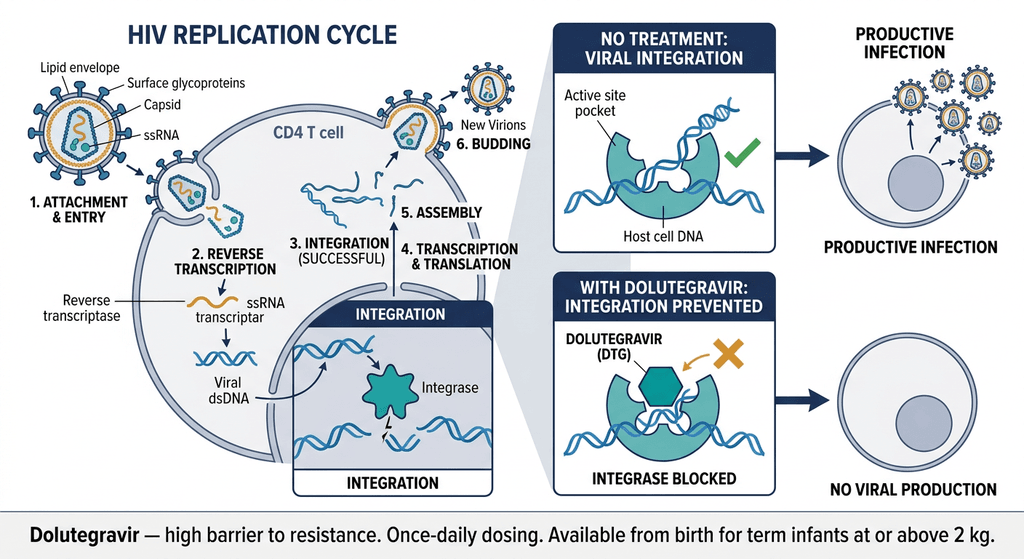
Dolutegravir is a second-generation integrase strand transfer inhibitor (INSTI) that works by binding to the active site of the HIV integrase enzyme and blocking the strand transfer step of viral DNA integration into the host cell genome. Without successful integration, the virus cannot establish a permanent infection in the cell, cannot replicate using the cell’s machinery, and cannot produce new viral particles.
What distinguishes dolutegravir from first-generation INSTIs (raltegravir, elvitegravir) is its resistance barrier. Dolutegravir has a slower dissociation rate from integrase than first-generation agents, meaning it stays bound to the enzyme more stably. This stability translates into a higher resistance barrier: selecting for mutations that confer clinically significant dolutegravir resistance requires multiple simultaneous mutations, which is substantially harder for the virus to achieve. As a result, virologic failure with dolutegravir rarely involves the emergence of integrase resistance mutations in treatment-naive or INSTI-naive patients.
This combination of high efficacy, once-daily dosing, favorable tolerability, and a high resistance barrier made dolutegravir the globally preferred HIV treatment for adults as reflected in WHO guidelines, and drove the development of pediatric formulations to extend these advantages to children.
The approval timeline reflects a systematic effort to close the age and weight gap:
| Approval | Population | Date |
|---|---|---|
| Tivicay (standard tablets) | Adults | August 2013 |
| Tivicay PD (dispersible tablets) | Pediatric patients 4 weeks and older, at least 3 kg | June 2020 |
| Tivicay PD (dispersible tablets) | Pediatric patients from birth, at least 2 kg | August 2026 |
The August 2026 expansion is the final step in making dolutegravir available across the full clinically relevant pediatric weight spectrum, from the smallest term newborns through childhood to adulthood.
The IMPAACT 2023 Study: What the Evidence Shows
Why this approval uses PK modeling rather than a randomized efficacy trial
The approval of Tivicay PD for infants weighing at least 2 kg is based on pharmacokinetic data and safety from the IMPAACT 2023 study, combined with population PK modeling incorporating additional pediatric data. It is not based on a traditional randomized, placebo-controlled efficacy trial.
This reflects standard regulatory practice for pediatric antiretroviral drug development. Conducting a placebo-controlled trial in HIV-positive newborns is ethically impermissible: withholding effective HIV treatment from infected infants when treatment is available would cause severe and preventable harm. The regulatory framework for pediatric HIV drug development, codified in the FDA’s Pediatric Research Equity Act requirements, allows sponsors to support pediatric indications through pharmacokinetic data that demonstrate the drug reaches appropriate therapeutic levels in the target population, combined with safety monitoring, and relying on efficacy extrapolated from older populations where efficacy is established.
The principle underlying this approach is that if dolutegravir reaches the same therapeutic plasma concentrations in neonates that it achieves in older pediatric patients and adults, and if the safety profile is consistent across populations, the efficacy observed in older populations can be reasonably expected in neonates. This principle is well-accepted in pediatric HIV drug development and has been used to support previous pediatric antiretroviral approvals.
What IMPAACT 2023 showed
The IMPAACT 2023 study enrolled 48 term newborns with HIV-1 infection weighing at least 2 kg. These infants received Tivicay PD from birth for up to 6 weeks, as part of combination antiretroviral regimens, and were then observed for a total of 16 weeks.
The key findings were:
Dolutegravir reached therapeutic drug levels in term neonates at the weight-based doses studied. Pharmacokinetic parameters, including area under the curve and trough concentrations, were within the ranges associated with viral suppression in older children and adults.
The safety profile was consistent with that established in older pediatric patients and adults. No new or unexpected safety signals were identified in the neonatal population.
Population PK modeling incorporating additional pediatric data confirmed the dosing approach and supported the weight-based dosing regimen specified in the updated prescribing information.
As Dr. Diana F. Clarke, PharmD, assistant professor of pediatrics at Boston University School of Medicine and lead investigator of IMPAACT 2023, stated: “For too long, newborns living with HIV have had too few treatment options designed and studied to meet their unique needs, despite the importance of starting treatment as early as possible. With the approval of a Tivicay PD dosing regimen, babies born at term and weighing at least 2 kg will now have access to dolutegravir-based therapy starting at birth.”
What the evidence does not cover
The clinical story requires one important honesty note. The IMPAACT 2023 data support therapeutic drug levels and short-term safety in term neonates. They do not represent a completed long-term efficacy trial demonstrating viral suppression rates specifically in this weight band. The 16-week observation period provides short-term safety data but not the 48-week or 96-week viral suppression outcomes that define standard antiretroviral efficacy trials.
Evidence also remains limited for premature neonates. The supporting data concerns term newborns at or above 2 kg, and extrapolation to significantly premature infants with different physiological and pharmacokinetic characteristics is not supported by the current data.
These are important clinical nuances for prescribers to understand and to communicate to families.
Dosing and Administration
Tivicay PD is available as dispersible tablets containing dolutegravir 5 mg per tablet. For infants weighing 2 kg to less than 3 kg, the dose and frequency are specified in the updated prescribing information weight-band dosing table. Consistent with the formulation design, tablets are dispersed in a small amount of water and administered orally as a suspension, making the formulation appropriate for infants who cannot swallow solid tablets.
Dosing is weight-based throughout the pediatric weight bands covered by the Tivicay PD indication. As infants grow and cross weight thresholds, doses are adjusted accordingly. Clinicians managing infants on Tivicay PD should review body weight at each visit and adjust the dose per the weight-band table in the current prescribing information.
Tivicay PD must be used in combination with other antiretroviral agents appropriate for the infant’s age and weight. The choice of companion agents requires careful consideration of available pediatric formulations, tolerability in neonates, and the overall combination regimen’s resistance profile.
Safety: What Prescribers and Families Need to Know
The safety profile of dolutegravir in the 2 kg and above population observed in IMPAACT 2023 was consistent with the established profile in older children and adults. No new safety concerns emerged.
The known safety considerations for dolutegravir across all populations apply to this age group as well. The most clinically relevant for newborns are:
Neural tube defect signal: Earlier pharmacovigilance data from the Tsepamo study in Botswana identified a potential signal for neural tube defects in infants born to women who were on dolutegravir at the time of conception. Subsequent larger analyses have not confirmed a definitive causal relationship, and the current clinical consensus is that the benefits of dolutegravir in pregnant women outweigh the risk. This signal is relevant for maternal prescribing decisions during early pregnancy rather than for neonatal dosing, but clinicians should be aware of the background context.
Drug interactions: Dolutegravir’s pharmacokinetics are affected by several drug classes that are sometimes used in neonatal medicine, including certain antacids, calcium, iron, and magnesium-containing preparations that can chelate dolutegravir and reduce absorption. Any concurrent medications in the neonate should be reviewed for potential interactions before starting Tivicay PD.
Hypersensitivity reactions: Serious hypersensitivity reactions including rash, constitutional findings, and organ dysfunction have been reported with dolutegravir across all age groups. These typically occur within the first few weeks of therapy. Parents and caregivers should be instructed to seek immediate evaluation for any rash or systemic symptoms.
What This Means for Pediatric Infectious Disease Specialists and Families
For clinicians
Tivicay PD at 2 kg and above gives pediatric HIV specialists and neonatologists a dolutegravir-based option from birth for term newborns diagnosed with HIV-1. Given that dolutegravir is the globally preferred antiretroviral backbone for adults and older children, having it available for neonates creates therapeutic consistency across the life course and removes the need to initiate neonates on older, less resistance-resilient regimens simply because dolutegravir was not cleared for this weight.
The dosing table in the updated prescribing information should be reviewed carefully before prescribing. Weight-band transitions require dose adjustments as the infant grows. Combination regimen selection requires pediatric infectious disease expertise.
For preterm infants weighing less than 2 kg, this approval does not apply, and alternative antiretroviral options appropriate for their weight and gestational age should be used. Consultation with a pediatric HIV specialist is warranted for any neonate diagnosed with HIV-1.
For families
If your newborn has been diagnosed with HIV-1, starting antiretroviral treatment as early as possible is the most important step for their long-term health. Dolutegravir-based treatment, which has been the standard of care for adults and older children with HIV for years, is now available for babies from birth if they weigh at least 2 kg. The medication is given as a small amount of dissolved tablet in water, making it practical for infants.
Caring for an infant with HIV requires a specialist team. Pediatric HIV programs at major children’s hospitals and university medical centers have the expertise to guide treatment decisions, monitor the infant’s response, and support families through what can be a challenging and frightening time.
For related HED coverage on HIV treatment developments, see our posts on Bixlenvo (bictegravir/lenacapavir) receiving FDA approval as the first single-tablet regimen for virologically suppressed adults on complex multi-drug regimens and our earlier post on Idvynso (doravirine/islatravir), the first two-drug HIV suppression regimen without a protease inhibitor or INSTI backbone.
The Elizabeth Glaser Pediatric AIDS Foundation (pedaids.org) and HIV.gov pediatric HIV resources are current starting points for families and clinicians navigating pediatric HIV care.
Sources
ViiV Healthcare FDA approval press release: U.S. FDA approves ViiV Healthcare’s Tivicay PD, helping close a critical HIV treatment gap for young children. BusinessWire. August 26, 2026.
ViiV Healthcare press release (full): U.S. FDA approves ViiV Healthcare’s Tivicay PD. viivhealthcare.com. August 2026.
Drugs.com approval news: U.S. FDA Approves ViiV Healthcare’s Tivicay PD for HIV Treatment in Pediatric Patients Weighing at Least 2 kg. drugs.com. August 2026.
Contagion Live (first second-generation INSTI for newborns framing, PK-based approval explanation, preterm limitation): FDA Approves Tivicay PD for Infants With HIV. contagionlive.com. August 2026.
Patient Care Online (48 neonates, 6-week treatment, 16-week observation, term newborn limitation, Dr. Clarke quote): FDA Expands Dolutegravir Approval to Infants With HIV-1 Weighing at Least 2 kg. patientcareonline.com. August 2026.
Managed Healthcare Executive (3 kg to 2 kg threshold change, IMPAACT 2023 summary, Dr. Clarke quote): FDA Approves Tivicay PD for Infants and Children With HIV Weighing at Least 2 kg. managedhealthcareexecutive.com. August 2026.
BioSpace (full ViiV press release, Jean van Wyk CMO quote, IMPAACT network description): U.S. FDA approves ViiV Healthcare’s Tivicay PD. biospace.com. August 2026.
Hospital Management (Jean van Wyk CMO quote, Priority Review, PK modeling basis): ViiV Healthcare’s Tivicay PD gains FDA approval for paediatric HIV therapy. hospitalmanagement.net. August 2026.
IMPAACT Network description: IMPAACT: International Maternal Pediatric Adolescent AIDS Clinical Trials Network. impaactnetwork.org.
Tivicay PD prescribing information: TIVICAY PD (dolutegravir) Prescribing Information. ViiV Healthcare. 2026.
Tivicay PD approval history: Tivicay PD FDA Approval History. drugs.com.
Patient resources: Elizabeth Glaser Pediatric AIDS Foundation | HIV.gov pediatric HIV treatment resources | Ryan White HIV/AIDS Program | ViiV Healthcare Tivicay PD patient information
| Disclaimer: Health Evidence Digest provides general information about FDA approvals and health research for educational purposes. This content is not a substitute for professional medical advice. The August 2026 approval of Tivicay PD for infants weighing at least 2 kg is supported by pharmacokinetic data and safety from the IMPAACT 2023 study combined with PK modeling; it is not based on a traditional randomized efficacy trial. The approval covers term newborns at or above 2 kg; data in premature neonates are not available. All antiretroviral treatment decisions for infants with HIV-1 should be made in close consultation with a board-certified pediatric infectious disease specialist with expertise in perinatal and pediatric HIV management. |
|---|
Leave a Reply