
| The essentials: On September 24, 2026, the FDA approved Onswik (insulin efsitora alfa-gobe, Eli Lilly) as an adjunct to diet and exercise to improve glycemic control in adults with type 2 diabetes mellitus. Onswik is a once-weekly basal insulin designed to maintain steady basal insulin levels across a full 7-day dosing interval. It reduces basal injections from approximately 365 to 52 per year versus once-daily basal insulin. This is the second FDA-approved once-weekly basal insulin for type 2 diabetes in 2026, following the March 26 approval of Awiqli (insulin icodec-abae, Novo Nordisk), which HED covered earlier this year. The two are now direct competitors in the once-weekly basal insulin category. What makes efsitora mechanistically distinct from icodec: insulin icodec works by reversible albumin binding that creates a circulating reservoir. Insulin efsitora is a basal insulin Fc fusion protein: it is engineered by fusing an insulin molecule to the Fc region of a human IgG antibody, which extends its half-life to approximately 17 days through FcRn-mediated recycling, enabling once-weekly dosing from a single weekly injection. The clinical basis: Phase 3 QWINT program, four global randomized controlled trials enrolling more than 3,400 adults with type 2 diabetes. All four trials used treat-to-target design. Both insulin-naive and basal-insulin-experienced populations were studied. Comparators: insulin glargine U100 (QWINT-1 and QWINT-4) and insulin degludec (QWINT-2 and QWINT-3). Key results across QWINT: noninferiority on HbA1c met in all four trials. QWINT-1 and QWINT-2 (insulin-naive): HbA1c reduction of 1.07% in both efsitora and comparator arms in QWINT-1; similar results in QWINT-2. Time in Range improvement: approximately 2 additional hours per day on efsitora versus comparators. Severe hypoglycemia rate versus insulin glargine: 0.50 versus 0.88 events per participant-year in QWINT-1 (approximately 40% lower with efsitora). Important distinction from Awiqli: Onswik is a fixed-dose regimen. Unlike Awiqli, which is titrated to a personalized dose based on fasting glucose monitoring, efsitora is given as a fixed dose that does not require weekly fasting glucose-guided titration in the same way, simplifying management for some patient populations. Available formats: U-500 KwikPen (doses in 5-unit increments, maximum 400 units per injection) and U-1000 KwikPen (doses in 10-unit increments, maximum 800 units per injection). The U-1000 concentration is the highest available for any basal insulin, designed for patients requiring high insulin doses. Not for type 1 diabetes: safety and efficacy have not been established in T1D; use increases risk of severe hypoglycemia. Fourth global approval: EU, Mexico, Japan, and now United States. |
|---|
Basal insulin therapy has anchored type 2 diabetes management for decades. It covers the slow, steady background insulin need that prevents fasting hyperglycemia between meals and overnight, and for millions of patients who cannot achieve glycemic goals with oral medications alone, it is not optional. It is what keeps blood sugar safe.
The problem has never been efficacy. Once-daily basal insulins, from NPH to glargine to degludec, work. The problem is the 365 injections per year that sustaining that coverage requires, and the very human tendency for injection fatigue, dose skipping, and delayed treatment initiation that 365 annual injections creates.
In March 2026, Novo Nordisk’s Awiqli became the first once-weekly basal insulin approved in the United States, bringing that number down to 52. On September 24, 2026, Eli Lilly’s Onswik became the second. Both work. Both reduce injection burden to once per week. But they get there through completely different molecular strategies, and those differences have practical implications for which patients and clinicians might prefer which drug.
This post covers what insulin efsitora is and how its Fc fusion mechanism differs from icodec’s albumin binding approach, what the four QWINT trials showed, the key distinctions between Onswik and Awiqli that clinicians and patients will actually notice, and where this approval leaves the rapidly evolving once-weekly basal insulin space. For full background on the category’s first approval, see our earlier HED post on Awiqli (insulin icodec-abae), the first once-weekly basal insulin and how its albumin-binding depot mechanism works.
How Insulin Efsitora Works: The Fc Fusion Approach
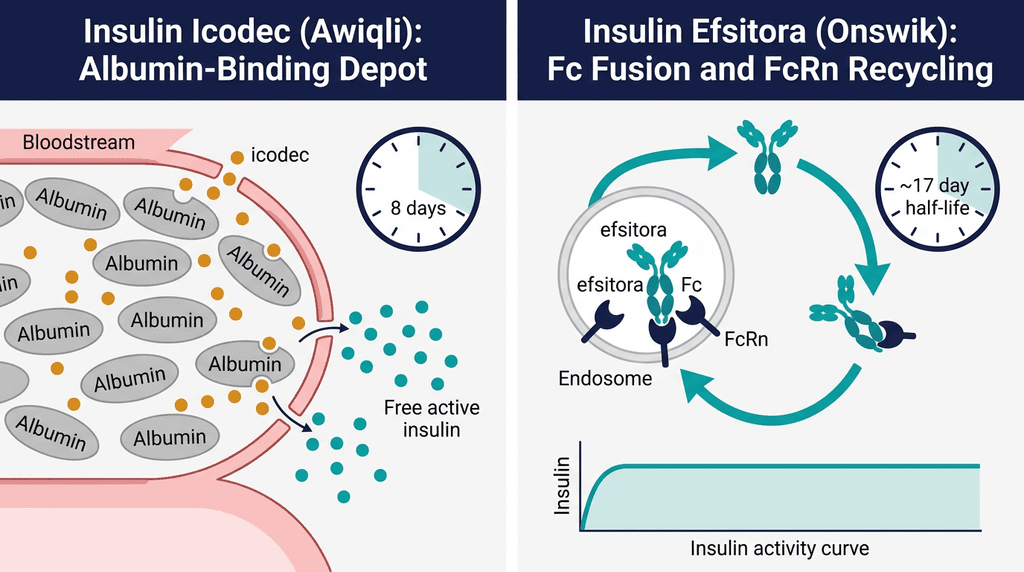
Insulin icodec extends its half-life by binding reversibly to albumin in the blood, creating a circulating depot that slowly releases active insulin. Efsitora takes a different route entirely.
Insulin efsitora alfa is a basal insulin Fc fusion protein. It is engineered by attaching an insulin molecule to the Fc region of a human IgG1 antibody, the same antibody domain that nipocalimab leverages for FcRn recycling in a very different context. The FcRn (neonatal Fc receptor) is the same receptor system that extends the half-life of IgG antibodies by rescuing them from lysosomal degradation and recycling them back into circulation. Because efsitora carries an Fc tag, it is recognized by FcRn and undergoes the same recycling mechanism, extending its effective half-life to approximately 17 days.
This prolonged half-life produces the pharmacokinetic profile that enables once-weekly dosing: after subcutaneous injection, efsitora is absorbed, distributes through tissues, and maintains a flat and stable insulin activity profile over the full 7-day interval before the next dose is administered. The goal is smooth, peakless basal coverage without the glucose-lowering peaks and troughs that can contribute to between-dose hypoglycemia and glucose variability.
The Fc fusion mechanism also creates a practical distinction from icodec: efsitora is a fixed-dose product. Because its pharmacokinetics are determined by the Fc recycling system rather than by titration of a circulating albumin-bound depot, the dose is calculated at initiation based on patient characteristics and adjusted according to clinical response on a less frequent schedule than the daily fasting glucose-guided titration that icodec requires. This fixed-dose approach reduces the ongoing titration burden for patients and makes Onswik particularly practical for patients who find glucose-guided dose adjustments difficult to manage.
The QWINT Phase 3 Program: Four Trials Across the T2D Spectrum
The QWINT program evaluated efsitora across four global, randomized, controlled, treat-to-target Phase 3 trials enrolling more than 3,400 adults with type 2 diabetes. Two trials studied insulin-naive patients (QWINT-1 and QWINT-2) and two studied patients already on basal insulin (QWINT-3 and QWINT-4). The program covered a range of background therapies and comparators to build a comprehensive picture of where efsitora fits in clinical practice.
QWINT-1 (NCT05662332): Insulin-naive, versus glargine U100
Published in the New England Journal of Medicine in 2025, QWINT-1 enrolled insulin-naive adults with T2D on oral or non-insulin injectable background therapy and randomized them to efsitora once weekly or insulin glargine U100 once daily. Both arms targeted the same fasting glucose goal. The primary endpoint was HbA1c change from baseline at 52 weeks.
QWINT-2 (NCT05275400): Insulin-naive, versus degludec
Published in the NEJM in 2024, QWINT-2 enrolled a similar insulin-naive population and compared efsitora to once-daily insulin degludec in a noninferiority design.
QWINT-3 (NCT05275400): Basal insulin-experienced, versus degludec
Published in The Lancet in June 2025, QWINT-3 enrolled adults already on once-daily basal insulin switching to once-weekly efsitora or continuing once-daily degludec.
QWINT-4 (NCT05462756): Basal-bolus regimen, versus glargine U100
Published in The Lancet in June 2025, QWINT-4 enrolled patients on basal-bolus multiple daily injection regimens (basal plus prandial insulin), comparing efsitora as a basal component versus insulin glargine U100.
Combined key efficacy and safety results
| Endpoint | Efsitora | Comparator | Notes |
|---|---|---|---|
| HbA1c change at 52 weeks (QWINT-1 and QWINT-2, insulin-naive) | Minus 1.07% | Minus 1.07% | Noninferiority met in all four trials |
| Time in Range improvement | Approximately plus 2 hours/day | Reference | Meta-analytic and trial-level data |
| Severe hypoglycemia rate (efsitora vs glargine, QWINT-1) | 0.50 events/participant-year | 0.88 events/participant-year | Approximately 40% lower with efsitora |
| Severe hypoglycemia versus degludec (QWINT-3) | 0.58 events/participant-year | 0.45 events/participant-year | Numerically higher with efsitora |
| Severe hypoglycemia in QWINT-2 (degludec comparator) | Zero severe episodes on efsitora | Reference | No severe hypoglycemia events |
| Weekly insulin requirements | Lower with efsitora | Reference | Meta-analytic finding |
Sources: QWINT-1 NEJM 2025. QWINT-2 NEJM 2024. QWINT-3 Lancet 2025. QWINT-4 Lancet 2025. NCT05662332, NCT05275400, NCT05462756.
The noninferiority findings across all four trials establish that efsitora produces the same glycemic reduction as well-established daily basal insulins when used in a treat-to-target design. The approximately 40% lower severe hypoglycemia rate versus glargine in QWINT-1 is a favorable safety signal, though the QWINT-3 data (numerically higher rate versus degludec in the insulin-switching population) adds nuance: the hypoglycemia profile may depend on which comparator and which patient population is being examined, and clinicians should review the trial-specific data rather than applying a single summary characterization.
The time in range improvement of approximately 2 additional hours per day is clinically meaningful for patients using continuous glucose monitoring. Two more hours per day within the 70 to 180 mg/dL target range represents roughly 8% improvement in TIR, and is increasingly recognized as a clinically significant outcome alongside HbA1c.
Onswik Versus Awiqli: What Clinicians and Patients Will Actually Notice
With two once-weekly basal insulins now FDA-approved, clinical practice will need to distinguish them. Several practical differences will shape that decision.
| Feature | Onswik (efsitora, Lilly) | Awiqli (icodec, Novo Nordisk) |
|---|---|---|
| Mechanism | Fc fusion protein; FcRn recycling extends half-life | Albumin-binding depot; releases from albumin reservoir |
| Half-life | Approximately 17 days | Approximately 196 hours (8 days) |
| Dosing approach | Fixed dose with periodic adjustment | Titrated dose based on fasting glucose monitoring |
| Concentrations | U-500 and U-1000 | U-700 |
| Maximum per-injection dose | 400 units (U-500) or 800 units (U-1000) | Determined by dose and volume |
| Switching guidance | Convert from daily basal at initiation | Start at 20% above prior daily dose when switching |
| Type 1 diabetes | Not approved; increased hypoglycemia risk | Not approved for T2D use in T1D |
| Global approvals | EU, Mexico, Japan, US | EU, Canada, Australia, Japan, US |
| Availability | Expected US launch in coming months | Available from launch |
The fixed-dose versus titrated-dose distinction is the most clinically practical difference. Awiqli requires more active fasting glucose monitoring and dose adjustment to optimize control, which aligns well with patients who are engaged in self-management and comfortable with titration. Onswik’s fixed-dose approach reduces the titration requirement, which may be more practical for patients who find frequent glucose-guided adjustments burdensome or for clinical settings where intensive titration support is limited.
The U-1000 concentration is the highest available for any basal insulin and is specifically designed for patients requiring large insulin doses, a population that often struggles with injection volume limitations of lower-concentration products. For patients on very high daily basal insulin doses, efsitora’s U-1000 option offers a practical advantage in injection volume management.
Safety: What the QWINT Data and Prescribing Information Cover
Not for type 1 diabetes. The prescribing information explicitly states that Onswik should not be used in patients with type 1 diabetes because safety and efficacy have not been established, and use in T1D carries an increased risk of severe hypoglycemia. This mirrors the T1D exclusion on Awiqli’s U.S. label.
High-concentration dispensing risk. Onswik’s U-500 and U-1000 formulations present a medication safety consideration that pharmacy and clinical teams must manage carefully. Errors in concentration selection or dose calculation could lead to significant insulin overdose. The U-500 KwikPen doses in 5-unit increments with a maximum of 400 units per injection. The U-1000 uses 10-unit increments with a maximum of 800 units. Syringe withdrawal from the pen cartridge is contraindicated, as doing so bypasses the pen’s dose-measuring mechanism and creates the risk of severe dosing errors.
Hypoglycemia. As with all insulin therapies, hypoglycemia is the primary safety concern. The risk profile varies across the QWINT trials and comparators, as described in the efficacy section. Patients and caregivers should be counseled on hypoglycemia recognition and management before initiating Onswik.
Drug interactions. Drugs that affect glucose metabolism (corticosteroids, beta-blockers, thiazolidinediones, and others) can alter insulin requirements. Review of concurrent medications before initiating Onswik and monitoring during initiation is appropriate.
Injection site reactions. Local reactions are possible as with any subcutaneous insulin.
What This Means for Endocrinologists, Primary Care Physicians, and Patients
For clinicians
The arrival of a second once-weekly basal insulin gives clinicians an actual choice within the category rather than a single option. For patients where injection burden is a meaningful barrier to insulin initiation or adherence, both agents are now available. The choice between them will largely come down to the fixed versus titrated dosing preference, dose range requirements, patient comfort with glucose monitoring, and formulary access.
For patients requiring high insulin doses, the U-1000 concentration option in Onswik fills a practical niche that icodec’s U-700 concentration does not cover at the same dose ceiling.
As Dr. Diana Isaacs of Cleveland Clinic framed it: “I expect we will initially use once-weekly insulin for people who struggle to take insulin every day, and its use will likely grow since it may be more convenient, reducing the number of injections per week.”
For related HED coverage on the once-weekly basal insulin category, see our earlier post on Awiqli (insulin icodec-abae), which covers the albumin-binding depot mechanism, the ONWARDS Phase 3 trial program, and the clinical context of the first once-weekly basal insulin approval in March 2026.
For patients with type 2 diabetes
If you are on or considering starting basal insulin for type 2 diabetes, Onswik is now a once-weekly option. One injection per week instead of one per day means 313 fewer injections annually compared to a daily basal insulin regimen. The fixed-dose format means you do not need to adjust the dose weekly based on fasting glucose readings the way you would with Awiqli, though your prescriber will still adjust your dose periodically based on your overall glucose control.
Onswik will be available in the United States in the coming months. Your endocrinologist or diabetes care team can discuss whether Onswik or another insulin option is right for your specific needs, taking into account your current regimen, glucose monitoring practice, and treatment goals.
The American Diabetes Association (diabetes.org; 1-800-342-2383) and the Juvenile Diabetes Research Foundation maintain current patient resources on insulin therapy options. The Lilly Insulin Value Program provides eligible patients with Lilly insulins at reduced cost; information is available through insulinaffordability.com.
Sources
FDA approval / Lilly press release: U.S. Food and Drug Administration (FDA) approves Lilly’s Onswik (insulin efsitora alfa-gobe), a once-weekly basal insulin injection treatment for adults living with type 2 diabetes. investor.lilly.com. September 24, 2026.
Drugs.com approval news: FDA Approves Onswik (insulin efsitora alfa-gobe) Once-Weekly Basal Insulin for Adults with Type 2 Diabetes. drugs.com. September 24, 2026.
HCPLive (four QWINT trials, 3,400 patients, Kenneth Custer quote, global approvals context): Weekly Insulin Efsitora Alfa (Onswik) Gains FDA Approval for Type 2 Diabetes. hcplive.com. September 2026.
Medscape (second once-weekly approval, U-500 and U-1000 pen details, T1D contraindication): FDA Approves Efsitora Once-Weekly Basal Insulin Injection. medscape.com. September 2026.
Pharmacy Times (dispensing safety, U-500 5-unit increments, U-1000 10-unit increments, syringe contraindication, meta-analytic TIR data, hypoglycemia comparison table): FDA Approves Insulin Efsitora, Once-Weekly Basal Insulin Injection for Adults With T2D. pharmacytimes.com. September 2026.
DiaTribe (TIR 2-hour improvement, Dr. Isaacs quote, comparison to icodec, severe hypoglycemia 40% lower versus glargine): Lilly’s Once-Weekly Insulin Delivers Similar A1C Reduction to Daily Basal Insulin. diatribe.org.
QWINT-1 NEJM publication (2025): Rosenstock J, Bailey T, Connery L, et al. Weekly fixed-dose insulin efsitora in type 2 diabetes without previous insulin therapy. NEJM. 2025;393(4):325-335. doi:10.1056/NEJMoa2502796.
QWINT-2 NEJM publication (2024): Wysham C, Bajaj HS, Del Prato S, et al. Insulin efsitora versus degludec in type 2 diabetes without previous insulin treatment. NEJM. 2024;391(23).
QWINT-3 Lancet publication (2025): Philis-Tsimikas A, Bergenstal RM, Bailey TS, et al. Once-weekly insulin efsitora alfa versus once-daily insulin degludec in adults with T2D currently treated with basal insulin (QWINT-3). Lancet. 2025;405(10497):2279-2289. doi:10.1016/S0140-6736(25)01044-X.
QWINT-4 Lancet publication (2025): QWINT-4: Once-weekly efsitora alfa versus once-daily glargine U100 in adults with T2D on multiple daily injections. Lancet. 2025;405(10497):2290-2301. doi:10.1016/S0140-6736(25)01069-4.
QWINT-1 trial registration: NCT05662332. ClinicalTrials.gov.
QWINT-3 trial registration: NCT05275400. ClinicalTrials.gov.
QWINT-4 trial registration: NCT05462756. ClinicalTrials.gov.
HED companion post (Awiqli, insulin icodec): 365 Injections a Year, or 52. Awiqli Is the First Once-Weekly Basal Insulin. healthevidencedigest.com.
Onswik prescribing information: ONSWIK (insulin efsitora alfa-gobe) Prescribing Information. Eli Lilly and Company. 2026.
Onswik approval history: Onswik FDA Approval History. drugs.com.
Patient resources: American Diabetes Association: 1-800-342-2383 | Lilly Insulin Value Program | JDRF diabetes resources | Lilly Onswik patient information
| Disclaimer: Health Evidence Digest provides general information about FDA approvals and health research for educational purposes. This content is not a substitute for professional medical advice. Onswik (insulin efsitora alfa-gobe) is not approved for use in type 1 diabetes; its safety and efficacy in T1D have not been established and use in T1D carries increased risk of severe hypoglycemia. Onswik is available in U-500 and U-1000 concentrations; syringe withdrawal from pens is contraindicated due to severe dosing error risk. All insulin therapy decisions for type 2 diabetes should be made in close collaboration with a qualified diabetes care provider. |
|---|
Leave a Reply