
| The essentials: On September 17, 2026, the FDA granted full standard approval to Fayuvi (rebisufligene etisparvovec-hopf, Ultragenyx Pharmaceutical) for the treatment of neurologic manifestations of mucopolysaccharidosis type IIIA (MPS IIIA, Sanfilippo syndrome type A) in pediatric patients with preserved neurodevelopmental function. This is the first FDA-approved treatment of any kind for Sanfilippo syndrome type A, which has caused progressive neurodegeneration and death in children without any therapeutic option throughout all of recorded medical history. Fayuvi is Ultragenyx’s second approved gene therapy and sixth FDA-approved product overall. A Rare Pediatric Disease Priority Review Voucher was awarded upon approval. What Sanfilippo syndrome type A is: an autosomal recessive lysosomal storage disease caused by loss-of-function mutations in the SGSH gene, which encodes the enzyme sulfamidase (heparan sulfate N-sulfatase). Without functional sulfamidase, heparan sulfate accumulates in lysosomes throughout the body, with the most devastating accumulation occurring in neurons of the brain and CNS, causing progressive neurodegeneration, loss of cognitive function, loss of language, behavioral dysregulation, seizures, loss of mobility, and death typically before or during the second decade of life. What Fayuvi is: a single-dose, intravenous AAV9 vector-based gene therapy delivering a functional copy of the SGSH gene to cells throughout the body and brain, enabling them to produce the sulfamidase enzyme that patients’ own cells cannot make. Dose: 3 x 10^13 vector genomes per kilogram (vg/kg). The therapy was originally developed by Abeona Therapeutics as ABO-102 and later as UX111 during Ultragenyx’s development phase. The clinical basis: Transpher A study (NCT02716246), a multicenter, open-label, Phase 1/2/3 trial enrolling 28 patients across three dose cohorts at five sites in three countries, with long-term follow-up through NCT04360265. The pivotal mITT efficacy population: 17 patients at the approved dose (3 x 10^13 vg/kg) who were either up to age 2 or older than 2 with a cognitive developmental quotient of 60 or above at enrollment. Primary surrogate endpoint: CSF heparan sulfate reduction. Key efficacy findings: median 63.98% reduction in CSF heparan sulfate (p less than 0.001); 81.5% of all treated patients and 88.2% of younger patients achieved at least 50% CSF-HS reduction. Bayley-III cognitive raw score: plus 23.2 points treatment effect versus natural history cohort during ages 24 to 60 months (p less than 0.0001). Receptive communication: plus 8.1 points versus natural history. Eight treated children developed cognitive skills equivalent to a 3-year-old, compared to none in the natural history cohort. Later-treated patients retained communication, ambulation, and feeding abilities at a median age of 9.7 years, compared to typical loss around age 7.6 years in untreated patients. Follow-up data: up to 8.5 years, the longest available follow-up for any AAV9 gene therapy in a lysosomal storage disease. Standard full approval, not accelerated, meaning the FDA concluded the evidence met the full approval threshold. Commercial product expected to ship to Qualified Treatment Centers within 30 to 60 days of approval. |
|---|
Parents of children with Sanfilippo syndrome describe a particular kind of heartbreak. Their children are born appearing healthy. They reach the early developmental milestones that new parents eagerly track. They begin to speak. They walk. They learn names for things. And then, slowly, all of it reverses. The words disappear. Sleep becomes fragmented and then chaotic. Behavior becomes increasingly dysregulated. Skills that were mastered are lost, one by one, as the brain deteriorates from the inside out. Most children lose the ability to speak by early school age. Most cannot walk by their early teens. Most are gone before they reach adulthood.
Until September 17, 2026, not a single treatment in the world had been FDA-approved to change that course.
Fayuvi (rebisufligene etisparvovec-hopf, Ultragenyx) is a one-time gene therapy that delivers to the cells of a child’s body what those cells were born unable to make: the functional enzyme sulfamidase, which should have been breaking down heparan sulfate all along. Children treated early, before the neural damage has accumulated beyond what the brain can compensate for, showed a 23.2-point improvement in cognitive raw scores compared to an untreated natural history cohort. Eight of them developed cognitive skills equivalent to a 3-year-old, reaching a milestone that none of the untreated children achieved. Older, later-treated children retained communication abilities nearly two years beyond when untreated children typically lost them.
This is not a cure. The heparan sulfate accumulation that occurred before treatment cannot be reversed. The neurological damage already present is permanent. But stopping or substantially slowing the accumulation that drives further damage gives children something they have never had: time. Time in which their brains are not actively being destroyed. Time in which cognitive function can be maintained rather than lost. Time in which families can be families rather than caregivers watching a one-way clock.
For the regulatory backstory that preceded this approval, including the original CRL, the manufacturing fix, and what the BLA resubmission process looked like, see our earlier post on the FDA accepting Ultragenyx’s resubmitted BLA for UX111 gene therapy in Sanfilippo syndrome type A.
Karim Mikhail, Director of the Center for Biologics Evaluation and Research, put it directly: “For families living with Sanfilippo syndrome type A, the trajectory of this disease is heartbreaking, children who develop normally in their earliest years facing a relentless regression with no approved treatment to slow it. Parents and clinicians have been waiting far too long for an option.”
What Sanfilippo Syndrome Type A Is: The Disease, the Enzyme, and the Clock
Mucopolysaccharidosis type IIIA (MPS IIIA), also known as Sanfilippo syndrome type A, is one of four subtypes of MPS III (types A through D), each caused by a deficiency in a different enzyme in the heparan sulfate degradation pathway. All four subtypes produce similar clinical syndromes; type A is caused specifically by deficiency of heparan sulfate N-sulfatase (sulfamidase), encoded by the SGSH gene, and is typically the most severe and most rapidly progressive.
The disease is autosomal recessive: a child must inherit a loss-of-function SGSH mutation from each parent to be affected. Without functional sulfamidase, heparan sulfate, a glycosaminoglycan normally found in the cell matrix and on cell surfaces throughout the body, cannot be degraded in lysosomes. It accumulates progressively over time in all cells that normally use it, but nowhere as consequentially as in the neurons of the central nervous system, where lysosomal storage disrupts cellular function and eventually triggers neuronal death.
The early clinical presentation, developmentally normal infancy giving way to progressive regression beginning between age 2 and 6, reflects the accumulation timeline. A child is born with a fully formed brain, but from the first day of life, heparan sulfate is building up in their neurons with nowhere to go. When the accumulation crosses a threshold, neurological function begins to unravel.
The clinical progression is consistent and devastating across most untreated patients:
Ages 1 to 4: Initial development is relatively normal. Some children show early speech delay. The subtle signs of the disease are often missed.
Ages 3 to 6: Behavioral dysregulation becomes prominent and can be severe: hyperactivity, aggression, sleep disruption (often severe, with children sleeping only 2 to 3 hours at night), developmental plateau and then regression.
Ages 6 to 10: Rapid loss of language. Progressive loss of motor skills. Increasing swallowing difficulties. Loss of toileting. Seizures become common.
Ages 8 to 14: Most children lose ambulation. Feeding difficulties require nutritional support. Cognitive function is severely impaired.
By the mid-teens to early 20s: Most patients have died, typically from respiratory complications, aspiration, or the direct consequences of neurodegeneration.
MPS IIIA affects approximately 1 in 70,000 to 1 in 100,000 live births. Based on current U.S. birth rates, this corresponds to roughly 35 to 50 new cases per year. Globally, roughly 500 to 1,000 children are living with MPS IIIA at any given time. The ultra-rarity of the disease, combined with its devastating natural history, is precisely why it has historically attracted insufficient commercial investment and why families have been waiting so long.
How Fayuvi Works: AAV9 Gene Delivery to the Brain
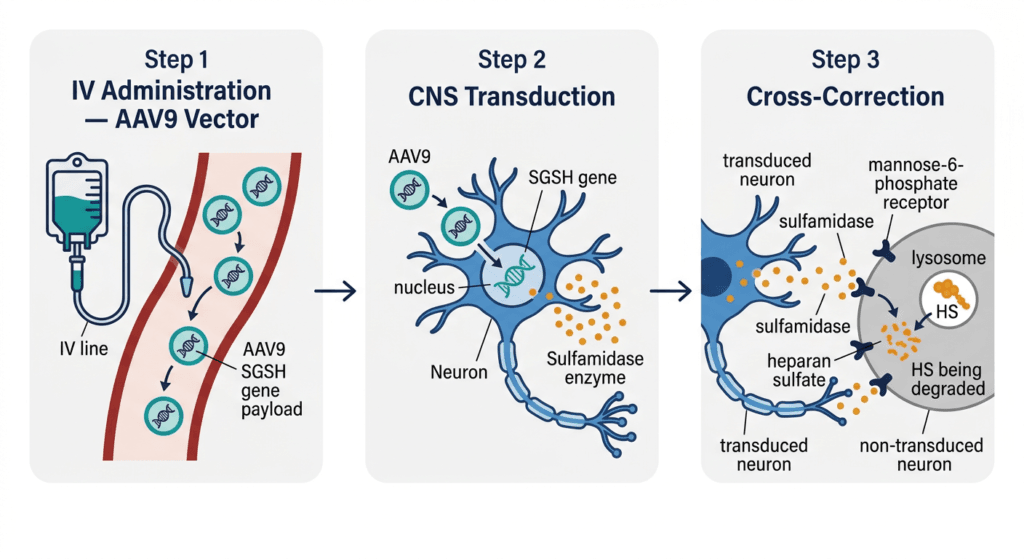
Fayuvi uses an adeno-associated virus serotype 9 (AAV9) vector to deliver a functional copy of the SGSH gene to cells throughout the body via a single intravenous infusion. The choice of AAV9 is critical: unlike AAV serotypes with limited CNS penetration, AAV9 has demonstrated the ability to cross the blood-brain barrier after systemic intravenous administration and transduce neurons and other CNS cells. This capacity for CNS penetration after IV delivery is what makes a one-time infusion capable of addressing the neurological disease.
After the IV infusion, the AAV9 vector distributes throughout the body and CNS. Vector particles that reach neurons and glial cells in the brain and spinal cord enter the cells and deliver the SGSH gene payload to the nucleus, where it is maintained as an episome and expressed continuously. The transduced cells begin producing functional sulfamidase protein, which they were not previously able to make. Sulfamidase then performs cross-correction: because lysosomal enzymes are secreted and taken up by neighboring cells through the mannose-6-phosphate receptor, even cells that did not directly receive the gene therapy vector can benefit from sulfamidase produced by cells that did. This bystander effect amplifies the therapeutic reach of the gene therapy beyond the directly transduced cells.
The result, ideally initiated before catastrophic neuronal loss has occurred, is that cells throughout the CNS can now degrade heparan sulfate in their lysosomes. The accumulation that drives neurodegeneration slows substantially. The toxic cascade is interrupted.
The dose of 3 x 10^13 vg/kg is delivered as a single one-hour intravenous infusion. The treatment is permanent in the sense that the gene expression persists in long-lived neurons. Because neurons do not undergo the rapid cell division that would dilute episomal gene expression, the therapeutic benefit should persist for years to decades, though the complete long-term durability has not yet been fully characterized beyond the 8.5-year follow-up available from the Transpher A program.
The Transpher A Clinical Data: What Eight Years of Follow-Up Shows
Design
Transpher A (NCT02716246) was a multicenter, open-label, dose-escalation Phase 1/2/3 clinical trial enrolling 28 patients with MPS IIIA across five sites in three countries at three dose levels. The highest dose cohort, 3 x 10^13 vg/kg, enrolled 22 patients. The modified intention-to-treat (mITT) efficacy population of 17 patients included those who received the approved dose and who at enrollment were either under 2 years of age or over 2 years with a cognitive developmental quotient (DQ) of 60 or above, representing children with preserved neurodevelopmental function at the time of treatment.
Because conducting a placebo-controlled trial in a uniformly fatal pediatric neurological disease is not feasible, the comparative effectiveness of Fayuvi was assessed against a natural history cohort of 27 untreated MPS IIIA patients with documented rapid progressor phenotypes.
The primary surrogate endpoint for the FDA application was CSF heparan sulfate reduction. Clinical endpoints including Bayley-III scores across five developmental domains were assessed as supportive evidence. Long-term follow-up has been tracked through a separate extension study (NCT04360265), with some patients having up to 8.5 years of data.
Key results (September 2025 data cutoff, presented at WORLDSymposium 2026)
| Outcome | Fayuvi-treated patients | Natural history comparison | Result |
|---|---|---|---|
| Median CSF heparan sulfate reduction (N=27 at approved dose) | 63.98% from baseline | Reference | p less than 0.001; effect within 1 month, sustained at full follow-up |
| Patients with at least 50% CSF-HS reduction | 81.5% (all patients); 88.2% (younger patients) | Reference | — |
| Bayley-III cognitive raw score, ages 24 to 60 months (mITT, n=17) | Plus 23.2 points treatment effect versus natural history | Natural history decline | p less than 0.0001 |
| Bayley-III receptive communication | Plus 8.1 points versus natural history | Natural history decline | Statistically significant |
| Children achieving 3-year-old cognitive equivalent | 8 of 17 | 0 of 27 | None in natural history cohort |
| Later-treated patients: age at communication loss | Retained at median age 9.7 years | Typical loss at approximately 7.6 years | Approximately 2-year retention |
| Maximum follow-up duration | 8.5 years | — | Longest for any AAV9 in lysosomal storage disease |
Sources: Ultragenyx WORLDSymposium 2026 data announcement. February 3, 2026. NeurologyLive full clinical data summary. Sanfilippo News long-term trial update. CGTlive Transpher A Bayley-III data. Transpher A NCT02716246.
The primary regulatory significance of the CSF heparan sulfate reduction data is that it represents the validated surrogate endpoint on which the FDA agreed to base the application, with clinical outcomes provided as confirmatory support. The 63.98% median reduction in CSF-HS, within the first month of treatment and sustained for up to 8.5 years, provides both proof of target engagement (the gene is being expressed and producing functional enzyme) and a basis for inferring disease modification (less HS accumulation means less lysosomal storage, less cellular damage, and less neurodegeneration).
The Bayley-III cognitive advantage of 23.2 points versus natural history, measured during the ages of 2 to 5, the precise developmental window when untreated children begin their most rapid regression, is the most clinically meaningful single number in the dataset. Natural history untreated children in that window are losing cognitive function rapidly. Fayuvi-treated children gained it. This is the difference between regression and development.
The later-treated patient data is equally important for a disease where many children are diagnosed after age 2. Even children who had more advanced disease at treatment retained meaningful function, specifically communication, at a median age of 9.7 years, compared to the expected loss around age 7.6 in untreated patients. This approximately 2-year extension of communicative function represents a meaningful increase in quality family time and quality of life, even for patients who are not early-treated.
Why standard full approval rather than accelerated
The FDA granted standard full approval, not accelerated approval with a surrogate endpoint. This is significant. The FDA concluded that the totality of evidence from Transpher A, including the CSF-HS reduction, Bayley-III clinical data, and 8.5-year follow-up, was sufficient to meet the full approval standard. This gives Fayuvi a stronger regulatory standing than accelerated approval and does not create a confirmatory trial requirement for continued marketing authorization.
The “Preserved Neurodevelopmental Function” Requirement: Who Is and Is Not Eligible
The approved indication specifically requires “preserved neurodevelopmental function” as an eligibility criterion. This is the clinically critical enrollment constraint from the Transpher A mITT population, and it reflects the biological reality of the treatment: gene therapy that delivers functional enzyme cannot recover neurons that have already been irreversibly destroyed.
In practice, preserved neurodevelopmental function means the child still has meaningful cognitive ability, language, and motor function at the time of treatment. The Transpher A mITT definition required either age under 2, or for children over 2, a cognitive developmental quotient of 60 or above at enrollment. Children with more advanced disease regression who have already lost most language and cognitive function were not in the mITT efficacy population and are not the intended treatment population.
This has direct implications for newborn screening. Early diagnosis, before symptoms are severe, is essential to realize the full benefit of Fayuvi. Several newborn screening programs in the United States are in various stages of adding MPS IIIA to their panels. The approval of a treatment for this condition is expected to accelerate that effort, since the clinical argument for newborn screening is substantially stronger when an effective therapy exists to act on a positive result.
Safety: What the Clinical Data Shows
Safety data were collected across 33 patients treated across all dose levels in Transpher A and a separate Phase 1/2 trial. The overall profile was characterized as generally well tolerated.
Most common treatment-emergent adverse events: Liver enzyme elevations (ALT, AST, GGT) were the most frequent adverse event. The majority were grade 1 or grade 2 in severity, and all resolved. This transient hepatotoxicity is a known class effect of systemic AAV gene therapy, driven by the immune response to the vector capsid.
Required corticosteroid prophylaxis: To manage the anticipated liver enzyme elevations and immune response to the AAV9 vector, the prescribing information requires corticosteroids to be administered to all patients before and after the Fayuvi infusion. Liver function must be assessed before treatment, and monitoring of ALT, AST, GGT, and total bilirubin is required during the post-infusion period.
Anti-AAV9 antibodies: Pre-existing neutralizing antibodies to AAV9 may reduce vector transduction efficiency. Patients should be assessed for anti-AAV9 antibody status before treatment. Patients with high pre-existing antibody titers may have reduced treatment response.
Single-treatment limitation: Because patients develop anti-AAV9 antibodies following treatment, re-treatment with an AAV9-based therapy is not feasible. The single administration is the only treatment opportunity.
No treatment-related serious adverse events were observed in the clinical program that led to the approval.
Ultragenyx’s Growing Gene Therapy Portfolio
Fayuvi is Ultragenyx’s second approved gene therapy and sixth FDA-approved product overall. Notably, Genglycos (pariglasgene brecaparvovec-opnr), approved August 19, 2026, was Ultragenyx’s first approved gene therapy, making Fayuvi its second in less than one month. Both approvals represent first-ever treatments for ultra-rare pediatric metabolic and neurological diseases, both use AAV-based gene delivery, and both came with Rare Pediatric Disease Priority Review Vouchers. Together, they position Ultragenyx as the most active company in ultra-rare pediatric gene therapy in the current FDA approval cycle. For detailed coverage of the GSD1a gene therapy mechanism and what the Genglycos approval means for metabolic disease treatment, see our earlier post.
What This Means for Pediatric Neurologists and Sanfilippo Families
For clinicians
Fayuvi is now the only approved treatment for MPS IIIA in the United States. The indication is pediatric patients with preserved neurodevelopmental function, which means the most critical clinical action following this approval is establishing early diagnostic pathways. Pediatric neurologists and metabolic disease specialists who manage children with unexplained developmental regression, behavioral dysregulation, or sleep disruption should include MPS IIIA on their differential and pursue SGSH enzyme activity testing and genetic confirmation promptly.
Fayuvi will be available at Qualified Treatment Centers with experience in AAV gene therapy administration. Ultragenyx expects to ship commercial product within 30 to 60 days of the September 17 approval. The UltraCare program provides access and reimbursement support.
The corticosteroid protocol and liver function monitoring requirements are built into the administration process and should be reviewed in the prescribing information before initiating therapy. Anti-AAV9 antibody screening before treatment is appropriate given its potential impact on transduction efficiency.
For Sanfilippo syndrome families
If your child has been diagnosed with Sanfilippo syndrome type A (MPS IIIA), or if you suspect it based on the clinical pattern of early normal development followed by behavioral regression and speech plateau, Fayuvi is now an FDA-approved option. The most important factor is timing. Children who still have meaningful language, cognitive ability, and motor function are the intended treatment population. If your child is still in that window, the discussion with a metabolic disease specialist about Fayuvi should happen urgently.
For families who have been fighting for a treatment for years, and for those who lost children before this approval arrived, the Cure Sanfilippo Foundation (curesanfilippofoundation.org) has been among the patient advocacy organizations most directly involved in accelerating Fayuvi’s path to approval. Their press release on the approval day captures the depth of what this moment means for the community.
The National MPS Society (mpssociety.org; 1-877-677-8799) and the Sanfilippo Syndrome Research Foundation also maintain current resources on MPS IIIA treatment options and family support.
Sources
FDA approval announcement: FDA Approves First Gene Therapy for Pediatric Patients with Sanfilippo Syndrome Type A. FDA.gov. September 17, 2026.
Ultragenyx approval press release: Ultragenyx Announces Approval of FAYUVI Gene Therapy, the First-Ever FDA-Approved Treatment for Sanfilippo Syndrome Type A. GlobeNewswire. September 17, 2026.
Ultragenyx investor relations: Ultragenyx Announces Approval of FAYUVI Gene Therapy. ir.ultragenyx.com. September 17, 2026.
Drugs.com approval news: FDA Approves Fayuvi for the Treatment of Sanfilippo Syndrome Type A. drugs.com. September 17, 2026.
NeurologyLive (complete Transpher A data, 63.98% CSF-HS reduction, Bayley-III treatment effect, 8.5-year follow-up, mITT definition): FDA Approves UX111, First Gene Therapy for Sanfilippo Syndrome Type A. neurologylive.com. September 2026.
PharmExec (first treatment framing, full indication language): FDA Approves Fayuvi for Pediatric Patients with Sanfilippo Syndrome Type A. pharmexec.com. September 2026.
CheckRare (AAV9 mechanism, SGSH enzyme replacement, cross-correction): FDA Approves Gene Therapy (Fayuvi) for Pediatric Patients With Sanfilippo Syndrome (MPS IIIA). checkrare.com. September 2026.
Cure Sanfilippo Foundation (Dr. Mikhail quote, family impact narrative): FDA Approves First-Ever Treatment for Sanfilippo Syndrome Type A, FAYUVI. curesanfilippofoundation.org. September 17, 2026.
CGTlive (Bayley-III subdomain data, +16-point mITT model-based mean, safety characterization): Ultragenyx’s Gene Therapy UX111 Improves Clinical Function in MPS IIIA. cgtlive.com.
Sanfilippo News (8 children at 3-year-old cognitive level, retention at age 9.7 versus 7.6, 88.2% reduction rate): UX111 gene therapy shows lasting benefit in Sanfilippo type A. sanfilipponews.com. February 2026.
WORLDSymposium 2026 data announcement (23.2-point Bayley-III treatment effect, +8.1 receptive communication): Ultragenyx Announces Positive Longer-Term Data. ir.ultragenyx.com. February 3, 2026.
WORLDSymposium 2025 data (Bayley-III statistical significance; correlation with CSF-HS): Ultragenyx Announces New Data Demonstrating UX111 Improved Clinical Function. globenewswire.com. February 5, 2025.
WORLDSymposium 2024 data (mITT 51% CSF-HS reduction, +16 Bayley-III cognitive raw score): Ultragenyx Announces Data Demonstrating UX111 Results in Significant Reduction in CSF Heparan Sulfate. ir.ultragenyx.com. February 6, 2024.
Transpher A trial registration: NCT02716246. ClinicalTrials.gov.
Long-term follow-up study registration: NCT04360265. ClinicalTrials.gov.
MPS IIIA disease overview: Mucopolysaccharidosis Type III. GeneReviews. NCBI.
Fayuvi prescribing information: FAYUVI (rebisufligene etisparvovec-hopf) Prescribing Information. Ultragenyx Pharmaceutical Inc. 2026.
Fayuvi FDA page: FAYUVI. FDA.gov.
Fayuvi approval history: Fayuvi FDA Approval History. drugs.com.
Patient resources: Cure Sanfilippo Foundation | National MPS Society: 1-877-677-8799 | Sanfilippo Syndrome Research Foundation | Ultragenyx UltraCare patient support | NORD MPS IIIA resources
| Disclaimer: Health Evidence Digest provides general information about FDA approvals and health research for educational purposes. This content is not a substitute for professional medical advice. Fayuvi (rebisufligene etisparvovec-hopf) is indicated for pediatric patients with preserved neurodevelopmental function; it is not established as effective in patients with advanced neurological regression. The single-dose treatment cannot be repeated due to development of anti-AAV9 antibodies. Corticosteroid pre-treatment and liver function monitoring are required. All treatment decisions for MPS IIIA should be made in close collaboration with a board-certified pediatric neurologist or metabolic disease specialist at a center with experience in gene therapy and lysosomal storage disorders. |
|---|
Leave a Reply