| The essentials: On September 23, 2026, the FDA approved Lyrfigtu (lirafugratinib, Elevar Therapeutics) for adults with previously treated unresectable, locally advanced, or metastatic cholangiocarcinoma harboring a fibroblast growth factor receptor 2 (FGFR2) gene fusion or other rearrangement. The approval came four days ahead of the September 27 PDUFA date. Lyrfigtu is an oral, once-daily, potent, selective, and irreversible small molecule inhibitor of FGFR2. It is the third FDA-approved FGFR2-targeted therapy for cholangiocarcinoma, joining pemigatinib (Pemazyre, Incyte) and futibatinib (Lytgobi, Taiho). What distinguishes lirafugratinib from those earlier agents: it is an irreversible covalent inhibitor of FGFR2, binding permanently to a cysteine residue in the kinase domain, producing sustained receptor inhibition even as drug plasma concentrations fluctuate. The earlier agents are reversible ATP-competitive inhibitors. The covalent mechanism also confers activity against several acquired FGFR2 resistance mutations (including V565I and L618V) that commonly emerge during treatment with earlier FGFR inhibitors and drive clinical resistance, potentially giving lirafugratinib a role in patients who progress on pemigatinib or futibatinib. Additionally, lirafugratinib is more selective for FGFR2 than FGFR1, FGFR3, and FGFR4, which reduces off-isoform toxicities seen with pan-FGFR inhibitors. The clinical basis: REFOCUS (NCT04526106), a multicenter, open-label, Phase 1/2 single-arm trial in 116 adults with unresectable or metastatic cholangiocarcinoma harboring FGFR2 fusions or rearrangements, FGFR inhibitor-naive, with prior chemotherapy or chemoimmunotherapy. Assessed by independent review using RECIST v1.1. ORR: 46% (95% CI 36 to 55). Median DOR: 11.8 months (95% CI 7.5 to 13.0). Median PFS: 11.3 months. Median OS: 22.8 months. Dosing: 70 mg orally once daily continuously until progression or unacceptable toxicity. Companion diagnostic required: FGFR2 fusion or rearrangement must be confirmed by an FDA-authorized test before initiating treatment. Regulatory designations: Breakthrough Therapy Designation; Priority Review; Orphan Drug Designation. Elevar Therapeutics is a majority-owned subsidiary of HLB Co., Ltd. A marketing authorization application has been submitted to the EMA for the same indication. |
|---|
Cholangiocarcinoma, cancer of the bile ducts, has historically been one of the least responsive gastrointestinal malignancies to systemic treatment. For most of its history, oncologists had little to offer beyond gemcitabine-based chemotherapy in the first-line setting and limited options thereafter. The first FGFR2 inhibitor approval for CCA in 2020 changed that for a specific molecular subgroup: patients whose tumors carry an FGFR2 gene fusion or rearrangement, which accounts for approximately 15% of intrahepatic cholangiocarcinomas.
The molecular subgroup is small, but the targeted therapy that matches it has been meaningful. Pemigatinib produced a 35.5% ORR. Futibatinib produced a 41.7% ORR. Both are now established second-line standards for FGFR2-altered CCA. And both are reversible inhibitors. When the tumor eventually adapts, as most tumors do, the mechanism by which it most commonly escapes is the acquisition of secondary FGFR2 kinase domain mutations that restore receptor activity despite drug binding.
Lyrfigtu (lirafugratinib, Elevar Therapeutics) addresses this evolution directly. Its covalent, irreversible binding to a cysteine residue in the FGFR2 kinase domain means the receptor is permanently inactivated after drug binding, and several of the resistance mutations that reduce the effectiveness of reversible inhibitors do not significantly impair lirafugratinib’s ability to bind and inactivate the target. The REFOCUS trial, which formed the basis for this approval, enrolled patients who had received prior chemotherapy but no prior FGFR inhibitor, producing a 46% ORR and 11.8-month median duration of response in a patient population with a historically difficult-to-treat cancer.
What Cholangiocarcinoma Is and Why FGFR2 Alterations Matter
Cholangiocarcinoma (CCA) is a malignancy arising from the epithelial cells lining the bile ducts, which carry bile from the liver and gallbladder to the small intestine. It is classified anatomically by location: intrahepatic CCA arises within the liver, while perihilar and distal CCA arise at or below the hilum of the liver. The American Cancer Society estimates approximately 8,000 new CCA diagnoses in the United States annually.
CCA is typically diagnosed at an advanced stage because it produces no symptoms until the tumor is large or obstructing. Overall prognosis at diagnosis is poor: median survival for unresectable metastatic CCA has historically been 12 to 15 months with first-line gemcitabine plus cisplatin chemotherapy, and the addition of durvalumab immunotherapy in TOPAZ-1 improved that modestly to approximately 12.9 months median OS.
FGFR2 gene fusions and rearrangements are among the most actionable molecular alterations in CCA. They occur in approximately 15% of intrahepatic cholangiocarcinomas, the most common CCA subtype, but in fewer than 3% of perihilar or distal CCA. When present, the FGFR2 gene is structurally rearranged, most often through fusion with a partner gene, producing an abnormal FGFR2 protein that is constitutively active, signaling for cell growth and proliferation without requiring normal growth factor stimulation. This oncogenic driver makes FGFR2-altered CCA particularly sensitive to targeted FGFR2 inhibition.
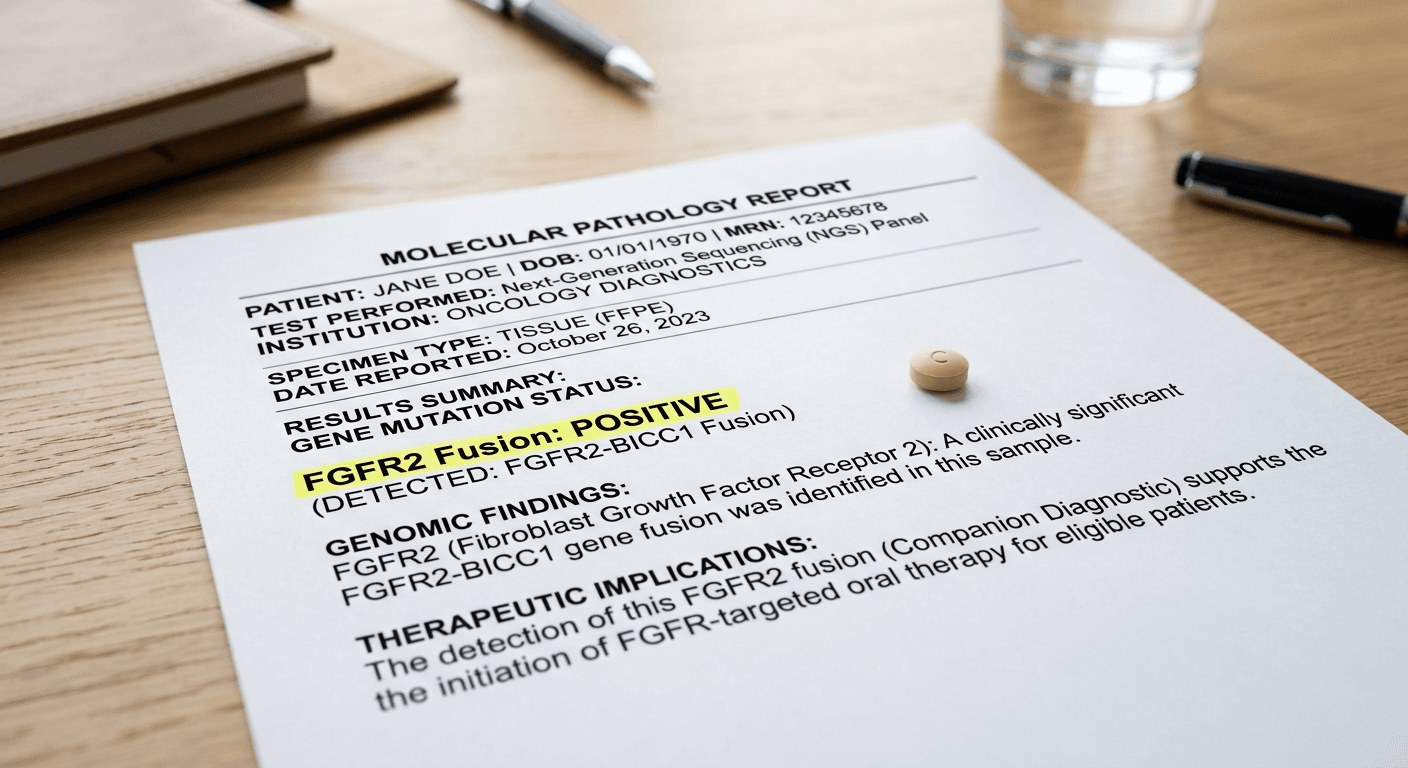
Because FGFR2 fusions are specific to intrahepatic CCA and are not present in the majority of patients, molecular testing is required before treatment. The approval of Lyrfigtu, like the earlier FGFR2-targeted CCA approvals, requires confirmation of an FGFR2 fusion or rearrangement by an FDA-authorized companion diagnostic test before initiating therapy. Next-generation sequencing (NGS) panels and liquid biopsy assays approved for this purpose identify the relevant alterations.
How Lirafugratinib Works: Covalent Binding and FGFR2 Selectivity
Fibroblast growth factor receptors (FGFRs) are a family of four receptor tyrosine kinases (FGFR1 through FGFR4) that regulate cell growth, proliferation, differentiation, and survival. When FGFR2 is constitutively activated by a gene fusion, it drives continuous downstream signaling through the RAS-MAPK and PI3K-AKT pathways, promoting tumor cell growth and survival.
Lirafugratinib blocks this signaling through two distinguishing pharmacological features.
Irreversible covalent binding
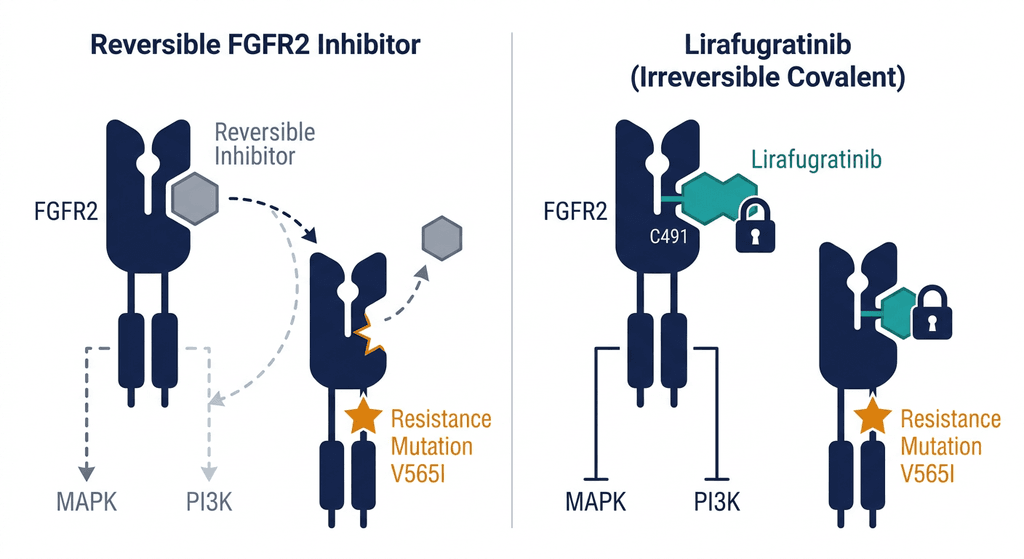
Reversible FGFR inhibitors (pemigatinib, futibatinib, infigratinib) compete with ATP at the kinase domain active site, blocking receptor phosphorylation. When drug plasma concentrations fall, the inhibitor dissociates and the receptor can resume signaling. Resistance mutations in the kinase domain can reduce the drug’s binding affinity, allowing the receptor to partially escape inhibition even at therapeutic concentrations.
Lirafugratinib takes a different approach. It binds covalently, forming a permanent chemical bond with a cysteine residue at position 491 of the FGFR2 kinase domain (C491). Once this bond forms, the receptor is irreversibly inactivated, regardless of drug plasma concentration fluctuations or dissociation. The tumor cell must synthesize new FGFR2 protein to restore receptor activity. This sustained inactivation provides more complete and durable target suppression than reversible inhibitors at equivalent doses.
The covalent binding mechanism also provides activity against several common acquired FGFR2 resistance mutations, including V565I and L618V, which reduce binding of reversible inhibitors by altering the gatekeeper residue or the hydrophobic pocket. Because lirafugratinib’s binding depends on the C491 cysteine rather than on the gatekeeper residue, these gatekeeper mutations do not significantly impair its activity. This is the scientific rationale for future investigation of lirafugratinib in patients who have progressed on prior reversible FGFR inhibitors.
FGFR2 selectivity versus pan-FGFR inhibition
Pemigatinib inhibits FGFR1, FGFR2, and FGFR3 broadly. This pan-FGFR activity produces the off-target toxicities most associated with this class: hyperphosphatemia (from FGFR1 inhibition in the kidney and bone) and nail toxicity. Lirafugratinib’s selectivity for FGFR2 over FGFR1, FGFR3, and FGFR4 reduces, though does not eliminate, these off-isoform effects, as Dr. Lipika Goyal, lead author of the REFOCUS study, noted: “Unlike earlier pan-FGFR inhibitors, it selectively targets FGFR2 while minimizing off-isoform toxicities.”
The REFOCUS Trial: Complete Data
Study Design
REFOCUS (NCT04526106) was a multicenter, open-label, Phase 1/2 single-arm trial of lirafugratinib in patients with advanced or metastatic solid tumors harboring FGFR2 alterations. The FDA approval is based on the CCA cohort, which enrolled 116 adults with unresectable or metastatic cholangiocarcinoma with confirmed FGFR2 fusions or rearrangements who were FGFR inhibitor-naive and had received prior chemotherapy or chemoimmunotherapy. Patients received lirafugratinib 70 mg orally once daily continuously. Efficacy was assessed by independent review using RECIST v1.1. Results were most recently presented at the 2026 ASCO Gastrointestinal Cancers Symposium by Dr. Antoine Hollebecque of Gustave Roussy Cancer Center.
Results
| Endpoint | Result |
|---|---|
| Objective response rate (ORR, primary; IRC per RECIST v1.1) | 46% (95% CI 36 to 55) |
| Median duration of response (DOR) | 11.8 months (95% CI 7.5 to 13.0) |
| Median progression-free survival (PFS) | 11.3 months |
| Median overall survival (OS) | 22.8 months |
| Dosing | 70 mg orally once daily |
| Safety | Consistent with on-target FGFR2 inhibition; managed through dose adjustments |
Sources: FDA approval announcement. September 23, 2026. Elevar Therapeutics press release. REFOCUS NCT04526106.
A 46% ORR in previously treated FGFR2-fusion CCA patients compares favorably to the established agents: pemigatinib showed 35.5% ORR in FIGHT-202 and futibatinib showed 41.7% in FOENIX-CCA2. Direct cross-trial comparisons have methodological limitations, but the trajectory of ORR improvement across the three FGFR2-targeted agents, 35.5% to 41.7% to 46%, is consistent with the pharmacological hypothesis that more selective and more potent FGFR2 inhibition produces deeper responses.
The median OS of 22.8 months is notable context: in previously treated unresectable CCA, median OS has historically been 6 to 9 months with chemotherapy. An approximately 22-month median survival in a second-line FGFR2-targeted population reflects the real clinical benefit of molecular targeting in this genomically defined subgroup.
The 11.3-month median PFS and 11.8-month median DOR are clinically durable for a single-agent second-line therapy in advanced GI cancer. Responses that last nearly a year from initiation represent sustained disease control in a population where progression typically occurs within 3 to 5 months of initiating standard second-line chemotherapy.
Lyrfigtu in the FGFR2 Cholangiocarcinoma Treatment Landscape
Three FGFR2-targeted agents are now FDA-approved for previously treated FGFR2-altered CCA. Understanding the practical differences among them helps clarify when each is most appropriate.
| Drug | Mechanism | ORR | Median DOR | Selectivity | Approved subtype |
|---|---|---|---|---|---|
| Pemigatinib (Pemazyre) | Reversible, ATP-competitive; pan-FGFR1-3 | 35.5% | 7.5 months | Pan-FGFR1-3 | All CCA with FGFR2 fusion/rearrangement |
| Futibatinib (Lytgobi) | Irreversible, covalent; pan-FGFR1-4 | 41.7% | 9.5 months | Pan-FGFR1-4 | Intrahepatic CCA only |
| Lirafugratinib (Lyrfigtu) | Irreversible, covalent; FGFR2-selective | 46% | 11.8 months | FGFR2-selective | All CCA with FGFR2 fusion/rearrangement |
Lyrfigtu carries a broader indication than futibatinib (all CCA subtypes with FGFR2 fusion or rearrangement, not limited to intrahepatic), matching pemigatinib’s breadth. Its FGFR2 selectivity differentiates it from both earlier agents by reducing off-isoform toxicity exposure. And its irreversible covalent mechanism, shared with futibatinib but applied in a more selective context, provides the theoretical and emerging clinical rationale for activity in patients with acquired resistance to earlier reversible FGFR inhibitors.
Safety: What Prescribers and Patients Need to Know
The safety profile of lirafugratinib in REFOCUS was consistent with on-target FGFR2 inhibition and was managed through dose adjustments. The prescribing information includes the following key warnings.
Ocular toxicity: Central serous retinopathy and retinal pigment epithelial detachment have been reported with FGFR inhibitors, including lirafugratinib. The prescribing information recommends ophthalmologic examination before treatment initiation and periodically during therapy. Patients should be counseled to report any visual disturbances promptly. Dose modification or discontinuation is required for significant ocular adverse events.
Hyperphosphatemia and soft tissue mineralization: Although lirafugratinib’s FGFR2 selectivity reduces the FGFR1-mediated hyperphosphatemia seen with pan-FGFR inhibitors, some degree of phosphate elevation may still occur. Serum phosphate should be monitored during treatment and dietary phosphate restrictions or phosphate-lowering agents used as clinically indicated.
Embryo-fetal toxicity: Lirafugratinib can cause fetal harm. Women of reproductive potential must use effective contraception during treatment and for a defined period after the last dose.
Common adverse reactions: Adverse events in the REFOCUS CCA cohort were consistent with FGFR2 inhibition and were managed through dose adjustments without high rates of treatment discontinuation. The most commonly reported adverse effects included nail-related toxicity, dry mouth, stomatitis, diarrhea, and fatigue. These are typical of the FGFR inhibitor class and are manageable with appropriate dose modification and supportive care.
Dosing: 70 mg orally once daily, taken continuously. Dose reduction to 50 mg and 35 mg is specified in the prescribing information for management of adverse reactions. Treatment continues until disease progression or unacceptable toxicity.
What This Means for GI Oncologists and Patients
For GI oncologists and hepatobiliary specialists
Lyrfigtu is now the third option in the second-line FGFR2-altered CCA space, and its approval raises a practical question that will shape institutional pathways: which agent to use first. Currently, all three agents are studied in FGFR inhibitor-naive patients. There is no head-to-head data comparing them directly.
The theoretical advantage of sequencing a reversible inhibitor first and an irreversible inhibitor second, to leverage the covalent agent’s resistance mutation coverage, is a rational hypothesis that is being investigated in trials exploring lirafugratinib in post-pemigatinib patients. Whether that strategy proves clinically beneficial is not yet established in prospective data, but it represents the most compelling positioning for lirafugratinib beyond the standard second-line FGFR inhibitor-naive setting.
For patients being considered for any FGFR2-targeted therapy, comprehensive molecular profiling to confirm FGFR2 fusion or rearrangement is essential. The specific FGFR2 partner gene and any co-occurring alterations may also inform prognosis and response, and prospective tissue collection for translational research continues to be valuable in this molecularly defined space.
Institutional pathway inclusion, as the Clinical Trial Vanguard noted, will be the practical determinant of whether Lyrfigtu reaches eligible patients efficiently. Oncologists and tumor boards at NET and hepatobiliary programs should review the REFOCUS data and determine their institutional approach to all three approved FGFR2 inhibitors.
For a related example of how molecular profiling drives treatment selection in another difficult-to-treat cancer, see our post on Rasonque (daraxonrasib), the first RAS-targeted therapy for metastatic pancreatic cancer.
For patients with cholangiocarcinoma
If you have bile duct cancer that has progressed on chemotherapy and your tumor has been found to have an FGFR2 fusion or rearrangement, Lyrfigtu is now a third approved oral targeted therapy option for your specific molecular subtype. The REFOCUS data showed that nearly half of patients responded to treatment, with responses lasting nearly a year on average.
Lyrfigtu is taken as a single oral tablet once daily, without specific food requirements. Like other FGFR inhibitors, it requires ophthalmologic monitoring and phosphate level checks during treatment.
The Cholangiocarcinoma Foundation (cholangiocarcinoma.org; 1-888-749-9945) is the leading patient advocacy organization for bile duct cancer and maintains current information on treatment options, clinical trials, and patient support.
Sources
FDA approval announcement: FDA approves lirafugratinib for previously treated, unresectable, locally advanced or metastatic cholangiocarcinoma. FDA.gov. September 23, 2026.
Elevar Therapeutics press release: Elevar Therapeutics Announces FDA Approval of Lyrfigtu (Lirafugratinib) as Second-line Cholangiocarcinoma Treatment. GlobeNewswire. September 23, 2026.
Drugs.com approval news: FDA Approves Lyrfigtu (lirafugratinib) for the Treatment of Cholangiocarcinoma with FGFR2 Fusion or Other Rearrangement. drugs.com. September 23, 2026.
CancerNetwork (irreversible covalent mechanism, REFOCUS design, dosing, key warnings): FDA Grants Approval to Lirafugratinib for Advanced Cholangiocarcinoma with FGFR2 Alteration. cancernetwork.com. September 2026.
Oncology Nursing News (full REFOCUS endpoint data, 116-patient population, nursing safety guidance): FDA Approves Lirafugratinib for Advanced FGFR2+ Cholangiocarcinoma. oncnursingnews.com. September 2026.
Medscape (ORR 46%, DOR 11.8 months, pemigatinib and futibatinib landscape context, FGFR2 selectivity quote): FDA Okays New FGFR2 Inhibitor for Cholangiocarcinoma. medscape.com. September 2026.
Healio (full ORR/DOR/PFS/OS data, prior chemotherapy requirement): Lyrfigtu gains FDA approval for previously treated cholangiocarcinoma with FGFR2 mutation. healio.com. September 2026.
OncoDaily (mechanism summary, FDA efficacy analysis exact CIs, resistance mutation rationale): FDA Approved Lirafugratinib for FGFR2 Fusion or Rearrangement-Positive Cholangiocarcinoma. oncodaily.com. September 2026.
Clinical Trial Vanguard (FGFR2 fusion frequency 15% intrahepatic/below 3% other, pathway inclusion analysis, Dr. Goyal quote full): FDA Approves Lyrfigtu for FGFR2-Rearranged Cholangiocarcinoma. clinicaltrialvanguard.com. September 2026.
REFOCUS trial registration: NCT04526106. ClinicalTrials.gov.
CCA overview: Cholangiocarcinoma. StatPearls. NCBI.
FGFR biology: FGFR signaling in cancer. PMC7234386.
Lyrfigtu prescribing information: LYRFIGTU (lirafugratinib) Prescribing Information. Elevar Therapeutics. 2026.
Lyrfigtu approval history: Lyrfigtu FDA Approval History. drugs.com.
Patient resources: Cholangiocarcinoma Foundation: 1-888-749-9945 | American Cancer Society bile duct cancer resources | Elevar Therapeutics Lyrfigtu patient support
| Disclaimer: Health Evidence Digest provides general information about FDA approvals and health research for educational purposes. This content is not a substitute for professional medical advice. Lyrfigtu (lirafugratinib) requires confirmation of FGFR2 gene fusion or other rearrangement by an FDA-authorized test before initiating treatment. Ophthalmologic monitoring and serum phosphate assessment are required during therapy. All treatment decisions for cholangiocarcinoma should be made in close collaboration with a board-certified medical oncologist or GI oncologist with expertise in biliary tract malignancies and molecular-targeted therapy. |
|---|
Leave a Reply