| The essentials: On July 16, 2026, the FDA granted traditional (full) approval to Fabhalta (iptacopan, Novartis) to slow kidney function decline in adults with primary IgA nephropathy (IgAN) at risk of disease progression. This is a regulatory conversion from accelerated approval (granted August 2024 for reduction of proteinuria) to traditional approval based on confirmatory eGFR data from the Phase 3 APPLAUSE-IgAN study. Fabhalta is now the first and only complement inhibitor with traditional FDA approval for IgAN, and the first drug in any IgAN indication to demonstrate preservation of kidney function through a statistically significant and clinically meaningful reduction in eGFR decline over two years. The APPLAUSE-IgAN primary endpoint (published NEJM 2025): annualized mean change from baseline in eGFR over 24 months: minus 3.0 mL/min/1.73 m2/year (iptacopan) versus minus 5.7 mL/min/1.73 m2/year (placebo). Absolute difference: 2.7 mL/min/1.73 m2/year benefit. 48% slowing of eGFR decline versus placebo. UPCR at month 24: consistent with the interim analysis data that supported accelerated approval (38% reduction versus placebo at 9 months). UPCR onset: clinically meaningful reduction as early as 2 weeks. Composite kidney failure endpoint: kidney failure event in 21.4% (iptacopan) versus 33.5% (placebo); HR 0.6 (95% CI 0.4 to 0.8); p=0.0015. Sustained 30% or greater decline in eGFR from baseline: 21% (iptacopan) versus 33.1% (placebo). Primary NEJM publication: Perkovic V, Barratt J, Rovin B et al. Alternative complement pathway inhibition with iptacopan in IgA nephropathy. NEJM. 2025;392:531-543. doi:10.1056/NEJMoa2410316. The full APPLAUSE-IgAN indication now reads: to slow the decline in kidney function in adults with primary IgAN at risk of rapid disease progression, generally a UPCR at or above 0.75 g/g. The prior accelerated approval language (to reduce proteinuria) was superseded by the traditional approval language (to slow decline in kidney function). Key safety: boxed warning for serious and life-threatening infections caused by encapsulated bacteria (Streptococcus pneumoniae, Neisseria meningitidis, Haemophilus influenzae type b), requiring vaccination before treatment initiation and ongoing vigilance. REMS program remains in effect. Most common adverse reactions in IgAN: abdominal pain, dizziness, nausea. Fabhalta’s other two indications (PNH and C3G) are not affected by this action. |
|---|
In the post on Trutakna earlier in HED’s coverage of the 2026 IgAN approval wave, we explained what accelerated approval means and what it does not. The short version: a drug that receives accelerated approval for reducing proteinuria has demonstrated that it lowers a surrogate marker that predicts kidney health. It has not yet demonstrated that it actually preserves kidney function over the years of treatment that matter to patients.
Fabhalta received its accelerated approval in August 2024 precisely because of this distinction. The APPLAUSE-IgAN interim analysis at 9 months showed a 38% reduction in UPCR compared to placebo, statistically significant and clinically meaningful. The FDA and Novartis were explicit in the accelerated approval label: it had not been established whether Fabhalta slows kidney function decline. The continued approval was contingent on verifying that the proteinuria reduction translated into preserved eGFR.
On October 16, 2025, Novartis announced that APPLAUSE-IgAN met its primary endpoint: over 24 months, iptacopan slowed eGFR decline by 48% versus placebo (minus 3.0 versus minus 5.7 mL/min/1.73 m2/year). The eGFR story confirmed what the proteinuria surrogate had predicted. The conversion to traditional approval, completed July 16, 2026, reflects the FDA’s formal conclusion that the clinical benefit is real and established.
This post covers what IgAN is and what happens to kidneys when it progresses, how iptacopan’s complement Factor B inhibition mechanism targets a key driver of that progression, what the complete APPLAUSE-IgAN data shows, what the accelerated-to-traditional conversion means for the IgAN treatment landscape, and where Fabhalta now sits relative to the growing number of approved IgAN therapies.
What IgA Nephropathy Is and Why the eGFR Endpoint Matters
IgA nephropathy is the most common primary glomerulonephritis worldwide, occurring when galactose-deficient IgA1 antibodies and their immune complexes deposit in the mesangium of the kidney’s glomeruli. The deposited immune complexes trigger complement activation, inflammatory cell recruitment, mesangial cell proliferation, and progressive fibrosis of the glomerular architecture. The clinical consequence is an inexorable decline in the kidney’s filtering capacity, measured by the fall in estimated glomerular filtration rate (eGFR) over years.
The disease burden of IgAN is substantial. Up to 50% of IgAN patients with persistent proteinuria progress to kidney failure within 10 to 20 years of diagnosis, often requiring dialysis and kidney transplantation. This statistic is the reason why the distinction between proteinuria reduction and eGFR preservation is not a regulatory technicality. It is the difference between demonstrating that a drug affects a biomarker that predicts kidney failure and demonstrating that it actually reduces the risk of kidney failure. HCP Live
Why eGFR is the endpoint that matters most
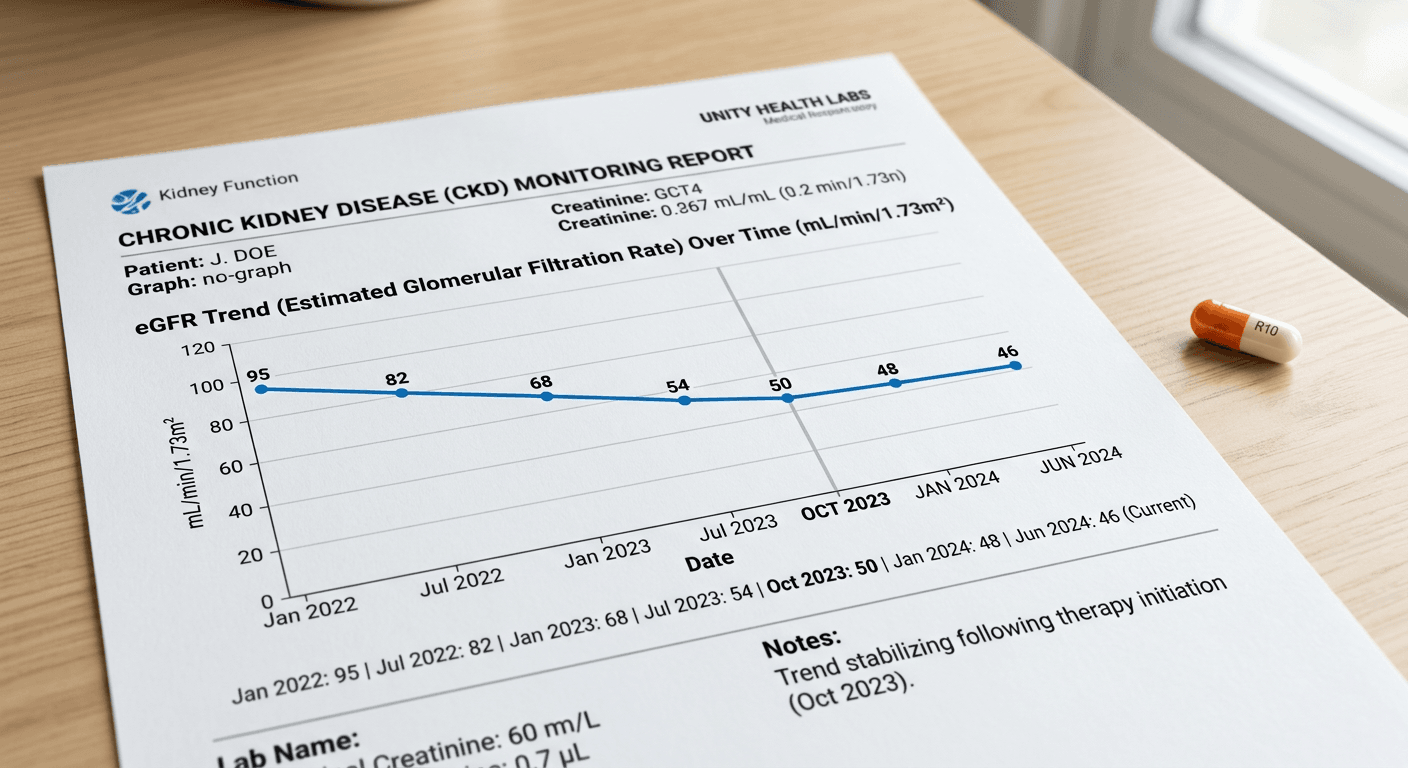
Estimated glomerular filtration rate (eGFR) is calculated from serum creatinine (and increasingly cystatin C) using validated equations and serves as the best clinically accessible measure of how well the kidneys are filtering blood. Normal eGFR in a healthy young adult is approximately 90 to 120 mL/min/1.73 m2. As glomerular damage accumulates in IgAN, eGFR falls progressively. Below 15 mL/min/1.73 m2, kidney failure requiring dialysis or transplantation typically occurs.
The rate of eGFR decline is directly predictive of time to kidney failure. A patient with IgAN losing 5.7 mL/min/1.73 m2 per year (the placebo rate in APPLAUSE-IgAN) will reach kidney failure thresholds approximately twice as fast as a patient losing 3.0 mL/min/1.73 m2 per year (the iptacopan rate). Over a decade, this difference compounds into years of kidney function preserved.
Proteinuria (measured by UPCR) is an important and validated surrogate: higher proteinuria predicts faster eGFR decline, and reducing proteinuria predicts slowing eGFR decline. But it is a prediction, not a demonstration. The regulatory value of the APPLAUSE-IgAN eGFR data is that it converts the prediction into clinical evidence.
How Iptacopan Works: Factor B Inhibition of the Alternative Complement Pathway
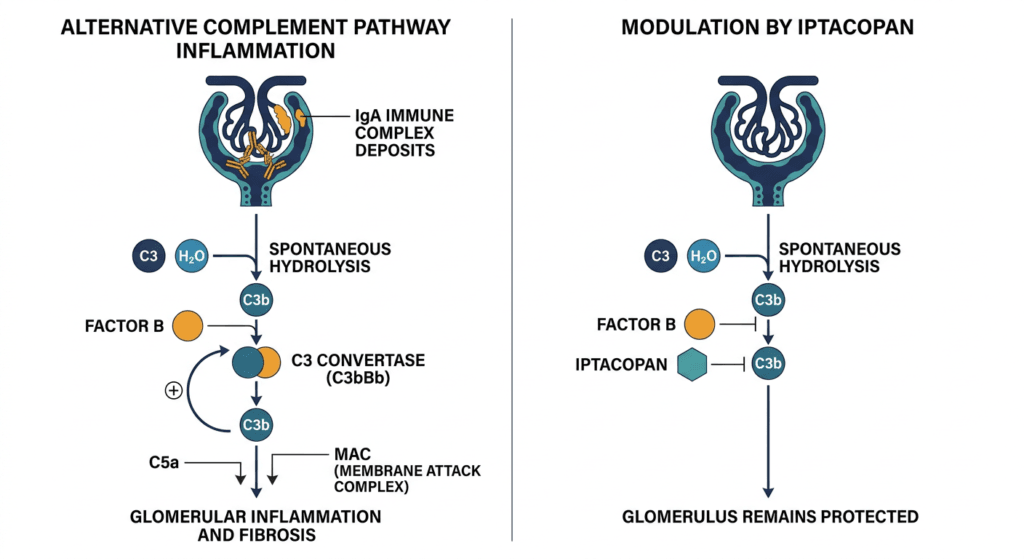
Complement is a system of proteins that form a critical arm of innate immunity, capable of directly lysing pathogens, marking them for phagocytosis, and triggering inflammation. The system operates through three pathways (classical, lectin, and alternative) that converge on a common lytic mechanism. In IgAN, the alternative complement pathway (ACP) plays a central role in amplifying the inflammatory injury triggered by IgA immune complex deposition in the mesangium.
The alternative complement pathway is constitutively activated at low levels under normal conditions through spontaneous hydrolysis of C3. When immune complexes or other activating surfaces are present, this spontaneous activation is dramatically amplified through a positive feedback loop: C3b deposits on activating surfaces, recruits Factor B, which is cleaved by Factor D to form the alternative pathway C3 convertase (C3bBb). This convertase cleaves more C3, generating more C3b and amplifying the loop. The downstream consequence in IgAN is glomerular inflammation, mesangial cell activation, and progressive injury.
Iptacopan is an oral, once-daily, small-molecule inhibitor of complement Factor B, the key amplification enzyme of the alternative pathway. By blocking Factor B, iptacopan prevents the formation and activity of the alternative pathway C3 convertase, selectively inhibiting ACP amplification without globally suppressing all complement pathways. This selectivity is pharmacologically important: the classical pathway (which handles routine immune complex clearance) and the lectin pathway (which handles certain pathogen recognition) are not directly inhibited, preserving aspects of innate immunity while specifically targeting the amplification loop responsible for the complement-driven injury in IgAN.
Iptacopan was discovered by Novartis and is the first approved oral Factor B inhibitor. The oral small-molecule format (twice daily, 200 mg capsules) is clinically significant in a nephrology population that commonly takes multiple medications daily and for whom an intravenous or subcutaneous dosing requirement would add meaningful burden.
The APPLAUSE-IgAN Study: Complete Data
Design
APPLAUSE-IgAN (NCT04578834) was a Phase 3, multicenter, randomized, double-blind, placebo-controlled trial enrolling adults with biopsy-confirmed primary IgAN who had eGFR of 30 to 90 mL/min/1.73 m2 at baseline and UPCR at or above 0.75 g/g despite optimized background therapy (maximally tolerated RAAS blockade). Patients were randomized 1:1 to iptacopan 200 mg twice daily or placebo for 24 months.
The trial had two pre-specified analysis timepoints: a 9-month interim analysis for proteinuria (which supported accelerated approval in August 2024) and a 24-month final analysis for eGFR (which supported the traditional approval in July 2026).
The primary endpoint for the traditional approval was the annualized mean change from baseline in eGFR over 24 months, assessed by the slope of eGFR over time using a linear mixed-effects model.
APPLAUSE-IgAN complete results
| Endpoint | Iptacopan | Placebo | Result |
|---|---|---|---|
| Annualized mean eGFR change from baseline (24 months, primary) | Minus 3.0 mL/min/1.73 m2/year | Minus 5.7 mL/min/1.73 m2/year | 2.7 mL/min/1.73 m2/year benefit; 48% slowing; p less than 0.001 |
| Sustained 30% or greater eGFR decline from baseline | 21.0% | 33.1% | Substantially lower with iptacopan |
| Composite kidney failure event | 21.4% | 33.5% | HR 0.6 (95% CI 0.4 to 0.8); p=0.0015 |
| UPCR at month 9 (accelerated approval interim) | Minus 44% from baseline | Minus 9% from baseline | 38% reduction versus placebo; p less than 0.0001 |
| UPCR at month 24 (consistent with interim) | Sustained | Sustained | Consistent with 9-month data |
| Onset of proteinuria reduction | As early as 2 weeks | — | Clinically meaningful early onset |
| Consistent treatment effect across subgroups | Yes | — | Including baseline eGFR, proteinuria, SGLT2i use |
Source: Perkovic V, Barratt J, Rovin B et al. Alternative complement pathway inhibition with iptacopan in IgA nephropathy. NEJM. 2025;392:531-543. doi:10.1056/NEJMoa2410316. NCT04578834.
The composite kidney failure endpoint result, a 40% relative reduction in kidney failure events (HR 0.6), is among the most clinically meaningful findings in the APPLAUSE-IgAN dataset. The absolute difference (21.4% versus 33.5%) means that approximately 1 in 8 patients avoided a kidney failure event over the 24-month period by receiving iptacopan. In a disease where kidney failure means dialysis or transplantation, this is a meaningful difference in outcomes.
The consistency of treatment effect across subgroups, including patients already on SGLT2 inhibitors (which also reduce proteinuria and are increasingly used in IgAN), is clinically relevant. The benefit of iptacopan appears additive to SGLT2 inhibitor background therapy rather than redundant, supporting its use in patients already on other IgAN-active agents.
The Regulatory Conversion: What It Means in the IgAN Context
This is the second accelerated-to-traditional approval conversion in IgAN following the post I covered for Retevmo in the broader precision oncology space, but here the conversion is specifically meaningful for nephrology practice.
The August 2024 accelerated approval for Fabhalta came with explicit language that was required in the label and in clinical communication: it has not been established whether Fabhalta slows kidney function decline. For patients, this meant starting a treatment whose long-term kidney benefit had not been proven. For payers, it meant coverage decisions made on surrogate data. For clinicians, it meant uncertainty about whether the drug would ultimately demonstrate what the surrogate predicted.
The July 2026 traditional approval resolves each of these tensions. The eGFR data are the clinical outcome that patients, payers, and clinicians were waiting for. The 48% slowing of eGFR decline over two years is not a surrogate. It is a direct measure of kidney function preserved. The HR 0.6 for the composite kidney failure endpoint is a direct measure of clinical events prevented. These data change the nature of the clinical conversation about iptacopan from “we believe this is likely to help your kidneys” to “we have demonstrated that this helps your kidneys.”
The practical implications for prescribing are modest because the indication, dosing, and patient population are unchanged. But the traditional approval removes the post-marketing uncertainty and strengthens the evidence base for formulary coverage and guideline integration.
Fabhalta’s Complete Indication Picture After July 2026
Iptacopan is the only drug currently approved across three distinct complement-mediated rare diseases:
| Indication | Approval type | Date | Basis |
|---|---|---|---|
| Paroxysmal nocturnal hemoglobinuria (PNH): increase hemoglobin and reduce need for transfusions without eculizumab/ravulizumab | Traditional | December 5, 2023 | APPLY-PNH Phase 3 |
| Primary IgAN: reduce proteinuria | Accelerated (now superseded) | August 8, 2024 | APPLAUSE-IgAN 9-month interim |
| Primary IgAN: slow decline in kidney function | Traditional | July 16, 2026 | APPLAUSE-IgAN 24-month final |
| Complement 3 glomerulopathy (C3G): reduce proteinuria | Accelerated | November 2025 | APPEAR-C3G Phase 3 |
The PNH indication, the original approval, demonstrated that iptacopan could be given as a standalone therapy to patients previously dependent on IV terminal complement inhibitors (eculizumab, ravulizumab), providing a fully oral alternative for a disease that had been managed exclusively with biweekly or monthly IV infusions. The C3G indication reflects the same Factor B mechanism applied to a different complement-driven kidney disease.
Where Fabhalta Fits in the IgAN Treatment Landscape After July 2026
The IgAN treatment landscape, covered in detail in our earlier post on Trutakna (atacicept-vymj, Vera Therapeutics), now includes six approved therapies targeting different mechanisms. Fabhalta’s traditional approval for eGFR preservation makes it the only drug in the IgAN space with full FDA approval based on a kidney function outcome endpoint rather than the proteinuria surrogate.
| Drug | Mechanism | FDA status in IgAN | Primary endpoint achieved |
|---|---|---|---|
| Tarpeyo (budesonide EC) | Gut mucosal IgA reduction | Full approval (2023) | Proteinuria (UPCR) |
| Filspari (sparsentan) | Dual endothelin A and AT1 antagonist | Full approval (2024) | eGFR slope (PROTECT trial) |
| Fabhalta (iptacopan) | Complement Factor B inhibitor | Full approval (July 2026) | eGFR slope (APPLAUSE-IgAN) |
| Vanrafia (atrasentan) | Selective endothelin A antagonist | Full approval (August 2024) | Composite kidney endpoint (ALIGN) |
| Trutakna (atacicept) | Dual BAFF/APRIL inhibitor | Accelerated approval (July 2026) | Proteinuria (UPCR) |
Fabhalta is the only drug targeting complement in this landscape. Its mechanism is entirely distinct from the RAAS-adjacent approaches (sparsentan, atrasentan), the mucosal IgA approach (budesonide EC), and the B-cell cytokine approaches (atacicept). This mechanistic diversity is relevant for clinical decision-making: patients who are on one of the other approved agents and still progressing have a mechanistically distinct alternative available in iptacopan.
The question of whether combination therapy across multiple mechanistic targets is safe and additive is one that ongoing clinical research is beginning to address but that is outside the current approved labels for any of these agents. Clinicians combining agents should do so with full awareness that combination safety and efficacy data are limited.
Safety: The Boxed Warning and What It Means in Practice
Boxed warning: serious infections from encapsulated bacteria
Factor B inhibition selectively suppresses the alternative complement pathway. While this selectivity preserves classical and lectin pathway function, the alternative pathway plays an important amplification role in the defense against encapsulated bacteria, particularly Neisseria meningitidis, Streptococcus pneumoniae, and Haemophilus influenzae type b. Inhibition of the alternative pathway therefore increases susceptibility to infections from these organisms, which can be rapidly fatal.
The Fabhalta prescribing information includes a boxed warning regarding an increased risk for serious and life-threatening infections caused by encapsulated bacteria, including Streptococcus pneumoniae, Neisseria meningitidis, and Haemophilus influenzae type b.
Required vaccination before treatment initiation: Patients must be vaccinated against Neisseria meningitis (serogroups A, C, W, Y, and B; two separate meningococcal vaccines are required), Streptococcus pneumoniae, and Haemophilus influenzae type b before starting iptacopan, unless the urgency of treatment outweighs the risk of not being vaccinated. Vaccination must precede the first dose by at least 2 weeks whenever possible.
REMS program: Fabhalta is available only through a Risk Evaluation and Mitigation Strategy (REMS) program. Prescribers must enroll in the REMS, patients must receive a medication guide, and pharmacies must be certified. The REMS exists to ensure patients are vaccinated before starting therapy and are educated about infection risk.
Ongoing vigilance: Patients receiving iptacopan should be counseled to seek immediate medical attention for any signs of meningococcal infection: sudden onset of fever, headache, stiff neck, nausea, vomiting, sensitivity to light, or altered mental status. These can progress to life-threatening illness within hours.
Common adverse reactions in IgAN
The most common adverse reactions reported with iptacopan in adults with IgAN were abdominal pain, dizziness, and nausea. These were generally mild to moderate in severity. The adverse reaction profile in IgAN is consistent with the established safety experience from the PNH program, where iptacopan was generally well tolerated with the encapsulated bacteria infection risk being the dominant safety concern.
Dosing
Fabhalta is administered as 200 mg (two 100 mg capsules) orally twice daily, with or without food. This is the same dose and schedule as used in the PNH and C3G indications. No dose adjustments are required for mild to moderate renal impairment; guidance for severe impairment should be reviewed in the prescribing information.
What This Means for Nephrologists and Patients
For nephrologists managing primary IgAN
The traditional approval of Fabhalta for eGFR preservation establishes the first complement inhibitor with a kidney function outcome in IgAN. This is a meaningful clinical milestone beyond regulatory classification: the APPLAUSE-IgAN data demonstrate that blocking the alternative complement pathway at Factor B translates into preserved kidney function over two years, not just reduced protein in the urine.
The 2.7 mL/min/1.73 m2/year absolute benefit in eGFR slope may appear modest in isolation, but in the context of IgAN’s decades-long progression, it represents a meaningful delay in time to kidney failure. The composite kidney failure event data (HR 0.6; 21.4% versus 33.5%) provides the most direct clinical outcome evidence for iptacopan’s benefit.
For patients already on Tarpeyo, sparsentan, or SGLT2 inhibitors: the consistent treatment effect of iptacopan across subgroups including SGLT2 inhibitor users supports its use as an add-on to background therapy. Whether it is additive to sparsentan or budesonide EC specifically is not established in the current trial data.
The vaccination requirement and REMS program add administrative steps to prescribing that should be built into practice workflows. Patients should be identified for vaccination at the time the treatment decision is made, not after, to avoid treatment delays.
For patients with primary IgAN
The traditional approval means that iptacopan has proven, in a two-year randomized controlled trial, that it slows the loss of kidney function. For patients who have been told they are at risk of progressing to kidney failure, this is the most directly relevant clinical evidence for any IgAN therapy approved to date alongside sparsentan (which also demonstrated eGFR benefit in the PROTECT trial).
The oral twice-daily dosing means no clinic visits for infusions or injections. The required vaccinations before starting are a one-time pre-treatment requirement, not an ongoing burden. The primary ongoing considerations are the infection monitoring, the twice-daily capsule regimen, and the management of GI adverse effects if they occur.
For related HED coverage on the expanding IgAN treatment landscape, see our earlier post on Trutakna (atacicept-vymj), the first dual BAFF/APRIL inhibitor approved for IgAN, which received accelerated approval on July 7, 2026, and for broader complement biology context, our post on Tregzi (marnetegragene autotemcel), which covers complement system biology in the context of LAD-I gene therapy.
For patients and families navigating an IgAN diagnosis, the IgA Nephropathy Foundation and the National Kidney Foundation (kidney.org; 1-800-622-9010) maintain current resources on treatment options, clinical trials, and patient support.
Sources
Novartis traditional approval press release: Novartis Fabhalta (iptacopan) receives FDA traditional approval as first and only complement inhibitor to significantly slow kidney function decline in primary IgAN. GlobeNewswire. July 16 to 17, 2026. Full press release.
Drugs.com approval news: Novartis Fabhalta receives FDA traditional approval as first and only complement inhibitor to significantly slow kidney function decline in primary IgAN. drugs.com. July 2026.
Renal and Urology News (composite kidney failure endpoint data, eGFR subgroup, adverse reactions): Fabhalta Earns Full FDA Approval to Slow Kidney Decline in Primary IgAN. renalandurologynews.com. July 2026.
HCPLive (eGFR slope data, conversion context, complementary mechanisms in IgAN landscape): FDA Grants Full Approval to Iptacopan (Fabhalta) in IgAN. hcplive.com. July 2026.
PharmExec (accelerated to traditional conversion narrative, REMS, Factor B mechanism): FDA Approves Fabhalta to Slow Kidney Function Decline in Primary IgAN. pharmexec.com. July 2026.
APPLAUSE-IgAN primary NEJM publication: Perkovic V, Barratt J, Rovin B et al. Alternative complement pathway inhibition with iptacopan in IgA nephropathy. NEJM. 2025;392:531-543. doi:10.1056/NEJMoa2410316.
APPLAUSE-IgAN primary endpoint announcement (Novartis, October 2025): Novartis Fabhalta meets Phase III primary endpoint, slows kidney function decline in patients with IgA nephropathy. novartis.com. October 16, 2025.
APPLAUSE-IgAN accelerated approval press release (August 2024): Novartis receives FDA accelerated approval for Fabhalta for reduction of proteinuria in primary IgAN. novartis.com. August 8, 2024.
APPLAUSE-IgAN trial registration: NCT04578834. ClinicalTrials.gov.
IgA nephropathy overview: IgA Nephropathy (Berger Disease). StatPearls. NCBI.
Complement system biology: Complement Pathway. PMC7234620.
Iptacopan mechanism review: Olezarsen/Iptacopan complement mechanism reference. PMC12700839.
Fabhalta prescribing information: FABHALTA (iptacopan) Prescribing Information. Novartis Pharmaceuticals Corp. July 2026.
Fabhalta approval history: Fabhalta FDA Approval History. drugs.com.
Patient resources: IgA Nephropathy Foundation | National Kidney Foundation: 1-800-622-9010 | American Kidney Fund | Novartis Fabhalta patient support
| Disclaimer: Health Evidence Digest provides general information about FDA approvals and health research for educational purposes. This content is not a substitute for professional medical advice. Fabhalta (iptacopan) carries a boxed warning for serious and life-threatening infections caused by encapsulated bacteria, including Neisseria meningitidis, Streptococcus pneumoniae, and Haemophilus influenzae type b. Vaccination against these pathogens is required before initiating treatment. Fabhalta is available only through a REMS program. Prescribing and monitoring should be carried out by a board-certified nephrologist or physician experienced in the management of primary IgA nephropathy and complement-mediated kidney disease. |
|---|
Leave a Reply