
| The essentials: On August 27, 2026, the FDA approved Bixlenvo (bictegravir 75 mg/lenacapavir 50 mg, Gilead Sciences) as a complete once-daily single-tablet regimen (STR) to replace the current antiretroviral regimen in adults who are virologically suppressed (HIV-1 RNA below 50 copies/mL) on a stable regimen with no known or suspected resistance to either component. Bixlenvo is the smallest available STR for HIV, measuring 7 by 13 mm, and the first and only STR available for virologically suppressed adults on complex multi-tablet regimens who have not been able to use currently available STRs due to pre-existing resistance or tolerability issues. What it combines: bictegravir (BIC), a guideline-recommended integrase strand transfer inhibitor (INSTI) with a high barrier to resistance, and lenacapavir (LEN), a first-in-class HIV-1 capsid inhibitor with a novel multi-stage mechanism and no cross-resistance to any other antiretroviral class. Together, the two drugs target HIV at two distinct and separate points in its replication cycle. The clinical basis: Phase 3 ARTISTRY-1 (NCT05502341; n=557, 15 countries; Lancet publication) and Phase 3 ARTISTRY-2 (NCT06333808; Lancet HIV publication). Both trials enrolled virologically suppressed adults with no known resistance to bictegravir or lenacapavir. ARTISTRY-1 evaluated switching from complex multi-tablet regimens; ARTISTRY-2 evaluated switching from Biktarvy (bictegravir/emtricitabine/tenofovir alafenamide). Both trials were randomized 2:1 to Bixlenvo or continuation of baseline regimen. Primary endpoint (both trials): proportion of participants with HIV-1 RNA at or above 50 copies/mL at week 48 (FDA Snapshot algorithm). ARTISTRY-1 result: 1.0% (Bixlenvo) versus 1.1% (complex regimen); difference minus 0.3% (95.002% CI minus 2.3% to 1.8%); noninferiority met. No resistance mutations emerged. ARTISTRY-2 result: 1% (Bixlenvo) versus 1% (Biktarvy); difference 0.3% (95.002% CI minus 1.9% to 2.4%); noninferiority met. Virologic suppression maintained in 93% (Bixlenvo) versus 91% (Biktarvy) at week 48. CD4 counts stable in both groups. No capsid resistance mutations. Treatment satisfaction higher with Bixlenvo in ARTISTRY-1. Most common adverse reactions (at least 2%): headache, nausea, diarrhea. Contraindications: dofetilide; strong CYP3A inducers. |
|---|
The history of HIV treatment is, in many ways, a story about simplification. In the early years of combination antiretroviral therapy, regimens commonly involved 20 or more pills per day, each with its own food requirements, side effect profile, and resistance history. The development of fixed-dose combinations progressively collapsed those regimens: first to triple combinations, then to three-drug single tablets. By the mid-2010s, a complete HIV regimen could fit in a single once-daily pill. That simplicity changed everything about adherence, tolerability, and quality of life.
But not everyone has been able to take advantage of it. A meaningful population of long-term HIV patients carry resistance mutations accumulated from years of earlier therapy or treatment interruptions. For these patients, the standard three-drug single tablets often do not work because the regimen includes at least one drug to which their virus has developed resistance. They instead remain on complex multi-tablet regimens, sometimes four or five pills across multiple classes, to maintain virologic suppression.
Until now, no single-tablet regimen existed that could reach them.
Bixlenvo (bictegravir/lenacapavir, Gilead) is specifically designed to address this gap. By combining bictegravir, already considered one of the most resistance-resilient INSTIs, with lenacapavir, a capsid inhibitor that works through a completely different mechanism with no cross-resistance to any other existing antiretroviral class, Bixlenvo offers a two-drug combination that maintains virologic suppression even in heavily treatment-experienced patients whose prior regimen history would have excluded them from every other STR on the market.
HIV-1 and Why Virologic Suppression Is the Central Treatment Goal
HIV-1 is a retrovirus that infects CD4-positive T cells and other immune cells, using the host cell machinery to replicate and progressively depleting the immune system if untreated. Without antiretroviral therapy, HIV infection eventually leads to AIDS and life-threatening opportunistic infections.
Modern antiretroviral therapy does not cure HIV. What it does is suppress viral replication to levels below the detection threshold of standard assays, typically defined as HIV-1 RNA below 50 copies/mL. At this level of virologic suppression, the immune system stabilizes, HIV-related morbidity falls dramatically, and life expectancy approaches that of the general population. Just as critically, a virologically suppressed person cannot sexually transmit the virus to partners, the U=U (undetectable equals untransmittable) principle that has reshaped both clinical practice and public health messaging.
Maintaining that suppression requires adherence to antiretroviral therapy indefinitely. This is why simplification matters so much in clinical practice. Every pill burden reduction, every drug interaction eliminated, and every side effect avoided is a factor that improves the chance that a patient stays on their regimen for life.
The Two Mechanisms: What Bictegravir and Lenacapavir Each Do
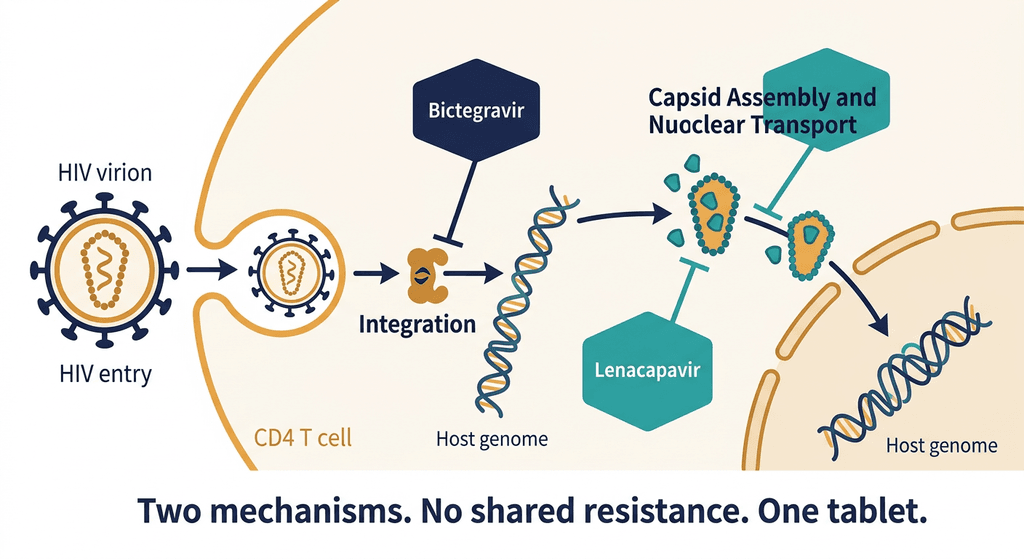
Bixlenvo works at two distinct stages of the HIV replication cycle, which is the core pharmacological rationale for the combination.
Bictegravir: INSTI with a high resistance barrier
Bictegravir is an integrase strand transfer inhibitor (INSTI). HIV integrase is the enzyme the virus uses to insert its DNA into the host cell genome, a step essential for establishing a persistent infection. By blocking integrase, bictegravir prevents the virus from integrating and establishing a permanent reservoir in new cells.
Bictegravir’s resistance barrier is notably high. Selecting for resistance mutations against bictegravir in vitro requires multiple simultaneous mutations, making it substantially harder for the virus to develop clinical resistance compared to first-generation INSTIs like raltegravir or elvitegravir. This high resistance barrier is why bictegravir remains effective even in patients with prior INSTI exposure, provided specific substitutions at key positions have not emerged.
Lenacapavir: the first-in-class capsid inhibitor
Lenacapavir is the only approved HIV-1 capsid inhibitor and works through a mechanism entirely unlike any other antiretroviral. The HIV capsid is a protein shell that forms around the viral core during replication and plays roles at multiple stages of the HIV lifecycle: capsid assembly during viral budding, nuclear transport of the viral complex into the host cell nucleus, and disassembly (uncoating) after cell entry to release the viral genome.
Lenacapavir binds directly to the capsid protein at a specific interface site and disrupts all of these functions simultaneously. Because the capsid protein target and binding site are structurally distinct from the targets of INSTIs, nucleoside reverse transcriptase inhibitors, protease inhibitors, and other classes, lenacapavir has no cross-resistance with any of them. A patient who carries mutations that render NRTI, protease inhibitor, or older INSTI therapy ineffective still has a fully functional capsid protein that lenacapavir can target.
In Bixlenvo, lenacapavir is dosed at 50 mg orally once daily, which is a different dose than the 600 mg subcutaneous injection dose used in Sunlenca (lenacapavir injection), already approved for heavily treatment-experienced adults. The oral daily formulation in Bixlenvo is specifically designed for the maintenance setting in virologically suppressed patients.
Who Bixlenvo Is and Is Not For
The approved indication is carefully defined and requires understanding on both dimensions.
Who it is for: Adults who are virologically suppressed, meaning HIV-1 RNA below 50 copies/mL for at least 6 months on a stable regimen, with no known or suspected resistance to bictegravir or lenacapavir. This includes both patients switching from complex multi-tablet regimens (ARTISTRY-1 population) and patients switching from Biktarvy (ARTISTRY-2 population).
Who it is not for: Patients with known resistance to bictegravir or lenacapavir are excluded. Bixlenvo is not approved for treatment-naive patients starting HIV therapy for the first time. It is a switch regimen for stable, suppressed adults, not an initiation regimen for newly diagnosed patients.
The complex regimen population covered by ARTISTRY-1 is particularly significant. These are patients who, because of prior antiretroviral resistance history, could not take any of the existing three-drug single-tablet options. For them, Bixlenvo is not just a simplification option. For the first time, it is the only STR available to them at all.
The ARTISTRY Trials: What the Data Shows
ARTISTRY-1 (NCT05502341): Switching from complex regimens
ARTISTRY-1 was a randomized, open-label, active-controlled, Phase 3 noninferiority trial conducted across 15 countries. It enrolled 557 virologically suppressed adults on complex multi-tablet antiretroviral regimens, meaning two or more separate antiretroviral agents taken as multiple pills. Participants were randomized 2:1 to switch to once-daily Bixlenvo (n=371) or continue their complex regimen (n=186). Enrollment required at least 6 months of virologic suppression on baseline therapy and no known or suspected resistance to bictegravir or lenacapavir.
The primary endpoint was the proportion of participants with HIV-1 RNA at or above 50 copies/mL at week 48 by FDA Snapshot algorithm, with a noninferiority margin of 4%.
| Endpoint at week 48 | Bixlenvo | Complex regimen | Result |
|---|---|---|---|
| HIV-1 RNA at or above 50 copies/mL (primary) | 1.0% | 1.1% | Difference minus 0.3% (95.002% CI minus 2.3% to 1.8%); noninferiority met |
| Resistance mutations | None | — | No resistance emerged in Bixlenvo arm |
| Treatment satisfaction | Higher | Reference | Statistically significant |
Source: ARTISTRY-1, The Lancet. 2026. NCT05502341.
Virologic failure rates were essentially identical between arms, at approximately 1%. No resistance mutations to either bictegravir or lenacapavir emerged in participants who switched to Bixlenvo. Treatment satisfaction was meaningfully higher with Bixlenvo, reflecting the quality-of-life impact of simplifying from a complex multi-pill regimen to a single small tablet.
ARTISTRY-2 (NCT06333808): Switching from Biktarvy
ARTISTRY-2 was a randomized, double-blind, active-controlled, Phase 3 noninferiority trial comparing Bixlenvo to continued Biktarvy (bictegravir/emtricitabine/tenofovir alafenamide) in virologically suppressed adults. Participants switching from Biktarvy were randomized 2:1 to Bixlenvo or continued Biktarvy. This trial addressed a different clinical question: does adding the capsid inhibitor dimension of lenacapavir, while dropping the two nucleoside analogs (emtricitabine and tenofovir alafenamide), maintain the same virologic control?
| Endpoint at week 48 | Bixlenvo | Biktarvy | Result |
|---|---|---|---|
| HIV-1 RNA at or above 50 copies/mL (primary) | 1.0% | 1.0% | Difference 0.3% (95.002% CI minus 1.9% to 2.4%); noninferiority met |
| Virologic suppression (HIV-1 RNA below 50 copies/mL) | 93% | 91% | Comparable |
| Capsid resistance mutations | None | — | No capsid resistance emerged |
| CD4 cell count | Stable | Stable | No meaningful change in either arm |
| Drug-related adverse events | 10.0% | 12.0% | Similar |
Source: ARTISTRY-2, Lancet HIV. Published May 6, 2026. NCT06333808.
One isolated integrase substitution without phenotypic resistance was detected in one ARTISTRY-2 participant on Bixlenvo, but no clinically meaningful resistance emerged in either trial. Body mass index remained stable after the switch. Together, the two ARTISTRY trials establish that Bixlenvo maintains virologic suppression comparably to both complex regimens and established three-drug STRs across the 48-week observation period.
Why the Two-Drug Combination Works Without NRTI Backbone
Traditional HIV regimens are built around a nucleoside reverse transcriptase inhibitor (NRTI) backbone, typically two NRTIs (such as emtricitabine and tenofovir alafenamide), which provides the foundational antiretroviral activity to which a third drug from another class is added. Biktarvy and most other STRs follow this framework.
Bixlenvo abandons the NRTI backbone entirely. It is a two-drug regimen using two classes that have not previously been combined in a daily oral format. This works because the resistance barrier of the bictegravir and lenacapavir combination in vitro is extremely high. Selecting for resistance to this combination simultaneously requires independent mutations at two unrelated targets, the integrase active site and the capsid protein binding interface, a pharmacologically demanding dual requirement. The absence of capsid resistance mutations across both ARTISTRY trials, even in participants with prior antiretroviral treatment history, supports the clinical robustness of this barrier.
The two-drug design also has practical advantages. Removing the NRTI backbone eliminates the renal and bone density concerns associated with tenofovir-based therapy, which is relevant for older patients or those with renal impairment who may already be managing these concerns.
For coverage of the other new two-drug switch regimen approved in 2026, Idvynso (doravirine/islatravir), which takes a different approach using an NNRTI plus a first-in-class NRTTI with no INSTI and no tenofovir, see our earlier post at healthevidencedigest.com/fda-approves-two-drug-hiv-suppression-regimen.
Safety: What Prescribers and Patients Need to Know
The safety profile of Bixlenvo across ARTISTRY-1 and ARTISTRY-2 was consistent with the established profiles of both component drugs and showed no new or unexpected safety signals.
Most common adverse reactions (at least 2% across the ARTISTRY program): headache, nausea, and diarrhea. These were generally mild and consistent with both bictegravir’s and lenacapavir’s known individual profiles.
Drug-related adverse event rates were 10.0% in the Bixlenvo arm and 12.0% in the Biktarvy arm in ARTISTRY-2, confirming that Bixlenvo was at least as well tolerated as the established comparator.
Contraindications: Bixlenvo is contraindicated with dofetilide (a cardiac antiarrhythmic) because bictegravir inhibits the renal transporter OCT2, which can dramatically increase dofetilide exposure and risk of serious cardiac arrhythmia. Strong CYP3A inducers (rifampin, carbamazepine, phenytoin, St. John’s wort, and others) are also contraindicated because they reduce bictegravir and lenacapavir plasma concentrations to subtherapeutic levels, risking virologic failure.
Drug interaction review is essential before switching. Lenacapavir is a substrate and inhibitor of CYP3A and P-glycoprotein, and bictegravir has its own interaction profile. Clinicians and pharmacists should review the full Bixlenvo prescribing information for each patient’s concurrent medications before initiating or approving a switch.
What This Means for HIV Clinicians and Patients
For infectious disease clinicians and HIV specialists
Bixlenvo addresses a real and longstanding gap. Heavily treatment-experienced patients on complex multi-pill regimens have tolerated that burden because no single-tablet alternative was accessible to them. For patients with no resistance to bictegravir or lenacapavir, Bixlenvo is now that alternative. The ARTISTRY-1 data, specifically in this complex-regimen population, support switching confidence: equivalent virologic outcomes, no emerging resistance, and better treatment satisfaction.
For the broader population already on Biktarvy who are managing renal or bone concerns from the tenofovir component, ARTISTRY-2 provides the evidence base to consider switching to the NRTI-free Bixlenvo formulation while maintaining virologic control.
Resistance testing before switching is essential: the absence of known or suspected resistance to either component is a hard requirement of the indication. The prescribing information’s drug interaction section requires careful review for each patient.
For patients living with HIV
If you are on HIV medication and your viral load has been undetectable, Bixlenvo is a once-daily single-tablet option to discuss with your HIV provider. For patients currently taking multiple pills, Bixlenvo may offer simplification to a single small tablet while maintaining the same virologic control. For patients who have been told they cannot switch to any existing single-tablet regimen because of their resistance history, Bixlenvo may be the first one that works for you.
The HIV.gov treatment resources page and AIDS.gov provide current patient information on HIV treatment options. The Ryan White HIV/AIDS Program provides assistance with medication costs and care access for uninsured and underinsured patients. Gilead’s patient assistance program can be reached through the Bixlenvo website.
Sources
FDA approval announcement: FDA approves bictegravir/lenacapavir (Bixlenvo) for virologically suppressed adults with HIV-1. FDA.gov. August 27, 2026.
Gilead approval press release: U.S. FDA Approves Gilead’s Bixlenvo, a New Once-Daily Single Tablet Option for Virologically Suppressed Adults With HIV. investors.gilead.com. August 27, 2026.
Drugs.com approval news: FDA Approves Bixlenvo (bictegravir and lenacapavir) for the Treatment of HIV in Adults Who Are Virologically Suppressed. drugs.com. August 28, 2026.
ARTISTRY-1 primary Lancet publication: Switch to single-tablet bictegravir–lenacapavir from a complex HIV regimen (ARTISTRY-1): a randomised, open-label, phase 3 clinical trial. The Lancet. 2026. NCT05502341.
ARTISTRY-2 Lancet HIV publication: Meissner EG, Ramgopal M, Ruane PJ, et al. Safety and efficacy of switching to bictegravir–lenacapavir versus continuing bictegravir–emtricitabine–tenofovir alafenamide in virologically suppressed people with HIV-1 (ARTISTRY-2). Lancet HIV. Published online May 6, 2026. NCT06333808.
Pharmacy Times (full ARTISTRY-2 endpoint data, contraindications, CD4 stability): FDA Approves Bixlenvo Once-Daily Single-Tablet Regimen for Virologically Suppressed Adults With HIV. pharmacytimes.com. August 2026.
Infectious Disease Advisor (complete indication language, drug interaction warning, suppression rates 93% vs 91%): Bixlenvo Approved as Single-Tablet Option in HIV-1 Management. infectiousdiseaseadvisor.com. August 2026.
Drug Topics (complex regimen population, smallest STR, contraindication detail): FDA Approves Bixlenvo, a Single Tablet Option for Adults With HIV. drugtopics.com. August 2026.
TheBodyPro (ARTISTRY-1 design detail, treatment satisfaction data, primary endpoint exact CI): ARTISTRY-1 Analysis: Bictegravir/Lenacapavir in Older, HIV Treatment-Experienced Patients. thebodypro.com. March 2026.
ARTISTRY-1 trial registration: NCT05502341. ClinicalTrials.gov.
ARTISTRY-2 trial registration: NCT06333808. ClinicalTrials.gov.
Bixlenvo HCP site (prescribing information, resistance barrier data): bixlenvohcp.com.
Bixlenvo prescribing information: BIXLENVO (bictegravir 75 mg/lenacapavir 50 mg) Prescribing Information. Gilead Sciences. 2026.
Bixlenvo approval history: Bixlenvo FDA Approval History. drugs.com.
Patient resources: HIV.gov treatment resources | Ryan White HIV/AIDS Program | Gilead Advancing Access patient assistance | Bixlenvo patient site | CDC HIV basics
| Disclaimer: Health Evidence Digest provides general information about FDA approvals and health research for educational purposes. This content is not a substitute for professional medical advice. Bixlenvo (bictegravir/lenacapavir) is indicated only for adults who are virologically suppressed with no known or suspected resistance to either component; it is not approved for treatment-naive patients initiating HIV therapy. Clinicians should review the complete prescribing information for drug interactions before initiating Bixlenvo, particularly regarding the contraindications with dofetilide and strong CYP3A inducers. All HIV treatment decisions should be made in collaboration with a board-certified infectious disease specialist or HIV clinician. |
|---|
Leave a Reply