
| 📌 The essentials On June 29, 2026, the FDA expanded the approval of Zoryve (roflumilast) cream 0.3% (Arcutis Biotherapeutics) to include children aged 2 years and older with plaque psoriasis, including intertriginous areas. The prior lower age limit was 6 years. The new approval makes Zoryve cream 0.3% the first once-daily, steroid-free topical treatment for plaque psoriasis approved down to age 2, and the only topical PDE4 inhibitor approved for plaque psoriasis in children under 6. This is not a new drug. Roflumilast is the active molecule in Zoryve cream 0.3%, a topical phosphodiesterase 4 (PDE4) inhibitor that has been approved for plaque psoriasis in patients 12 and older since July 2022, extended to ages 6 to 11 in October 2023, and now extended to ages 2 to 5. The indication, including application to intertriginous (skin fold) areas, is now continuous from age 2 through adulthood with no restrictions on duration of use. Formulation: Zoryve cream 0.3% is steroid-free, does not contain PEG, propylene glycol, ethanol, or fragrances, and is applied once daily to affected areas. Supplied in a 60 g tube. The clinical basis for the ages 2 to 5 expansion: Phase 2 open-label MUSE study (ARQ-151-216; NCT04746911), 4 weeks, evaluating pharmacokinetics, safety, tolerability, and exploratory efficacy in children aged 2 to 5 years with plaque psoriasis involving at least 2% BSA; and long-term open-label trial (ARQ-151-306; NCT04286607) providing supportive safety, tolerability, and efficacy data through 24 weeks. At week 4 in the MUSE 2-to-5 cohort (n=10): IGA success 90%; PASI-75 90%; Worst Itch NRS success 90% (caregiver-reported). Safety consistent with the established profile in older patients. Systemic absorption detected but within acceptable bounds under maximal-use conditions, consistent with prior adult and adolescent pharmacokinetic observations. AAD designation: strong recommendation for Zoryve cream 0.3% in pediatric atopic dermatitis ages 6 and older in the AAD’s first-ever pediatric atopic dermatitis guidelines (April 2026). National Psoriasis Foundation Seal of Recognition awarded to Zoryve cream 0.3% and Zoryve foam 0.3%, the first FDA-approved prescription brand to receive this honor. |
|---|
The first thing most people need to understand about psoriasis in very young children is that it looks and behaves differently from psoriasis in adults, and the places it appears most commonly are precisely the places where standard treatment is most constrained. A two-year-old with plaque psoriasis is not just a smaller version of a forty-year-old with plaque psoriasis. The disease in toddlers and preschool-age children frequently involves the face, including the hairline and ears, and the skin folds: the diaper area, groin, axillae, and neck creases. These are all areas where topical corticosteroids, the standard of care for decades, carry the highest risk of local adverse effects with extended use.
Topical corticosteroids applied to the face and intertriginous areas of young children can cause skin atrophy, striae, telangiectasia, and with potent or prolonged application, suppression of the hypothalamic-pituitary-adrenal axis. Guidelines do not support their long-term use in these locations. But pediatric plaque psoriasis is a chronic disease. It does not resolve after a four-week course of cream. Families managing it need a treatment that can be applied consistently, anywhere on the body, for as long as the disease requires. For children under six, there has been essentially nothing that meets that description.
Zoryve cream 0.3% (roflumilast, Arcutis Biotherapeutics) received FDA approval on June 29, 2026, for the treatment of plaque psoriasis in children as young as age 2, making it the first once-daily steroid-free treatment for plaque psoriasis approved in this age group. The approval closes a real prescribing gap rather than an incremental one: the drug is now labeled for use anywhere on the body including intertriginous areas, with no restrictions on duration, from age 2 through adulthood.
The Pediatric Psoriasis Treatment Gap: Why This Age Range Matters
Pediatric psoriasis affects approximately 1% of children and accounts for roughly 30% of all psoriasis cases when considered across lifetime onset. Onset in the first five years of life is not uncommon, and early-onset disease is often associated with a chronic relapsing course that extends into adulthood.
For children under six, the practical treatment options before this approval were:
Emollients and moisturizers: Appropriate for all pediatric psoriasis as supportive care but not therapeutic in moderate disease.
Mild topical corticosteroids: Acceptable for short-term use on the body in young children, but guidance against extended use on the face, skin folds, and genital area is consistent across dermatology guidelines. The very areas most commonly affected by psoriasis in toddlers are the areas most restricted for steroid use.
Topical calcineurin inhibitors (tacrolimus, pimecrolimus): Approved for atopic dermatitis but carry an FDA boxed warning about a theoretical cancer risk that has made many families and clinicians reluctant to use them long-term, despite the fact that current evidence does not substantiate the concern. Not approved for psoriasis.
Coal tar preparations: Older, generally well-tolerated, but cosmetically challenging and with limited acceptability in daily use on young children.
Systemic therapy: Not appropriate for most toddlers with mild-to-moderate plaque psoriasis, and options for systemic therapy in children under 6 are even more constrained than for older children.
The result: families of young children with chronic plaque psoriasis have often cycled through short courses of topical steroids, periods without effective treatment, and repeated conversations with pediatric dermatologists about what to do next. This is the clinical reality that the Zoryve cream 0.3% approval for ages 2 to 5 addresses.
As Dr. Lisa Swanson, a board-certified pediatric dermatologist at Ada West Dermatology and a clinical trial investigator, noted: “Young children with plaque psoriasis face unique challenges, including disease involvement on sensitive skin, such as the face and skin folds. In clinical studies, Zoryve cream 0.3% demonstrated consistent safety and efficacy in improving the signs and symptoms of plaque psoriasis as seen in adults and adolescents, and was safe and well tolerated in children as young as age 2.”
What Roflumilast Is: The PDE4 Inhibitor Mechanism in Skin Disease
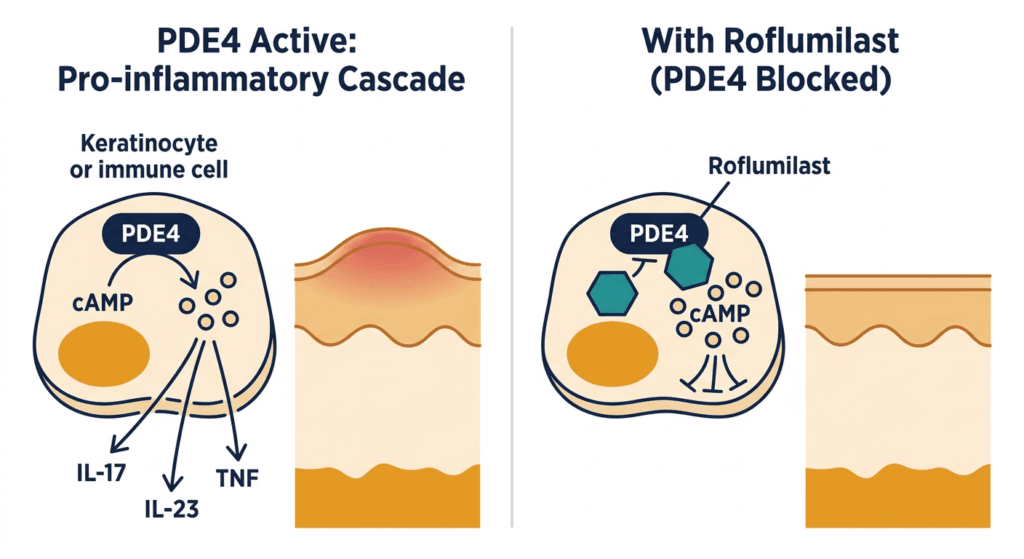
Roflumilast is a selective inhibitor of phosphodiesterase type 4 (PDE4), a family of intracellular enzymes responsible for degrading cyclic AMP (cAMP). PDE4 is the dominant phosphodiesterase in immune and inflammatory cells, including T cells, neutrophils, eosinophils, macrophages, and keratinocytes.
Under normal signaling conditions, cAMP acts as an intracellular second messenger that inhibits pro-inflammatory activity in immune cells. When PDE4 degrades cAMP, this anti-inflammatory brake is released and inflammatory mediators are produced. By inhibiting PDE4, roflumilast prevents cAMP degradation, allowing cAMP to accumulate intracellularly, which suppresses the production of pro-inflammatory cytokines including TNF-alpha, IL-2, IL-4, IL-5, IL-12, IL-13, IL-17, and IL-23. These are precisely the cytokines that drive psoriatic skin inflammation.
The clinical consequence of this mechanism in psoriasis is anti-inflammatory activity that reduces plaque thickness, erythema, and scaling without the structural effects of corticosteroids on the skin. Roflumilast does not thin the skin, does not cause striae, and does not suppress adrenal function. These properties are what enable its use without restrictions on body site or treatment duration.
Roflumilast in oral form (Daliresp) has been approved since 2011 for COPD, where it reduces systemic inflammation. The topical formulations used in dermatology are chemically the same molecule but delivered in cream and foam vehicles designed to maximize skin penetration while minimizing systemic absorption.
The Zoryve cream formulation is notable for what it does not contain alongside the active ingredient: no PEG, no propylene glycol, no ethanol, and no fragrances. These are common irritants and sensitizers that make many topical preparations inappropriate for inflamed or sensitive skin in young children. The absence of these excipients is a meaningful formulation attribute for the ages 2 to 5 population, where skin barrier function may already be compromised by psoriatic inflammation.
How Zoryve Cream 0.3%’s Approval History Has Expanded: Age by Age
Understanding this approval requires understanding where Zoryve cream 0.3% stands in the broader Zoryve portfolio and how its age indication has been systematically extended.
| Approval | Date | Indication | Age range |
|---|---|---|---|
| Original Zoryve cream 0.3% | July 29, 2022 | Plaque psoriasis including intertriginous areas | Ages 12 and older |
| Age expansion | October 9, 2023 | Plaque psoriasis including intertriginous areas | Ages 6 and older (added 6 to 11) |
| Zoryve cream 0.15% | July 9, 2024 | Mild-to-moderate atopic dermatitis | Ages 6 and older |
| Zoryve cream 0.05% | October 2025 | Mild-to-moderate atopic dermatitis | Ages 2 to 5 |
| This approval | June 29, 2026 | Plaque psoriasis including intertriginous areas | Ages 2 and older (added 2 to 5) |
The Zoryve portfolio now covers plaque psoriasis and atopic dermatitis across overlapping pediatric age ranges with different concentrations tailored to the inflammation depth and pharmacokinetic considerations relevant to each age group. For plaque psoriasis specifically, Zoryve cream 0.3% now covers from age 2 through adulthood in a continuous, unrestricted indication.
Zoryve foam 0.3%, approved separately for scalp and body plaque psoriasis, is indicated for adults and patients aged 12 and older and has not been extended to younger children in this action.
The MUSE Study and Supporting Data: What the Evidence Shows
The FDA approval for ages 2 to 5 is based on two clinical studies specifically conducted in this age group, supported by the larger efficacy database in older patients.
MUSE study (ARQ-151-216; NCT04746911)
The MUSE study was a Phase 2, open-label trial evaluating roflumilast cream 0.3% in children aged 2 to 5 years (n=10) with plaque psoriasis involving at least 2% body surface area. This was a maximal usage systemic exposure study, meaning the drug was applied to the maximum amount of affected skin to evaluate pharmacokinetics and confirm that systemic absorption under worst-case conditions remained within acceptable safety limits.
At 4 weeks:
| Endpoint | Result (ages 2 to 5, n=10) |
|---|---|
| IGA success (clear or almost clear, plus at least 2-grade improvement) | 90% |
| PASI-75 (at least 75% improvement in PASI) | 90% |
| WI-NRS success (at least 4-point reduction in worst itch, caregiver-reported for children under 8) | 90% |
Source: HCPLive MUSE data summary. June 2026. NCT04746911.
Evidence of systemic absorption of roflumilast and its active N-oxide metabolite was detected in most participants, consistent with prior Phase 3 pharmacokinetic data in adults and adolescents. The pharmacokinetic profiles were within the acceptable range established by the broader adult and adolescent safety database.
Long-term open-label study (ARQ-151-306; NCT04286607)
The long-term study provided supportive safety and efficacy data through up to 24 weeks of treatment in children aged 2 to 5 years. Results showed the safety and efficacy of roflumilast cream 0.3% in patients 2 years and older were generally consistent with those observed in clinical trials involving pediatric patients aged 6 to 11 years, adolescents, and adults.
Interpreting the small-n MUSE data honestly
The MUSE cohort for ages 2 to 5 enrolled 10 patients. This is a small sample, and the 90% response rates at 4 weeks should be interpreted in that context: with n=10, each patient accounts for 10 percentage points of any rate. The open-label, single-arm design without a placebo comparator also means the observed rates include the natural course of psoriasis during the observation period alongside the drug effect.
The FDA’s decision to approve based on this data rests on several established principles for pediatric drug development. The efficacy of roflumilast cream 0.3% has been established in large, well-controlled Phase 3 trials in adults and adolescents (DERMIS-1 and DERMIS-2). The mechanism of action and pharmacokinetics are well-characterized across multiple age groups. The MUSE study’s role was primarily to confirm that systemic exposure in the youngest children does not differ meaningfully from the established safety-relevant exposure range in older patients, and that the clinical response is directionally consistent with what has been observed in the rest of the population. Both were confirmed.
The single most important limitation to acknowledge: long-term pharmacokinetic surveillance in children aged 2 to 5 with real-world application patterns is not available from the clinical trial program. The MUSE design was built for maximal use conditions over 4 weeks. Whether extended real-world use in this age group produces different systemic exposure patterns will be learned over time in clinical practice.
The Established Phase 3 Efficacy Base: DERMIS-1 and DERMIS-2
Because the ages 2 to 5 approval relies on consistency with the broader efficacy database, understanding that broader database is essential context for clinicians and families.
DERMIS-1 (NCT04211363) and DERMIS-2 (NCT04211389) were the pivotal Phase 3 trials supporting the original roflumilast cream 0.3% approvals. Both were 8-week, randomized, double-blind, vehicle-controlled trials in patients aged 2 years and older (the trials were designed with the full age range in mind, though the youngest age group’s formal approval has come in stages).
At week 8, significantly more roflumilast-treated than vehicle-treated patients achieved PASI-75 (40.3% versus 6.5%; p less than 0.0001). Using the more sensitive PASI-HD endpoint, which captures finer changes in plaque thickness, erythema, and scaling, 59.9% versus 17.9% achieved the threshold at week 8 (p less than 0.0001).
Among patients with intertriginous psoriasis, IGA success in the affected intertriginous area was achieved in 73% of roflumilast 0.3%-treated patients versus 29% of vehicle-treated patients. This intertriginous-specific response rate is clinically significant given how commonly this body site is affected in young children with psoriasis.
These are the efficacy data that anchor the confidence in the younger age group approval: a drug with well-demonstrated efficacy in adults and older children, consistent pharmacokinetic behavior across age groups in the MUSE studies, and directionally consistent response rates in the 2-to-5 cohort.
Zoryve’s Full Current Indication Coverage After June 2026
| Product | Indication | Age range |
|---|---|---|
| Zoryve cream 0.3% | Plaque psoriasis, including intertriginous areas | Ages 2 and older |
| Zoryve foam 0.3% | Plaque psoriasis, scalp and body | Ages 12 and older |
| Zoryve cream 0.15% | Mild-to-moderate atopic dermatitis | Ages 6 and older |
| Zoryve cream 0.05% | Mild-to-moderate atopic dermatitis | Ages 2 to 5 |
Zoryve is also approved for seborrheic dermatitis in foam formulation in adults. The portfolio now represents the broadest age coverage of any topical PDE4 inhibitor franchise in the United States.
Safety: What Prescribers and Caregivers Need to Know
The safety profile of Zoryve cream 0.3% in the ages 2 to 5 population was consistent with the established profile in older patients and adults. No new safety signals emerged in the MUSE study or the long-term extension study.
Contraindication: Zoryve cream 0.3% is contraindicated in patients with moderate-to-severe liver impairment (Child-Pugh B or C). This reflects the hepatic metabolism of roflumilast and is standard across all roflumilast formulations.
Common adverse reactions (occurring in at least 1% of patients in clinical trials of Zoryve cream 0.3% for plaque psoriasis): diarrhea, headache, insomnia, nausea, application site pain, upper respiratory tract infection, and urinary tract infection. These reflect low-level systemic exposure to roflumilast even from a topical formulation, consistent with the known pharmacology of PDE4 inhibition.
Systemic absorption in young children: Roflumilast is absorbed to a small degree through the skin. In the MUSE study, systemic exposure was detected in most participants aged 2 to 5 under maximal-use conditions. The FDA considered this acceptable based on consistency with adult and adolescent exposure levels. For clinical practice, applying the drug to the minimum area necessary to control disease, rather than liberally to all skin regardless of activity, is appropriate practice in any age group.
No boxed warning, no restriction on duration, no restriction on body site including face, skin folds, and genitalia. These are the specific label attributes that make roflumilast cream 0.3% suitable as a long-term topical option in young children with psoriasis in locations where corticosteroids cannot be used indefinitely.
Driving and machinery: Not relevant for the ages 2 to 5 population. The adverse event of headache, nausea, and insomnia noted in clinical trials are worth monitoring; caregivers should report persistent systemic symptoms to the treating dermatologist.
What This Means for Pediatric Dermatologists and Families
For pediatric dermatologists
This approval fills a specific prescribing gap that has been documented in the literature for years: children aged 2 to 5 with moderate plaque psoriasis involving the face and intertriginous areas, where corticosteroids are inappropriate for long-term use, now have an FDA-approved once-daily steroid-free option. The label explicitly covers these body sites, which removes any ambiguity about whether the approval supports use in the locations most relevant to this age group.
The MUSE data should be interpreted in the context of the broader Phase 3 efficacy database and the established pharmacokinetic consistency across age groups, rather than as a standalone primary efficacy study. The response signals in the 2-to-5 cohort were directionally strong (90% IGA success at 4 weeks), but the n=10 sample size means these numbers carry wide uncertainty bounds.
The AAD’s strong recommendation for various Zoryve formulations in pediatric atopic dermatitis, combined with this psoriasis indication expansion, makes roflumilast a versatile topical option for pediatric inflammatory skin disease broadly, with age-appropriate concentrations and indications mapped across the full pediatric range.
For families
If your child is aged 2 to 5 and has been diagnosed with plaque psoriasis, and particularly if their disease involves the face, diaper area, groin, or other skin folds where you have been told steroid creams cannot be used long-term, Zoryve cream 0.3% is now an FDA-approved option that your child’s pediatric dermatologist can prescribe.
The cream is applied once daily to affected areas. It does not need to be washed off before bedtime. It can be applied to skin folds. There is no defined treatment duration limit. It is steroid-free and does not contain common skin irritants.
Because Zoryve cream 0.3% is a specialty prescription product, insurance prior authorization is typically required. Arcutis operates a patient support program, Arc+, that provides insurance and access support for patients prescribed Zoryve. A specialty pharmacy familiar with Arcutis products can help navigate the prior authorization process.
For related HED coverage on pediatric dermatology and biologic approvals for psoriatic disease in children, see our post on Skyrizi (risankizumab-rzaa) becoming the first IL-23 inhibitor approved for children aged 6 and older with plaque psoriasis and psoriatic arthritis, approved four days before this Zoryve action on June 26, 2026.
Sources
Arcutis FDA approval press release: FDA Approves Arcutis’ ZORYVE (roflumilast) Cream 0.3% for the Treatment of Plaque Psoriasis in Children as Young as Age 2. Arcutis Biotherapeutics. June 29, 2026.
BusinessWire press release: FDA Approves Arcutis’ ZORYVE (roflumilast) Cream 0.3% for the Treatment of Plaque Psoriasis in Children as Young as Age 2. BioSpace. June 29, 2026.
Drugs.com approval news: FDA Approves Arcutis’ Zoryve (roflumilast) Cream 0.3% for the Treatment of Plaque Psoriasis in Children as Young as Age 2. drugs.com. June 29, 2026.
HCPLive (MUSE data with exact response rates, age-by-age context): FDA Approves Roflumilast 0.3% Cream for PsO in Children 2-5 Years. hcplive.com. June 2026.
Dermatology Advisor (clinical summary and Dr. Swanson quote): FDA Expands Zoryve Cream 0.3% Approval for Plaque Psoriasis Down to Age 2. dermatologyadvisor.com. June 2026.
Dermatology Times (ARQ-151-306 long-term study reference): FDA Approves Roflumilast Cream 0.3% for Plaque Psoriasis Down to Age 2. dermatologytimes.com. June 2026.
Patient Care Online (adverse reaction list, contraindication): FDA Expands Roflumilast Cream 0.3% Approval for Plaque Psoriasis in Children Aged 2 Years and Older. patientcareonline.com. June 2026.
Medscape (approval timeline context): Topical Roflumilast Approval Expanded to Include Children Ages 2-5 With Psoriasis. medscape.com. June 2026.
Healio (prescribing gap narrative and Dr. Swanson commentary): FDA expands approval for Zoryve cream 0.3% to children with psoriasis as young as 2 years. healio.com. June 2026.
Clinical Trial Vanguard (PK limitation analysis, competitive context): FDA Approves Roflumilast Cream for Plaque Psoriasis in Children Age 2+. clinicaltrialvanguard.com. June 2026.
Contemporary Pediatrics (sNDA acceptance and MUSE/long-term study context): FDA accepts roflumilast cream 0.3% sNDA to treat plaque psoriasis in children 2 to 5 years. contemporarypediatrics.com. 2025.
DERMIS-1 and DERMIS-2 pooled PASI data (PMC): Roflumilast Cream 0.3% in Patients with Chronic Plaque Psoriasis: Pooled PASI and PASI-HD Results from the DERMIS Phase III Trials. PMC12619852.
DERMIS Phase 2 adult trial NEJM publication: Lebwohl MG et al. Trial of Roflumilast Cream for Chronic Plaque Psoriasis. NEJM. 2020;383(3):229-239.
DERMIS-1 trial registration: NCT04211363. ClinicalTrials.gov.
DERMIS-2 trial registration: NCT04211389. ClinicalTrials.gov.
MUSE 2-to-5 trial registration: NCT04746911. ClinicalTrials.gov.
Long-term open-label trial registration: NCT04286607. ClinicalTrials.gov.
Zoryve cream 0.3% prescribing information: ZORYVE (roflumilast) Cream 0.3% Prescribing Information. Arcutis Biotherapeutics. 2026.
Zoryve approval history: Zoryve FDA Approval History. drugs.com.
Pediatric psoriasis and plaque psoriasis overview: Psoriasis. StatPearls. NCBI.
National Psoriasis Foundation: npf.org
Patient resources: National Psoriasis Foundation: 1-800-723-9166 | Society for Pediatric Dermatology | Arcutis Arc+ patient support program | American Academy of Dermatology Find-a-Derm (pediatric dermatologists)
| Disclaimer: Health Evidence Digest provides general information about FDA approvals and health research for educational purposes. This content is not a substitute for professional medical advice. The expansion of Zoryve cream 0.3% to children aged 2 to 5 years is based on data from a small open-label pharmacokinetic study (n=10) and a long-term extension study in this age group, supported by the established efficacy and safety database in older patients. Treatment decisions for pediatric plaque psoriasis should be made in consultation with a board-certified pediatric dermatologist who can evaluate disease severity, body site involvement, and the full range of treatment options appropriate for the individual child. |
|---|
Leave a Reply