
| 📌 The essentials On July 1, 2026, the FDA granted supplemental approval to Casgevy (exagamglogene autotemcel, Vertex Pharmaceuticals and CRISPR Therapeutics) for patients aged 2 years and older with either sickle cell disease (SCD) with recurrent vaso-occlusive crises (VOCs) or transfusion-dependent beta thalassemia (TDT). The prior lower age limit was 12 years. Casgevy is now the first gene therapy approved for young children with SCD and the first CRISPR-based gene editing therapy to reach patients as young as age 2 in either condition. This expansion makes approximately 5,500 additional children in the United States newly eligible for this one-time therapy. What Casgevy is: an autologous CRISPR/Cas9 genome-edited hematopoietic stem cell-based gene therapy that edits the patient’s own CD34-positive stem cells ex vivo to reactivate fetal hemoglobin (HbF) production. The edited cells are infused back into the patient in a single dose following myeloablative conditioning. Fetal hemoglobin, which does not sickle and is not affected by beta-thalassemia mutations, compensates for the defective adult hemoglobin and prevents the downstream complications of both diseases. The evidence base for the age expansion rests on two distinct evidentiary components: for children aged 5 to younger than 12 years: Phase 3 CLIMB-151 (NCT05329649 for SCD) and Phase 3 CLIMB-141 (for TDT), with clinical trial data presented at EHA 2026 and simultaneously published in the New England Journal of Medicine. CLIMB-151 SCD cohort (ages 5 to 11, n=11 dosed): 100% of patients (8 of 8) with sufficient follow-up achieved VF12 (freedom from VOCs for at least 12 consecutive months); mean VOC-free duration 19.0 months (range 13.2 to 30.1 months). CLIMB-141 TDT cohort (ages 5 to 11, n=15 dosed): 100% of patients (8 of 8) with sufficient follow-up achieved TI12 (transfusion independence for at least 12 consecutive months while maintaining weighted average hemoglobin at or above 9 g/dL); mean transfusion-free duration 23.4 months (range 13.3 to 28.5 months). For children aged 2 to younger than 5 years: approval based on product characteristics and extrapolated clinical study data; CLIMB-141 and CLIMB-151 are ongoing for this youngest cohort. Long-term adult/adolescent data (CLIMB-121/CLIMB-111/CLIMB-131 as of April 2025): SCD: 100% of patients (45 of 45) achieved VF12; mean VOC-free duration 35.3 months (range 12.9 to 67.7 months). TDT: 98.2% of patients (55 of 56) achieved TI12; mean transfusion-free duration 41.4 months (range 13 to 72.3 months). Safety in children ages 5 to 11: consistent with myeloablative conditioning and autologous transplant as established in older patients. Most common grade 3 or 4 non-laboratory adverse reactions: mucositis and febrile neutropenia (SCD and TDT); decreased appetite (TDT). One death in the CLIMB-141 TDT cohort from severe veno-occlusive disease attributed to busulfan conditioning, not to Casgevy. |
|---|
Sickle cell disease and transfusion-dependent beta thalassemia are diseases that begin damaging the body in early childhood. The sickling crises that define SCD can begin as early as the first year of life. The transfusion burden of TDT typically starts before age two. Organ damage, stroke risk, growth delay, developmental disruption, and the cumulative physical and psychological toll of years of medical management all accumulate from the earliest years onward.
For a one-time curative gene therapy, the question of when to treat matters profoundly. Treating a child at age eight who has already spent years hospitalized with pain crises and organ damage prevents further damage but cannot reverse what has already occurred. Treating a child at age two, before years of disease burden have accumulated, offers the possibility of a genuinely different life trajectory rather than a rescue from an already-damaged one.
When the FDA first approved Casgevy in December 2023 as the world’s first CRISPR-based gene therapy, the lower age limit was 12 years. That was appropriate given the evidence available at the time. But it left the children most vulnerable to early-onset disease complications, those under 12, without access to a therapy that might prevent those complications before they developed.
The July 1, 2026 supplemental approval, expanding Casgevy to patients aged 2 and older, is supported by Phase 3 data in children aged 5 to 11 showing the same complete response rates in SCD and TDT that have been observed in adults and adolescents. In the CLIMB-151 SCD trial, every child with sufficient follow-up was free from vaso-occlusive crises. In CLIMB-141 for TDT, every child with sufficient follow-up achieved transfusion independence. And the long-term data in adults and adolescents continues to show durable fetal hemoglobin expression and disease-free survival approaching six years in some patients.
What Sickle Cell Disease and Transfusion-Dependent Beta Thalassemia Are
Sickle cell disease
Sickle cell disease is caused by a point mutation in the HBB gene encoding the beta-globin subunit of hemoglobin. The most common and severe form, sickle cell anemia (HbSS), results from homozygous inheritance of the HbS allele. The abnormal HbS hemoglobin polymerizes when deoxygenated, deforming red blood cells into the rigid, crescent-shaped “sickle” morphology that gives the disease its name.
These sickled cells have a much shorter lifespan than normal red cells (10 to 20 days versus 120 days), causing chronic hemolytic anemia. They are also rigid and adhesive, obstructing blood flow in small vessels and triggering the vaso-occlusive crises (VOCs) that are the hallmark of severe SCD. A vaso-occlusive crisis is a period of intense pain caused by ischemia in the affected tissue. Episodes last hours to days, frequently require hospitalization and opioid analgesia, and represent the leading cause of emergency department visits and hospitalizations for patients with SCD.
The cumulative damage from repeated VOCs is devastating. Strokes occur in approximately 11% of children with SCD before age 20 without preventive treatment. Pulmonary hypertension, kidney disease, avascular necrosis of the joints, chronic pain, and progressive organ failure accumulate over years and decades. Life expectancy, though improved by modern management, is shortened by 20 to 30 years compared to the general population.
Approximately 100,000 Americans are affected by SCD, with the disease disproportionately impacting people of African descent. Approximately 1 in 365 Black Americans is born with SCD. The disease is also prevalent in Hispanic, Mediterranean, Middle Eastern, and South Asian populations. In the U.S., newborn screening detects SCD at birth, meaning the diagnosis is typically established in infancy.
Transfusion-dependent beta thalassemia
Beta thalassemia results from mutations in the HBB gene that reduce or eliminate beta-globin production. In transfusion-dependent beta thalassemia (the most severe form, also called thalassemia major), both copies of the HBB gene are severely affected, resulting in near-total absence of normal adult hemoglobin. Red blood cells are small, fragile, and short-lived. Without intervention, the resulting severe anemia is life-threatening.
The standard treatment for TDT is lifelong regular blood transfusions, typically every 3 to 5 weeks, to maintain hemoglobin levels adequate for normal function. These transfusions come with their own burden: over years and decades, iron accumulates in tissues from transfused red blood cells, causing iron overload that damages the heart, liver, and endocrine organs. Iron chelation therapy is required alongside transfusions to manage this accumulation. The combined burden of regular transfusions, chelation therapy, and monitoring defines the life of a child with TDT from the first years onward.
Approximately 1,000 Americans have TDT, with substantially higher global prevalence in the Mediterranean basin, the Middle East, and South and Southeast Asia.
Why early treatment matters more than it might seem
The case for treating SCD and TDT as early as possible is straightforward. These are not diseases that begin causing harm in adolescence. A child with severe SCD is at risk for stroke from the first years of life. A child with TDT begins accumulating iron overload from the first transfusions. The organ damage that reduces life expectancy and quality of life is cumulative. Every year of exposure to the underlying disease, without disease modification, represents irreversible damage.
The prior lower age limit of 12 years for Casgevy meant that a child diagnosed with SCD at birth would not be eligible for this one-time curative therapy until 12 years of disease burden had accumulated. For a therapy that can potentially eliminate VOCs and transfusion dependence with a single treatment, treating earlier means preventing more cumulative harm.
How CRISPR/Cas9 Gene Editing Works in Casgevy: The Science
Casgevy is the first approved therapeutic use of CRISPR/Cas9 (clustered regularly interspaced short palindromic repeats and CRISPR-associated protein 9) technology in humans. Understanding what it does requires understanding why the target it edits matters.
The fetal hemoglobin solution
Adult human hemoglobin consists of two alpha-globin and two beta-globin chains. The beta-globin gene is the site of mutation in both SCD and TDT. During fetal development, the body produces a different form of hemoglobin: fetal hemoglobin (HbF), which uses gamma-globin chains instead of beta-globin. HbF is the oxygen-carrying hemoglobin of the fetus and newborn; it is gradually replaced by adult hemoglobin (HbA) during the first year of life as the gamma-globin genes are switched off.
HbF does not sickle. The alpha-gamma chains of HbF do not polymerize in response to deoxygenation the way HbS chains do. And HbF compensates for absent or deficient beta-globin in TDT, because its gamma-globin chains pair with alpha-globin to form functional hemoglobin molecules. People who retain elevated HbF production into adult life due to a genetic variant called hereditary persistence of fetal hemoglobin (HPFH) are protected from sickle cell disease symptoms even when they carry the HbS allele.
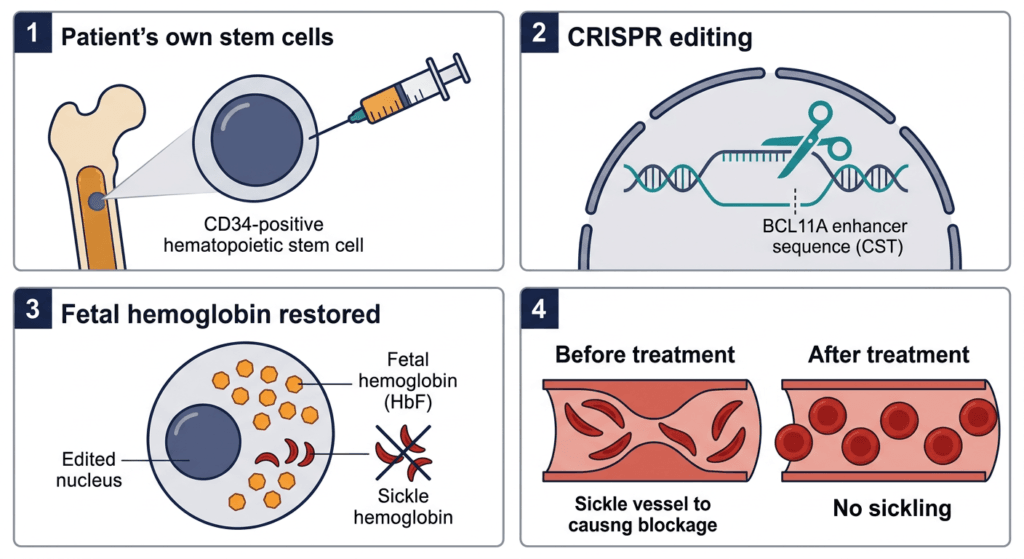
The therapeutic insight behind Casgevy is to reactivate HbF production by editing the gene that normally switches it off. The primary switch for HbF silencing in adult life is a transcriptional repressor called BCL11A. BCL11A binds to an erythroid enhancer region and suppresses gamma-globin gene expression, reducing HbF to the low levels seen in most adults. Deleting or disrupting this BCL11A erythroid enhancer through CRISPR editing allows gamma-globin expression to resume and HbF to accumulate in adult red cells.
The ex vivo editing process
The gene editing in Casgevy does not occur inside the patient. It occurs in the manufacturing laboratory, and the process follows a sequence of steps:
Mobilization and collection: The patient receives growth factor medications (G-CSF and plerixafor) to mobilize hematopoietic stem and progenitor cells (HSPCs) from the bone marrow into the peripheral blood, where they are collected by apheresis.
Ex vivo CRISPR/Cas9 editing: The collected CD34-positive HSPCs are taken to a manufacturing facility where CRISPR/Cas9 components are delivered into the cells. The Cas9 protein, guided by a specifically designed guide RNA, creates a targeted double-strand DNA break at the BCL11A erythroid enhancer sequence. The cells’ natural DNA repair mechanism introduces small insertions or deletions at the cut site, disrupting the enhancer function and relieving BCL11A-mediated HbF repression. The editing is verified for efficiency and safety before the product is released.
Myeloablative conditioning: Before reinfusion, the patient undergoes full myeloablative conditioning, typically high-dose busulfan chemotherapy, to clear the bone marrow and create space for the edited cells to engraft. This conditioning is the primary source of short-term treatment-related toxicity, not the gene editing itself.
Single-dose infusion: The edited cells are returned to the patient in a single intravenous infusion. They travel to the bone marrow, engraft, and begin producing red blood cells expressing high levels of HbF. As the edited cell population expands, HbF levels rise, sickling is prevented, and transfusion requirements fall.
The editing is permanent. Because the modified HSPCs continue to self-renew and produce HbF-expressing red blood cells for life, the effect is lifelong, not temporary. This is why Casgevy is described as a one-time treatment rather than an ongoing therapy.
The Clinical Evidence: What the CLIMB Trials Show
The Casgevy clinical program is called CLIMB (CRISPR Therapeutics and Vertex-authored studies in blood diseases). The evidence base for the July 2026 age expansion comes from two distinct bodies of data.
Adult and adolescent data (ages 12 to 35): the established foundation
The long-term dataset from the pivotal CLIMB-111 (TDT) and CLIMB-121 (SCD) trials, with ongoing follow-up in the CLIMB-131 long-term extension study, provides the most mature evidence base for Casgevy’s durability.
As of April 2025, the most recent data cutoff reported:
SCD (CLIMB-121/CLIMB-131): 100% of patients (45 of 45) achieved VF12, defined as freedom from severe VOCs for at least 12 consecutive months. The mean duration of VOC-free status was 35.3 months (range 12.9 to 67.7 months). The longest-treated patients have now been VOC-free for more than 5 years.
TDT (CLIMB-111/CLIMB-131): 98.2% of patients (55 of 56) achieved TI12, defined as transfusion independence for at least 12 consecutive months while maintaining weighted average hemoglobin at or above 9 g/dL. The mean duration of transfusion independence was 41.4 months (range 13 to 72.3 months). One patient did not achieve TI12 due to disease-related complications unrelated to the gene therapy product.
These durability data, showing sustained HbF expression and disease-free status approaching six years in some adults, are the foundation on which the pediatric expansion rests.
CLIMB-151 (SCD, ages 5 to 11): the primary new evidence
CLIMB-151 (NCT05329649) is an ongoing Phase 3 open-label trial evaluating Casgevy in patients aged 2 to 11 years with SCD and recurrent VOCs. The approval for ages 5 to younger than 12 with SCD was based on data from this trial, as presented at the European Hematology Association Congress in June 2026 and simultaneously published in the New England Journal of Medicine.
| Outcome | CLIMB-151 (SCD, ages 5 to 11) |
|---|---|
| Patients dosed | 11 |
| Patients achieving VF12 (sufficient follow-up) | 8 of 8 (100%) |
| All patients free from any VOC after infusion | Yes (0 VOC events across all 11 patients post-infusion) |
| Mean VOC-free duration among VF12 achievers | 19.0 months (range 13.2 to 30.1 months) |
| Consistency with adult/adolescent profile | Confirmed |
Source: CLIMB-151 data, EHA 2026 and NEJM June 2026. NCT05329649.
Every child with sufficient follow-up was free from vaso-occlusive crises for at least a year, and no child experienced any VOC at any point after Casgevy infusion. The complete response rate is consistent with the 100% VF12 rate observed in adults and adolescents, confirming that the mechanism operates as effectively in younger children.
CLIMB-141 (TDT, ages 5 to 11): the TDT pediatric evidence
CLIMB-141 is the parallel trial for TDT in the 2 to 11 age range. The most recent interim data (EHA 2026) enrolled 15 children, of whom 8 had sufficient follow-up to assess TI12.
| Outcome | CLIMB-141 (TDT, ages 5 to 11) |
|---|---|
| Patients dosed | 15 |
| Patients achieving TI12 (sufficient follow-up) | 8 of 8 (100%) |
| All TI12 achievers maintained transfusion independence throughout follow-up | Yes |
| Mean transfusion-free duration among TI12 achievers | 23.4 months (range 13.3 to 28.5 months) |
Source: CLIMB-141 interim data, EHA 2026 and NEJM June 2026.
Again, the 100% primary endpoint achievement rate in children is consistent with the 98.2% TI12 rate observed in adults and adolescents.
Ages 2 to younger than 5: the extrapolation basis
For the youngest children in the expanded indication (ages 2 to younger than 5), the FDA approved Casgevy based on product characteristics and extrapolated clinical study data, not on completed efficacy data from this specific age group. CLIMB-141 and CLIMB-151 are continuing to enroll and dose children aged 2 to 4, and clinical trial data from this cohort will be forthcoming. The extrapolation approach is appropriate when the biological mechanism is age-independent (the BCL11A enhancer disruption and HbF reactivation operate the same way in a 3-year-old’s stem cells as in a 15-year-old’s), and when pharmacokinetic and safety data support equivalent treatment in the younger age range.
This extrapolation for ages 2 to 4 is the most important interpretive nuance in this approval for clinicians counseling families. The therapy is approved, the mechanism is sound, and the 5-to-11 data strongly support efficacy across the pediatric range. But formal efficacy data specifically in the 2-to-4 age group are not yet available and will emerge from the ongoing trials.
The Treatment Process: What Families Need to Know Before Deciding
The decision to pursue Casgevy is among the most consequential a family of a child with SCD or TDT will face, and it is genuinely complex. This is not a medication taken daily or a treatment given in an outpatient clinic. It is a months-long medical process with significant procedural risks alongside transformative potential.
The treatment timeline
The full Casgevy treatment process, from initial preparation to recovery, typically spans 6 to 12 months and involves the following phases:
Preparation and eligibility evaluation (weeks to months before treatment): Comprehensive baseline assessment including organ function, prior treatment history, infectious disease screening (hepatitis B, hepatitis C, HIV), and confirmation that the patient is clinically stable and appropriate for myeloablative conditioning. Prior hydroxyurea use is required before Casgevy treatment in SCD. Patients cannot have received prior allogeneic HSCT.
Cell collection (mobilization and apheresis): Growth factors are administered to mobilize HSPCs into the bloodstream; cells are then collected by apheresis. Multiple collection sessions may be required.
Manufacturing (4 to 6 months, approximately): The collected cells are shipped to Vertex/CRISPR Therapeutics’ manufacturing facility where CRISPR editing occurs. Quality testing verifies editing efficiency, sterility, and product release criteria. This step takes several months and cannot be accelerated, meaning the timing of the overall process is largely determined by manufacturing.
Myeloablative conditioning: High-dose busulfan is administered to destroy the patient’s existing bone marrow. This is the most medically intense phase of the treatment, requiring inpatient hospitalization and carrying risks including mucositis, febrile neutropenia, veno-occlusive disease of the liver, and other conditioning-related toxicities.
Casgevy infusion: The edited cells are returned as a single intravenous infusion. Engraftment takes several weeks, during which the patient is vulnerable to infection and requires intensive inpatient supportive care.
Recovery and monitoring: Patients are monitored for engraftment, HbF levels, and safety outcomes over months following infusion. All patients are enrolled in CLIMB-131, the 15-year long-term follow-up study, which is a post-marketing commitment to characterize long-term safety including any potential oncogenic risk from the CRISPR editing or lentiviral vector integration (Casgevy uses CRISPR rather than a lentiviral vector, but insertional mutagenesis from off-target editing remains a theoretical risk requiring long-term surveillance).
The risk that requires honest discussion: VOD from busulfan
Among the most clinically significant safety findings in the CLIMB-141 TDT pediatric trial was one death, in a child with TDT who developed severe veno-occlusive disease (VOD) of the liver from busulfan conditioning. This death was attributed to the conditioning regimen rather than to Casgevy itself, and VOD is a known risk of busulfan-based myeloablative conditioning. But the event underscores that the myeloablative conditioning required before Casgevy infusion carries real and serious risks, separate from any risks attributable to the gene editing.
Families and clinicians considering Casgevy for young children must have an explicit discussion about the risks of the conditioning regimen. VOD prophylaxis with ursodiol and careful busulfan pharmacokinetic monitoring (to individualize dosing and reduce over-exposure) are standard at experienced transplant centers and reduce but do not eliminate the risk. The treatment should be undertaken at centers with dedicated expertise in myeloablative conditioning and pediatric hematopoietic stem cell transplantation.
Who Is Newly Eligible: Approximately 5,500 Additional U.S. Children
Vertex estimates that approximately 5,500 additional children in the United States are now eligible for Casgevy following the age expansion. These are children aged 2 to 11 with:
SCD with recurrent VOCs: the indication requires a documented history of recurrent severe vaso-occlusive crises. Specific thresholds (typically at least 2 protocol-defined severe VOCs in the preceding 2 years) apply and are specified in the prescribing information.
Transfusion-dependent beta thalassemia: the indication covers patients requiring regular red blood cell transfusions to maintain adequate hemoglobin for normal function.
Both indications carry additional eligibility requirements including negative hepatitis B, hepatitis C, and HIV screening; no prior allogeneic HSCT; clinical stability appropriate for myeloablative conditioning; and for SCD, prior or documented intolerance to hydroxyurea.
Access and the cost reality
Casgevy carries a list price of approximately $2.2 million per treatment. This is a one-time cost for a one-time treatment, and cost-effectiveness modeling that accounts for avoided hospitalizations, transfusions, chelation therapy, and long-term organ damage supports the economic case for the price at a population level. But the logistics of prior authorization, payer coverage, and access to qualified treatment centers create real-world barriers that do not dissolve because the therapy is clinically compelling.
For families navigating coverage, Vertex’s patient support program and the Sickle Cell Disease Association of America and Cooley’s Anemia Foundation both maintain access resources. Medicaid covers Casgevy in most states for eligible patients, which is significant given the disproportionate enrollment of SCD patients in Medicaid programs.
The therapy is available exclusively at authorized treatment centers. Finding a qualified center experienced in both pediatric stem cell transplantation and gene therapy is a prerequisite for access. Vertex maintains a directory of authorized treatment centers on casgevy.com.
Dr. Megha Kaushal, acting deputy director of the Office of Therapeutic Products at FDA’s Center for Biologics Evaluation and Research, noted that these disorders carry a heavy burden for children and their families, affecting growth, development, and long-term health in profound ways. The FDA’s approval, she said, provides pediatric patients as young as age 2 with access to a critical additional treatment option.
For related HED coverage on CRISPR gene therapy and rare pediatric blood diseases, see our post on KRESLADI (marnetegragene autotemcel), the first gene therapy for severe Leukocyte Adhesion Deficiency Type I and our coverage of Tregzi, the first precision-engineered cell therapy for allogeneic stem cell transplantation approved for blood cancers.
For families living with SCD or TDT, the Sickle Cell Disease Association of America (sicklecelldisease.org; 1-800-421-8453) and the Thalassemia International Federation maintain current patient resources, treatment center directories, and peer support networks. In the United States, Cooley’s Anemia Foundation (thalassemia.org; 1-800-522-7222) provides comprehensive TDT support.
Sources
FDA supplemental approval announcement: FDA Approves First Gene Therapy for Young Children with Sickle Cell Disease. FDA.gov. July 1, 2026.
Vertex FDA approval press release: Vertex Announces US FDA Approval for Expanded Use of CASGEVY for the Treatment of People Ages 2 Years and Older With Sickle Cell Disease or Transfusion-Dependent Beta Thalassemia. BusinessWire. July 1, 2026.
Vertex newsroom: Vertex Announces US FDA Approval for Expanded Use of CASGEVY. news.vrtx.com. July 1, 2026.
Drugs.com approval news: Vertex Announces FDA Approval for Expanded Use of Casgevy for the Treatment of People Ages 2 Years and Older With Sickle Cell Disease or Transfusion-Dependent Beta Thalassemia. drugs.com. July 1, 2026.
CLIMB-151 and CLIMB-141 EHA 2026 and NEJM publication (ages 5 to 11): Vertex Presents New Data on CASGEVY, Including First European Presentation of Data in Children Ages 5–11, at the European Hematology Association Congress. Vertex/BusinessWire. June 10, 2026.
CLIMB-151 and CLIMB-141 ASH 2025 (ages 5 to 11, first-ever pediatric data): Vertex Presents New Data on CASGEVY, Including First-Ever Data in Children Ages 5-11 Years, at the American Society of Hematology Annual Meeting. Vertex/BusinessWire. December 6, 2025.
CLIMB-151 trial registration (SCD ages 2 to 11): NCT05329649. ClinicalTrials.gov.
CLIMB-131 long-term follow-up trial registration: NCT04208529. ClinicalTrials.gov.
HCPLive (first CRISPR therapy for ages 2+ context): FDA Expands Exa-Cel Gene Therapy Approval to Children 2 Years and Up With SCD or beta-Thalassemia. hcplive.com. July 2026.
Pharmacy Times (VF12 ages 5 to 11 complete data, busulfan VOD death detail): FDA Expands Casgevy Approval to Children as Young as 2 Years With Sickle Cell Disease or Transfusion-Dependent beta-Thalassemia. pharmacytimes.com. July 2026.
Clinical Advisor and Hematology Advisor (age 2 to 4 extrapolation clarification): Gene Therapy Casgevy Approved for Younger SCD and TDT Patients. clinicaladvisor.com. July 2026.
Healio (Dr. Kaushal FDA quote): FDA expands Casgevy approval to children 2 years and older with sickle cell disease. healio.com. July 2026.
Casgevy original December 2023 FDA approval: FDA approves exagamglogene autotemcel for sickle cell disease. FDA.gov.
CRISPR/Cas9 mechanism overview: CRISPR/Cas9 Gene Editing Technology. PMC6107701.
SCD overview: Sickle Cell Disease. StatPearls. NCBI.
Beta thalassemia overview: Beta Thalassemia. StatPearls. NCBI.
SCD data: CDC Sickle Cell Disease Data.
Casgevy prescribing information: CASGEVY (exagamglogene autotemcel) Prescribing Information. Vertex Pharmaceuticals. 2026.
Casgevy approval history: Casgevy FDA Approval History. drugs.com.
Patient resources: Sickle Cell Disease Association of America: 1-800-421-8453 | Cooley’s Anemia Foundation: 1-800-522-7222 | Thalassemia International Federation | Vertex Casgevy patient support | National Heart, Lung, and Blood Institute: Sickle Cell Disease
| Disclaimer: Health Evidence Digest provides general information about FDA approvals and health research for educational purposes. This content is not a substitute for professional medical advice. Casgevy (exagamglogene autotemcel) is a complex gene therapy requiring myeloablative conditioning and administration at specialized authorized treatment centers. The approval for children aged 2 to younger than 5 years is based on product characteristics and extrapolated data; direct efficacy data in this youngest cohort are forthcoming from ongoing trials. The treatment carries serious risks including those related to myeloablative conditioning. All decisions about gene therapy for sickle cell disease or transfusion-dependent beta thalassemia must be made in close collaboration with a board-certified hematologist and a center with expertise in pediatric hematopoietic stem cell transplantation and gene therapy. |
|---|
Leave a Reply