
| The essentials: On July 2, 2026, the FDA approved expanded use of Wilate (von Willebrand Factor/Coagulation Factor VIII Complex Human, Octapharma) for routine prophylaxis to reduce the frequency of bleeding episodes in pediatric patients with von Willebrand disease (VWD) who are younger than 6 years of age. The prior lower age limit for the prophylaxis indication was 6 years. This makes Wilate the first and only VWF concentrate approved for prophylactic treatment across all ages and all types of VWD, from early childhood through adulthood. What this approval is: a label expansion for an established, approved product adding the under-6 prophylaxis indication. Wilate has been approved since December 2009, with the prophylaxis indication for adults and children aged 6 and older added in December 2023. The July 2, 2026 action fills the youngest pediatric gap. The WIL-33 trial: Phase 3 open-label, multicenter, international trial (NCT04953884), 12 patients, median age 2.0 years (range 1.0 to 5.0), all with severe VWD (VWF:RCo below 20%). VWD types: type 2 (4 patients; 3 type 2A, 1 type 2B); type 3 (8 patients). Dosing: 30 to 50 IU/kg administered intravenously 2 to 3 times per week over 12 months. Primary endpoint: total annualized bleeding rate (TABR) during prophylaxis. Results: mean TABR 4.6 (standard deviation 6.1) in the full analysis set; 2.7 (SD 1.8) in the per-protocol robustness set. Mean spontaneous ABR 0.9 (SD 1.2), indicating very low spontaneous bleeding on prophylaxis. 98.2% of all 56 bleeding episodes during prophylaxis were minor in nature. 95.6% of treated bleeding episodes required only 1 infusion to control. Pharmacokinetics: VWF:RCo half-life 11.7 hours, within expected ranges for this age group. No thrombotic events or FVIII accumulation. ABR comparison across age groups in the prescribing information: 4.6 (younger than 6 years) versus 3.73 (6 to 12 years) versus 4.28 (12 to younger than 17 years), showing consistency across the full pediatric range. The approval fulfills FDA postmarketing requirement number 1 established following the December 2023 prophylaxis approval. This is also the first prospective, dedicated clinical trial of VWF prophylaxis in children under 6 years worldwide: prior to WIL-33, practice guidance for this age group was extrapolated from very small case series and adult data. |
|---|
This analysis was featured by Hemostasis Today in their clinical Insight series covering FDA‑approved therapies in hematology. Read the feature: https://hemostasistoday.com/insight/melina-rodriguez-70989
Von Willebrand disease is frequently described as the most common inherited bleeding disorder in the world, and the description is accurate. Affecting an estimated 1 in 100 to 1 in 1,000 people depending on the diagnostic threshold used, VWD is far more prevalent than hemophilia. Yet it is substantially less visible in the public discourse, receives less research funding in proportion to its disease burden, and is diagnosed and managed less systematically, particularly at the severe end of the spectrum where the clinical consequences are most significant.
For children with severe VWD, the bleeding risk is real and starts early. Nosebleeds that last hours. Bruising from minor contact. Mucosal bleeding that does not stop without intervention. In VWD type 3, the most severe form, joint bleeds can occur and cause the same progressive joint damage seen in hemophilia. The youngest children face these risks at a time when they are developmentally most active, most prone to minor trauma, and least able to communicate pain or bleeding symptoms to caregivers.
Evidence-based guidelines have recommended prophylactic VWF replacement therapy for patients with severe, frequent bleeds since this approach was demonstrated to reduce bleeding rates substantially in older patients and adults. But until July 2, 2026, pediatric hematologists managing children younger than 6 years with severe VWD had no FDA-approved option for routine prophylaxis. They were extrapolating from older patient data, using off-label approaches, or treating on-demand only: waiting for a bleed to occur before intervening rather than preventing it.
Wilate (Octapharma) is now approved for this purpose. The Phase 3 WIL-33 trial, the first dedicated prospective global trial of VWF prophylaxis specifically in children under 6 years, enrolled 12 children with a median age of 2 years and demonstrated that prophylaxis was safe, well-tolerated, and associated with low bleeding rates across all VWD types. The spontaneous bleeding rate was 0.9 events per year on average, 98.2% of all bleeds during prophylaxis were minor, and no thrombotic events occurred.
For a broader look at the pediatric rare disease approval landscape in 2026, see our post on KRESLADI (marnetegragene autotemcel), the first gene therapy for Leukocyte Adhesion Deficiency Type I.
What Von Willebrand Disease Is: The Disease and the Protein
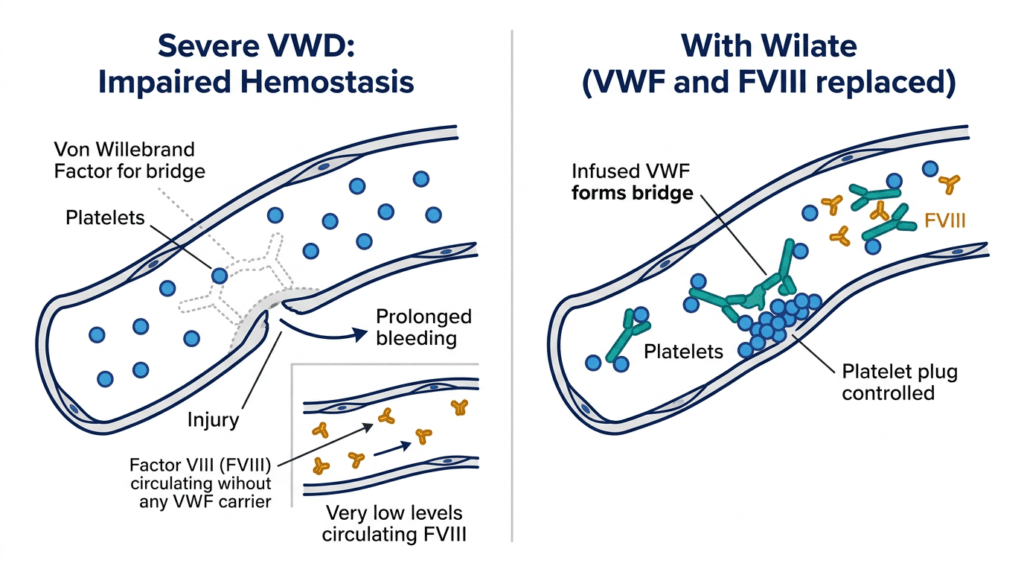
Von Willebrand factor (VWF) is a large multimeric glycoprotein produced by endothelial cells and megakaryocytes and stored in Weibel-Palade bodies in the vascular endothelium and in platelet alpha granules. It serves two essential functions in hemostasis. The first is platelet adhesion: when a blood vessel is injured, VWF binds to exposed subendothelial collagen and then captures circulating platelets via the platelet surface receptor GPIb-IX-V, enabling primary platelet plug formation. The second is FVIII stabilization: VWF circulates in the blood as a carrier protein for coagulation factor VIII, protecting it from premature degradation and concentrating it at sites of vascular injury where coagulation is needed.
Von Willebrand disease results from quantitative deficiency or qualitative dysfunction of VWF. The consequences of VWF deficiency are impaired platelet adhesion (reduced primary hemostasis) and reduced FVIII levels (impaired secondary coagulation), together producing a bleeding tendency that ranges from mild to severe.
VWD is classified into three main types:
Type 1 (approximately 60 to 80% of cases): Partial quantitative deficiency of VWF, with structurally normal protein but reduced levels. Typically mild, often not requiring regular treatment.
Type 2 (approximately 15 to 30% of cases): Qualitative abnormality of VWF, with normal or near-normal quantities but dysfunctional protein. Divided into subtypes: type 2A (reduced high-molecular-weight multimers), type 2B (enhanced binding to platelet GPIb, which paradoxically depletes VWF and platelets), type 2M (reduced platelet-dependent function without loss of multimers), and type 2N (reduced binding affinity for FVIII).
Type 3 (approximately 1 to 5% of cases): Severe quantitative deficiency of VWF, with virtual absence of the protein and correspondingly very low FVIII levels. This is the most severe form, producing significant spontaneous mucosal bleeding, joint bleeding, and surgical bleeding risk. The WIL-33 trial enrolled primarily type 3 patients (8 of 12) with 4 type 2 patients, reflecting the clinical priority of treating the highest-risk children.
The clinical features of VWD reflect its primary hemostatic defect: mucosal bleeding is the dominant symptom. Nosebleeds that are prolonged, difficult to control, and recurrent. Gum bleeding. Easy bruising disproportionate to the trauma that caused it. In females with VWD, heavy menstrual bleeding is often the presenting complaint. Gastrointestinal bleeding. Postoperative bleeding. In type 3 and some type 2 subtypes, joint bleeding (hemarthrosis) occurs and can cause the same progressive arthropathy seen in hemophilia A and B.
VWD affects approximately 3.2 million Americans at some level of severity, though most have mild type 1 disease. Approximately 20,000 to 40,000 people in the United States have type 3 or severe type 2 disease requiring regular treatment. The disease occurs across all racial and ethnic groups and affects males and females approximately equally, though females are more often diagnosed because of heavy menstrual bleeding bringing them to medical attention.
Why Prophylaxis Matters: The Case for Prevention Over On-Demand Treatment
The management of severe VWD has historically followed one of two approaches: on-demand treatment, in which VWF-containing product is administered only when a bleeding episode occurs or is anticipated, or prophylactic treatment, in which VWF is administered regularly to maintain hemostatic function and prevent bleeds from occurring in the first place.
The evidence supporting prophylaxis over on-demand treatment in severe VWD is well-established for adults and older children. The prior pivotal trial program for Wilate’s prophylaxis indication (WIL-31, which supported the December 2023 approval for ages 6 and older) showed an 84% reduction in mean total annualized bleeding rate when patients switched from on-demand to prophylactic treatment. This magnitude of benefit is consistent with what has been shown for hemophilia prophylaxis: preventing bleeds prevents the cumulative damage from repeated tissue injury.
For young children specifically, the case for early prophylaxis carries additional weight. Repeated mucosal bleeding events, even minor ones, cause pain, family anxiety, and healthcare utilization from infancy. More significantly, joint bleeding in type 3 VWD begins accumulating damage from the first events, and joint damage in childhood is progressive and irreversible. Starting prophylaxis before a pattern of bleeding-related complications develops, rather than after, is the logical application of the same principle that moved hemophilia management from on-demand to prophylaxis in the 1980s and 1990s.
As Dr. Akshat Jain, MD, MPH, principal investigator of the WIL-33 trial, noted: prior research into prophylactic treatment for VWD has been very limited in this age group. Now there is pharmacokinetic data and clinical evidence to confirm that VWF prophylaxis is safe, effective, and well-tolerated in pediatric patients with VWD, including children younger than 6 years of age.
| Why treating VWD under age 6 has been so underdeveloped VWD in young children presents a compound challenge for clinical research. The disease is less visible than hemophilia, receives less funding, and its heterogeneity across types makes population-level study design complex. The youngest children, particularly those under 6, are also the hardest to enroll in clinical trials: they require pediatric-specific pharmacokinetic studies with appropriate dosing, they cannot report symptoms reliably, and their caregivers face significant logistical burdens in trial participation. The WIL-33 trial is, by the account of its investigators, the first prospective, dedicated global clinical trial of VWF prophylaxis specifically in children under 6 years with severe VWD. Previous practice guidance in this age range relied on extrapolation from adult and older pediatric data, small case series, and individual center experience. This evidentiary gap was the basis for the FDA’s postmarketing requirement number 1 established in 2023, requiring Octapharma to conduct and submit WIL-33 data. The July 2, 2026 approval reflects the completion of that commitment. |
|---|
What Wilate Is: The Product and Its Mechanism
Wilate is a plasma-derived combination product containing von Willebrand factor and coagulation factor VIII, both derived from human plasma and manufactured by Octapharma using a proprietary purification process that includes two dedicated viral inactivation steps (solvent/detergent treatment and dry heat treatment at 100°C for 2 hours) and nanofiltration for pathogen safety.
The combination of VWF and FVIII in a single product reflects the biological relationship between the two proteins. VWF carries FVIII in the circulation and protects it from premature clearance. In VWF-deficient patients, FVIII levels are also reduced (especially in type 3 VWD), because FVIII is rapidly degraded without its VWF carrier. Replacing VWF alone ultimately stabilizes endogenous and exogenous FVIII; replacing both together in a single dose addresses the immediate hemostatic deficiency more completely.
The 1:1 ratio of VWF:RCo to FVIII in Wilate’s formulation is designed to reflect the physiological ratio of these proteins in circulation, providing balanced hemostatic support without excessive FVIII accumulation over time.
The product’s full indication coverage after July 2026
| Indication | Patient population | Approval date |
|---|---|---|
| On-demand treatment and control of bleeding episodes (VWD) | Adults and pediatric patients, all ages | December 4, 2009 |
| Perioperative management of bleeding (VWD) | Adults and pediatric patients, all ages | August 13, 2015 |
| Routine prophylaxis to reduce frequency of bleeding episodes (VWD) | Adults and pediatric patients aged 6 and older | December 1, 2023 |
| On-demand treatment and control of bleeding episodes (hemophilia A) | Adults and patients aged 12 and older | October 8, 2019 |
| Routine prophylaxis for bleeding episodes (hemophilia A) | Adults and patients aged 12 and older | October 8, 2019 |
| Routine prophylaxis to reduce frequency of bleeding episodes (VWD) | Pediatric patients younger than 6 years | July 2, 2026 |
The WIL-33 Trial: Full Data
Design
WIL-33 (NCT04953884) was a Phase 3, open-label, prospective, non-controlled, international, multicenter trial evaluating efficacy, pharmacokinetics, immunogenicity, and safety of Wilate prophylaxis in children younger than 6 years with severe VWD, defined as VWF ristocetin cofactor activity (VWF:RCo) below 20%. This is a clinically relevant threshold: VWF:RCo below 20% identifies the most severely affected patients, including virtually all type 3 patients and the most clinically significant type 2 subtypes.
The 12 enrolled patients had a median age of 2.0 years (range 1.0 to 5.0 years), making this a genuinely very young cohort. Eight patients had type 3 VWD and four had type 2 VWD (3 type 2A and 1 type 2B). This distribution reflects the clinical priority: type 3 VWD carries the most severe bleeding risk and the most compelling need for prophylaxis.
Wilate was administered intravenously at 30 to 50 IU/kg, two to three times per week, for 12 months. The primary endpoint was the total annualized bleeding rate (TABR) during prophylaxis, capturing spontaneous, traumatic, and other bleeds occurring between the first prophylactic dose and study completion.
Efficacy results
| Endpoint | Full analysis set (n=12) | Per-protocol robustness set (n=9) |
|---|---|---|
| Mean total ABR (TABR) | 4.6 (SD 6.1) | 2.7 (SD 1.8) |
| Mean TABR, type 2 VWD | 2.1 (SD 1.0) | 2.0 (SD 1.1) |
| Mean TABR, type 3 VWD | 5.8 (SD 7.2) | 3.4 (SD 2.2) |
| Mean spontaneous ABR | 0.9 (SD 1.2) | 1.0 (SD 1.3) |
| Total bleeding episodes during prophylaxis | 56 | — |
| Episodes classified as minor | 98.2% (55 of 56) | — |
| Treated bleeding episodes requiring only 1 infusion | 95.6% (43 of 45) | — |
| Median weekly prophylactic dose | 100 IU/kg (range 63 to 311, FAS); 92 IU/kg (range 63 to 130, PPR) | — |
Source: WIL-33 ASH 2025 abstract. Blood. 2025;146(Supplement 1):4855. NCT04953884.
The primary finding is a mean TABR of 4.6 in the full analysis set, falling to 2.7 in the per-protocol population that excluded patients with dosing deviations. The spontaneous ABR of 0.9 is particularly meaningful: spontaneous bleeds (those occurring without identifiable trauma or provocation) are the most clinically significant bleeding category in VWD, reflecting the adequacy of hemostatic protection during daily life. A mean of fewer than one spontaneous bleed per year in children aged 1 to 5 with severe VWD represents effective prophylactic coverage.
An important contextual note: 22 of the 56 total bleeding episodes (39%) occurred in a single patient whose bleeds were attributed to allergic rhinitis rather than hemostatic failure. Allergic rhinitis causes mucosal inflammation that can trigger or exacerbate nosebleeds in VWD patients even on adequate prophylaxis. When this one patient’s unusual contribution to the total bleed count is considered, the underlying prophylaxis performance across the rest of the cohort is even more favorable.
The per-protocol robustness set (n=9, excluding 3 patients with dosing deviations), with a mean TABR of 2.7 and type 3-specific rate of 3.4, likely represents the most informative dataset for predicting outcomes in a clinical practice setting where adherence to the recommended dosing protocol is achieved.
Pharmacokinetics
The mean VWF:RCo half-life in children under 6 was 11.7 hours, within the expected range established from data in older patients and adults and consistent with the pharmacokinetic modeling used to support the 2 to 3 times weekly dosing schedule. No clinically meaningful differences in pharmacokinetic parameters from older age groups were identified, supporting the extrapolation of the established dosing guidance to this youngest patient population.
Comparison across age groups
One of the most informative elements of the approved prescribing information is the cross-age ABR comparison:
| Age group | Total ABR during prophylaxis |
|---|---|
| Younger than 6 years (WIL-33) | 4.6 |
| 6 to 12 years (WIL-31 pediatric cohort) | 3.73 |
| 12 to younger than 17 years (WIL-31 adolescent cohort) | 4.28 |
The consistency of the ABR values across age groups in the pediatric range is clinically reassuring: children under 6 on prophylaxis have bleeding rates comparable to older children on the same treatment. The slightly higher absolute ABR in the youngest group likely reflects their developmental stage (more minor trauma from active play and toddler activity) and the contribution of the single rhinitis patient, rather than a true pharmacodynamic age effect.
Safety
Wilate was well-tolerated in the WIL-33 population. No thrombotic events occurred. No FVIII accumulation was observed, consistent with the physiological 1:1 VWF:FVIII ratio in the product. No inhibitor formation (neutralizing antibodies against VWF or FVIII) was detected in the study period, though inhibitor development remains a potential risk of any VWF-containing product requiring ongoing monitoring.
One patient discontinued prematurely due to adverse events that were not classified as treatment-emergent, and this patient was excluded from the per-protocol analysis set. The specific nature of these events is not described in the available publications.
Safety: What the Prescribing Information Covers
Wilate’s safety profile is well-characterized across its 17-year history of use since 2009, and the warnings applicable to the under-6 prophylaxis indication are consistent with the established class-level risks of plasma-derived VWF/FVIII concentrates.
Hypersensitivity and anaphylaxis: Serious hypersensitivity reactions, including anaphylaxis, can occur with Wilate and with plasma-derived coagulation products generally. Type 2B VWD patients are particularly noted in the prescribing information because VWF infusion can cause platelet aggregation and thrombocytopenia in this subtype through enhanced binding of infused VWF to platelet GPIb. Close monitoring and platelet counts during treatment initiation are recommended for type 2B patients.
Thromboembolic events: Thrombosis has been reported with VWF-containing products, particularly in patients with additional thrombotic risk factors or when products are used at high doses in perioperative settings. No thrombotic events occurred in WIL-33, but monitoring for signs and symptoms of thrombosis remains a prescribing information requirement.
FVIII monitoring: Because Wilate contains FVIII in addition to VWF, plasma FVIII activity should be monitored, particularly during high-dose or prolonged use, to avoid supra-physiological FVIII levels that could increase thrombotic risk. In the WIL-33 pediatric prophylaxis setting at the recommended 30 to 50 IU/kg doses, FVIII accumulation was not observed.
Inhibitor development: Development of neutralizing antibodies (inhibitors) against VWF or FVIII can occur with any plasma-derived or recombinant coagulation factor product, though it is less common with VWF products than with factor concentrates used in hemophilia. Immunogenicity monitoring was conducted in WIL-33 and no inhibitors were detected.
Plasma-derived product risk: As with any product derived from human plasma, despite multiple viral inactivation and reduction steps, the theoretical risk of transmission of blood-borne infectious agents cannot be entirely eliminated. Patients and families should be counseled about this risk, which is considered very low given the manufacturing safeguards.
What This Means for Pediatric Hematologists and Families
For pediatric hematologists
For pediatric hematologists managing VWD prophylaxis in children under 6, the practical implication of this approval is straightforward: children younger than 6 years with severe VWD (types 2 or 3) who have a documented history of frequent or severe bleeding episodes now have an FDA-approved option for routine prophylaxis. The WIL-33 dosing guidance, 30 to 50 IU/kg administered intravenously 2 to 3 times per week, is consistent with what has been used in older patients and can be initiated under the existing Wilate label without the need for off-label justification.
The small sample size of WIL-33 (n=12) is the most important interpretive limitation. The trial was designed and sized as a dedicated pediatric PK and safety study, not a large-scale efficacy trial. The bleeding rate data support efficacy at a clinical level, but the confidence intervals around the mean TABR are wide given the sample size, and the contribution of one outlier patient to total bleed count is substantial. Clinical practice should incorporate this context when counseling families about expected outcomes.
The cross-age ABR consistency in the prescribing information, showing comparable values across pediatric age groups, is the most practically useful data point for framing treatment expectations: children under 6 on Wilate prophylaxis achieve bleeding control comparable to older children on the same regimen.
For patients with type 2B VWD specifically, the enhanced VWF-platelet interaction that characterizes this subtype warrants careful monitoring during treatment initiation, including platelet counts, consistent with the prescribing information.
For another first-ever hematologic approval from the same August 2026 period, see our post on Imaavy (nipocalimab), the first FDA-approved treatment for warm autoimmune hemolytic anemia.
For families
If your child is younger than 6 and has been diagnosed with severe VWD (type 2 or type 3) and experiences frequent or significant bleeding episodes, Wilate prophylaxis is now an FDA-approved option. The discussion with your child’s pediatric hematologist about whether prophylaxis is appropriate should include your child’s bleeding history, the frequency and severity of episodes, and whether the venous access and infusion frequency (2 to 3 times weekly by intravenous infusion) are practical given your child’s age and individual circumstances.
For very young children requiring regular IV infusions, central venous access devices (port-a-cath or implanted port) are sometimes considered to facilitate consistent treatment. This is a decision made by the treating hematologist in consultation with the family, weighing the benefits of reliable venous access against the procedural and infection risks of central line placement.
Patient support resources for VWD families include the National Hemophilia Foundation (hemophilia.org; 1-800-42-HANDI), which provides information on both hemophilia and VWD across all ages, and the VWD Connect Foundation, which focuses specifically on the VWD community.
For related HED coverage on rare pediatric hematologic disease and gene therapy, see our post on Casgevy (exagamglogene autotemcel) expanding to patients as young as age 2 with sickle cell disease and transfusion-dependent beta thalassemia and our post on Hympavzi (marstacimab-hncq) becoming available to children aged 6 to 11 and to patients with hemophilia inhibitors.
Sources
Octapharma FDA approval press release: Octapharma USA Announces Expanded FDA Approval of wilate for von Willebrand Disease Prophylaxis in Children Younger Than 6 Years. PRNewswire. July 8, 2026.
BioSpace press release: Octapharma USA Announces Expanded FDA Approval of wilate for von Willebrand Disease Prophylaxis in Children Younger Than 6 Years. biospace.com. July 8, 2026.
Drugs.com approval news: Octapharma USA Announces Expanded FDA Approval of Wilate for von Willebrand Disease Prophylaxis in Children Younger Than 6 Years. drugs.com. July 8, 2026.
BioPharm International (PMR context, safety summary): FDA Approves Expanded Use of Wilate for Von Willebrand Disease Prophylaxis in Children Under Age 6. biopharminternational.com. July 2026.
AJMC (first dedicated prospective trial context, Dr. Jain and Nielsen quotes): FDA Expands Approval for VWD Prophylaxis in Children Younger Than 6. ajmc.com. July 2026.
Hematology Advisor (WIL-33 full data table, ABR breakdown by type, spontaneous ABR): FDA Expands Wilate Approval for VWD Prophylaxis in Children Under 6. hematologyadvisor.com. July 2026.
Hematology Advisor (WIL-33 interim data, first prospective trial): First Prospective Global Trial Demonstrates Benefit of VWF Prophylaxis in Young Children With Severe VWD. hematologyadvisor.com. December 2025.
Pharmacy Times (cross-age ABR comparison data from PI, treated episode infusion data): FDA Expands Wilate Approval for Routine Prophylaxis in Children Younger Than 6 With von Willebrand Disease. pharmacytimes.com. July 2026.
Pharmacally (PMR fulfillment detail): FDA Expands WILATE Prophylaxis Approval to Children Under 6 With von Willebrand Disease. pharmacally.com. July 2026.
Healio (Dr. Kaushal expansion statement): FDA expands Casgevy approval to children 2 years and older with sickle cell disease. healio.com.
WIL-33 ASH 2025 abstract (Blood): Plasma-derived VWF/FVIII prophylaxis in children under 6 with VWD: First results from WIL-33. Blood. 2025;146(Supplement 1):4855. doi:10.1182/blood-2025-219636.
WIL-33 trial registration: NCT04953884. ClinicalTrials.gov.
VWD overview: Von Willebrand Disease. StatPearls. NCBI.
CDC VWD facts: Von Willebrand Disease Data and Statistics. CDC.
Original Wilate FDA approval (December 2009): FDA Approves Wilate, the First Replacement Therapy Developed Specifically for Von Willebrand Disease. Octapharma. December 2009.
Wilate prescribing information: WILATE Prescribing Information. Octapharma. 2026.
Wilate approval history: Wilate FDA Approval History. drugs.com.
Patient resources: National Hemophilia Foundation: 1-800-42-HANDI | VWD Connect Foundation | Octapharma Wilate patient information
| Disclaimer: Health Evidence Digest provides general information about FDA approvals and health research for educational purposes. This content is not a substitute for professional medical advice. The WIL-33 trial enrolled 12 patients; the relatively small sample size should be considered when interpreting bleeding rate estimates and their precision. Decisions about initiating routine prophylaxis with Wilate in children younger than 6 years with von Willebrand disease should be made in consultation with a board-certified pediatric hematologist with expertise in bleeding disorders, taking into account the individual child’s VWD type, bleeding history, and the practical considerations of regular intravenous infusion in young children. |
|---|
Leave a Reply