
| The essentials: On July 14, 2026, the FDA approved Revtorpyk (gedatolisib, Celcuity Inc.) in combination with fulvestrant, with or without palbociclib (Ibrance), for the treatment of adults with HR-positive, HER2-negative locally advanced or metastatic breast cancer without a PIK3CA mutation (PIK3CA wild-type), following progression on or after at least one line of endocrine therapy in the metastatic setting. Revtorpyk is the first FDA-approved multi-target PI3K/AKT/mTOR (PAM pathway) inhibitor, and the first targeted therapy approved for PIK3CA wild-type HR+/HER2- advanced breast cancer. What “PIK3CA wild-type” means and why it matters: approximately 40% of HR+/HER2- breast cancers carry activating PIK3CA mutations, for which alpelisib (Piqray) is approved. The remaining approximately 60% have PIK3CA wild-type disease, meaning no activating PIK3CA mutation is detected. This larger population has had no approved targeted inhibitor of the PI3K pathway because existing approved agents (alpelisib, inavolisib) require a PIK3CA mutation for indication. Gedatolisib works across both PIK3CA mutant and wild-type disease by targeting the pathway more comprehensively than PI3K-alpha-specific inhibitors. Mechanism: gedatolisib is a potent, pan-PI3K and mTORC1/2 inhibitor that blocks all four class I PI3K isoforms (alpha, beta, delta, gamma) plus both mTOR complexes simultaneously, providing comprehensive PAM pathway suppression that cannot be bypassed through isoform switching or mTOR feedback loops that limit single-target inhibitors. Administration: intravenous infusion over 30 minutes on days 1, 8, and 15 of a 28-day cycle. Lyophilized powder reconstituted before administration. The clinical basis: VIKTORIA-1 Study 1 (NCT05501886), Phase 3, open-label, randomized. PIK3CA wild-type cohort results published in JCO in March 2026. Median PFS: 9.3 months (gedatolisib plus palbociclib plus fulvestrant, triplet) versus 2.0 months (fulvestrant monotherapy); HR 0.24 (95% CI 0.17 to 0.35); p less than 0.001. 76% reduction in risk of progression or death with the triplet. Median PFS: 7.4 months (gedatolisib plus fulvestrant, doublet) versus 2.0 months; HR 0.33 (95% CI 0.24 to 0.48); p less than 0.001. 67% reduction in risk of progression or death with the doublet. ORR: approximately 32% (triplet) and 28.3% (doublet) versus approximately 1% (fulvestrant). Median DOR: 11.4 months (triplet) and 12.0 months (doublet). Regulatory pathway: NDA submitted November 2025 under the Real-Time Oncology Review (RTOR) program; Priority Review granted January 2026; Breakthrough Therapy Designation and Fast Track Designation previously granted. PIK3CA mutant indication: an sNDA for gedatolisib in PIK3CA-mutant HR+/HER2- breast cancer is planned for Q3 2026 submission, based on the PIK3CA-mutant cohort of VIKTORIA-1 (Study 2), presented at ASCO 2026. |
|---|
HR-positive, HER2-negative breast cancer is the most common subtype of metastatic breast cancer, accounting for approximately 70% of all advanced cases. The treatment landscape has been transformed over the past decade by CDK4/6 inhibitors paired with endocrine therapy, which have extended median survival to several years for many patients. But the disease almost always progresses, and what comes after CDK4/6 inhibitor-based treatment is one of the most actively contested questions in breast oncology.
The PI3K/AKT/mTOR pathway is one of the most important drivers of endocrine resistance in HR+ breast cancer. Activating mutations in PIK3CA, the gene encoding the PI3K alpha catalytic subunit, are present in approximately 40% of HR+/HER2- tumors and lead to constitutive PI3K activation that drives cell proliferation regardless of hormone availability. For this 40%, alpelisib (Piqray) provides an approved PI3K-alpha-specific targeted option.
But 60% of HR+/HER2- breast cancers have PIK3CA wild-type disease. No activating mutation. No approved PI3K-directed targeted therapy. Until July 14, 2026.
Revtorpyk (gedatolisib, Celcuity Inc.) is the first drug approved for this population, and its approval rests on a biological insight that distinguishes it from every prior PI3K inhibitor: the PAM pathway drives endocrine resistance not only when PIK3CA is mutated but across the broader population, and blocking the pathway comprehensively rather than at a single node produces clinical benefit even in the absence of a defining mutation. The Phase 3 VIKTORIA-1 data in PIK3CA wild-type patients, with a 76% reduction in risk of progression with the triplet regimen versus fulvestrant monotherapy, are among the most striking efficacy numbers produced in post-CDK4/6 inhibitor breast cancer trials to date.
The HR+/HER2- Treatment Landscape After CDK4/6 Inhibitor Progression
HR-positive, HER2-negative breast cancer is driven primarily by estrogen receptor signaling. Endocrine therapy blocks this signaling, and the addition of CDK4/6 inhibitors (palbociclib, ribociclib, abemaciclib) to endocrine therapy has produced median progression-free survival of 25 to 30 months or more in the first-line metastatic setting, a major advance over endocrine therapy alone.
After CDK4/6 inhibitor-based first-line therapy progresses, the standard approach depends on disease characteristics. For patients with ESR1 mutations (which develop in approximately 30 to 40% of patients on aromatase inhibitor-based therapy), elacestrant (Orserdu) or other agents targeting mutant ESR1 are options. For patients with PIK3CA mutations, alpelisib (and more recently inavolisib) provide PI3K-directed options. For patients with BRCA1/2 mutations, PARP inhibitors are relevant.
The PIK3CA wild-type population, approximately 60% of all post-CDK4/6 inhibitor HR+/HER2- patients, has had none of these mutation-matched targeted options. The available treatments are additional endocrine therapy combinations, everolimus (mTOR inhibitor)-based regimens, and increasingly antibody-drug conjugates like sacituzumab govitecan. Everolimus specifically targets mTORC1 in isolation, and its clinical benefit in this setting has been partial, limited by the feedback reactivation of PI3K that occurs when mTORC1 alone is blocked.
Gedatolisib’s approval provides this population’s first approved targeted inhibitor of the PAM pathway.
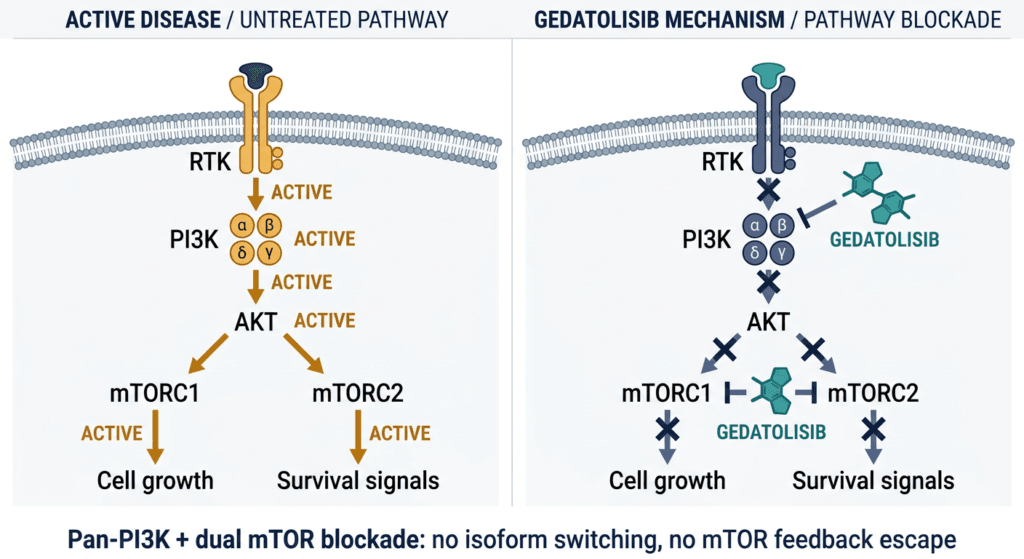
The Science: Why Pan-PI3K Plus Dual mTOR Inhibition Is Mechanistically Different
The PI3K/AKT/mTOR pathway is a master regulator of cell growth, survival, and metabolism. Its dysregulation is among the most common events in human cancer. In HR+ breast cancer, the pathway drives endocrine resistance through multiple mechanisms: it activates estrogen receptor independently of ligand, promotes cell cycle re-entry through CDK4/6 activation, and drives antiapoptotic signaling that keeps tumor cells alive despite endocrine blockade.
The pathway architecture is a cascade: growth factor signals activate PI3K (which phosphorylates PIP2 to PIP3), which activates AKT, which activates mTORC1 and mTORC2, which drive downstream transcription and protein synthesis for proliferation and survival. The cascade also includes a critical negative feedback loop: mTORC1 inhibition (as produced by everolimus) triggers PI3K reactivation through relief of the S6K1-IRS-1 feedback, partially undercutting the intended therapeutic effect.
Gedatolisib addresses the pathway comprehensively:
All four class I PI3K isoforms (alpha, beta, delta, gamma): In PIK3CA wild-type disease, other PI3K isoforms (PI3K-beta particularly) can compensate when PI3K-alpha alone is blocked by an alpha-specific inhibitor. By blocking all four isoforms simultaneously, gedatolisib prevents isoform switching that would otherwise allow the pathway to remain active.
Both mTOR complexes (mTORC1 and mTORC2): mTORC2 phosphorylates AKT at Ser473, maintaining AKT activity even when upstream PI3K is partially inhibited. By blocking mTORC2 as well as mTORC1, gedatolisib closes the reactivation loop that limits the efficacy of mTORC1-selective inhibitors like everolimus.
The result is a mechanistic approach that suppresses the PAM pathway more completely and more durably than any single-target inhibitor, and that does so regardless of which specific mutation (or absence of mutation) is driving pathway activation. This is why gedatolisib produces clinical benefit in PIK3CA wild-type patients, where no single-node inhibitor has succeeded: the wild-type pathway remains abnormally activated through other mechanisms (receptor tyrosine kinase signaling, loss of PTEN, AKT mutations), and comprehensive blockade addresses these regardless of which upstream event is present.
Dr. Sara Hurvitz, principal investigator for VIKTORIA-1, stated that the trial validates the PAM pathway as a molecular driver in HR+/HER2- advanced breast cancer regardless of PIK3CA mutation status, meaning the approach of comprehensive pathway blockade is supported across the full population rather than requiring a specific mutation.
| Why PIK3CA wild-type disease still has an active PAM pathway The intuition that PIK3CA wild-type disease lacks meaningful PI3K pathway activation is incorrect. Multiple mechanisms drive abnormal PAM pathway activity without a PIK3CA mutation: overactivation of receptor tyrosine kinases (HER3, IGF-1R, FGFR) that signal through PI3K; loss of PTEN (the phosphatase that opposes PI3K activity), present in 15 to 30% of HR+ breast cancers regardless of PIK3CA status; activating mutations in AKT1 or other pathway components; and post-CDK4/6 inhibitor adaptive changes that upregulate pathway activity as a resistance mechanism. Gedatolisib’s clinical activity in PIK3CA wild-type disease confirms that the pathway is biologically active and targetable in this population even without a defining PIK3CA mutation. |
|---|
The VIKTORIA-1 Study 1 Trial: Full Data for the Wild-Type Cohort
Design
VIKTORIA-1 (NCT05501886) is a Phase 3, multicenter, open-label, randomized trial with two independently powered cohorts: Study 1 (PIK3CA wild-type) and Study 2 (PIK3CA-mutant). The two cohorts were analyzed separately. The approval and this post cover Study 1.
Study 1 enrolled adults with HR-positive, HER2-negative locally advanced or metastatic breast cancer with PIK3CA wild-type disease (no activating PIK3CA mutation detected by an FDA-authorized companion diagnostic assay) who had progressed on or after at least one line of endocrine therapy in the metastatic setting. The vast majority of enrolled patients had received prior CDK4/6 inhibitor-based therapy.
Patients were randomized 1:1:1 to three arms:
- Gedatolisib plus palbociclib plus fulvestrant (triplet arm)
- Gedatolisib plus fulvestrant (doublet arm)
- Fulvestrant monotherapy (control arm)
Gedatolisib was administered as a 30-minute IV infusion on days 1, 8, and 15 of each 28-day cycle. Palbociclib was given at 125 mg orally on days 1 to 21 of each cycle. Fulvestrant was given at standard dosing (500 mg IM on days 1 and 15 of cycle 1, then day 1 of each subsequent cycle). The primary endpoint was progression-free survival (PFS) by blinded independent central review (BICR) in each gedatolisib-containing arm versus fulvestrant. Results were published in the Journal of Clinical Oncology in March 2026.
Primary efficacy results at median follow-up 12.8 months
| Endpoint | Gedatolisib triplet | Gedatolisib doublet | Fulvestrant |
|---|---|---|---|
| Median PFS (BICR) | 9.3 months | 7.4 months | 2.0 months |
| Hazard ratio versus fulvestrant | 0.24 (95% CI 0.17 to 0.35) | 0.33 (95% CI 0.24 to 0.48) | Reference |
| p-value versus fulvestrant | p less than 0.001 | p less than 0.001 | — |
| Risk reduction in progression or death | 76% (triplet) | 67% (doublet) | — |
| PFS incremental improvement | 7.3 months | 5.4 months | — |
Source: Hurvitz SA et al. VIKTORIA-1 trial of gedatolisib plus fulvestrant with or without palbociclib in HR+/HER2-/PIK3CA wild-type advanced breast cancer. JCO. 2026. doi:10.1200/JCO-25-02643. NCT05501886.
The magnitude of these PFS improvements is exceptional for the post-CDK4/6 inhibitor setting, where standard second-line endocrine combinations typically produce median PFS of 4 to 6 months. A median PFS of 9.3 months for the triplet and 7.4 months for the doublet, compared to 2.0 months for fulvestrant alone, represents a clinically dramatic separation of the curves. The control arm median PFS of 2.0 months reflects the biological reality of post-CDK4/6 inhibitor PIK3CA wild-type disease: fulvestrant monotherapy provides very limited benefit in this setting, confirming the extent of endocrine resistance and the unmet need.
Response and durability
| Endpoint | Gedatolisib triplet | Gedatolisib doublet | Fulvestrant |
|---|---|---|---|
| Objective response rate (ORR) | Approximately 32% | 28.3% | Approximately 1% |
| Median duration of response (DOR) | 11.4 months | 12.0 months | Not determinable (only 1 response) |
The ORR of approximately 32% for the triplet and 28% for the doublet versus approximately 1% for fulvestrant reflects a real tumor-shrinking activity in a population where endocrine monotherapy produces almost no responses. The durability of approximately 11 to 12 months in responders is consistent with meaningful clinical benefit.
VIKTORIA-1 Study 2: The PIK3CA-Mutant Data at ASCO 2026
Though the July 14, 2026 approval covers only the PIK3CA wild-type population based on Study 1, Celcuity presented the PIK3CA-mutant cohort (Study 2) results at the 2026 ASCO Annual Meeting as a late-breaking abstract (LBA1008). The data showed statistically significant and clinically meaningful PFS improvements with both gedatolisib combinations versus standard of care in PIK3CA-mutant patients as well, with hazard ratios in the same directionally strong range as the wild-type cohort. An sNDA for the mutant indication is planned for Q3 2026 submission. This means gedatolisib, if that sNDA is approved, will ultimately cover the full HR+/HER2- post-endocrine therapy population regardless of PIK3CA mutation status, making mutation testing a guide to which comparator benchmark to use rather than a gating criterion for eligibility.
The VIKTORIA-1 Study 1 Design: What Makes the Control Arm Comparison Meaningful
One important interpretive context for the VIKTORIA-1 data: the control arm is fulvestrant monotherapy, not an active CDK4/6 inhibitor combination or another targeted agent. This is an appropriate and clinically grounded comparator for the post-CDK4/6 inhibitor PIK3CA wild-type setting, where physicians currently have no approved targeted option beyond fulvestrant. But it means the absolute PFS numbers should be interpreted as comparison to the current clinical standard (fulvestrant) rather than to other active agents that are also used in this setting.
No head-to-head trial has compared gedatolisib directly to other agents used in this line (such as sacituzumab govitecan or everolimus/exemestane). Those comparisons will emerge from clinical experience and real-world data over time.
Dosing and Administration
Revtorpyk is supplied as a lyophilized powder that requires reconstitution before administration. This manufacturing form reflects the formulation chemistry needed to maintain stability of the compound; it is reconstituted by pharmacy personnel and administered to the patient as a ready-to-use infusion.
Dosing schedule:
- Gedatolisib: reconstituted and administered as a 30-minute IV infusion on days 1, 8, and 15 of each 28-day cycle
- Palbociclib (in the triplet): 125 mg orally once daily on days 1 to 21 of each 28-day cycle, with 7 days off
- Fulvestrant (in both regimens): 500 mg IM on days 1 and 15 of cycle 1, then day 1 of each subsequent cycle
The weekly infusion schedule (3 infusions per 4-week cycle) is the most notable practical consideration for patients. This is more frequent clinical contact than the every-2-to-3-week infusion schedules of some other IV-administered oncology drugs, and it represents a meaningful time commitment for patients managing advanced breast cancer. The 30-minute infusion duration is relatively short compared to some IV biologics, but the weekly schedule means patients visit an infusion center three times every four weeks indefinitely.
PIK3CA testing requirement:
The approved indication specifies PIK3CA wild-type disease, meaning testing to confirm the absence of an activating PIK3CA mutation is required before initiating treatment. An FDA-authorized companion diagnostic assay must be used. This is a companion diagnostic requirement that should be incorporated into the workup for all patients with HR+/HER2- advanced breast cancer progressing on CDK4/6 inhibitor therapy, both to confirm gedatolisib eligibility and to identify the approximately 40% of patients who may instead be eligible for alpelisib, inavolisib, or the future PIK3CA-mutant gedatolisib indication.
Safety: The VIKTORIA-1 Profile
The safety profile of gedatolisib in VIKTORIA-1 is consistent with the known class effects of PAM pathway inhibition, with stomatitis and hyperglycemia as the most pharmacologically characteristic adverse events, and neutropenia as the dominant toxicity in the triplet arm due to the addition of palbociclib.
Grade 3 or higher treatment-related adverse events in Study 1
| Adverse event | Gedatolisib triplet | Gedatolisib doublet | Fulvestrant |
|---|---|---|---|
| Neutropenia | 62.3% | 0.8% | 0.8% |
| Stomatitis | 19.2% | 12.3% | 0% |
| Rash | 4.6% | 5.4% | 0% |
| Hyperglycemia | 2.3% | 2.3% | 0% |
| Diarrhea | 1.5% | 0.8% | 0% |
| Nausea | 3.8% | 0.8% | 0% |
| Leukopenia (grade 4) | 0.8% | 0% | 0% |
| Pneumonitis (grade 4) | 0% | 0.8% | 0% |
| Treatment discontinuation due to TRAEs | 2.3% | 3.1% | — |
Source: Hurvitz SA et al. JCO. 2026. PMC13075786.
Stomatitis: The most characteristic and commonly discussed gedatolisib-specific toxicity. Grade 3 stomatitis occurred in 19.2% (triplet) and 12.3% (doublet) of patients. Importantly, among patients who did develop stomatitis, the majority experienced grade 1 as their first event (57 of 90 in the triplet arm; 48 of 74 in the doublet arm), with fewer progressing to grade 2 or 3 as their initial presentation. Stomatitis is a class effect of PI3K and mTOR inhibitors and is managed with prophylactic mouthwash protocols, dose modifications, and patient education on early symptom reporting. The treatment discontinuation rate due to stomatitis alone was low (overall discontinuation for any TRAE was 2.3% in the triplet and 3.1% in the doublet).
Neutropenia in the triplet: The high grade 3 or higher neutropenia rate of 62.3% in the triplet arm is driven primarily by the palbociclib component, consistent with palbociclib’s established neutropenia profile in all of its approved regimens. CBC monitoring before each cycle and dose modification per the Revtorpyk and palbociclib prescribing information apply. The neutropenia rate in the doublet (0.8%) confirms that gedatolisib itself does not substantially contribute to bone marrow suppression; this is a palbociclib effect in the triplet.
Hyperglycemia: PI3K inhibition affects insulin signaling, and hyperglycemia is a known class effect. Grade 3 hyperglycemia occurred in 2.3% of patients in both gedatolisib arms. Blood glucose monitoring before treatment initiation and periodically during treatment, with dose modification and antidiabetic medication management as appropriate, follows the established management framework for PAM pathway inhibitors. Patients with pre-existing diabetes should be closely monitored.
Pneumonitis: Grade 4 pneumonitis occurred in 0.8% of doublet-treated patients. Pneumonitis is a known and serious risk associated with PI3K and mTOR inhibitors as a class. Patients should be monitored for new or worsening pulmonary symptoms; grade 2 or higher pneumonitis typically requires treatment interruption and corticosteroid management, with permanent discontinuation for grade 3 or higher.
Key warnings and precautions (from Revtorpyk prescribing information):
| Warning | Clinical guidance |
|---|---|
| Hyperglycemia | Fasting glucose before initiating and periodically during treatment; dose modification for grade 3 or higher; may require antidiabetic medication initiation or dose adjustment |
| Stomatitis | Oral hygiene and prophylactic mouthwash regimens recommended before initiating; dose modification for grade 2 or higher; patient education on early reporting |
| Pneumonitis | Monitor for pulmonary symptoms; hold for grade 2 pneumonitis; permanently discontinue for grade 3 or higher |
| Embryo-fetal toxicity | Gedatolisib can cause fetal harm; effective contraception during treatment and for at least the period specified in prescribing information after last dose |
| Neutropenia (triplet) | CBC at baseline and before each cycle; dose modifications per palbociclib and Revtorpyk prescribing information for grade 3 or higher neutropenia |
What This Means in Clinical Practice
For patients with HR+/HER2- PIK3CA wild-type advanced breast cancer
If you have HR-positive, HER2-negative metastatic breast cancer, your tumor has been tested and does not have a PIK3CA mutation, and your disease has progressed on or after prior endocrine therapy (including CDK4/6 inhibitor-based regimens), you are now in the patient population for which Revtorpyk is approved. This is the first targeted agent specifically approved for your PIK3CA status in this disease.
The treatment involves weekly IV infusions (three per four-week cycle) plus fulvestrant injections and, in the triplet, oral palbociclib. The clinical decision between the triplet and doublet depends on your prior therapy, current blood counts, and your oncologist’s assessment of the most appropriate regimen for your situation. Patients who have previously received a CDK4/6 inhibitor may or may not be candidates for the triplet re-challenge with palbociclib depending on the reasons for prior CDK4/6 inhibitor discontinuation.
For oncologists
VIKTORIA-1 Study 1 establishes gedatolisib plus fulvestrant, with or without palbociclib, as a new evidenced-based option for post-CDK4/6 inhibitor PIK3CA wild-type HR+/HER2- advanced breast cancer. The hazard ratios of 0.24 (triplet) and 0.33 (doublet) represent strong clinical benefit signals in a population with historically limited targeted options.
The companion diagnostic testing requirement adds a testing step to the treatment planning workflow that should now be standardized for all HR+/HER2- advanced breast cancer patients progressing on CDK4/6 inhibitor therapy, covering both PIK3CA mutation testing (to identify alpelisib/inavolisib-eligible patients) and confirming wild-type status for gedatolisib eligibility. ESR1 mutation testing for elacestrant eligibility remains a parallel testing requirement that the same blood sample or tissue can typically address.
The weekly infusion schedule is a meaningful practical factor in patient selection and treatment planning. Patients whose performance status, transportation access, and support systems make weekly clinic visits feasible are appropriate candidates; for patients where this frequency is a significant barrier, the clinical conversation should include the doublet, which has the same visit schedule but without the oral palbociclib complexity.
Dr. Joyce O’Shaughnessy of Baylor University Medical Center noted that in her opinion, this could be immediately practice changing, given the PFS data in both the PIK3CA wild-type and PIK3CA-mutant populations being consistently better than the control arm.
The upcoming sNDA for the PIK3CA-mutant indication (planned Q3 2026 submission) is the next major regulatory event to watch. If approved, gedatolisib will cover the full HR+/HER2- post-endocrine therapy population and PIK3CA testing will guide regimen selection and comparator benchmarking rather than drug eligibility.
For related HED coverage on HR+/HER2- breast cancer approvals, see our post on palbociclib (Ibrance) receiving its first HER2-positive breast cancer approval for HR+/HER2+ maintenance and our post on Trodelvy (sacituzumab govitecan) receiving two new first-line approvals for metastatic TNBC.
For patients and families navigating an HR-positive metastatic breast cancer diagnosis, the National Breast Cancer Foundation (nationalbreastcancer.org), the Susan G. Komen Foundation (komen.org; 1-877-GO-KOMEN), and the LBBC (Living Beyond Breast Cancer) maintain current resources on treatment options, clinical trials, and financial assistance.
Sources
FDA approval announcement: FDA approves gedatolisib with fulvestrant, with or without palbociclib, for HR-positive, HER2-negative locally advanced or metastatic breast cancer. FDA.gov. July 14, 2026.
Celcuity FDA approval press release: Celcuity Announces FDA Approval of REVTORPYK (gedatolisib) for the Treatment of HR+/HER2-, PIK3CA Wild-Type Locally Advanced or Metastatic Breast Cancer. GlobeNewswire. July 14, 2026.
Drugs.com approval news: FDA Approves Revtorpyk (gedatolisib) for the Treatment of HR+/HER2-, PIK3CA Wild-Type Locally Advanced or Metastatic Breast Cancer. drugs.com. July 14, 2026.
VIKTORIA-1 Study 1 JCO primary publication (March 2026): Hurvitz SA et al. VIKTORIA-1 trial of gedatolisib plus fulvestrant with or without palbociclib in hormone receptor-positive/HER2-/PIK3CA wild-type advanced breast cancer. Journal of Clinical Oncology. 2026. doi:10.1200/JCO-25-02643.
VIKTORIA-1 trial registration: NCT05501886. ClinicalTrials.gov.
Celcuity JCO publication press release (March 9, 2026): Celcuity Announces Publication of Results from PIK3CA Wild-Type Cohort of Phase 3 VIKTORIA-1 Study. GlobeNewswire. March 9, 2026.
CancerNetwork full efficacy and clinical context (with Dr. O’Shaughnessy quote): FDA Approves Gedatolisib for HR+, HER2- PIK3CA Wild-Type Advanced Breast Cancer. cancernetwork.com. July 2026.
Targeted Oncology (RTOR, Breakthrough Therapy designation, ASCO context): FDA Approves Gedatolisib for HR+/HER2-, PIK3CA Wild-Type Advanced Breast Cancer. targetedonc.com. July 2026.
Pharmacy Times (full safety table, mechanism detail): Gedatolisib Combination Approved for PIK3CA Wild-Type HR+, HER2- Breast Cancer. pharmacytimes.com. July 2026.
CURE (patient-facing dosing and administration detail): FDA Approves Revtorpyk for Advanced HR-Positive, HER2-Negative Breast Cancer. curetoday.com. July 2026.
VIKTORIA-1 ESMO 2025 presentation (Celcuity PDF): VIKTORIA-1 PIK3CA WT ESMO Presentation. celcuity.com. October 2025.
CancerNetwork VIKTORIA-1 Study 2 ASCO 2026 data (mutant cohort): VIKTORIA-1 Regimen Shows Efficacy in PIK3CA+ Breast Cancer. cancernetwork.com. June 2026.
VIKTORIA-1 Study 2 ASCO 2026 abstract: Hurvitz SA et al. VIKTORIA-1 Study 2. J Clin Oncol. 44, 2026 (suppl 17; abstr LBA1008). doi:10.1200/JCO.2026.44.17_suppl.LBA1008.
FCS Hematology Oncology Review (complete grade 3/4 safety table): VIKTORIA-1 Trial of Gedatolisib Plus Fulvestrant With or Without Palbociclib. fcshemoncreview.com.
PI3K/AKT/mTOR pathway biology: PI3K/AKT/mTOR Signaling in Cancer. PMC7734386.
Breast cancer overview: Breast Cancer. StatPearls. NCBI.
Alpelisib FDA approval (PIK3CA-mutant reference): FDA approves alpelisib for breast cancer. FDA.gov.
Revtorpyk prescribing information: REVTORPYK (gedatolisib) Prescribing Information. Celcuity Inc. 2026.
Revtorpyk approval history: Revtorpyk FDA Approval History. drugs.com.
Patient resources: National Breast Cancer Foundation | Susan G. Komen Foundation: 1-877-GO-KOMEN | Living Beyond Breast Cancer | Celcuity Revtorpyk patient support
| Disclaimer: Health Evidence Digest provides general information about FDA approvals and health research for educational purposes. This content is not a substitute for professional medical advice. Revtorpyk (gedatolisib) requires PIK3CA wild-type confirmation by an FDA-authorized companion diagnostic assay before initiating treatment. Treatment decisions for HR-positive, HER2-negative advanced breast cancer, including regimen selection following CDK4/6 inhibitor-based therapy, should be made in close collaboration with a board-certified medical oncologist experienced in breast cancer management and familiar with the full clinical context including prior therapy, mutation status, and performance status. |
|---|
Leave a Reply