
| The essentials: On August 28, 2026, the FDA approved Mimrylo (rusfertide, Takeda/Protagonist Therapeutics) for the treatment of erythrocytosis in adults with polycythemia vera (PV). Mimrylo is the first and only hepcidin mimetic peptide approved for any indication and the first therapy for PV designed to limit iron availability for red blood cell overproduction rather than suppressing the bone marrow or targeting the JAK2 mutation. This gives PV patients a third approved treatment option, alongside hydroxyurea and ropeginterferon alfa-2b (Besremi, covered in a prior HED post), and ruxolitinib. What rusfertide is: a synthetic peptide that mimics hepcidin, a natural hormone produced by the liver that regulates iron homeostasis throughout the body. By binding to the iron export protein ferroportin and triggering its internalization and degradation, rusfertide restricts the flow of iron from storage sites into the plasma, limiting the iron available for red blood cell synthesis in the bone marrow. Less iron available means the bone marrow cannot maintain the excessive red blood cell production rate that drives erythrocytosis and elevated hematocrit in PV. Dosing: once-weekly subcutaneous self-injection. Initiated at 19 mg and titrated to maintain hematocrit below 45%. Available doses: 10, 20, 30, 40, 50, 60, 70, 80, and 90 mg. The clinical basis: Phase 3 VERIFY study (NCT05210790), global, randomized, double-blind, placebo-controlled, 293 adults with PV who remained phlebotomy-dependent despite current standard of care. Randomized 1:1 to rusfertide plus current SOC or placebo plus current SOC for 32 weeks. Primary endpoint: proportion of patients achieving clinical response during weeks 20 to 32, defined as the absence of phlebotomy eligibility (no confirmed hematocrit at or above 45% that was at least 3% above baseline, or hematocrit at or above 48%, and no phlebotomies during this period). Result: 76.9% (rusfertide) versus 33% (placebo); p less than 0.0001. All four key secondary endpoints also met: mean phlebotomies weeks 0 to 32: 0.5 (rusfertide) versus 1.8 (placebo; p less than 0.0001); hematocrit below 45%: 62.6% versus 14.4% (p less than 0.0001); PROMIS Fatigue SF-8a improvement: statistically significant (p less than 0.03); MFSAF TSS7 symptom score improvement: statistically significant (p less than 0.03). Long-term support: 4-year efficacy and safety data from Phase 2 REVIVE study and its THRIVE long-term extension. Safety: generally well tolerated through 52 weeks. Most common adverse reactions: injection site reactions, iron deficiency, dizziness, and decreased platelet count. Regulatory designations: Priority Review. |
|---|
Polycythemia vera’s central clinical problem is one of abundance: too many red blood cells, too much hemoglobin, too thick a blood. The bone marrow, driven by a constitutively active JAK2 signaling pathway, produces red cells at a rate the body did not ask for and cannot regulate. Hematocrit climbs. Blood viscosity rises. The risk of thrombosis, stroke, pulmonary embolism, and abdominal vein thrombosis climbs with it.
The therapeutic response to that problem has, for decades, been essentially mechanical: remove the excess red cells through phlebotomy. The procedure is straightforward but burdensome. Patients return to their hematologist regularly, sometimes every few weeks, to have blood drawn until hematocrit falls below the 45% threshold that guidelines define as the target. For many patients, this cycle continues indefinitely. The underlying disease does not stop producing excess cells because blood has been removed.
Cytoreductive drugs reduce the bone marrow’s output. Hydroxyurea is the most widely used, modestly effective, and carries concerns about long-term use including leukemic transformation risk. Ropeginterferon alfa-2b (Besremi), covered in HED’s earlier post, reduces the JAK2V617F mutant clone over years and is the only drug to offer meaningful disease modification. Ruxolitinib provides symptomatic relief and some hematocrit control for hydroxyurea-intolerant patients.
Mimrylo (rusfertide, Takeda/Protagonist) approaches the problem from a completely different angle. Instead of suppressing the bone marrow or targeting the mutant JAK2 clone, it targets the iron supply chain. Red cell production requires iron. Without adequate iron reaching the bone marrow, excessive red cell production cannot continue at the rate PV drives it. Rusfertide mimics hepcidin, the body’s own iron regulatory hormone, to restrict iron availability at a systemic level and bring red cell production back toward a manageable rate.
What Polycythemia Vera Is: A Brief Refresher
As covered in detail in HED’s earlier post on Besremi (ropeginterferon alfa-2b) and the BESREMi Pen approval, PV is a clonal myeloproliferative neoplasm caused by a gain-of-function JAK2V617F mutation in more than 95% of patients. The mutant JAK2 kinase is constitutively active, driving uncontrolled proliferation of red cell precursors without requiring the growth factor signal that normally regulates production.
The resulting erythrocytosis raises blood viscosity and creates the thrombosis risk that is responsible for most early mortality in PV. Maintaining hematocrit below 45%, the central therapeutic target recommended by ACC/AHA, NCCN, and European guidelines, is the most evidence-based way to reduce that risk. Every approved PV therapy is ultimately measured against how well it achieves and sustains this goal.
What Hepcidin Is and Why It Is the Right Target
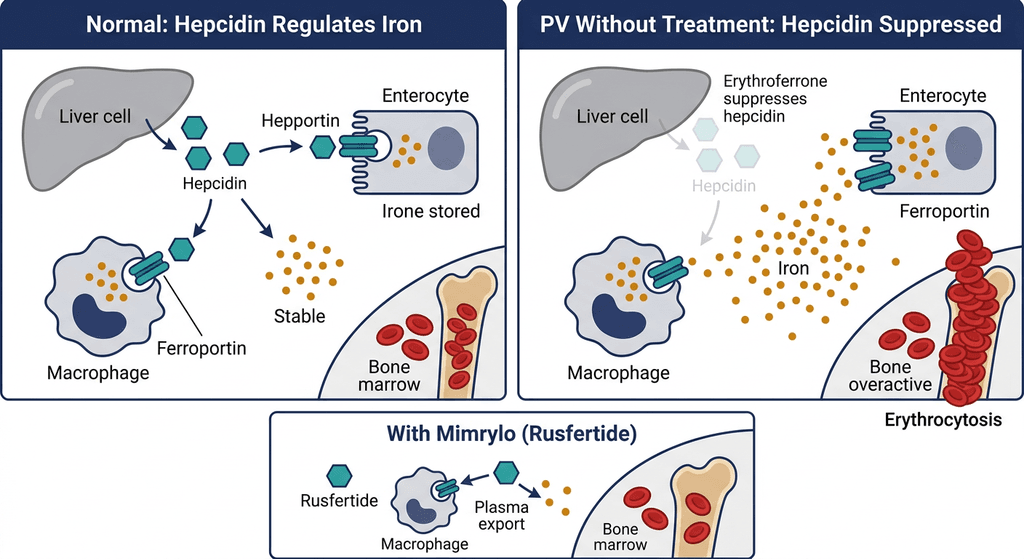
To understand rusfertide’s mechanism, understanding hepcidin is essential. Hepcidin is a 25-amino acid peptide hormone produced primarily by hepatocytes. It is the master regulator of systemic iron homeostasis, controlling how much iron is available in the plasma for use by the bone marrow and other tissues.
Hepcidin exerts its effect through ferroportin, the only known cellular iron export protein. Ferroportin sits on the surface of enterocytes (intestinal cells that absorb dietary iron), macrophages (which recycle iron from old red blood cells), and hepatocytes (which store iron as ferritin). When hepcidin binds ferroportin, it triggers the receptor’s internalization and degradation inside the cell. Without functional ferroportin on the cell surface, iron cannot be exported. Dietary iron absorption from the gut falls. Iron recycled from old red cells stays trapped in macrophages. Iron stored in the liver remains sequestered.
The net result: plasma iron concentration falls, transferrin saturation falls, and iron delivery to the bone marrow’s erythroid precursors decreases. With less iron available, the bone marrow cannot sustain its normal rate of red cell synthesis, let alone the elevated rate driven by mutant JAK2 signaling in PV.
In PV, hepcidin is often suppressed. The expansion of the erythroid progenitor pool sends signals (primarily through erythroferrone, a hormone produced by erythroid precursors) that suppress hepcidin production, creating a feedback loop that ensures the bone marrow gets the iron it needs to keep overproducing cells. Rusfertide breaks this loop by providing exogenous hepcidin-like activity that overrides the erythroferrone-mediated suppression.
How Rusfertide Works: The Synthetic Hepcidin Mimetic
Rusfertide is a synthetic peptide engineered to replicate the iron-regulatory activity of endogenous hepcidin with improved pharmacokinetic properties that support once-weekly subcutaneous dosing. Natural hepcidin has a very short half-life; its rapid clearance would require frequent dosing to maintain therapeutic iron restriction. Rusfertide’s structural modifications extend its half-life to support the weekly dosing interval used in the VERIFY trial.
After subcutaneous injection, rusfertide binds ferroportin on the cell surfaces of enterocytes, macrophages, and hepatocytes. This binding triggers ferroportin internalization and degradation, restricting iron export from all three major iron pools simultaneously. Plasma iron availability falls. Erythropoiesis slows. Hematocrit, which rises when erythropoiesis is excessive, is brought back toward the normal range.
The pharmacological elegance of this approach is that it works downstream of the JAK2 mutation. Whether the bone marrow is over-signaling because of JAK2V617F or any other driver, the erythroid precursors still need iron to complete red cell synthesis. Limiting that iron at the systemic level restricts red cell overproduction regardless of the upstream molecular driver. This is why rusfertide is effective across the PV patient population, not limited to a specific genetic subgroup.
The VERIFY Trial: Complete Data
Design
VERIFY (NCT05210790) is a global, ongoing, three-part, randomized, double-blind, placebo-controlled Phase 3 study enrolling 293 adults with PV over a 156-week treatment period. The pivotal efficacy analysis covered Part 1a (weeks 0 to 32).
Patients were eligible if they remained phlebotomy-dependent despite current standard of care, which could include phlebotomy alone, hydroxyurea, interferon, ruxolitinib, or combinations. They were randomized 1:1 to once-weekly subcutaneous rusfertide plus current SOC, or placebo plus current SOC. Rusfertide was initiated at 19 mg and titrated by the investigator to maintain hematocrit below 45%, with available doses ranging from 10 to 90 mg (median dose in the trial: 30 mg).
After Part 1a, all patients entered Part 1b (weeks 32 to 52) in open-label rusfertide. The crossover design allows assessment of whether placebo-treated patients who had not achieved hematocrit control during Part 1a could achieve response when switched to active therapy.
Efficacy results
| Endpoint | Rusfertide plus SOC | Placebo plus SOC | Result |
|---|---|---|---|
| Clinical response weeks 20 to 32 (primary) | 76.9% | 33% | p less than 0.0001 |
| Mean phlebotomies weeks 0 to 32 (key secondary 1) | 0.5 | 1.8 | p less than 0.0001 |
| Hematocrit below 45% (key secondary 2) | 62.6% | 14.4% | p less than 0.0001 |
| PROMIS Fatigue SF-8a improvement (key secondary 3) | Statistically significant | Reference | p less than 0.03 |
| MFSAF TSS7 symptom score improvement (key secondary 4) | Statistically significant | Reference | p less than 0.03 |
| Mean hematocrit through Week 52 | Remained below 43% | — | Sustained through open-label period |
Sources: Takeda VERIFY topline press release. March 11, 2025. JCO 2025 ASCO plenary abstract LBA3. ASH 2025 data. NCT05210790.
The primary endpoint result, 76.9% response versus 33% for placebo, is clinically meaningful in a population whose hematocrit was uncontrolled despite receiving standard of care treatments including phlebotomy, hydroxyurea, or interferon. The response definition requiring the absence of phlebotomy eligibility across weeks 20 to 32 is stringent: patients had to maintain hematocrit below the threshold consistently over a 12-week window, not just at a single timepoint.
The secondary endpoints add the clinical dimension. A reduction in mean phlebotomies from 1.8 to 0.5 over 32 weeks represents a more than 70% reduction in the procedure burden that defines daily life for phlebotomy-dependent PV patients. The PROMIS Fatigue and MFSAF symptom score improvements are, as highlighted by the investigators, the first statistically significant patient-reported fatigue and symptom improvements demonstrated prospectively in a PV randomized trial.
At week 52, mean hematocrit remained below 43% in patients who had received rusfertide continuously through Parts 1a and 1b, as well as in those who crossed over from placebo to rusfertide in Part 1b. The 77.9% response rate in crossover patients at weeks 40 to 52 confirms that the treatment effect is attributable to rusfertide rather than to natural disease variation.
Where Mimrylo Fits in the PV Treatment Landscape
PV treatment is stratified by risk level, with cytoreductive therapy recommended for high-risk patients (aged above 60 or with a history of thrombosis). The treatment toolkit after this approval now includes:
| Treatment | Mechanism | Role | Key limitation |
|---|---|---|---|
| Phlebotomy | Physical removal of red cells | Universal; hematocrit control | Burdensome; does not modify disease |
| Hydroxyurea | Cytoreduction (oral chemotherapy) | First-line cytoreduction | Leukemia transformation concern; no molecular benefit |
| Besremi (ropeginterferon alfa-2b) | Interferon-mediated JAK2 clone suppression | Disease modification over years | Injection every 2 to 4 weeks; slow onset |
| Ruxolitinib (Jakafi) | JAK1/2 inhibition | Second-line for HU-intolerant/resistant | Limited molecular benefit; symptom-focused |
| Mimrylo (rusfertide) | Hepcidin mimetic; iron restriction | Add-on to SOC for phlebotomy-dependent patients | Iron deficiency risk; does not modify JAK2 clone |
Mimrylo is positioned as an add-on to current standard of care, not a replacement for it. The VERIFY trial enrolled patients who remained phlebotomy-dependent despite existing therapy, making it specifically relevant for the subset of PV patients whose hematocrit cannot be adequately controlled on current treatments. Its approval label reflects this: treatment of erythrocytosis in adults with PV, without specifying a particular line of therapy.
The mechanistic complementarity with Besremi is worth noting. Ropeginterferon works at the clonal level, progressively reducing the JAK2V617F allele burden over years. Rusfertide works at the iron availability level, restricting the resources the expanded clone needs for erythropoiesis. Whether combination therapy produces additive or synergistic hematocrit control is a logical clinical question; it has not yet been addressed in clinical trials.
Safety: What the VERIFY Data Shows
Mimrylo was generally well tolerated through 52 weeks of treatment in VERIFY. No new safety signals emerged beyond those anticipated from the mechanism.
The most common adverse reactions include injection site reactions (consistent with any weekly subcutaneous injection regimen), iron deficiency (the expected pharmacodynamic consequence of limiting systemic iron availability), dizziness, and decreased platelet count. The iron deficiency signal deserves specific attention. By design, rusfertide reduces iron availability in the plasma. In patients who already have iron stores at the lower end of normal, or who develop symptomatic iron deficiency (fatigue, pica, restless legs), dose adjustment is guided by the titration framework in the prescribing information. Monitoring serum ferritin and transferrin saturation during treatment is appropriate.
Iron deficiency is a nuanced adverse effect in PV: it is simultaneously the mechanism of action and a potential toxicity. The treating hematologist must distinguish between iron restriction that is achieving hematocrit control and iron depletion that is causing symptoms requiring dose adjustment. This clinical judgment is a routine part of managing a drug with a pharmacodynamic effect on iron homeostasis.
The decreased platelet count signal (thrombocytopenia) warrants monitoring. Hepcidin and iron homeostasis have complex interactions with platelet production, and restricting iron in a myeloproliferative context can affect megakaryopoiesis. Platelet counts should be monitored at baseline and periodically during treatment.
There are no boxed warnings for Mimrylo. The contraindications and full prescribing information should be reviewed before initiating therapy and before making dose adjustments.
Dosing and Administration
Mimrylo is self-administered subcutaneously once weekly, following reconstitution from lyophilized powder. The starting dose of 19 mg is titrated by the treating hematologist based on hematocrit response, with available doses of 10, 20, 30, 40, 50, 60, 70, 80, and 90 mg per injection. Dose adjustments are made in response to hematocrit levels and tolerability, with the goal of maintaining hematocrit below 45%.
Patient education on self-reconstitution and injection technique is an important component of starting therapy. The once-weekly dosing, combined with the home self-administration format, represents a meaningful practical advantage over the every-2-to-4-week clinical visit required for phlebotomy.
What This Means for Hematologists and PV Patients
For hematologists
Mimrylo provides a mechanistically distinct add-on option for the subset of PV patients who remain phlebotomy-dependent despite hydroxyurea, interferon, or ruxolitinib. The 76.9% response rate in a population specifically selected for inadequate hematocrit control on existing therapy is a clinically meaningful result in a disease where achieving and sustaining the less than 45% hematocrit target is directly linked to thrombosis prevention.
The iron deficiency monitoring requirement adds a layer of clinical management that is straightforward but requires patient education and periodic laboratory surveillance. For most PV patients, the exchange of continued phlebotomy dependence for once-weekly self-injection with iron monitoring will represent a clinically favorable trade.
The first prospective demonstration of fatigue improvement in a PV trial is a clinically significant secondary finding. Fatigue is reported as one of the most debilitating symptoms by PV patients and has not been addressed by prior approved cytoreductive therapies in a randomized controlled setting.
For PV patients
If you have PV and continue to need phlebotomies regularly despite your current medication, Mimrylo is now an FDA-approved add-on option. A once-weekly self-injection from home is a different treatment experience from monthly or bi-monthly phlebotomy clinic visits. The VERIFY data showed that most patients who added rusfertide to their existing regimen no longer needed phlebotomy during the controlled assessment period.
For related HED coverage on PV treatment, see our post on Besremi (ropeginterferon alfa-2b) and the BESREMi Pen delivery device approval, which covers the JAK2 clone reduction approach and the importance of treatment adherence over years of therapy. Besremi and Mimrylo address PV from complementary mechanisms: one at the clonal level, one at the iron availability level.
The MPN Research Foundation (mpnresearchfoundation.org) and MPN Advocacy and Education International maintain current resources on PV treatment options, clinical trials, and patient community support.
Sources
FDA approval announcement: FDA approves first drug of its kind for polycythemia vera, a rare blood disorder. FDA.gov. August 28, 2026. Full announcement.
Takeda approval press release: Takeda Receives U.S. FDA Approval of MIMRYLO (rusfertide), Marking a Potential Shift in the Treatment Paradigm for Polycythemia Vera. BusinessWire. August 28, 2026.
Protagonist Therapeutics press release: Protagonist Therapeutics Announces U.S. FDA Approval of MIMRYLO (rusfertide) for Polycythemia Vera. BioSpace. August 28, 2026.
Drugs.com approval news: FDA Approves Mimrylo (rusfertide) for the Treatment of Polycythemia Vera. drugs.com. August 28, 2026.
Hematology Advisor (Dr. Kuykendall quote, safety profile): FDA Clears Hepcidin Mimetic Mimrylo for Polycythemia Vera. hematologyadvisor.com. August 2026.
Oncology Nursing News (dosing detail, 19 mg initiation, full safety profile, nursing practice context): FDA Approves Rusfertide, First-in-Class Hepcidin Mimetic for Polycythemia Vera. oncnursingnews.com. August 2026.
OncoDaily (mechanism summary, hematocrit control data): FDA Approves Takeda’s Mimrylo (Rusfertide) for Polycythemia Vera. oncodaily.com. August 2026.
Takeda VERIFY topline results press release (primary data, all secondary endpoints): Protagonist and Takeda Announce Positive Topline Results from Phase 3 VERIFY Study. takeda.com. March 11, 2025.
ASCO 2025 plenary abstract (primary and secondary endpoint exact numbers): Results from VERIFY, a phase 3, double-blind, placebo-controlled study of rusfertide for treatment of polycythemia vera. JCO. 2025;43(17 suppl):LBA3.
ASH 2025 data (Week 52 crossover data, 77.9% crossover response, hematocrit below 43%): Rusfertide ASH 2025 VERIFY Data in Polycythemia Vera. takeda.com. December 6, 2025.
OncLive (0.5 vs 1.8 phlebotomies exact figure, 62.6% vs 14.4% hematocrit control): Rusfertide Meets Response End Point in Phlebotomy-Dependent Polycythemia Vera. onclive.com.
VERIFY trial registration: NCT05210790. ClinicalTrials.gov.
REVIVE Phase 2 trial registration: NCT04057040. ClinicalTrials.gov.
THRIVE long-term extension trial registration: NCT06033586. ClinicalTrials.gov.
Mimrylo prescribing information: MIMRYLO (rusfertide) Prescribing Information. Takeda Pharmaceuticals America Inc. 2026.
Mimrylo approval history: Mimrylo FDA Approval History. drugs.com.
Patient resources: MPN Research Foundation | MPN Advocacy and Education International | Takeda Mimrylo patient support | American Society of Hematology PV resources
| Disclaimer: Health Evidence Digest provides general information about FDA approvals and health research for educational purposes. This content is not a substitute for professional medical advice. Mimrylo (rusfertide) requires dose titration based on hematocrit response and monitoring of iron status, platelet counts, and other laboratory parameters during treatment. All treatment decisions for polycythemia vera should be made in close collaboration with a board-certified hematologist experienced in the management of myeloproliferative neoplasms. |
|---|
Leave a Reply