
| The essentials: On September 14, 2026, the FDA approved Bexlutry (lutetium Lu 177 dotatate injection, Curium) for the treatment of adults with somatostatin receptor-positive gastroenteropancreatic neuroendocrine tumors (SSTR-positive GEP-NETs), including foregut, midgut, and hindgut neuroendocrine tumors. Bexlutry is a radioligand therapy delivering targeted beta radiation to somatostatin receptor-expressing tumor cells. It is Curium’s first FDA-approved radioligand therapy and the first approved radioligand equivalent for this indication. What “radioligand equivalent” means: Bexlutry was approved through the FDA’s 505(b)(2) regulatory pathway, referencing Lutathera (lutetium Lu 177 dotatate, Novartis/AAA), which received original FDA approval in January 2018 for the same indication. Bexlutry contains the same active ingredient as Lutathera and was approved based on previously published clinical evidence (the ERASMUS and NETTER-1 trials supporting Lutathera) combined with targeted bridging data demonstrating a similar biological and chemical profile. No new independent pivotal trial was conducted. This is not a generic in the traditional pharmaceutical sense. Radiopharmaceuticals are complex manufactured radioactive drugs that cannot simply be replicated through bioequivalence testing; they require demonstration of comparable manufacturing quality and radiochemical purity. Bexlutry is currently indicated for adults only; Lutathera’s indication was expanded in 2024 to include pediatric patients aged 12 and older, and Bexlutry does not yet carry that pediatric expansion. What changes with this approval: a second fully vertically integrated lutetium-based GEP-NET therapy manufacturer enters the U.S. market, adding supply redundancy and the potential for improved access and scheduling reliability at NET treatment centers. Curium describes itself as the only vertically integrated lutetium-based NETs therapy manufacturer, operating its own lutetium-177 production, drug manufacturing, and distribution infrastructure. Bexlutry was available for prescribing immediately upon approval. Dosing: 7.4 GBq (200 mCi) intravenously every 8 weeks for 4 doses. Companion amino acid infusion required to protect renal function during administration. SSTR imaging confirmation required before treatment. |
|---|
Lutetium Lu 177 dotatate has been an approved treatment for somatostatin receptor-positive GEP-NETs since January 2018, when Lutathera received FDA clearance based on compelling data from the NETTER-1 Phase 3 trial. For eight years, Novartis through its Advanced Accelerator Applications (AAA) subsidiary has been the only FDA-approved source of this therapy in the United States. On September 14, 2026, that changed.
Bexlutry (Curium) is not a new drug. The active ingredient is the same. The mechanism is the same. The clinical evidence base that supported approval is the same evidence generated by the Lutathera trials. What is new is the manufacturer, the manufacturing infrastructure behind it, and what that second source means for the practical delivery of peptide receptor radionuclide therapy at NET treatment centers across the United States.
Understanding this approval requires understanding both what lutetium Lu 177 dotatate actually does in GEP-NET patients, and why having a second manufacturer matters in the specialized world of radiopharmaceutical therapy.
What GEP-NETs Are and Why Somatostatin Receptors Are the Key Target
Gastroenteropancreatic neuroendocrine tumors arise from the diffuse neuroendocrine cell population throughout the gastrointestinal tract and pancreas. These cells, which are found in the stomach, small intestine, colon, rectum, and pancreas, among other sites, share characteristics of both endocrine cells (hormone-secreting) and neurons. When they become malignant, they can grow slowly or aggressively depending on their grade and site of origin.
GEP-NETs account for 60 to 70% of all neuroendocrine tumors. The annual incidence of all NETs in the United States is approximately 8 per 100,000 people, and because many are slow-growing, the prevalence is substantially higher than the incidence. Approximately 170,000 Americans are living with a NET diagnosis.
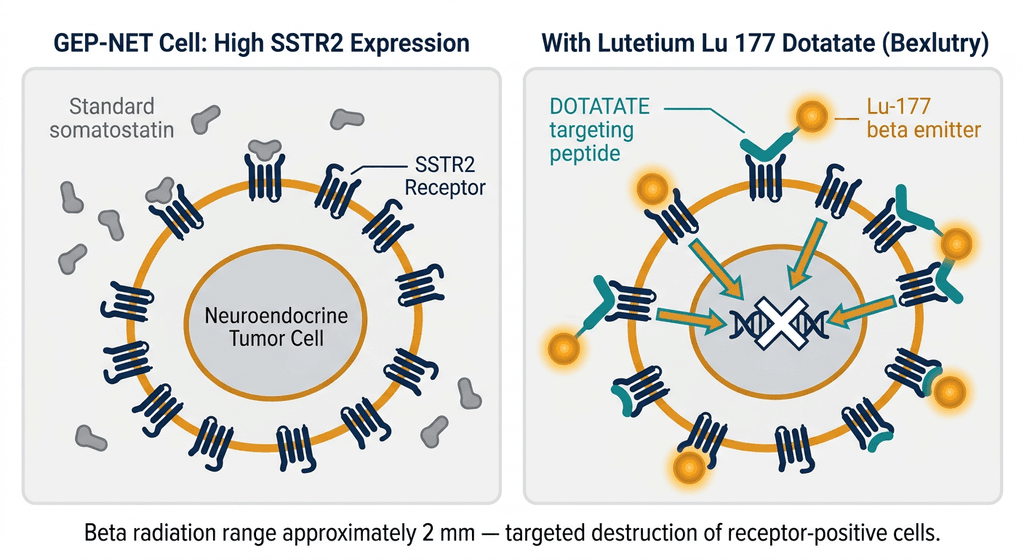
Neuroendocrine tumors, particularly the well-differentiated types, characteristically overexpress somatostatin receptors, especially somatostatin receptor subtype 2 (SSTR2), on their cell surfaces. This receptor expression serves two clinical purposes. It is diagnostic: somatostatin receptor imaging (octreotide scintigraphy historically, and now 68Ga-dotatate PET/CT) allows tumor visualization and staging based on receptor expression. And it is therapeutic: high SSTR expression makes these tumors targetable by somatostatin analog-based radioligand therapy.
How Lutetium Lu 177 Dotatate Works: The Radioligand Mechanism
Lutetium Lu 177 dotatate is a peptide receptor radionuclide therapy (PRRT) combining two components. The targeting component is DOTATATE, a somatostatin analog peptide that binds with high affinity to SSTR2 on tumor cell surfaces. The payload is lutetium-177, a radioactive isotope that emits beta particles, which are ionizing radiation capable of damaging DNA in cells within a short range (approximately 2 mm).
After intravenous administration, DOTATATE circulates through the bloodstream and binds to SSTR2 receptors on GEP-NET cells wherever they are located in the body. The lutetium-177 payload then delivers localized beta radiation to the receptor-positive tumor cells and their immediate neighbors, causing DNA double-strand breaks that lead to tumor cell death.
This “seek and irradiate” approach delivers tumor-directed radiation from within, rather than from an external beam, which allows precise targeting of multiple tumor sites including distant metastases simultaneously. Because the range of beta radiation is short, normal tissue that does not express SSTR2 at high levels is relatively spared.
The primary off-target organs in PRRT are those with physiological somatostatin receptor expression, mainly the kidneys, which filter and partially retain the peptide, and the bone marrow. This is why amino acid infusion (a mixture of lysine and arginine) must be given concurrently with each dose to reduce renal tubular reabsorption of the radioligand and protect kidney function.
What the 505(b)(2) Pathway Means in the Radiopharmaceutical Context
Bexlutry was approved through the FDA’s 505(b)(2) New Drug Application pathway, referencing Lutathera as the listed drug. The 505(b)(2) pathway allows an applicant to rely on data not generated by the applicant, including published clinical evidence, to support approval, provided the new product demonstrates that it is sufficiently similar to the reference to be expected to perform equivalently.
For conventional pharmaceuticals, bioequivalence testing compares plasma concentration-time profiles. For radiopharmaceuticals, the approach is different. Radiopharmaceuticals are complex manufactured radioactive drugs where the chemical identity, radiochemical purity, specific activity (ratio of radioactive to non-radioactive isotope), sterility, and manufacturing consistency all contribute to the product’s performance. Curium’s 505(b)(2) application was supported by published clinical data from the ERASMUS and NETTER-1 trials, combined with targeted bridging data demonstrating similar biological and chemical profiles between Bexlutry and Lutathera.
No independent pivotal efficacy trial was required or conducted. The FDA determined that the bridging data, combined with the established clinical evidence base from Lutathera’s development, was sufficient to support approval of Bexlutry for the same indication.
The Supporting Evidence Base: NETTER-1 and ERASMUS
Because Bexlutry’s approval rests on the same clinical foundation as Lutathera, understanding the pivotal evidence supporting this drug class requires reviewing that foundation.
NETTER-1: The randomized Phase 3 trial
NETTER-1 (NCT01578239) was a Phase 3, randomized, controlled trial enrolling 229 patients with progressive, unresectable, locally advanced or metastatic, SSTR-positive midgut NETs who had failed or were not candidates for somatostatin analog therapy. Patients were randomized 1:1 to lutetium Lu 177 dotatate 7.4 GBq every 8 weeks for 4 doses plus octreotide LAR, or high-dose octreotide LAR alone.
The primary endpoint was progression-free survival. Results showed a dramatic PFS benefit: at 20-month follow-up, estimated PFS was 65.2% with lutetium Lu 177 dotatate versus 10.8% with octreotide LAR. Median PFS in the control arm was 8.4 months; median PFS in the lutetium arm was not yet reached at the time of primary analysis. The overall response rate was 18% versus 3%.
These NETTER-1 results were the principal efficacy evidence supporting Lutathera’s 2018 approval and remain the primary efficacy evidence underlying Bexlutry’s 505(b)(2) application.
ERASMUS: The single-arm expanded access and dose-finding study
The ERASMUS study was a single-arm study evaluating lutetium Lu 177 dotatate in a broader GEP-NET population, including foregut, midgut, and hindgut NETs, providing the clinical evidence to support the broader indication that covers all three anatomic origins rather than just midgut. In the ERASMUS efficacy population, among 60 responders, the median duration of response was 35 months (95% CI 17 to 38). The median age was 60 years; 51% were male; 71% had Karnofsky performance status at or above 90. Median cumulative lutetium Lu 177 dotatate dose was 29.6 GBq.
These data, together with NETTER-1, form the complete clinical evidence base from which both Lutathera and now Bexlutry derive their indication.
Why a Second Manufacturer Matters: The Supply and Access Dimension
The clinical story of Bexlutry’s approval is not a story about new efficacy data. It is a story about access and supply chain resilience for a therapy that requires specialized manufacturing and delivery infrastructure.
Radiopharmaceutical therapy is logistically different from conventional drug therapy in ways that affect patient access directly. Lutetium-177 has a half-life of approximately 6.7 days. The drug must be manufactured, quality tested, shipped, and administered within a tight time window. Treatment centers must be qualified to handle radioactive materials, require specialized infrastructure and staff, and must coordinate with the manufacturer on scheduling. When a single manufacturer controls the entire supply of a therapy for a condition with tens of thousands of eligible patients, any disruption to manufacturing, quality issues, or capacity constraints ripples directly into patient scheduling and access.
Adding a second fully integrated manufacturer with its own lutetium-177 production capacity creates redundancy. Treatment centers now have an alternative source they can turn to if supply from one manufacturer is disrupted. For a therapy administered on a specific 8-week schedule with 4 doses total, scheduling reliability is clinically meaningful: delays between doses can affect treatment outcomes.
Curium’s positioning as a vertically integrated manufacturer controlling its own lutetium-177 production, radiolabeling, quality release, and distribution is commercially and clinically significant. Unlike contract manufacturers that source isotopes externally, vertical integration provides greater control over the supply chain from isotope production through to final drug delivery.
Mike Patterson, Curium’s North American Chief Executive Officer, captured the practical value: “As the only vertically integrated, lutetium-based NETs therapy manufacturer, Curium is uniquely positioned to support a reliable supply of Bexlutry and help sites of care prepare for radioligand therapy delivery at scale.”
What Bexlutry Is and Is Not: The Radioligand Equivalent Distinction
The FDA’s “radioligand equivalent” framing for Bexlutry is worth being precise about. This is not a generic drug in the traditional sense. Generic small-molecule drugs demonstrate bioequivalence through pharmacokinetic studies in healthy volunteers. Radiopharmaceuticals are manufactured radioactive drugs where the manufacturing process itself is a critical part of what determines the product’s safety and performance.
What Bexlutry’s 505(b)(2) approval demonstrates is that Curium’s manufacturing process produces lutetium Lu 177 dotatate with a biological and chemical profile that is demonstrably similar to Lutathera’s, and that the existing clinical evidence for lutetium Lu 177 dotatate as a class is sufficient to support approval of a second manufacturer’s product.
For physicians and patients, the practical implication is that Bexlutry delivers the same active therapeutic agent as Lutathera, at the same dose and schedule, for the same indication, through a different manufacturer’s supply chain. The clinical expectation of efficacy and safety is the same.
One current distinction between the two products is the pediatric label. Lutathera’s indication was expanded in 2024 to include pediatric patients aged 12 and older. Bexlutry’s current FDA indication covers adults only. Pediatric use of Bexlutry is not yet approved.
Dosing, Administration, and Patient Selection Requirements
Bexlutry is administered as 7.4 GBq (200 mCi) by intravenous infusion once every 8 weeks for a total of 4 doses. This is the same dose and schedule as Lutathera.
SSTR imaging before treatment is required. Patients must have confirmed SSTR positivity on somatostatin receptor imaging before starting treatment. Adequate receptor expression on tumor tissue is the essential eligibility criterion, confirmed by 68Ga-dotatate PET/CT (Locametz or Detectnet) or equivalent FDA-approved SSTR imaging agent.
Amino acid infusion is required concurrently with each Bexlutry dose to protect renal tubular cells from radiation exposure. The amino acid solution (lysine and arginine) competitively inhibits renal tubular reabsorption of the radioligand, substantially reducing the cumulative renal radiation dose.
Administration setting: Bexlutry must be prepared and administered at qualified nuclear medicine or radiation oncology facilities with appropriate radioactive materials handling certification, radiation safety infrastructure, and infusion monitoring capability.
Concomitant somatostatin analogs: In ERASMUS, 52% of patients received a concomitant somatostatin analog. Long-acting somatostatin analogs should be held for at least 4 to 24 hours before each Bexlutry dose to avoid competitive receptor binding that would reduce uptake of the radioligand.
Safety: What Prescribers Need to Know
The safety profile of Bexlutry is consistent with the established safety experience of lutetium Lu 177 dotatate from the Lutathera clinical program. The FDA labeling includes specific warnings and precautions reflecting the radiopharmaceutical nature of the therapy.
Boxed warning: radiation exposure. Bexlutry is a radioactive drug. Healthcare providers, family members, and caregivers must follow radiation safety precautions after administration. Patients emit radiation for several days post-infusion and should limit close contact with children and pregnant women during this period. Providers administering Bexlutry must follow institutional radiation safety protocols.
Myelosuppression. Beta radiation from circulating lutetium-177 affects bone marrow. Grade 3 or higher cytopenias, including neutropenia, thrombocytopenia, and lymphopenia, have been reported. Complete blood counts must be monitored before each cycle and dose modifications applied for clinically significant myelosuppression.
Secondary myelodysplastic syndrome and leukemia. As with other radiation-emitting therapies, there is a risk of radiation-induced secondary malignancies including MDS and leukemia. This risk is included as a warning in the prescribing information.
Renal toxicity. Cumulative renal radiation dose is a dose-limiting consideration with PRRT. Amino acid infusion reduces but does not eliminate renal exposure. Renal function must be monitored before and during treatment, and dose modification or discontinuation is required for significant renal function deterioration.
Embryo-fetal toxicity. Radiation-based therapies can cause fetal harm. Effective contraception is required during treatment and for a specified period after the last dose for both male and female patients.
What This Means for NET Specialists and Patients
For oncologists and nuclear medicine physicians
Bexlutry gives centers a second FDA-approved source of lutetium Lu 177 dotatate, with the potential to improve scheduling flexibility and supply reliability for PRRT programs. The clinical approach to patient selection, somatostatin receptor confirmation, amino acid infusion, blood count monitoring, and renal function monitoring is the same as for Lutathera. Centers already running PRRT programs with Lutathera will find the Bexlutry administration protocol familiar.
For centers that have been limited in their PRRT capacity by Lutathera supply constraints or scheduling bottlenecks, Bexlutry’s entry into the market provides an alternative source. Whether commercial availability translates into improved scheduling reliability will depend on Curium’s ability to execute its supply chain promise at volume.
For related HED coverage on radioligand therapy, see our post on Pluvicto (lutetium Lu 177 vipivotide tetraxetan) receiving FDA approval for PSMA-positive metastatic hormone-sensitive prostate cancer, which covers the broader radioligand therapy mechanism and the infrastructure requirements for RLT administration in detail.
For patients with GEP-NETs
If you have been diagnosed with a somatostatin receptor-positive GEP-NET and your oncologist has discussed lutetium-based PRRT as a treatment option, Bexlutry is now a second FDA-approved source of the same active therapy as Lutathera. Both deliver the same drug at the same dose and schedule. The availability of Bexlutry alongside Lutathera may improve scheduling access at NET treatment centers.
PRRT is given at specialized nuclear medicine centers. If you are evaluating PRRT, your oncologist will refer you to a center equipped to administer radioligand therapy, where your SSTR imaging results will confirm eligibility.
The Neuroendocrine Tumor Research Foundation (netrf.org; 1-877-8-NETRF-8), The Carcinoid Cancer Foundation (carcinoid.org; 1-888-722-3132), and the North American Neuroendocrine Tumor Society (NANETS) maintain current patient resources on GEP-NET treatment options and PRRT center locations.
Sources
FDA approval announcement: FDA approves lutetium Lu 177 dotatate injection (Bexlutry) for adults with SSTR-positive GEP-NETs. FDA.gov. September 14, 2026.
Curium press release: Curium announces FDA approval of BEXLUTRY lutetium Lu 177 dotatate injection for adults with SSTR-positive GEP-NETs. GlobeNewswire. September 14, 2026.
BioSpace press release: Curium announces FDA approval of BEXLUTRY. biospace.com. September 14, 2026.
Drugs.com approval news: FDA Approves Bexlutry (lutetium Lu 177 dotatate) for Somatostatin Receptor-Positive GEP-NETs. drugs.com. September 14, 2026.
OncoDaily (505(b)(2) pathway detail, first radioligand equivalent framing, pediatric limitation): FDA Approves Curium’s Bexlutry for SSTR-Positive GEP-NETs. oncodaily.com. September 2026.
CancerNetwork (ERASMUS trial data, DOR 35 months, patient demographics): FDA Approves Lutetium Lu 177 Dotatate Injection for GEP-NETs. cancernetwork.com. September 2026.
Targeted Oncology (ERASMUS clinical data, median DOR, Karnofsky status, concomitant somatostatin analog frequency): FDA Approves Radioligand Equivalent Bexlutry for SSTR+ GEP-NETs. targetedonc.com. September 2026.
Cancer Therapy Advisor (warnings and precautions summary, myelosuppression, renal toxicity, MDS risk): FDA Approves Radioligand Equivalent Bexlutry for SSTR+ GEP-NETs. cancertherapyadvisor.com. September 2026.
Morning Glory Sciences (505(b)(2) analytical deep-dive, no new pivotal trial, supply chain competitive analysis): FDA Approves Lutetium Lu 177 Dotatate (BEXLUTRY) for SSTR-Positive GEP-NETs. morningglorysciences.com. September 2026.
NETTER-1 trial registration: NCT01578239. ClinicalTrials.gov.
GEP-NET overview: Gastroenteropancreatic Neuroendocrine Tumors. StatPearls. NCBI.
Bexlutry prescribing information: BEXLUTRY (lutetium Lu 177 dotatate) Prescribing Information. Curium. 2026.
Bexlutry approval history: Bexlutry FDA Approval History. drugs.com.
Patient resources: Neuroendocrine Tumor Research Foundation: 1-877-8-NETRF-8 | The Carcinoid Cancer Foundation: 1-888-722-3132 | North American Neuroendocrine Tumor Society | Curium Bexlutry information
| Disclaimer: Health Evidence Digest provides general information about FDA approvals and health research for educational purposes. This content is not a substitute for professional medical advice. Bexlutry (lutetium Lu 177 dotatate) is a radioactive drug requiring administration by qualified nuclear medicine personnel at certified facilities. SSTR imaging confirmation of somatostatin receptor positivity is required before initiating treatment. Amino acid infusion must be co-administered with each dose to protect renal function. Bexlutry is currently approved for adults only; the pediatric expansion approved for Lutathera does not apply to Bexlutry at this time. Treatment decisions for GEP-NETs should be made in collaboration with a board-certified oncologist and nuclear medicine physician experienced in neuroendocrine tumor management and peptide receptor radionuclide therapy. |
|---|
Leave a Reply