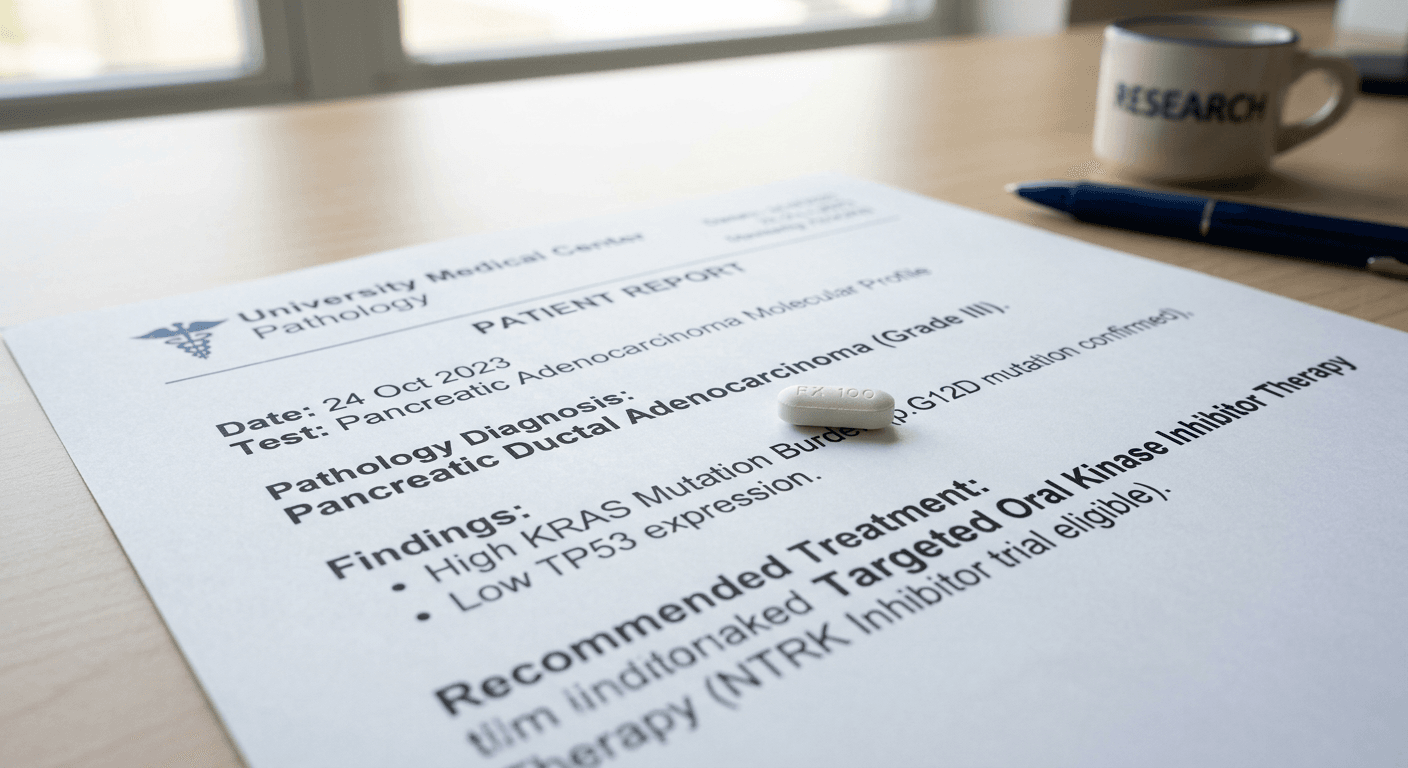
| The essentials: On August 26, 2026, the FDA approved Rasonque (daraxonrasib, Revolution Medicines) for adults with metastatic pancreatic adenocarcinoma who have received at least one prior systemic therapy or who are not candidates for multiagent systemic therapy. Rasonque is the first approved RAS-targeted therapy for pancreatic cancer and the first approved agent in the new RAS(ON) multi-selective inhibitor class. The approval was granted 6.5 months before its PDUFA deadline. No companion diagnostic test is required. Rasonque is approved for patients with or without an identified RAS tumor mutation. Dosing: 300 mg orally once daily. The clinical basis: Phase 3 RASolute 302 (NCT06625320), a randomized, open-label, multicenter trial comparing daraxonrasib versus investigator’s choice of cytotoxic chemotherapy in 500 adults with previously treated metastatic PDAC. Both co-primary endpoints (OS and PFS) were met in both the RAS G12 mutant population and the overall intent-to-treat (ITT) population. Median OS: 13.2 months (daraxonrasib) versus 6.7 months (chemotherapy); HR 0.40 (95% CI 0.30 to 0.53; p less than 0.0001). 60% reduction in risk of death. 12-month OS rate: 53.2% (daraxonrasib) versus 17.3% (chemotherapy). Median PFS: 7.2 months versus 3.6 months; HR 0.45 (95% CI 0.34 to 0.59). ORR: 31.6% (daraxonrasib) versus 11.2% (chemotherapy). Grade 3 or higher AEs: 43.6% (daraxonrasib) versus 57.5% (chemotherapy). Treatment discontinuation due to toxicity: 1.2% (daraxonrasib) versus 11.2% (chemotherapy). Published simultaneously in the New England Journal of Medicine. At ASCO 2026, the invited discussant called daraxonrasib “probably the most exciting strategy in five decades” for pancreatic cancer. Regulatory designations: Breakthrough Therapy Designation; Orphan Drug Designation; Priority Review. |
|---|
For more than 50 years, the treatment of metastatic pancreatic cancer has been defined by a single clinical reality: the disease is largely resistant to targeted therapy. While lung cancer, breast cancer, and colorectal cancer acquired a growing menu of molecularly targeted agents over the past two decades, pancreatic cancer had almost nothing. Chemotherapy remained the standard: harsh, modestly effective, and unable to touch the molecular drivers that make pancreatic cancer so aggressive.
The central molecular driver, present in over 90% of pancreatic ductal adenocarcinomas, is a mutant RAS protein locked permanently in its active, growth-signaling state. For decades, RAS was considered undruggable. It has no obvious binding pocket, no enzymatic activity that small molecules can inhibit cleanly, and no dependence on the kind of receptor signaling that first-generation targeted therapies could block.
Rasonque (daraxonrasib, Revolution Medicines) is the first drug that has broken through that barrier. It targets all active (ON-state) RAS proteins across multiple mutation types simultaneously, producing a 60% reduction in the risk of death and nearly doubling median overall survival compared to chemotherapy in the Phase 3 RASolute 302 trial. The approval, granted 6.5 months ahead of schedule, marks one of the most significant advances in pancreatic cancer treatment since FOLFIRINOX was introduced in 2011.
What Pancreatic Ductal Adenocarcinoma Is and Why It Has Been So Hard to Treat
Pancreatic ductal adenocarcinoma (PDAC) arises from the exocrine cells lining the ducts of the pancreas. It accounts for approximately 90 to 95% of the roughly 67,000 new pancreatic cancer cases diagnosed in the United States annually. Despite making up only 3.2% of all cancer diagnoses, PDAC is responsible for a disproportionately high share of cancer deaths, because most cases are diagnosed at advanced stages, when curative surgery is no longer possible.
The 5-year survival rate for metastatic PDAC is approximately 3 to 4%. Median overall survival in the second-line setting, after progression on first-line gemcitabine-based or FOLFIRINOX-based chemotherapy, has historically been 4 to 6 months with available cytotoxic agents. The disease’s resistance to most systemic therapies reflects its dense stromal microenvironment, its highly immunosuppressive tumor immune landscape, and above all, the near-universal presence of mutant RAS proteins that drive autonomous, relentless tumor growth.
The RAS Problem: Why This Target Took Decades to Drug
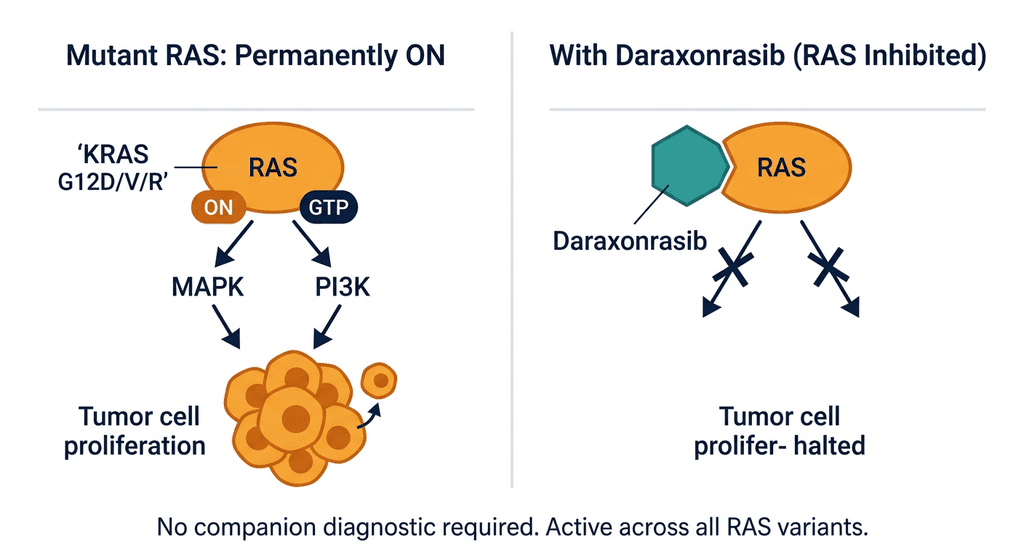
RAS proteins are GTPases, molecular switches that cycle between an active GTP-bound state (RAS-ON) and an inactive GDP-bound state (RAS-OFF). In normal cells, growth factor signaling activates RAS transiently, triggering downstream proliferation and survival signals, before GTPase activity hydrolyzes GTP to GDP and turns the signal off.
In PDAC, activating mutations at codon 12 of the KRAS gene, most commonly G12D (approximately 42%), G12V (approximately 32%), and G12R (approximately 14%), impair GTPase activity and lock RAS in its active ON state permanently. The cell receives a continuous, unregulated growth signal it cannot turn off.
For decades, attempts to drug mutant RAS failed because RAS has an unusually smooth protein surface with no obvious deep binding pocket for small molecules. The first breakthrough came in 2021, when KRAS G12C inhibitors (sotorasib, adagrasib) were approved, exploiting a unique cysteine residue created by the G12C mutation. However, KRAS G12C accounts for only 1 to 2% of PDAC cases. The dominant PDAC mutations, particularly G12D and G12V, have no equivalent cysteine and could not be targeted by this approach.
Daraxonrasib represents a fundamentally different strategy. Rather than targeting the nucleotide-binding pocket occupied by GDP or GTP, it binds to an alternative site on the RAS protein that is accessible in the active (ON) state across all RAS variants. This RAS(ON) inhibitor approach allows daraxonrasib to inhibit multiple RAS GTPase family members simultaneously, regardless of which specific mutation is present or even in the absence of a mutation.
How Daraxonrasib Works: The RAS(ON) Multi-Selective Mechanism
Daraxonrasib is a RAS(ON) multi-selective inhibitor, designed to bind directly to active RAS proteins across a broad spectrum of mutations. It inhibits KRAS, HRAS, and NRAS in their GTP-bound active conformations, covering not only the three major KRAS G12 variants that together account for nearly 90% of PDAC but also less common RAS variants and potentially RAS pathway activation even in the absence of a direct RAS mutation.
This broad coverage is precisely why no companion diagnostic is required. Because the drug works across essentially the full RAS mutation landscape present in PDAC, testing for a specific mutation is unnecessary for eligibility. Any patient with metastatic PDAC who has received prior therapy is a candidate.
The once-daily oral 300 mg tablet delivers drug exposure that sustains RAS inhibition throughout the dosing interval, keeping the primary oncogenic driver of the tumor suppressed continuously rather than in episodic bursts that might allow recovery.
The RASolute 302 Trial: Complete Data
Design
RASolute 302 (NCT06625320) was a global, randomized, open-label, multicenter Phase 3 trial. It enrolled 500 adults with metastatic PDAC who had progressed on at least one prior line of systemic therapy. Patients were randomized to daraxonrasib 300 mg orally once daily or investigator’s choice of cytotoxic chemotherapy (FOLFOX, FOLFIRI, gemcitabine-based regimens, or other standard options). The trial included patients with RAS G12 mutations (the primary population) and a broader overall ITT population that included less common RAS mutations and RAS wild-type patients. Both groups were analyzed as co-primary populations.
The two co-primary endpoints were overall survival and progression-free survival in the RAS G12 population, with OS, PFS, and ORR as key secondary endpoints in the ITT population.
Efficacy results at median follow-up of 8.5 months
| Endpoint | Daraxonrasib | Chemotherapy | Result |
|---|---|---|---|
| Median OS, RAS G12 population | 13.2 months (95% CI 10.0 to NE) | 6.6 months (95% CI 5.4 to 8.2) | HR 0.40 (95% CI 0.30 to 0.54); p less than 0.0001 |
| Median OS, ITT population | 13.2 months | 6.7 months | HR 0.40 (95% CI 0.30 to 0.53); p less than 0.0001 |
| 12-month OS rate, ITT | 53.2% | 17.3% | — |
| Median PFS, RAS G12 population | 7.3 months | 3.5 months | HR 0.45 (95% CI 0.34 to 0.59) |
| Median PFS, ITT population | 7.2 months | 3.6 months | HR 0.45 |
| ORR, RAS G12 population | 33.2% | 11.8% | — |
| ORR, ITT population | 31.6% | 11.2% | — |
| Grade 3 or higher AEs | 43.6% | 57.5% | Lower with daraxonrasib |
| Treatment discontinuation (toxicity) | 1.2% | 11.2% | Substantially lower |
Sources: RASolute 302 data. ASCO 2026 Plenary. NEJM June 2026 publication. NCT06625320.
The headline number, median OS of 13.2 months versus 6.7 months with HR 0.40, represents a 60% reduction in the risk of death and a near-doubling of survival time. To put that in context: the largest survival improvement achieved by any second-line PDAC treatment in the preceding two decades was the approximately 2-month improvement offered by olaparib in BRCA-mutant patients, and that applied to fewer than 5% of PDAC patients. The RASolute 302 result applies to essentially the entire PDAC population, across all RAS mutation types, with the same magnitude of benefit observed whether patients had a RAS G12 mutation or not.
The 12-month OS rate is perhaps even more striking than the median: 53.2% of daraxonrasib patients were alive at one year versus only 17.3% on chemotherapy. Three times as many patients alive at one year is not a marginal clinical improvement. It is a transformation of what patients with second-line metastatic PDAC can expect.
The safety advantage is also clinically meaningful. Grade 3 or higher adverse events occurred in 43.6% of daraxonrasib patients versus 57.5% on chemotherapy. Treatment discontinuation due to toxicity was 1.2% with daraxonrasib versus 11.2% with chemotherapy. Patients survived longer and tolerated the therapy better than the comparator.
What the safety profile looks like
The most common adverse events with daraxonrasib in the Phase 1/2 NEJM-published dataset (168 PDAC patients) were rash, diarrhea, nausea, mucositis, vomiting, and fatigue. Grade 3 or higher events occurred in 30% of patients at the approved 300 mg dose, driven primarily by these gastrointestinal and skin effects. These are manageable toxicities with appropriate supportive care and dose modification, and they compare favorably to the bone marrow suppression, neuropathy, and fatigue that dominate chemotherapy toxicity profiles.
What No Companion Diagnostic Means in Practice
One of the most clinically important features of the Rasonque label is what it does not require: a companion diagnostic test. Unlike KRAS G12C inhibitors (sotorasib, adagrasib), which require confirmed KRAS G12C mutation for eligibility, Rasonque is approved for all patients with previously treated metastatic PDAC regardless of RAS mutation status.
This matters enormously for access. Pancreatic cancer patients often receive their diagnosis under urgent circumstances, with rapid clinical deterioration. The time and infrastructure required to obtain and process molecular profiling results from a biopsy adds weeks to treatment planning. For patients who are not candidates for multiagent chemotherapy due to performance status or comorbidity, any delay is especially costly.
Removing the testing requirement means that any oncologist can prescribe Rasonque to any eligible PDAC patient without waiting for molecular results. Molecular profiling remains valuable for other reasons (identifying candidates for BRCA-targeted therapy, NTRK inhibitors, and tumor-agnostic indications), but it is no longer a gating criterion for RAS-targeted therapy in pancreatic cancer.
The ASCO 2026 Reaction and What It Tells Us
The RASolute 302 data were presented at the ASCO 2026 Annual Meeting Plenary Session, one of only four or five presentations given this designation each year and reserved for the most practice-changing results in oncology. The invited discussant, Dr. Jennifer Knox of Princess Margaret Cancer Center, called daraxonrasib a “game changer” and described it as “probably the most exciting strategy in five decades” for pancreatic cancer.
That framing is not hyperbole in the context of the history. FOLFIRINOX’s introduction in 2011 improved median OS in first-line metastatic PDAC from approximately 6.8 months to 11.1 months, and it was considered a landmark. Daraxonrasib’s 6.5-month absolute OS improvement over chemotherapy in the second-line setting, in a patient population with much worse prognosis than first-line patients, is a larger absolute benefit in a harder clinical context.
As Brian Wolpin, MD, director of the Hale Family Center for Pancreatic Cancer Research at Dana-Farber Cancer Institute and principal investigator for RASolute 302, noted: this approval gives physicians the confidence that directly inhibiting RAS can make a striking difference for patients and provides a critically needed new approach to treating patients with metastatic pancreatic cancer.
What Comes Next: The Rasonque Pipeline
Daraxonrasib’s approval in second-line PDAC is the beginning of a broader development program. Revolution Medicines is evaluating the drug in additional settings:
RASolute 303: Phase 3 trial evaluating daraxonrasib as monotherapy and in combination with chemotherapy in first-line metastatic PDAC. If successful, Rasonque could move to earlier lines of therapy where the potential survival benefit may be even larger.
RASolute 304: Phase 3 trial evaluating daraxonrasib in the adjuvant setting after surgery and perioperative chemotherapy in resectable PDAC, where the goal is preventing recurrence rather than treating established metastatic disease.
RASolve 301: Phase 3 trial in NSCLC, reflecting the broader RAS-addicted cancer indication that the RAS(ON) inhibitor approach enables beyond pancreatic cancer.
RASolute 309: Evaluation of the combination of daraxonrasib plus zoldonrasib (a KRAS G12D-selective inhibitor), a RAS inhibitor doublet strategy targeting the pathway at two distinct points simultaneously.
The Pipeline post on olomorasib (LY3537982) receiving Breakthrough Therapy Designation for KRAS G12C-mutant pancreatic cancer provides additional context on the broader KRAS-targeting landscape. Daraxonrasib’s approval and olomorasib’s continued development together illustrate that the “undruggable” RAS mutation may become the most targetable oncogene in pancreatic cancer within the next few years.
What This Means for Oncologists and Patients
For oncologists
Rasonque represents a new standard of care option for patients with previously treated metastatic PDAC. The OS benefit is large, consistent across RAS mutation subgroups and the ITT population, and accompanied by a favorable tolerability profile relative to chemotherapy. No companion diagnostic is required, simplifying treatment access.
The approval also covers patients who are not candidates for multiagent systemic therapy, meaning that even patients whose performance status or comorbidities previously excluded them from second-line treatment now have an oral, once-daily option with demonstrated survival benefit.
Quality of life data from RASolute 302, including patient-reported outcomes, are a key secondary endpoint that will inform how to counsel patients about the lived experience of treatment. Early indications from ASCO presentations suggest QoL was maintained or improved with daraxonrasib versus deteriorating with chemotherapy.
For patients with metastatic pancreatic cancer
If you have been diagnosed with metastatic pancreatic adenocarcinoma and have received prior chemotherapy, Rasonque is now an FDA-approved oral option your oncologist can prescribe without requiring any additional molecular testing. The trial data show that patients receiving Rasonque lived nearly twice as long as those receiving chemotherapy, with better tolerability.
For patients who have been told they are not well enough for more chemotherapy, the “not candidates for multiagent systemic therapy” approval pathway may also provide access to this therapy. Discussing this with your oncologist is the right starting point.
The Pancreatic Cancer Action Network (pancan.org; 1-877-272-6226) maintains current resources on treatment options, clinical trials, and patient support for pancreatic cancer. Revolution Medicines’ patient support program can be accessed through the Rasonque website.
Sources
FDA approval announcement: FDA approves daraxonrasib for metastatic pancreatic adenocarcinoma. FDA.gov. August 26, 2026.
FDA press announcement: FDA approves first in class targeted therapy for metastatic pancreatic cancer. FDA.gov. August 26, 2026.
Revolution Medicines approval press release: U.S. FDA Approves Revolution Medicines’ RASONQUE (daraxonrasib). ir.revmed.com. August 26, 2026.
Drugs.com approval news: FDA Approves Rasonque (daraxonrasib), the First Broad RAS-Targeted Medicine in Metastatic Pancreatic Cancer. drugs.com. August 26, 2026.
RASolute 302 topline data announcement: Daraxonrasib Demonstrates Unprecedented Overall Survival Benefit in Pivotal Phase 3 RASolute 302 Clinical Trial. ir.revmed.com. April 13, 2026.
ASCO 2026 Plenary announcement: Revolution Medicines Announces ASCO Plenary Presentation Highlighting Unprecedented Results from RASolute 302. ir.revmed.com. May 31, 2026.
Cancer Therapy Advisor (full data table, 12-month OS rates, PFS data, Dr. Wolpin quote): RASolute-302: Daraxonrasib Improves Survival, ORR in Metastatic PDAC. cancertherapyadvisor.com. June 2026.
Targeted Oncology (NEJM publication context, Phase 1/2 safety data, grade 3 AE rates, discontinuation data): Daraxonrasib PDAC Data Published in NEJM as FDA Allows Expanded Access. targetedonc.com.
Binaytara Foundation (full safety data, ORR by population, trial eligibility criteria): Daraxonrasib Pancreatic Cancer Trial: RASolute 302 Data. binaytara.org. July 2026.
Medscape (6.5 months ahead of schedule, Dr. Knox “game changer” quote, expanded access letter): FDA Approves RAS Inhibitor Daraxonrasib for Pancreatic Cancer. medscape.com. August 2026.
NBC News (patient-facing summary, Dr. Shroff context): FDA approves game-changing pancreatic cancer drug. nbcnews.com. August 26, 2026.
RASolute 302 trial registration: NCT06625320. ClinicalTrials.gov.
PDAC overview: Pancreatic Ductal Adenocarcinoma. StatPearls. NCBI.
Rasonque prescribing information: RASONQUE (daraxonrasib) Prescribing Information. Revolution Medicines. 2026.
Rasonque approval history: Rasonque FDA Approval History. drugs.com.
Patient resources: Pancreatic Cancer Action Network: 1-877-272-6226 | American Cancer Society pancreatic cancer resources | Revolution Medicines patient support | ClinicalTrials.gov: search daraxonrasib
| Disclaimer: Health Evidence Digest provides general information about FDA approvals and health research for educational purposes. This content is not a substitute for professional medical advice. Treatment decisions for metastatic pancreatic adenocarcinoma should be made in close collaboration with a board-certified medical oncologist experienced in pancreatic cancer management. |
|---|
Leave a Reply