
| The essentials: On July 7, 2026, the FDA expanded the approval of Ryaltris (olopatadine hydrochloride 665 mcg and mometasone furoate 25 mcg nasal spray, Glenmark Pharmaceuticals) to include children aged 6 to less than 12 years with seasonal allergic rhinitis (SAR). The prior lower age limit was 12 years. Ryaltris is now approved for adults and pediatric patients aged 6 and older, making it the first fixed-dose antihistamine-corticosteroid nasal spray approved for this age group in the United States. What Ryaltris is: a fixed-dose combination (FDC) nasal spray containing olopatadine hydrochloride (an antihistamine, H1 receptor antagonist) at 665 mcg per spray and mometasone furoate (a corticosteroid) at 25 mcg per spray. Two sprays per nostril are used for the adult dose; for children aged 6 to 11, one spray per nostril twice daily is the approved pediatric dose. The two active ingredients address both the histamine-mediated and inflammatory components of SAR simultaneously in a single device. The clinical basis for the age expansion: Phase 3, randomized, double-blind, placebo-controlled trial, n=446, children aged 6 to less than 12 years with seasonal allergic rhinitis. Dosing: one spray in each nostril twice daily for 14 days. Primary endpoint: change from baseline in average AM and PM patient-reported 12-hour reflective Total Nasal Symptom Score (rTNSS) over the 14-day period. Result: statistically significant improvement in average AM and PM rTNSS versus placebo (p=0.001). Trial completion rate: 96.6% (431 of 446 patients). TEAEs: 10.4% (Ryaltris) versus 12.0% (placebo), comparable between arms. Most common TEAEs: dysgeusia 1.3% versus 0.0% placebo; headache 1.3% versus 0.5%; epistaxis 0.9% versus 2.3% (nosebleed rate actually lower with Ryaltris than placebo). The pediatric findings were consistent with the clinical trial experience in the more than 4,000 adults and adolescents studied in the Ryaltris Phase 3 program. Primary publication: Prenner BM et al. Ann Allergy Asthma Immunol. 2022. doi:10.1016/j.anai.2022.07.029. Key safety warnings: potential reduction in pediatric growth velocity with intranasal corticosteroid use; immunosuppression risks (consistent with corticosteroid class); epistaxis; nasal ulceration; septal perforation; hypersensitivity. |
|---|
Seasonal allergic rhinitis is, by prevalence, one of the most common chronic conditions affecting school-age children in the United States. Estimates consistently place the prevalence at 10 to 15% of children aged 6 to 11 years, with up to 40% of all children affected by some form of allergic rhinitis across their school years. The condition is responsible for missed school days, reduced academic performance, impaired sleep, and daytime fatigue that affects every aspect of a child’s functioning during allergy season. Pediatric allergists and primary care physicians who manage these children have solid options for their older adolescent patients; the treatment toolkit for the 6-to-11 age group has been meaningfully more limited.
The standard treatment approach for pediatric SAR has historically combined a non-sedating antihistamine (oral or intranasal) with an intranasal corticosteroid, each addressing different aspects of the allergic response. This two-medication approach is effective but creates adherence challenges: two devices, two dosing regimens, and for a school-age child managing medications, more complexity than a single product requires.
Ryaltris (Glenmark Pharmaceuticals) was approved in January 2022 as the first fixed-dose combination of an antihistamine (olopatadine) and a corticosteroid (mometasone furoate) in a single nasal spray for SAR. The July 7, 2026 expansion to children aged 6 to 11 is supported by Phase 3 data specifically generated in this population, not extrapolated from adult data, and demonstrates that the same fixed-dose combination approach is effective and well-tolerated at the reduced one-spray-per-nostril pediatric dose.
What Seasonal Allergic Rhinitis Is and Why It Matters in Children
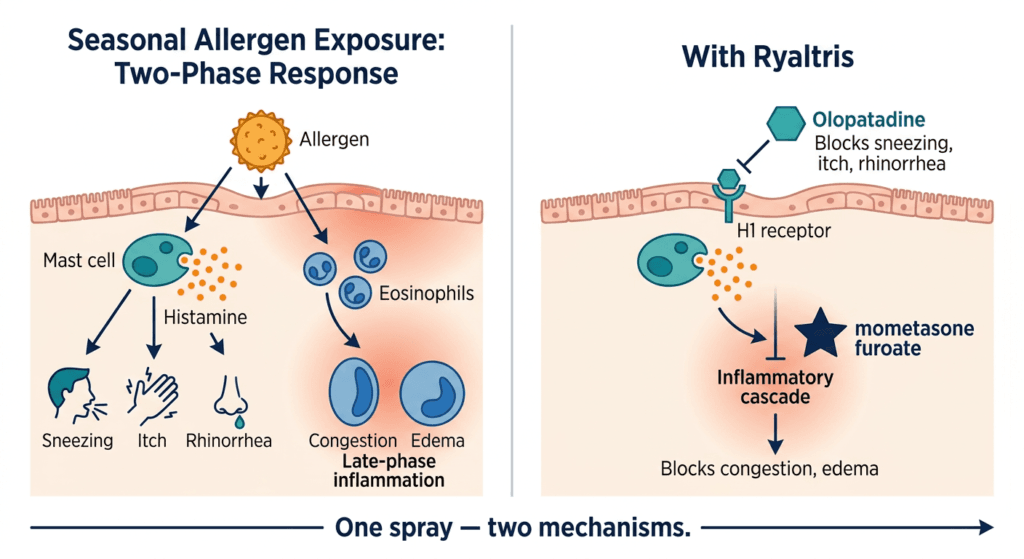
Seasonal allergic rhinitis is an IgE-mediated hypersensitivity response to seasonal aeroallergens, most commonly tree pollen (spring), grass pollen (late spring and summer), and weed pollen including ragweed (late summer and fall). When a sensitized individual inhales these allergens, they bind to IgE antibodies on mast cells in the nasal mucosa. The mast cells degranulate, releasing histamine and other preformed mediators that produce the immediate symptoms of allergic rhinitis: sneezing, nasal itching, rhinorrhea, and watery eyes. A late-phase inflammatory response follows hours later, driven by eosinophils, basophils, and T cells, producing nasal congestion, mucosal edema, and the persistent stuffiness that dominates many patients’ experience of allergy season.
The four nasal symptoms scored in the rTNSS, nasal congestion, rhinorrhea, nasal itching, and sneezing, capture both the histamine-mediated immediate response and the inflammatory late-phase response, which is why a drug that addresses only one pathway (antihistamine only, or corticosteroid only) may not address all four symptoms adequately.
In children aged 6 to 11, SAR is not a minor inconvenience. Studies of SAR’s impact on school-age children consistently document:
Sleep disruption from nighttime nasal congestion, with consequent daytime fatigue and difficulty concentrating. Poor school performance during peak allergy season, with documented effects on standardized testing scores in allergic versus non-allergic children during high-pollen days. Reduced participation in outdoor activities and physical education. Behavioral effects including irritability and reduced quality of life, reported by both children and their caregivers. Comorbidity with asthma, which is more likely to be poorly controlled in children with untreated or undertreated allergic rhinitis, through the unified airway model.
Effective treatment of SAR in this age group is therefore not cosmetic or optional. It has direct implications for academic function, physical activity, sleep, and asthma control.
How Ryaltris Works: The Two-Mechanism Fixed-Dose Combination
Ryaltris addresses SAR through the complementary mechanisms of its two active ingredients, delivered simultaneously in a single nasal spray device.
Olopatadine hydrochloride 665 mcg: the antihistamine component
Olopatadine is a selective, relatively non-sedating H1 receptor antagonist that blocks histamine from binding to H1 receptors on nasal mucosal cells. When histamine is blocked at the H1 receptor, the immediate allergic response, sneezing, nasal itching, and rhinorrhea, is substantially reduced. Olopatadine also has mast cell-stabilizing properties, inhibiting the release of mediators from mast cells and thereby reducing both the immediate and the late-phase components of the allergic response.
Intranasal olopatadine at 665 mcg is a higher dose than what was available in prior intranasal antihistamine products (azelastine, for example, is available at much lower per-spray concentrations but with a distinct pharmacological profile). The 665 mcg dose was selected through the Ryaltris development program to optimize the antihistamine contribution to the fixed-dose combination.
Mometasone furoate 25 mcg: the corticosteroid component
Mometasone furoate is a synthetic corticosteroid with high intranasal activity and very low systemic bioavailability when administered intranasally. Less than 1% of an intranasal mometasone dose reaches the systemic circulation, which is one of the reasons intranasal corticosteroids are considered safe for long-term use in allergic rhinitis at labeled doses.
Corticosteroids reduce allergic inflammation through broad suppression of the inflammatory gene expression cascade: they reduce the production of cytokines, chemokines, and arachidonic acid-derived mediators from eosinophils, mast cells, and T cells in the nasal mucosa. This suppression of the late-phase inflammatory response addresses nasal congestion, a symptom that antihistamines alone do not adequately control, because congestion is driven primarily by inflammatory vasodilation and edema rather than by histamine directly.
Why combining both in one spray is more than convenience
The clinical rationale for fixed-dose combination therapy in SAR is not merely adherence convenience. The two active mechanisms are complementary, not redundant: the antihistamine addresses the immediate histamine-mediated response while the corticosteroid addresses the late-phase inflammatory response. Clinical studies of SAR treatment consistently show that patients on combination antihistamine plus corticosteroid therapy achieve better symptom control than those on either monotherapy, particularly for the congestion symptom that antihistamines address inadequately. The Ryaltris Phase 3 pivotal program in adults and adolescents directly compared Ryaltris to both component monotherapies (olopatadine-only and mometasone-only nasal sprays), demonstrating superiority over each monotherapy.
Delivering both in a single device adds the practical benefit of a simplified regimen. For a school-age child who needs to use a nasal spray twice daily, the difference between one device and two devices is meaningful for adherence and for the practical management of a medication routine across a school day.
The Phase 3 Pediatric Trial: What the Data Shows
Design
The Phase 3 pediatric trial was a randomized, double-blind, placebo-controlled parallel-group study enrolling 446 children aged 6 to less than 12 years with a documented history of seasonal allergic rhinitis and a positive skin prick test to a relevant seasonal allergen. Patients were required to have a nasal symptom score at screening consistent with at least moderate disease. Participants were randomized approximately 1:1 to Ryaltris one spray per nostril twice daily or placebo nasal spray for 14 days.
The primary endpoint was the change from baseline in average morning (AM) and evening (PM) patient-reported 12-hour reflective Total Nasal Symptom Score (rTNSS) over the 14-day treatment period. The rTNSS is the sum of patient-rated severity (0 to 3 scale for each) across four nasal symptoms: nasal congestion, rhinorrhea, nasal itching, and sneezing, for a maximum score of 12. The reflective score captures symptoms over the prior 12 hours, covering the full day’s experience across both AM and PM assessment points.
A pediatric-adapted quality of life questionnaire was used as a secondary endpoint, appropriate for the younger age group.
Results
| Endpoint | Ryaltris | Placebo | Result |
|---|---|---|---|
| Primary: mean change from baseline in average AM/PM rTNSS | Statistically significant improvement | Reference | p=0.001 |
| Trial completion rate | — | — | 96.6% (431 of 446) |
| TEAEs | 10.4% | 12.0% | Comparable; lower rate with Ryaltris |
| Dysgeusia (taste disturbance) | 1.3% | 0.0% | Higher with Ryaltris (class effect of olopatadine) |
| Headache | 1.3% | 0.5% | Slight numeric difference |
| Epistaxis (nosebleed) | 0.9% | 2.3% | Lower with Ryaltris than placebo |
| Quality of life (secondary) | Positive impact | Reference | Consistent with symptom improvement |
The primary endpoint result (statistically significant rTNSS improvement, p=0.001) confirms that the fixed-dose combination produces meaningful reduction in the four core nasal symptoms in children aged 6 to 11. The effect is described as clinically meaningful and statistically significant, consistent with the language from the adult and adolescent pivotal trials.
The safety profile is notably favorable. The total TEAE rate was actually lower with Ryaltris (10.4%) than with placebo (12.0%), which is unusual and reflects that the active treatment may reduce some symptom-related adverse events (nosebleed rate was 0.9% with Ryaltris versus 2.3% with placebo, likely because better allergen symptom control reduces nasal mucosal trauma from excessive nose-blowing and sneezing). Dysgeusia, the most characteristic adverse effect of intranasal olopatadine from its pharmacological bitter taste profile, occurred in 1.3% of active-treated children, consistent with the known tolerability profile.
The 96.6% trial completion rate in 6-to-11-year-olds over a 14-day double-blind treatment period is also noteworthy: it reflects high acceptability of the nasal spray device and administration regimen in this age group, suggesting the once-or-twice-daily spray routine is practical in pediatric clinical practice.
Dosing: The Pediatric Dose Is Different From the Adult Dose
This distinction is important for prescribing accuracy and for family counseling.
| Population | Dose | Frequency | Route |
|---|---|---|---|
| Adults and adolescents aged 12 and older | 2 sprays per nostril | Twice daily | Intranasal |
| Children aged 6 to less than 12 | 1 spray per nostril | Twice daily | Intranasal |
Children aged 6 to 11 receive one spray per nostril (rather than the two-spray adult dose) twice daily. At the 665 mcg/25 mcg per spray concentration, this delivers 665 mcg olopatadine and 25 mcg mometasone furoate per nostril per dose, or a total of 1,330 mcg olopatadine and 50 mcg mometasone per dosing event across both nostrils. The dose differentiation was built into the clinical trial design specifically for the pediatric age group.
Families and prescribers should be clear that a child using a caregiver’s Ryaltris prescription intended for an adult would receive double the labeled pediatric dose. This is a practical counseling point: prescriptions for children in this age group should specify the one-spray-per-nostril dose clearly, and shared medication between family members using different doses should be avoided.
Safety: What Prescribers and Families Need to Know
The Ryaltris safety profile in the pediatric population was consistent with the established adult profile, with the additional pediatric-specific considerations that apply to all intranasal corticosteroid products in children.
Potential reduction in growth velocity: Intranasal corticosteroids, including mometasone furoate, have the potential to reduce growth velocity in pediatric patients. This is a class effect of systemic and topically-absorbed corticosteroids. At the doses used in Ryaltris, intranasal mometasone has very low systemic bioavailability (less than 1%), and long-term studies with mometasone furoate nasal spray at licensed doses have not demonstrated clinically significant effects on growth velocity or hypothalamic-pituitary-adrenal axis function. However, the prescribing information includes a standard precaution to monitor growth in pediatric patients on any intranasal corticosteroid-containing product with prolonged use, and to use the minimum effective dose.
Systemic corticosteroid warnings: The prescribing information carries standard warnings regarding: immunosuppression with possible exacerbation of existing infections (patients with active or latent infections should be monitored); hypercorticism and adrenal suppression with misuse (exceeding recommended doses or using occlusive dressings over intranasal corticosteroids); and hypersensitivity reactions.
Local nasal effects: Epistaxis, nasal ulcerations, septal perforation, and impaired wound healing are warnings for all intranasal corticosteroid products. These are uncommon at standard doses but warrant monitoring, particularly with prolonged use. As noted in the trial data, epistaxis occurred at a lower rate with Ryaltris than with placebo in the pediatric trial (0.9% versus 2.3%), likely reflecting better symptom control rather than any specific protective effect.
Contraindication: Ryaltris is contraindicated in patients with known hypersensitivity to mometasone furoate, olopatadine, or any component of the formulation.
Dysgeusia: The mild bitter taste that some patients experience from intranasal olopatadine (occurring in 1.3% of pediatric trial participants) is a recognized class characteristic of some intranasal antihistamines. It is not harmful, typically brief, and rarely leads to discontinuation. Advising children that a mild taste sensation after nasal spray use is normal can reduce parent anxiety about this symptom.
The Ryaltris Indication Picture After July 2026
| Indication | Patient population | Approval date |
|---|---|---|
| Seasonal allergic rhinitis | Adults and pediatric patients aged 12 and older | January 13, 2022 |
| Seasonal allergic rhinitis | Children aged 6 to less than 12 | July 7, 2026 |
Where Ryaltris Fits in the Pediatric SAR Treatment Landscape
Seasonal allergic rhinitis in children aged 6 to 11 has several approved treatment options, and understanding where Ryaltris fits requires situating it against the alternatives.
Oral second-generation antihistamines (cetirizine, loratadine, fexofenadine, levocetirizine, desloratadine): approved for children as young as 2 to 6 years depending on the product. Effective for sneezing, itching, and rhinorrhea; less effective for nasal congestion. Convenient (once-daily oral dosing) but do not provide anti-inflammatory coverage for the late-phase response.
Intranasal corticosteroids alone (fluticasone propionate, mometasone furoate, budesonide, triamcinolone acetonide): approved for children as young as 2 to 6 years depending on the product. Effective for all four nasal symptoms including congestion; require 1 to 2 weeks to reach full effect; excellent safety profile with very low systemic bioavailability.
Intranasal antihistamines alone (azelastine, olopatadine): faster onset of action than intranasal corticosteroids; effective for immediate symptoms; the most common adverse effect is dysgeusia.
Fixed-dose combination (Ryaltris): now the first FDC of antihistamine plus corticosteroid approved in a single nasal spray for children aged 6 to 11. Addresses both pathways simultaneously; backed by dedicated pediatric Phase 3 data; one device simplifies the regimen.
For children whose symptoms are mild and who respond adequately to a once-daily oral antihistamine or intranasal corticosteroid monotherapy, there is no clinical imperative to switch to a fixed-dose combination. For children with moderate-to-severe SAR who have inadequate control on monotherapy, or for children starting treatment who are likely to need both antihistamine and corticosteroid coverage, Ryaltris now provides a pediatric-labeled fixed-dose option backed by dedicated trial data in this age group.
Marc Kikuchi, President and Business Head, North America at Glenmark, noted that the approval expands access to Ryaltris for younger children with seasonal allergic rhinitis and allows closer engagement with healthcare professionals and patients as Glenmark assumes direct commercialization of Ryaltris in the United States, which it took over on April 1, 2026.
For related HED coverage on pediatric allergic disease and respiratory treatments, see our post on Skyrizi (risankizumab-rzaa) becoming the first IL-23 inhibitor approved for pediatric plaque psoriasis and psoriatic arthritis in children aged 6 and older and our post on Zoryve (roflumilast) cream 0.3% extending plaque psoriasis treatment to children as young as age 2.
Sources
Glenmark FDA approval press release: Glenmark Receives U.S. FDA Approval to Expand the Use of Ryaltris Nasal Spray for Children Aged 6 to Less Than 12 Years. Glenmark Specialty S.A. July 21, 2026.
Drugs.com approval news: Glenmark Receives U.S. FDA Approval to Expand the Use of Ryaltris Nasal Spray for Children Aged 6 to Less Than 12 Years. drugs.com. July 21, 2026.
HCPLive clinical summary (safety warnings, dosing, FDA expansion date): FDA Approves Ryaltris for Children Aged 6 to 11 With Seasonal Allergic Rhinitis. hcplive.com. July 2026.
Healio (publication reference, Annals of Allergy): FDA expands Ryaltris approval to include children aged 6 to 11 years. healio.com. July 2026.
Medical Dialogues (Marc Kikuchi quote, direct commercialization context): USFDA Approves Expanded Pediatric Use of Glenmark’s RYALTRIS Nasal Spray. medicaldialogues.in. July 2026.
Pulmonology Advisor (rTNSS endpoint, p=0.001, TEAE data, Dr. Rahman quote): Ryaltris Safe, Effective for Pediatric Patients in Seasonal Allergic Rhinitis Trial. pulmonologyadvisor.com.
BioSpace (original Phase 3 pediatric data announcement, primary endpoint result, TEAE rates): Glenmark Pharmaceuticals Announces Results from a Phase 3 Study of Ryaltris in Patients Aged 6 to Under 12 Years. biospace.com. May 8, 2019.
Prenner BM et al. Annals primary publication: Prenner BM et al. Efficacy and safety of olopatadine/mometasone furoate nasal spray in pediatric patients 6 to less than 12 years old with seasonal allergic rhinitis. Ann Allergy Asthma Immunol. 2022. doi:10.1016/j.anai.2022.07.029.
Canada Regulatory Decision Summary (rTNSS range from adult pivotal trials context): Regulatory Decision Summary for Ryaltris. Health Canada HPFB.
Ryaltris HCP website (adult rTNSS details): About Ryaltris. us.ryaltris.com.
Ryaltris original FDA approval (January 13, 2022): FDA approves Ryaltris (mometasone furoate and olopatadine hydrochloride) nasal spray. FDA.gov.
Ryaltris approval history: Ryaltris FDA Approval History. drugs.com.
Seasonal allergic rhinitis overview: Allergic Rhinitis. StatPearls. NCBI.
Ryaltris prescribing information: RYALTRIS (olopatadine hydrochloride and mometasone furoate) Prescribing Information. Glenmark Pharmaceuticals. 2026.
Patient resources: American Academy of Allergy, Asthma and Immunology: aaaai.org | Asthma and Allergy Foundation of America: aafa.org | Glenmark Ryaltris patient information
| Disclaimer: Health Evidence Digest provides general information about FDA approvals and health research for educational purposes. This content is not a substitute for professional medical advice. Ryaltris (mometasone furoate and olopatadine hydrochloride) contains an intranasal corticosteroid; pediatric patients on this product should be monitored for growth velocity with long-term use. The pediatric dose (1 spray per nostril twice daily) differs from the adult dose (2 sprays per nostril twice daily) and must be prescribed and communicated accurately. Treatment decisions for seasonal allergic rhinitis in children should be made in consultation with a qualified healthcare provider, such as a board-certified allergist or pediatrician. |
|---|
Leave a Reply