
| The essentials: On August 19, 2026, the FDA approved Pasatru (garetosmab-grts, Regeneron Pharmaceuticals) to reduce the formation of new heterotopic ossification (HO) lesions and clinician-assessed flare-ups in adults with fibrodysplasia ossificans progressiva (FOP). Pasatru is the second FDA-approved treatment for FOP, joining palovarotene (Sohonos, Ipsen), which received FDA approval in August 2023. It is the first FOP therapy demonstrated to reduce new lesion formation in a placebo-controlled randomized trial, and the first Activin A-blocking antibody approved for any condition. What FOP is: an ultra-rare, debilitating autosomal dominant genetic disorder affecting approximately 800 to 900 people worldwide (fewer than 300 in the United States) in which a gain-of-function mutation in the ACVR1 gene, encoding Activin A receptor type 1, causes the body to convert muscle, tendons, ligaments, and other soft connective tissues into bone. The progressive heterotopic ossification that defines FOP immobilizes patients joint by joint, beginning in childhood. Most patients cannot walk by age 30. Median survival is 56 years. Trauma, including minor injuries, intramuscular injections, surgery, falls, and even viral illness, triggers flare-ups that deposit new bone. What garetosmab is: a VelocImmune-derived, fully human monoclonal antibody that blocks Activin A, a TGF-beta superfamily ligand that Regeneron scientists discovered to be the critical mediator of ACVR1 gain-of-function-driven heterotopic ossification. The clinical basis: Phase 3 OPTIMA trial (NCT05394116), 63 adults with FOP randomized to garetosmab 10 mg/kg IV monthly (n=23), garetosmab 3 mg/kg IV monthly (n=19), or placebo (n=21). Week 56 primary results: new HO lesions detected in 2 of 23 patients (10 mg/kg), 1 of 19 patients (3 mg/kg), and 19 of 21 patients (placebo). Calculated reductions: 90% (10 mg/kg; p less than 0.0001) and 94% (3 mg/kg; p less than 0.0001). Clinician-assessed flare-ups: substantially reduced in both active arms versus placebo. Both doses approved with a dose reduction option: starting dose 10 mg/kg IV every 4 weeks; may decrease to 3 mg/kg IV every 4 weeks if not tolerated. Home infusion is supported where appropriate given the mobility challenges of FOP patients. Safety: consistent with Activin A blockade. Most common adverse reactions: skin and subcutaneous tissue disorders, infections, musculoskeletal symptoms, and headache. Serious adverse reaction: nosebleeds (epistaxis) requiring medical intervention in some patients. Regulatory designations: Breakthrough Therapy Designation; Fast Track Designation; Orphan Drug Designation; Priority Review. |
|---|
There are diseases so rare that a clinical trial enrolling 63 patients is not a compromise. It is the full scope of feasibility. Fibrodysplasia ossificans progressiva affects approximately 800 to 900 people worldwide. In the United States, fewer than 300 people are known to have it. Designing a randomized, placebo-controlled Phase 3 trial in this population, and convincing patients whose condition is triggered and worsened by trauma including the trauma of study procedures to participate in it, represents one of the most challenging feats in rare disease drug development.
Regeneron did it. And the results were not modest. In the OPTIMA trial, patients receiving garetosmab developed new heterotopic ossification lesions at a rate reduced by 90 to 94% compared to placebo. Of 21 patients in the placebo group, 19 developed new bone lesions over 56 weeks. In the active treatment groups, only 2 of 23 (10 mg/kg) and 1 of 19 (3 mg/kg) did. This is, by any measure, a dramatic pharmacological intervention in a disease where new bone formation is the direct mechanism of progressive irreversible disability.
Pasatru (garetosmab-grts, Regeneron) is approved on the strength of these numbers, and the 63-patient OPTIMA trial that generated them is a reminder that in ultra-rare disease, the size of the evidence does not determine its significance. When the effect size is large enough and the disease severe enough, small trials can carry the weight of approval.
What Fibrodysplasia Ossificans Progressiva Is: Stone Man Syndrome
Fibrodysplasia ossificans progressiva is one of the most severe rare diseases in medicine. It is caused by a gain-of-function mutation in ACVR1, the gene encoding the Activin A receptor type 1 (ALK2), a type I bone morphogenetic protein (BMP) receptor. The same mutation, c.617G>A (R206H), is present in nearly all FOP patients, arising de novo in the vast majority of cases. The mutation is autosomal dominant, but because most carriers are unable to reproduce due to the severity of the disease, almost all cases represent new mutations rather than inherited ones.
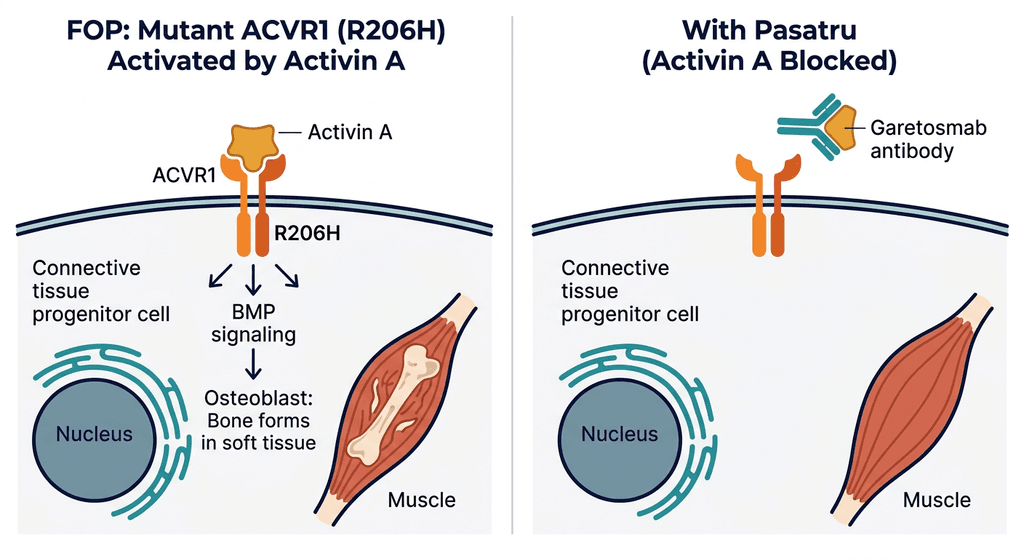
The mutated ACVR1 receptor is constitutively more active than the normal receptor and becomes pathologically activated by Activin A, a TGF-beta superfamily ligand that normally does not activate the wild-type receptor at all. This aberrant signaling activates BMP signaling pathways in connective tissue progenitor cells, driving their differentiation into bone-forming cells (osteoblasts) and the progressive conversion of soft connective tissues into bone.
The name “Stone Man Syndrome,” used colloquially to describe FOP, captures the clinical reality. The heterotopic bone that forms is structurally real bone, histologically normal, with cortex, marrow, and blood supply. It is simply in the wrong place: inside muscles, around joints, within tendons, and eventually encasing the ribcage and spine. As more soft tissue converts to bone across each flare-up, joints lose mobility permanently. The restriction is irreversible because the heterotopic bone cannot be surgically removed without triggering more bone formation from the trauma of surgery.
The clinical progression: what FOP patients and families live with
FOP typically presents at birth with a characteristic malformation of the great toes (shortened, malformed hallux valgus), which is diagnostic for the condition in a newborn. Heterotopic ossification begins in the neck and upper back in early childhood, typically following a trauma trigger. The disease progresses in episodic flare-ups, each of which deposits new bone that does not resolve. With each flare-up, function decreases.
Most patients lose the ability to walk by age 30, with a median survival age of 56. The causes of premature death in FOP are predominantly respiratory: as heterotopic bone encases the ribcage and spine, breathing becomes progressively restricted, leading to respiratory failure. Pneumonia in immobilized patients is a common precipitating cause of death. Patient Care Online
The triggers for FOP flare-ups include any trauma to soft tissue: falls, contact sports, intramuscular injections (including routine vaccines, which must be given subcutaneously or intravenously rather than intramuscularly in FOP patients), dental procedures, viral respiratory illness, and even fatigue. Managing FOP is therefore not just about treating flare-ups but about preventing the triggers that cause them, which imposes profound restrictions on daily life.
No surgery can remove FOP bone. No drug can dissolve bone that has already formed. The therapeutic goal is prevention of new bone formation, which is precisely what Pasatru targets.
The Activin A Discovery: Why This Target Matters
The scientific story behind Pasatru begins with a discovery by Regeneron scientists: that Activin A, a member of the TGF-beta superfamily previously not known to drive bone formation in normal physiology, is the critical mediator of the aberrant BMP-ACVR1 signaling that causes FOP’s heterotopic ossification.
ACVR1 R206H, the gain-of-function mutation present in virtually all FOP patients, makes the receptor hypersensitive to ligands from the TGF-beta superfamily. Crucially, it converts Activin A from a signal that normally does not activate ACVR1 at all into a potent activator. In FOP patients, Activin A, which is produced during inflammation and tissue injury, triggers the mutant ACVR1 receptor to drive BMP-like signaling in connective tissue progenitor cells, initiating the bone formation cascade.
This discovery provided the molecular explanation for why trauma triggers FOP flare-ups: soft tissue injury produces inflammation and Activin A release, which in FOP patients activates the mutant receptor and starts new bone formation at the injury site. Blocking Activin A prevents this signaling cascade even though the mutant receptor remains present.
Garetosmab is a fully human monoclonal antibody that specifically binds and neutralizes Activin A, preventing it from activating the mutant ACVR1 receptor. The antibody was developed using Regeneron’s VelocImmune technology, a proprietary platform that generates fully human antibodies by engineering mice with humanized immune systems. The clinical translation from the Activin A discovery to an approved antibody therapeutic represents one of the cleaner molecular target-to-drug success stories in rare disease pharmacology.
The OPTIMA Trial: 63 Patients, Dramatic Results
Design
The phase 3 OPTIMA trial (NCT05394116) was a randomized, double-blind, placebo-controlled trial enrolling adults with FOP. Sixty-three participants were randomized to one of three arms: garetosmab 10 mg/kg IV monthly (n=23), garetosmab 3 mg/kg IV monthly (n=19), or placebo IV monthly (n=21). All received infusions once every 4 weeks for 56 weeks. FOP was confirmed by molecular diagnosis (ACVR1 R206H mutation) in all participants.
The primary endpoint was the total number of new heterotopic ossification lesions detected by whole-body MRI at week 56. Additional assessments included clinician-assessed flare-ups, patient-reported flare-ups, joint involvement, disease severity scores, and safety.
Results at week 56
At week 56, investigators counted 2 new lesions in the 10-mg/kg group, 1 in the 3-mg/kg group, and 19 in the placebo group, corresponding to reported reductions of 90% and 94%, respectively.
| Endpoint at week 56 | Garetosmab 10 mg/kg (n=23) | Garetosmab 3 mg/kg (n=19) | Placebo (n=21) |
|---|---|---|---|
| Patients with any new HO lesion | 2 of 23 | 1 of 19 | 19 of 21 |
| New HO lesion reduction versus placebo | 90% | 94% | Reference |
| p-value | p less than 0.0001 | p less than 0.0001 | — |
| Clinician-assessed flare-ups | Substantially reduced | Substantially reduced | Reference |
Sources: FDA approval announcement. FDA.gov. August 19, 2026. Regeneron press release. August 19, 2026. OPTIMA NCT05394116.
The magnitude of the effect is striking in absolute terms: 19 of 21 placebo patients developed new HO lesions over 56 weeks, while only 3 of 42 active treatment patients did across both doses combined. The treatment effect is not subtle or marginal. It is a near-complete suppression of new bone formation in a disease defined by progressive bone formation as its primary pathophysiology.
The equal or greater effect at the lower 3 mg/kg dose versus the 10 mg/kg dose reflects the practical reality of Activin A neutralization: the biologically relevant threshold for blocking enough Activin A to prevent ACVR1 activation may be reached at both doses, with the lower dose being sufficient for the mechanistic target even though it provides a lower peak antibody concentration. Both doses are approved, with the 10 mg/kg dose as the starting standard and the 3 mg/kg dose as the tolerated alternative.
The LUMINA-1 Phase 2 foundation
The OPTIMA data built on earlier Phase 2 evidence from LUMINA-1 (Raje N, Hochberg Z, Hsiao EC, et al. Nat Med. 2023;29(10):2614-2623), which provided the first placebo-controlled evidence of garetosmab’s activity in FOP and established the pharmacological proof of concept for Activin A neutralization in this disease. LUMINA-1 results were published in Nature Medicine in 2023, providing the scientific foundation that supported the Phase 3 OPTIMA trial design and the subsequent BLA submission.
FOP’s Second Approved Treatment: Where Pasatru Fits Alongside Sohonos
Pasatru is the second drug approved for patients with this very rare disease. The first, palovarotene (Sohonos, Ipsen), was approved in August 2023 for adults and adolescents with FOP aged 14 and older (females) and 8 and older (males, reflecting differential growth plate closure timing). Palovarotene is an oral retinoic acid receptor gamma (RARgamma) agonist that works downstream of ACVR1 signaling to suppress chondrogenesis and endochondral ossification, the bone formation pathway through which HO occurs in FOP.
The two drugs address FOP through distinct mechanisms at different points in the pathological cascade:
| Feature | Pasatru (garetosmab) | Sohonos (palovarotene) |
|---|---|---|
| Mechanism | Blocks Activin A (upstream ligand neutralization) | RARgamma agonism (downstream ossification suppression) |
| Target | ACVR1 signaling trigger | Chondrogenesis and endochondral bone formation |
| Route | IV infusion monthly | Oral daily |
| Age approved | Adults (18 and older) | Adults and adolescents (8/14 and older) |
| Approval type | Traditional (full) | Traditional (full) |
| Primary trial evidence | OPTIMA Phase 3 | MOVE Phase 3 |
The availability of two mechanistically distinct approved therapies for FOP for the first time in history means that the approximately 800 to 900 patients worldwide with this condition now have two options that their physicians can select between based on patient age, tolerance, and individual disease characteristics, and potentially explore in combination in future research.
As Dr. Kathryn Dahir, professor of medicine at Vanderbilt University and a primary OPTIMA investigator, noted: for people living with FOP, every irregular new bone formation is a step toward disability and potential loss of mobility. Reducing new lesions and flare-ups provides another treatment option for affected adults.
Safety: What the OPTIMA Data and Prescribing Information Cover
The safety profile of garetosmab in OPTIMA was consistent with the known biology of Activin A blockade. Activin A has physiological roles beyond FOP pathology, including in mucosal integrity, immune regulation, and reproductive biology, and blocking it produces some predictable off-target effects.
Most common adverse reactions from the OPTIMA trial and the broader garetosmab clinical program included skin and subcutaneous tissue disorders, infections (consistent with modest immunomodulatory effects), musculoskeletal symptoms, and headache.
Epistaxis (nosebleed): The most clinically notable adverse reaction with garetosmab is nosebleeds requiring medical intervention in some patients, an effect attributed to Activin A’s role in nasal mucosal vascular integrity. The prescribing information includes guidance on management and monitoring of epistaxis. Patients should be counseled about this risk before starting treatment and instructed to report significant or persistent nosebleeds.
Reproductive and fetal considerations: Activin A plays important roles in reproductive biology including follicular development and pregnancy. Garetosmab should not be used during pregnancy. Patients of reproductive potential must use effective contraception during treatment and for a defined period after the last dose. Patients should be counseled about the reproductive implications before initiating therapy.
Administration across care settings: Recognizing the profound mobility limitations of many FOP patients, Regeneron has designed the administration framework to support home infusion where appropriate, in addition to clinical infusion settings. This is a meaningful clinical consideration: FOP patients who have limited ability to travel to infusion centers due to joint ankylosis, spinal restriction, or mobility loss should not be excluded from treatment access for logistical reasons.
What This Means for Rare Disease Specialists and FOP Families
For clinicians
Pasatru is approved for adults (18 and older) with FOP, with both the 10 mg/kg and 3 mg/kg doses available. The practical treatment decision between Pasatru and Sohonos (or their potential future combination) will be made by FOP specialists at centers with experience in this ultra-rare disease. The mechanistic complementarity of the two drugs (upstream Activin A blockade versus downstream ossification suppression) provides a rational basis for exploring combination approaches in future research.
For patients aged 18 and older, Pasatru now represents a monthly IV treatment option with robust Phase 3 evidence of 90 to 94% reduction in new HO lesion formation. For adolescent patients (ages 8/14 to 17), Sohonos remains the only approved option pending future pediatric data for Pasatru.
The home infusion option for Pasatru is clinically significant. Requiring FOP patients to travel to an infusion center monthly, when travel itself carries fall risk and any physical trauma can trigger flare-ups, imposes an unacceptable burden. The prescribing information’s explicit support for home infusion where appropriate addresses this correctly.
For FOP patients and families
If you are an adult with FOP, Pasatru is the most effective FOP treatment ever tested in a randomized placebo-controlled trial. The OPTIMA data showing 90 to 94% reduction in new bone lesions is not a modest effect. It is near-complete prevention of the bone formation that has been progressively immobilizing you and every other FOP patient throughout their lives.
The therapy does not reverse existing bone. Bone that has already formed does not dissolve with garetosmab. But preventing new formation from occurring is the most meaningful intervention available in a disease that is entirely defined by progressive accumulation of new bone with each flare-up.
The epistaxis risk is real and worth discussing with your physician before starting. Monthly IV infusion, whether at home or at a treatment center, requires logistical planning in a population for whom any fall or physical contact carries trauma risk. These are manageable considerations but should be part of the pre-treatment discussion.
For related HED coverage on gene therapy for rare pediatric diseases, see our post on Genglycos (pariglasgene brecaparvovec) receiving the first FDA approval for glycogen storage disease type Ia, approved the same day as Pasatru.
The International FOP Association (IFOPA) (ifopa.org; 1-800-IFOPA-14) is the leading patient advocacy organization for FOP worldwide and maintains current information on treatment options, FOP specialists, and patient community support.
Sources
FDA approval announcement: FDA approves second treatment for fibrodysplasia ossificans progressiva. FDA.gov. August 19, 2026. Full announcement.
Regeneron approval press release: Pasatru (garetosmab-grts) first and only FDA-approved treatment demonstrating reduction in new HO lesions and clinician-assessed flare-ups in adults with FOP. GlobeNewswire. August 19, 2026.
Regeneron investor relations: Pasatru (garetosmab-grts) FDA approval announcement. investor.regeneron.com. August 19, 2026.
Drugs.com approval news: FDA Approves Pasatru (garetosmab-grts) for the Treatment of Fibrodysplasia Ossificans Progressiva. drugs.com. August 19, 2026.
PharmTech (63-patient trial context, full OPTIMA data, Activin A mechanism): How a 63-Patient Trial Delivered an FDA Approval. pharmtech.com. August 2026.
Patient Care Online (Dr. Dahir quote, 90% and 94% reduction data, flare-up data): FDA Approves Garetosmab for Adults With Fibrodysplasia Ossificans Progressiva. patientcareonline.com. August 2026.
BioPharm International (OPTIMA trial NCT, RMAT designation, FOP global prevalence): FDA Approves Garetosmab-grts (Pasatru) for Bone Lesions in Rare Disease FOP. biopharminternational.com. August 2026.
BLA acceptance announcement (February 2026): Garetosmab Biologics License Application Accepted for FDA Priority Review for FOP. investor.regeneron.com. February 19, 2026.
LUMINA-1 Phase 2 Nature Medicine publication: Raje N, Hochberg Z, Hsiao EC, et al. Garetosmab in fibrodysplasia ossificans progressiva: a randomized, double-blind, placebo-controlled phase 2 trial. Nat Med. 2023;29(10):2614-2623. doi:10.1038/s41591-023-02561-8.
OPTIMA trial registration: NCT05394116. ClinicalTrials.gov.
FOP GeneReviews overview: Fibrodysplasia Ossificans Progressiva. GeneReviews. NCBI.
Pasatru prescribing information: PASATRU (garetosmab-grts) Prescribing Information. Regeneron Pharmaceuticals. 2026.
Pasatru approval history: Pasatru FDA Approval History. drugs.com.
Patient resources: International FOP Association (IFOPA): 1-800-IFOPA-14 | FOP Action, UK | Regeneron Pasatru patient support | NORD (National Organization for Rare Disorders) FOP resources
| Disclaimer: Health Evidence Digest provides general information about FDA approvals and health research for educational purposes. This content is not a substitute for professional medical advice. Pasatru (garetosmab-grts) has not been established as safe and effective in children. Intramuscular injections are contraindicated in FOP patients due to flare-up risk; IV administration must be used. Patients of reproductive potential must use effective contraception during treatment. The safety and efficacy of Pasatru was established in a 63-patient Phase 3 trial reflecting the ultra-rare nature of FOP. Treatment decisions for FOP should be made in close collaboration with a physician or center with expertise in fibrodysplasia ossificans progressiva management. |
|---|
Leave a Reply