
| The essentials: On August 5, 2026, the FDA approved mFLUSIVA (mRNA-1010, Moderna) for adults aged 50 years and older for the prevention of influenza caused by influenza A and B strains. mFLUSIVA is the first influenza vaccine built on messenger RNA technology to receive FDA approval in the United States. It is Moderna’s fourth FDA-approved product, joining Spikevax and mNEXSPIKE (COVID-19) and mResvia (RSV). The approval is age-stratified: full traditional approval for adults aged 50 to 64, based on clinical efficacy data from the Phase 3 FLUENT trial. Accelerated approval for adults aged 65 and older, based on immunogenicity data from a separate trial (NCT05827978), with a required postmarketing confirmatory efficacy trial in this age group. The FLUENT trial (NCT06602024): 40,805 adults aged 50 and older enrolled across 301 sites in 11 countries during the 2024 to 2025 influenza season. Randomized 1:1 to trivalent mFLUSIVA 37.5 mcg (12.5 mcg hemagglutinin mRNA per strain) or a standard-dose inactivated influenza vaccine comparator (Fluarix/Fluarix Tetra or equivalent). Primary endpoint: relative vaccine efficacy (rVE) against RT-PCR-confirmed, protocol-defined influenza-like illness caused by any influenza A or B strain. Results: influenza-like illness in 2.0% of mFLUSIVA recipients versus 2.8% of standard-dose comparator recipients. rVE 26.6% (95% CI 16.7% to 35.4%); met prespecified thresholds for noninferiority, superiority, and higher-level superiority (p less than 0.001). rVE in adults aged 65 and older: 27.4% (95% CI 12.1% to 40.0%). Published in the New England Journal of Medicine. NEJM doi:10.1056/NEJMoa2516491. Safety: solicited adverse reactions more frequent with mFLUSIVA than comparator. Injection-site pain: 65.8% versus 29.8%. Fatigue: 45.1% versus 20.3%. Headache: 37.8% versus 18.0%. Myalgia: 35.4% versus 11.6%. Most reactions mild to moderate and transient, resolving within 1 to 2 days. No myocarditis or pericarditis identified. Serious adverse events: 2.2% (mFLUSIVA) versus 1.9% (comparator); three mFLUSIVA-related serious events. No new safety concerns. Regulatory context: Moderna filed an initial BLA that the FDA refused to file in February 2026, citing incomplete information. A resubmission was accepted and the approval was granted on the PDUFA date of August 5, 2026. ACIP recommendation: pending; the Advisory Committee on Immunization Practices must issue a recommendation before federal vaccine programs (Medicare, Medicaid, VFC) can incorporate mFLUSIVA into routine vaccination schedules. This timing may affect coverage and availability for the 2026 to 2027 season. Commercial availability: Moderna expects mFLUSIVA to be available at select U.S. retailers within weeks of approval, with broader deployment for the 2026 to 2027 respiratory virus season. The vaccine contains three mRNA strains selected by the FDA for the 2026 to 2027 season: A/Missouri/11/2025 (H1N1), A/Michigan/105/2025 (H3N2-like), and B/Pennsylvania/19/2025. |
|---|
Every year, influenza kills between 12,000 and 52,000 Americans and hospitalizes hundreds of thousands more. For the past 70 years, the response to that annual threat has been built on the same foundational technology: inactivated or live-attenuated influenza viruses grown in chicken eggs or cell culture, formulated into a shot that must be reformulated annually as circulating strains change and that provides variable protection depending on how accurately the season’s vaccine strains were predicted.
The mRNA platform changed the playbook for COVID-19. The same platform is now the basis of the first FDA-approved mRNA influenza vaccine.
mFLUSIVA (mRNA-1010, Moderna), approved August 5, 2026, is not just a technological curiosity. It is a vaccine that, in a 40,805-person Phase 3 trial covering the 2024 to 2025 influenza season, produced 26.6% fewer influenza illness episodes than a standard-dose inactivated flu vaccine, met all three prespecified superiority thresholds, and was published in the New England Journal of Medicine. It is more effective than the standard flu shot that most adults under 65 currently receive. It requires higher-frequency surveillance of adverse reactions, primarily due to more injection site discomfort and systemic symptoms, consistent with the mRNA vaccine class. And it opens a door that extends well beyond annual flu shots: a path to rapidly updated influenza vaccines, combination COVID-flu shots, and potentially pandemic-response influenza vaccines that could be designed and deployed in weeks rather than months.
This post covers what mFLUSIVA is and how it works, what the FLUENT trial showed and how to interpret the comparative efficacy data, the age-stratified approval structure and what the accelerated approval for adults 65 and older means practically, the safety profile and how it compares to existing flu vaccines, and what the ACIP recommendation question means for access this season.
What Influenza Is and Why the Annual Vaccine Is Imperfect
Influenza is a respiratory illness caused by influenza A and B viruses that circulate globally in seasonal epidemics, typically peaking in the Northern Hemisphere between October and March. Influenza viruses mutate rapidly through a process called antigenic drift, meaning the surface proteins of the virus, primarily hemagglutinin (HA) and neuraminidase (NA), change incrementally from season to season in ways that can reduce or eliminate the immunity generated by prior vaccination or infection.
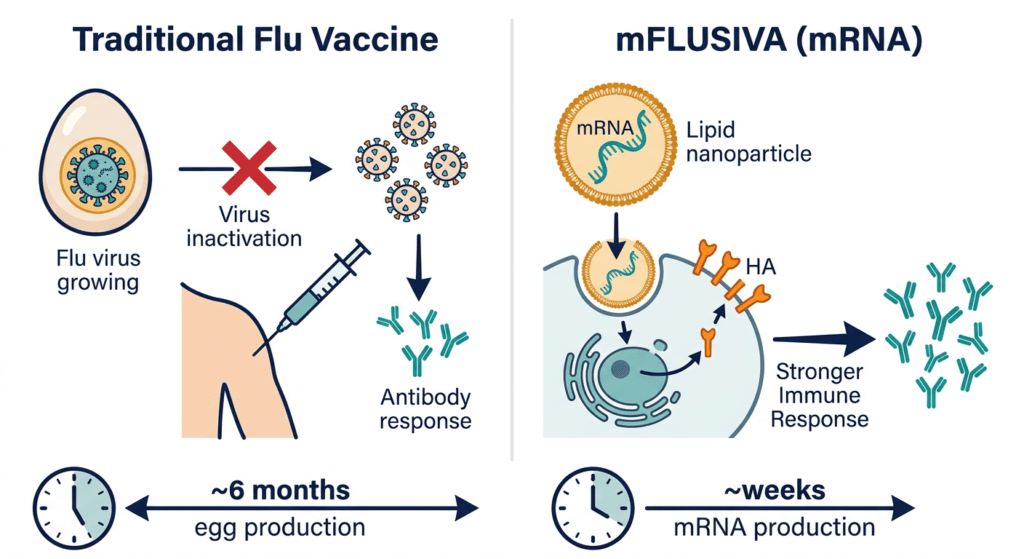
This continuous evolution requires a new flu vaccine every year. The World Health Organization and the FDA recommend which strains to include in the coming season’s vaccine based on global surveillance of circulating strains. Manufacturers then produce the vaccine to match those recommendations. The process takes approximately 6 months from strain selection to distribution.
The limitation of egg-based and conventional cell-based influenza vaccines is that their efficacy is highly sensitive to how accurately the predicted strains match the strains that actually circulate. In seasons with good strain match, standard-dose vaccines produce approximately 40 to 60% efficacy. In poorly matched seasons, efficacy can fall to 20% or lower. The average annual efficacy of standard-dose flu vaccines in adults, across matched and mismatched seasons, has historically been 40 to 50%.
For adults 65 and older, the situation is more challenging. Aging immune systems produce lower antibody responses to standard-dose vaccines, leading to reduced protection in the population that accounts for the majority of influenza-associated hospitalizations and deaths. This is why higher-dose (Fluzone High-Dose) and adjuvanted (Fluad) influenza vaccines are specifically recommended for adults 65 and older: they stimulate stronger immune responses in older immune systems.
How mFLUSIVA Works: The mRNA Influenza Vaccine Mechanism
mFLUSIVA (mRNA-1010) uses the same lipid nanoparticle-encapsulated mRNA technology as Moderna’s COVID-19 vaccines. Rather than delivering inactivated virus particles or viral proteins directly, mFLUSIVA delivers messenger RNA sequences encoding the hemagglutinin proteins of the three target influenza strains. After injection, these mRNA sequences are taken up by cells at the injection site, which temporarily produce the encoded hemagglutinin proteins. The immune system recognizes these foreign proteins and mounts an adaptive immune response: generating antibodies against the HA proteins and establishing immunological memory.
The 2026 to 2027 mFLUSIVA formulation is trivalent, encoding HA from three strains:
- A/Missouri/11/2025 (H1N1 pdm09-like)
- A/Michigan/105/2025 (H3N2-like)
- B/Pennsylvania/19/2025 (B lineage)
Each strain component contains 12.5 mcg of hemagglutinin-encoding mRNA, for a total dose of 37.5 mcg per 0.38 mL injection.
Why mRNA vaccine manufacturing may improve speed and precision
The most significant potential advantage of the mRNA platform for influenza is not the approved product’s efficacy relative to existing vaccines. It is what the platform enables for future seasons:
Speed of strain update: Traditional egg-based flu vaccine manufacturing requires approximately 6 months from strain selection to distribution. mRNA sequences can be designed, synthesized, and scaled up substantially faster, potentially allowing vaccine composition updates later in the season cycle when circulating strains are better characterized.
No egg adaptation issues: Egg-based vaccines occasionally require adaptation of virus strains to grow efficiently in eggs, which can introduce mutations in the HA protein that reduce the match between the vaccine strain and circulating viruses. mRNA vaccines bypass egg production entirely, eliminating this source of mismatch.
Pandemic preparedness: An mRNA pandemic influenza vaccine could theoretically be designed within days of identifying a novel pandemic strain and manufactured at scale within weeks. This is the capability that makes the mFLUSIVA approval strategically important beyond its immediate clinical impact.
The FLUENT Trial: What the Data Shows
Design
FLUENT (NCT06602024) was a Phase 3, randomized, observer-blind, active-controlled, case-driven study enrolling 40,805 adults aged 50 years and older across 301 sites in 11 countries during the 2024 to 2025 Northern Hemisphere influenza season. Participants were randomized 1:1 to receive a single intramuscular dose of trivalent mFLUSIVA 37.5 mcg or a licensed standard-dose inactivated comparator (Fluarix, Fluarix Tetra, Influsplit Tetra, or Alpharix Tetra depending on country). Median follow-up was 181 days.
Influenza surveillance used twice-weekly electronic symptom prompts, with nasopharyngeal swabs collected within 72 hours of symptom onset and RT-PCR confirmation of influenza A or B. The primary endpoint was relative vaccine efficacy against the first episode of RT-PCR-confirmed, protocol-defined influenza-like illness caused by any influenza A or B strain beginning at least 14 days after vaccination through the end of the influenza season.
Efficacy results
| Endpoint | mFLUSIVA | Standard-dose comparator | Result |
|---|---|---|---|
| Protocol-defined ILI (primary, per-protocol) | 2.0% of participants | 2.8% of participants | rVE 26.6% (95% CI 16.7% to 35.4%); met noninferiority, superiority, and higher-level superiority; p less than 0.001 |
| rVE in adults aged 65 and older (subgroup) | — | — | 27.4% (95% CI 12.1% to 40.0%) |
| Median follow-up | 181 days | 181 days | — |
| Participant demographics | Median age 64; 56.9% female; 82.6% White; 13.2% Black; 10.4% Hispanic/Latino | — | — |
Source: Efficacy and Safety of an mRNA Seasonal Influenza Vaccine in Adults. NEJM. 2026. doi:10.1056/NEJMoa2516491. FLUENT NCT06602024.
How to interpret the 26.6% relative vaccine efficacy number
The 26.6% relative vaccine efficacy means mFLUSIVA reduced the risk of RT-PCR-confirmed influenza-like illness by 26.6% compared to the standard-dose comparator vaccine. This is a superiority result over an active comparator, not over placebo. The standard-dose comparator was itself protecting participants from influenza, and mFLUSIVA provided an additional 26.6% reduction on top of that protection.
Absolute terms: 2.0% of mFLUSIVA recipients developed influenza illness versus 2.8% of standard-dose comparator recipients. The absolute risk reduction is 0.8 percentage points. In a population of 100 adults vaccinated with mFLUSIVA rather than a standard-dose vaccine, approximately 1 fewer person develops influenza during the season.
This framing matters for patient counseling. The trial was conducted during the 2024 to 2025 season, which may have had moderate strain match. In a high-match season, both vaccines perform better and the absolute risk difference may be smaller. In a low-match season, the mRNA vaccine’s composition precision may provide a larger relative advantage. The clinical significance of the 26.6% improvement over standard-dose will vary across seasons.
For adults 65 and older, the comparison that matters most is not mFLUSIVA versus standard-dose (which is not the recommended flu vaccine for this age group) but mFLUSIVA versus high-dose or adjuvanted vaccines. FLUENT was not powered to make this comparison directly; the accelerated approval for adults 65 and older reflects this gap.
The Two-Tier Approval Structure: What It Means for Adults 65 and Older
The age-stratified approval is the most practically important nuance of the mFLUSIVA label for clinicians.
Full approval for adults 50 to 64: Supported by the FLUENT Phase 3 clinical efficacy trial demonstrating statistically significant and clinically superior protection against influenza-like illness versus standard-dose vaccine. Standard-dose inactivated flu vaccines are the currently recommended option for this age group, and mFLUSIVA has now demonstrated clinical superiority over them.
Accelerated approval for adults 65 and older: This age group was included in FLUENT (n=19,260 participants aged 65 and older, rVE 27.4%), and the descriptive efficacy data are favorable. However, the FDA required the accelerated approval pathway for this age group based on a separate immunogenicity study (NCT05827978, n=2,992 adults aged 65 and older in the United States) that compared mFLUSIVA’s immune response against a high-dose inactivated influenza vaccine comparator. The accelerated approval for adults 65 and older is contingent on a required postmarketing confirmatory efficacy trial demonstrating clinical benefit versus the high-dose or adjuvanted comparators that are the current recommended standard for this age group.
Why does this matter clinically? Adults 65 and older are already recommended to receive high-dose (Fluzone High-Dose Quadrivalent) or adjuvanted (Fluad Quadrivalent) influenza vaccines rather than standard-dose vaccines, because those formulations provide stronger immune responses in the aging immune system. FLUENT compared mFLUSIVA against standard-dose, not against high-dose or adjuvanted vaccines. The accelerated approval structure acknowledges that clinical efficacy superiority versus the actual recommended standard of care for adults 65 and older has not yet been established. The confirmatory postmarketing trial will answer this question.
Safety: A Meaningful Increase in Reactogenicity
The safety profile of mFLUSIVA is characterized by higher rates of solicited local and systemic adverse reactions compared to standard-dose inactivated flu vaccines. This is a consistent feature of mRNA vaccines broadly, reflecting the more robust innate immune activation that the lipid nanoparticle mRNA delivery mechanism produces.
| Adverse reaction | mFLUSIVA | Standard-dose comparator |
|---|---|---|
| Injection-site pain | 65.8% | 29.8% |
| Fatigue | 45.1% | 20.3% |
| Headache | 37.8% | 18.0% |
| Myalgia | 35.4% | 11.6% |
| Serious adverse events | 2.2% | 1.9% |
| Vaccine-related serious adverse events | 3 events | 2 events |
Source: NEJM FLUENT publication. doi:10.1056/NEJMoa2516491.
Most reactions were mild to moderate and resolved within 1 to 2 days. Importantly, solicited adverse reaction rates were generally lower in adults 65 and older than in younger participants, which is consistent with the known pattern that older adults often experience less intense vaccine reactogenicity despite having weaker overall immune responses to vaccines.
No cases of myocarditis or pericarditis were identified across the full three-part clinical development program evaluating more than 4,200 participants. No new safety signals beyond the expected mRNA platform adverse reaction profile were identified.
The practical implication for patient counseling: adults receiving mFLUSIVA should be advised to expect a higher likelihood of injection site soreness, fatigue, headache, and muscle aches than they may have experienced with prior standard-dose flu vaccines. These reactions are evidence of immune activation, are expected, and resolve quickly. They do not indicate a problem with the vaccine.
The ACIP Recommendation Gap: What It Means for the 2026 to 2027 Season
FDA approval and ACIP recommendation are two distinct regulatory steps for vaccines. FDA approval authorizes a vaccine’s use in the United States. ACIP (Advisory Committee on Immunization Practices) recommendations, issued by the CDC, determine which vaccines are incorporated into federal vaccine programs including Medicare, Medicaid, the Vaccines for Children (VFC) program, and the immunization schedules used by most healthcare providers.
For a flu vaccine to be covered under Medicare Part B with no cost-sharing to patients, it must carry an ACIP recommendation. Without an ACIP recommendation, mFLUSIVA may be available commercially and administered to patients who choose it and whose insurance covers it, but it will not automatically be covered as a routine recommended vaccine at the zero cost-sharing level that applies to other ACIP-recommended flu vaccines.
ACIP meetings are scheduled periodically and must vote on new vaccines and vaccine recommendations. The timing of mFLUSIVA’s approval in early August 2026, with the flu season beginning in fall 2026, creates a potential window between approval and ACIP recommendation during which access will be limited for many patients.
Clinicians should be prepared for patient questions about whether mFLUSIVA is covered and available, and should be aware that the standard recommended flu vaccines remain the appropriate choice for patients who cannot access mFLUSIVA due to coverage or availability constraints. Receiving any recommended influenza vaccine is substantially better than delaying vaccination to wait for a specific formulation.
What mFLUSIVA Means for the Broader mRNA Vaccine Platform
The mFLUSIVA approval carries implications that extend beyond the 2026 to 2027 flu season:
mRNA-1083 (COVID-flu combination vaccine): Moderna has indicated that the mFLUSIVA approval resolves a key regulatory prerequisite for resubmitting its combination COVID-19 and influenza mRNA vaccine (mRNA-1083) in the United States. Establishing mFLUSIVA as an approved mRNA flu vaccine is part of the regulatory foundation for the combination product, which would allow simultaneous protection against both viruses with a single injection.
H5 pandemic influenza preparedness: Moderna and the Coalition for Epidemic Preparedness Innovations (CEPI) have embedded the FLUENT Phase 3 data into a pandemic H5 influenza vaccine licensure plan. An mRNA H5 vaccine could be updated and manufactured far more rapidly than traditional egg-based H5 vaccines if an avian influenza pandemic emerged, providing a critical public health advantage.
Demonstrating mRNA flu platform validity: The approval confirms that the mRNA approach can produce clinically superior protection against influenza, not merely immune responses that might predict benefit. This is an important distinction: prior mRNA influenza Phase 2 studies showed strong immunogenicity; FLUENT is the first Phase 3 trial demonstrating actual efficacy superiority in a head-to-head comparison with an approved vaccine.
What This Means for Clinicians and Patients
For clinicians and vaccination providers
For adults aged 50 to 64, mFLUSIVA is now an FDA-approved flu vaccine option that demonstrated statistically significant superiority over standard-dose inactivated flu vaccines in a large Phase 3 trial. Standard-dose inactivated vaccines remain appropriate for this age group and are widely available; mFLUSIVA is an evidence-backed alternative when it becomes available in your market.
For adults aged 65 and older, the clinical picture is more nuanced. mFLUSIVA received accelerated approval in this age group and the FLUENT trial showed 27.4% relative efficacy versus standard-dose comparator. However, the recommended flu vaccines for adults 65 and older are high-dose or adjuvanted formulations. Whether mFLUSIVA is superior, inferior, or equivalent to Fluzone High-Dose or Fluad is not established from the available data. Until the confirmatory postmarketing efficacy trial comparing mFLUSIVA to high-dose/adjuvanted vaccines in adults 65 and older is completed, the established high-dose or adjuvanted vaccines remain the standard-of-care recommendation for this age group in guidelines.
ACIP recommendation timing will be the critical factor for broad deployment. Monitor ACIP meeting schedules and recommendations before the peak of the 2026 to 2027 flu season.
For patients
If you are 50 years of age or older and would like to receive the first mRNA-based flu vaccine, mFLUSIVA will become available at pharmacies and other vaccination locations during the fall 2026 flu season. The main practical difference from a standard flu shot you may notice is that injection site soreness, fatigue, headache, and muscle aches are more common with mFLUSIVA and may last 1 to 2 days.
If you are 65 or older: the high-dose and adjuvanted flu vaccines remain the standard recommendation for your age group. Whether mFLUSIVA is superior to those vaccines for people your age is an ongoing clinical question. Discuss the options with your provider.
The most important message remains unchanged regardless of which flu vaccine you choose: get vaccinated. Any approved influenza vaccine is substantially more protective than no vaccine, and the flu season waits for no one.
For related HED coverage on the mRNA vaccine platform and respiratory virus prevention, see our post on Leqembi Iqlik (lecanemab-irmb subcutaneous) receiving FDA approval as the first at-home disease-modifying Alzheimer’s therapy for a discussion of how delivery innovation changes treatment access, and our broader vaccine and public health coverage.
The CDC flu resources page (cdc.gov/flu) maintains current flu vaccine recommendations, ACIP schedules, and flu activity surveillance data. For 2026 to 2027 season flu shot availability in your area, the VaccineFinder tool at vaccines.gov is the most current locator.
Sources
FDA approval/Moderna press release: Moderna receives US FDA approval for influenza vaccine mFLUSIVA (mRNA-1010). Moderna. August 5, 2026.
FLUENT Phase 3 NEJM primary publication: Efficacy and Safety of an mRNA Seasonal Influenza Vaccine in Adults. New England Journal of Medicine. 2026. doi:10.1056/NEJMoa2516491.
FLUENT trial registration: NCT06602024. ClinicalTrials.gov.
Immunogenicity trial registration (ages 65 and older, accelerated approval basis): NCT05827978. ClinicalTrials.gov.
HCPLive (full approval summary, trial design detail, ACIP context): mFLUSIVA Receives FDA Approval for Influenza in Adults 50 and Older. hcplive.com. August 2026.
PharmExec (rVE 26.6%, accelerated approval structure, geriatric burden data): FDA Approves Moderna’s mRNA-Based Flu Vaccine. pharmexec.com. August 2026.
Pharmacy Times (primary endpoints, safety profile full table, ACIP timing concern): FDA Approves mFlusiva, the First mRNA-Based Influenza Vaccine. pharmacytimes.com. August 2026.
Drug Topics (NCT05827978 enrollment detail, safety by age group, immunogenicity design): FDA Approves mFLUSIVA, First mRNA-Based Flu Vaccine. drugtopics.com. August 2026.
AJMC (refusal-to-file February 2026, resubmission timeline, Bancel quote): FDA Approves Moderna’s mRNA Flu Vaccine After Phase 3 Success. ajmc.com. August 2026.
TechTimes (mRNA-1083 combination vaccine context, pandemic H5 preparedness implication): mFLUSIVA Approved: FDA Clears mRNA Flu Shot, Unlocking Combo and Pandemic Vaccine Resubmission. techtimes.com. August 2026.
NBC News (general audience summary, first mRNA flu shot framing): FDA approves 1st mRNA flu shot, from Moderna. nbcnews.com. August 2026.
Applied Clinical Trials (trial design detail, reactogenicity exact numbers, swab methodology): Phase 3 Trial Finds Moderna’s mRNA-1010 Influenza Vaccine Outperformed Standard-Dose Vaccines. appliedclinicaltrialsonline.com. August 2026.
PMC FLUENT abstract: mRNA-1010, an mRNA-Based Influenza Vaccine, is Safe and Efficacious in Adults Aged 50 Years. PMC12792163.
CDC influenza overview: Influenza (Flu). CDC.
FDA flu vaccine information: Influenza Vaccines. FDA.
mFLUSIVA prescribing information: mFLUSIVA (mRNA-1010) Prescribing Information. Moderna. 2026.
Patient resources: CDC VaccineFinder / vaccines.gov: flu shot locator | CDC Flu Season Resources | ACIP recommendations | Moderna mFLUSIVA information
| Disclaimer: Health Evidence Digest provides general information about FDA approvals and health research for educational purposes. This content is not a substitute for professional medical advice. mFLUSIVA received accelerated approval for adults aged 65 and older based on immunogenicity data; clinical efficacy versus high-dose or adjuvanted influenza vaccines, which are the currently recommended standard for adults 65 and older, has not been established in a completed confirmatory trial. ACIP recommendation status, which affects vaccine coverage under federal programs including Medicare, was pending at time of publication. Vaccination decisions should be made in consultation with a qualified healthcare provider. |
|---|
Leave a Reply