
| The essentials: On July 13, 2026, the FDA approved a supplemental Biologics License Application for Leqembi Iqlik (lecanemab-irmb, Eisai and Biogen) as a once-weekly subcutaneous injection for treatment initiation in adults with early Alzheimer’s disease. This is the world’s first anti-amyloid therapy that can be started at home, without a clinic visit, and administered by the patient or a caregiver in approximately 15 seconds per injection. What this approval adds: Leqembi Iqlik was previously approved (August 2025) for subcutaneous maintenance dosing following 18 months of IV treatment. The July 13, 2026 approval extends SC use to the initiation phase, meaning the entire treatment course can now be managed subcutaneously from the first dose. No IV infusion is required at any point for patients who choose the SC formulation. The approved initiation regimen: 500 mg subcutaneous once weekly, delivered as two simultaneous 250 mg injections, each administered in approximately 15 seconds, via a pre-filled autoinjector. After completing the initiation phase (18 months of SC or IV dosing), patients transition to maintenance dosing at 360 mg SC once weekly. The evidentiary basis: sub-studies within the Phase 3 Clarity AD long-term extension (LTE) demonstrating that once-weekly SC administration achieves pharmacokinetic exposure equivalent to the approved biweekly IV regimen, with similar clinical and biomarker (amyloid removal) benefits. ARIA-E (amyloid-related imaging abnormalities, edema type) rates with SC administration are expected to be comparable to IV. The underlying efficacy data: the Phase 3 Clarity AD trial (n=1,795, 18 months, double-blind, randomized, placebo-controlled) showed 27% slowing of clinical decline on CDR-SB versus placebo (treatment difference minus 0.45; 95% CI minus 0.67 to minus 0.23; p=0.00005). All key secondary endpoints met. Four-year open-label extension data shows the benefit deepening over time: CDR-SB benefit versus ADNI-matched controls grew from 0.52 points at 18 months to 1.01 at 36 months and 1.75 at 48 months. Real-world data from the LEADER study (AAIC 2026, July 2026): over 75% of early AD patients remained stable and nearly 7% improved over an average of 17 months of lecanemab treatment in clinical practice. U.S. commercial launch of Leqembi Iqlik as initiation dose: planned for late August 2026. Leqembi is currently approved in 53 countries. Leqembi Iqlik is the first and only anti-amyloid treatment in the world to offer at-home dosing from the beginning of treatment through maintenance. |
|---|
Alzheimer’s disease affects approximately 7 million Americans today and is projected to affect nearly 13 million by 2050. It is the only disease in the top 10 causes of death in the United States without a therapy that prevents it, stops it, or reverses it. The disease modifies everything, the person living with it, the family surrounding them, the daily structure of home life, the ability to work, to drive, to recognize the people who matter most.
The January 2023 accelerated approval and July 2023 full traditional approval of Leqembi (lecanemab-irmb, Eisai/Biogen) represented the first time a drug had demonstrated statistically significant, clinically meaningful slowing of Alzheimer’s disease progression in a Phase 3 trial with sufficient safety profile to support full approval. The Phase 3 Clarity AD data were not a marginal finding: 27% slowing of clinical decline measured by the CDR-SB, beginning as early as 6 months of treatment, growing over time, sustained through four years of open-label extension. This was not the drug that reverses Alzheimer’s disease. But it was proof, for the first time in the disease’s clinical history, that the underlying biological process could be meaningfully slowed.
What it was not, until now, was accessible in the most practical sense. Every lecanemab dose required a biweekly trip to an infusion center. For a patient with mild cognitive impairment or mild Alzheimer’s dementia, managing regular clinic visits was manageable. Over time, as disease progresses, or for patients in rural areas, or for those whose caregiver situation makes regular infusion center visits logistically difficult, this requirement becomes an accumulating burden. And the infusion reactions that occurred in 26% of IV-treated patients in Clarity AD added another layer of clinical management to every visit.
Leqembi Iqlik’s July 13, 2026 approval as an initiation-dose subcutaneous treatment removes that burden from the first dose. A 15-second subcutaneous injection at home replaces a biweekly infusion clinic visit. For patients who want it, and for whom home administration is appropriate, the treatment that slows Alzheimer’s disease is now something that can happen at the kitchen table rather than in a healthcare facility. That is not a trivial change.
What Alzheimer’s Disease Is and Why the Disease Stage Matters
Alzheimer’s disease is a progressive neurodegenerative disease and the most common cause of dementia. It is characterized pathologically by the accumulation of amyloid beta plaques and neurofibrillary tangles of tau protein in the brain, beginning years or decades before clinical symptoms appear, and progressing through stages of cognitive impairment that ultimately result in the inability to perform basic daily functions.
The disease is understood to follow a continuum:
Preclinical Alzheimer’s disease: Amyloid accumulation detectable by PET scan or CSF analysis but no cognitive symptoms. This is the earliest detectable stage, before the disease has clinically manifested.
Mild cognitive impairment (MCI) due to Alzheimer’s disease: Subtle but measurable cognitive changes, below the threshold for dementia, with confirmed amyloid pathology. Activities of daily living are largely preserved. Patients may notice memory lapses, word-finding difficulties, or difficulty with complex planning, but remain independent.
Mild Alzheimer’s dementia: Cognitive impairment that interferes with daily functioning, though patients retain significant independence. This is the stage at which symptoms are first clearly apparent to family members and often when a diagnosis is formally established.
Leqembi (and Leqembi Iqlik) is approved for early Alzheimer’s disease, which encompasses both MCI due to Alzheimer’s and mild Alzheimer’s dementia. The approval requires confirmation of amyloid pathology before initiating treatment, either by amyloid PET scan or CSF analysis showing abnormal amyloid levels. This confirmation is not optional: lecanemab’s mechanism of action is directed at amyloid, and the clinical evidence was generated exclusively in amyloid-confirmed patients. Treating without confirmed amyloid would be treating without evidence that the drug’s target is present.
The restriction to early stages is biologically appropriate and clinically important. The disease-modifying mechanism of lecanemab addresses the amyloid pathology that drives neurodegeneration. By the time a patient reaches moderate or severe dementia, the downstream consequences of amyloid accumulation, significant neuronal loss, synapse loss, and tau tangle burden, are already extensive. Clearing amyloid at that stage provides less opportunity for clinical benefit. The window for anti-amyloid therapy is earlier, before irreversible neuronal damage has accumulated.
The Amyloid Hypothesis and How Lecanemab Works
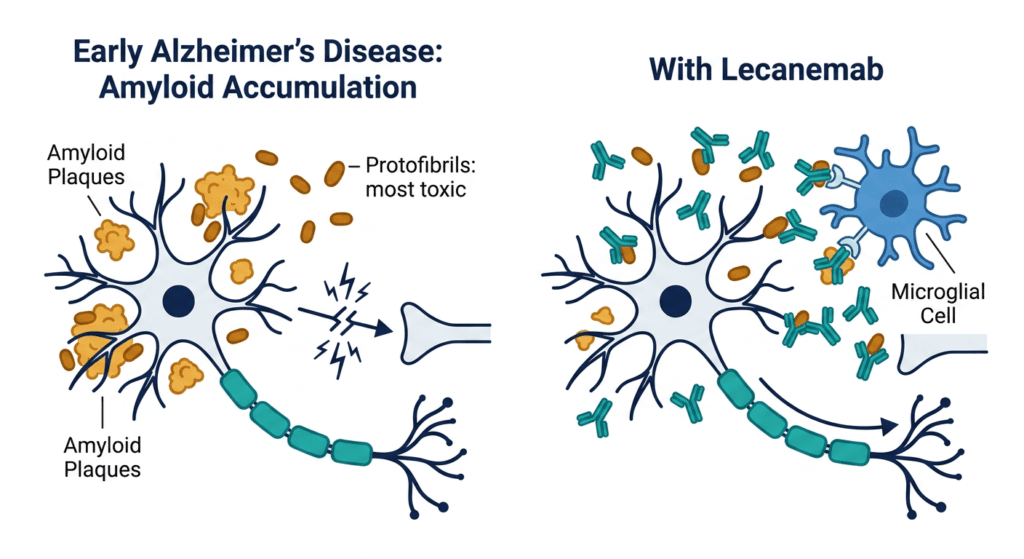
Amyloid beta is a small peptide generated by cleavage of the amyloid precursor protein (APP) by beta-secretase and gamma-secretase enzymes. In normal aging, amyloid beta is produced and cleared in balance. In Alzheimer’s disease, this balance is disrupted: amyloid beta accumulates, misfolds, and aggregates into progressively larger and more toxic forms, from monomers to oligomers to protofibrils and eventually to the insoluble fibrillar plaques that appear in the brains of patients with the disease.
The amyloid cascade hypothesis holds that this accumulation is not merely a biomarker of Alzheimer’s disease but a key early driver of the downstream pathological cascade, including tau phosphorylation, neuroinflammation, synaptic dysfunction, and neuronal death. The hypothesis has generated decades of scientific debate, and the failures of numerous amyloid-targeting drugs in clinical trials have repeatedly raised questions about its validity. The Clarity AD results, showing that clearing amyloid produces measurable slowing of clinical decline, provide the strongest clinical evidence to date that the hypothesis is at least partially correct in the early disease setting.
Lecanemab is a humanized IgG1 monoclonal antibody that targets aggregated forms of amyloid beta, with particularly high affinity for soluble amyloid protofibrils, which are thought to be among the most neurotoxic forms of the protein. The binding specificity for aggregated amyloid (protofibrils and fibrils) rather than monomeric amyloid is a key pharmacological feature. By engaging the aggregated forms most associated with toxicity, lecanemab is thought to clear them through several mechanisms: direct antibody-mediated dissolution of aggregates, Fc-receptor-mediated microglial phagocytosis of opsonized amyloid complexes, and inhibition of further fibril formation.
The pharmacodynamic evidence from Clarity AD confirms robust amyloid clearance: patients treated with lecanemab showed near-complete clearance of amyloid from PET-measurable brain regions by 18 months. This amyloid removal from the brain, measured in centiloids on PET imaging, was one of the key secondary endpoints and showed highly statistically significant differences versus placebo across all brain regions examined.
How Leqembi Iqlik Is Different: The Subcutaneous Formulation Story
The development of a subcutaneous formulation for lecanemab required solving a pharmaceutical challenge that applies to all large monoclonal antibodies: how to deliver an effective therapeutic dose through the skin, where the absorption rate and volume limitations differ substantially from intravenous administration.
The approved SC formulation uses a concentrated lecanemab solution delivered via pre-filled autoinjector at 500 mg per 2 mL injection volume for initiation dosing (two 250 mg autoinjectors per dose) and 360 mg for maintenance. The formulation does not include hyaluronidase, unlike the SC pembrolizumab formulation (Keytruda Qlex) discussed in a previous HED post. Lecanemab’s SC delivery achieves pharmacokinetically equivalent exposure to IV dosing through the concentration and volume of the SC formulation itself, without enzymatic disruption of the subcutaneous matrix.
The pharmacokinetic equivalence to IV was demonstrated through sub-studies in the Clarity AD long-term extension (LTE). These studies evaluated multiple SC dosing regimens and established that once-weekly SC administration produces area under the curve (AUC) and steady-state trough concentrations equivalent to the approved biweekly IV regimen of 10 mg/kg. The amyloid removal on PET imaging in LTE participants who switched from IV to SC maintenance dosing was maintained, providing biomarker evidence that the SC route produces clinically equivalent amyloid clearance.
The autoinjector device is designed for patient or caregiver self-administration. Each injection delivers the dose in approximately 15 seconds. For the 500 mg initiation dose, two injections are given simultaneously or in close sequence at each weekly dosing occasion. Injection sites include the abdomen and thigh.
The most significant clinical implication of the SC initiation approval is the elimination of infusion reactions as a clinical concern at treatment start. In Clarity AD with IV dosing, infusion reactions occurred in 26.4% of lecanemab-treated patients, concentrated in the first dose (75% occurred on day 1). These reactions, predominantly mild to moderate, required premedication protocols, monitoring time, and occasional infusion rate modifications. The SC route eliminates infusion reactions from the ARIA and infusion management framework.
The Clarity AD Evidence Base: What the Foundational Trial Data Shows
The efficacy and safety of lecanemab rest on Phase 3 Clarity AD (NCT03887455), the pivotal global randomized trial that supported full traditional FDA approval in July 2023 and all subsequent regulatory approvals globally.
Clarity AD design and population
Clarity AD enrolled 1,795 adults aged 50 to 90 years with confirmed amyloid pathology (by PET or CSF) and clinical diagnosis of either MCI due to Alzheimer’s disease or mild Alzheimer’s dementia. Baseline CDR-SB score indicated early disease (mean approximately 3.2 on a 0 to 18 scale). Patients were randomized 1:1 to lecanemab 10 mg/kg IV every 2 weeks or placebo for 18 months. 95% of completers enrolled in the open-label extension.
Primary and key secondary endpoints at 18 months
| Endpoint | Lecanemab | Placebo | Result |
|---|---|---|---|
| CDR-SB change from baseline (primary) | 1.21 | 1.66 | Difference minus 0.45 (95% CI minus 0.67 to minus 0.23); p=0.00005; 27% slowing |
| Amyloid PET (centiloids, key secondary) | Near-complete clearance | Accumulation | p less than 0.001 |
| ADAS-Cog14 (key secondary) | Less decline | More decline | p less than 0.001 |
| ADCOMS (key secondary) | Less decline | More decline | p less than 0.001 |
| ADCS-MCI-ADL (key secondary) | Less decline | More decline | p less than 0.001 |
| Earliest significant CDR-SB separation | 6 months | — | p less than 0.01 |
The 27% slowing of clinical decline is measured on the CDR-SB, the Clinical Dementia Rating Sum of Boxes, a clinician-administered scale assessing six domains: memory, orientation, judgment and problem solving, community affairs, home and hobbies, and personal care. Each domain is rated 0 to 3 and the scores are summed for a total of 0 to 18. A lower score reflects better function. The treatment difference of 0.45 points at 18 months, on a scale where a change from 0.5 to 1 in any domain reflects a meaningful shift in independence, represents measurable preservation of function across the early disease population.
Long-term open-label extension data: the benefit deepens
The Clarity AD OLE, with four years of data, shows the clinical benefit of sustained lecanemab treatment growing over time compared to a matched control cohort from the Alzheimer’s Disease Neuroimaging Initiative (ADNI):
| Timepoint | CDR-SB benefit versus ADNI-matched controls |
|---|---|
| 18 months (end of core study) | 0.52 points |
| 36 months (18 months of OLE) | 1.01 points |
| 48 months (30 months of OLE) | 1.75 points |
Source: Clarity AD OLE 48-month data. PMC12725329.
This growing absolute benefit over time is consistent with the hypothesis that early removal of amyloid pathology interrupts the downstream disease cascade in a way that produces compounding benefit: the longer treatment continues, the more neurological damage is prevented compared to the untreated trajectory.
The OLE data also showed that 95% of Clarity AD completers chose to enroll in the open-label extension, a patient choice rate that reflects the acceptability of continued treatment and confidence in the drug’s benefit profile among both patients and their treating physicians.
LEADER real-world data: the clinical practice picture
The LEADER study, Leqembi’s real-world evidence program, presented data at the Alzheimer’s Association International Conference (AAIC) in July 2026 showing that in clinical practice:
Over 75% of early Alzheimer’s patients enrolled in the study remained stable and nearly 7% improved over an average of 17 months of treatment. Eisai
This real-world data is complementary to the controlled trial results and addresses the question of whether the Clarity AD findings translate to the broader clinical population. The stability rate in clinical practice, in patients selected by treating physicians rather than a research protocol, provides some reassurance that the trial results are not artifactual of a highly selected trial population.
The Leqembi Iqlik Dosing Framework: What the Full SC Schedule Looks Like
The approval of SC initiation dosing creates a complete at-home treatment pathway for the first time:
| Phase | Formulation | Dose | Frequency | Duration | Setting |
|---|---|---|---|---|---|
| Initiation (SC) | Leqembi Iqlik | 500 mg (two 250 mg injections) | Once weekly | 18 months | Home (patient or caregiver) |
| Initiation (IV alternative) | Leqembi | 10 mg/kg | Every 2 weeks | 18 months | Infusion center |
| Maintenance (SC) | Leqembi Iqlik | 360 mg | Once weekly | Ongoing | Home (patient or caregiver) |
Patients and physicians can choose between the SC and IV initiation routes. The clinical data support equivalent efficacy and biomarker outcomes for both routes; the choice is a shared decision based on patient preference, caregiver capacity, infusion center access, and the individual clinical context.
For patients who initiate with IV and want to transition to SC maintenance, the August 2025 maintenance approval supports that pathway. For patients who prefer to start at home from dose one, the July 2026 initiation approval enables that pathway. The result is flexibility that was not available at any point in the drug’s first three years of commercial availability.
Safety: What Patients, Caregivers, and Prescribers Need to Understand
The safety considerations for lecanemab center on ARIA (amyloid-related imaging abnormalities), which are an on-target effect of anti-amyloid antibody therapy reflecting the vascular and parenchymal response to amyloid removal from the brain.
ARIA: what it is and how it is managed
ARIA occurs in two forms. ARIA-E involves cerebral edema or sulcal effusion visible on FLAIR MRI sequences, reflecting blood-brain barrier disruption and edema at sites of amyloid clearance. ARIA-H involves cerebral microhemorrhages, superficial siderosis, or macrohemorrhages, reflecting small vascular bleeds associated with amyloid clearance from vessel walls.
In Clarity AD:
- ARIA-E: 12.6% (lecanemab) versus 1.7% (placebo). Symptomatic ARIA-E: 2.8% versus 0.0%
- ARIA-H: 17.3% (lecanemab) versus 9.0% (placebo). Symptomatic ARIA-H: 0.7% versus 0.2%
The large majority of ARIA events were asymptomatic and detected on protocol MRI monitoring. Symptomatic ARIA events produced headache, confusion, dizziness, or visual disturbances in a minority of those detected radiographically. Most ARIA events resolved spontaneously or with temporary treatment interruption.
ApoE4 carrier status substantially affects ARIA risk: homozygous ApoE4 carriers (approximately 2 to 3% of the population) had ARIA rates approximately 3-fold higher than non-carriers. ApoE4 genotyping before treatment initiation is recommended in the prescribing information to inform the risk-benefit discussion.
ARIA monitoring requirements
MRI monitoring before initiating treatment, before the 5th, 7th, and 14th infusions (at approximately 3, 6, and 12 months with IV dosing), and as clinically indicated is required per the prescribing information. The monitoring schedule for SC initiation dosing aligns with similar timepoints. ARIA detection before it becomes symptomatic allows dose holds to support resolution, which is the primary management approach.
The ARIA context for SC administration
The SC formulation is expected to produce ARIA rates comparable to IV administration, based on the pharmacokinetic equivalence and the established relationship between amyloid clearance (which is equivalent between routes) and ARIA incidence. This does not eliminate ARIA risk; it means the risk profile is similar to what has been established with IV dosing. The elimination of infusion reactions with SC administration improves one aspect of the safety experience without affecting the ARIA monitoring requirements.
Boxed warnings
Leqembi (and Leqembi Iqlik) carries a boxed warning for ARIA, including serious and life-threatening events. Patients on anticoagulants, or with additional risk factors for bleeding, may have higher ARIA-H risk and should be evaluated carefully before initiating treatment. The use of tissue plasminogen activator (tPA) for stroke in lecanemab-treated patients requires careful clinical judgment given the potential for increased hemorrhagic risk in ARIA-affected individuals.
The Meaning of This Approval Beyond the Label
The approval of lecanemab as an at-home self-administered treatment from the first dose is not a minor administrative update to an existing drug. It is a conceptual shift in what disease-modifying Alzheimer’s therapy looks like as a lived experience.
Every other element of Alzheimer’s disease management, the cognitive and behavioral symptoms, the functional decline, the caregiver burden, the loss of independence, happens at home, in daily life. Until this approval, the only disease-modifying therapy available required a patient and caregiver to organize their lives around biweekly clinic visits for infusions that could last several hours. The subcutaneous initiation approval brings the disease-modifying treatment into the same setting where the disease itself is experienced.
For early Alzheimer’s patients who retain sufficient independence and cognitive function to engage meaningfully with their own care, a treatment that can be self-administered at home is one that they can participate in as an active health decision rather than as a healthcare system dependent. That distinction matters to patients, to caregivers, and to the long-term sustainability of treatment adherence.
The LEADER real-world data, showing 75% stability and 7% improvement at an average of 17 months, is the early evidence that this is working outside of trial conditions. It is not definitive; it is not placebo-controlled; but it is a signal from clinical practice that the Clarity AD trial results are not confined to the controlled research environment.
For patients and families living with early Alzheimer’s disease who want to understand whether lecanemab or Leqembi Iqlik may be appropriate: the conversation begins with a neurologist who can evaluate cognitive status, confirm amyloid pathology, assess ApoE4 status, review anticoagulant and other medications, and discuss the specific risk-benefit profile in the context of the individual patient’s disease stage and overall health.
The Alzheimer’s Association (alz.org; 24-hour helpline 1-800-272-3900) and the Alzheimer’s Drug Discovery Foundation maintain current information on treatment options, clinical trials, and caregiver resources.
Sources
FDA approval announcement: FDA approves first at-home starting dose for Alzheimer’s disease treatment. FDA.gov. July 13, 2026.
Eisai and Biogen press release: FDA Approves LEQEMBI IQLIK (lecanemab-irmb) Subcutaneous Injection as an Initiation Dose for Early Alzheimer’s Disease. GlobeNewswire. July 13, 2026.
Biogen investor news: FDA Approves LEQEMBI IQLIK (lecanemab-irmb) Subcutaneous Injection as an Initiation Dose for Early Alzheimer’s Disease. investors.biogen.com. July 13, 2026.
BioArctic press release: FDA approves Leqembi Iqlik (lecanemab-irmb) subcutaneous injection as a starting dose for early Alzheimer’s disease. bioarctic.com. July 13, 2026.
Drugs.com approval news: FDA Approves Leqembi Iqlik (lecanemab-irmb) Subcutaneous Injection as an Initiation Dose for Early Alzheimer’s Disease. drugs.com. July 13, 2026.
Psychiatry Advisor (SC formulation clinical context, home administration framing): Lecanemab SC Starting Regimen Approved for Early Alzheimer Disease. psychiatryadvisor.com. July 2026.
Healio (LEADER real-world data, AAIC 2026 reference): FDA approves subcutaneous Leqembi for initiation. healio.com. July 2026.
Clarity AD primary NEJM publication: van Dyck CH et al. Lecanemab in Early Alzheimer’s Disease. NEJM. 2023;388(1):9-21. doi:10.1056/NEJMoa2212948.
Clarity AD topline press release (Biogen): LECANEMAB CONFIRMATORY PHASE 3 CLARITY AD STUDY MET PRIMARY ENDPOINT. investors.biogen.com. September 2022.
Clarity AD full results (Eisai/CTAD 2022): Eisai Presents Full Results of Lecanemab Phase 3 Confirmatory Clarity AD Study. eisai.com. November 2022.
Clarity AD OLE 48-month data (PMC): The Lecanemab Clarity AD Open-Label Extension in Early Alzheimer’s Disease: Initial Findings From the 48-Month Analysis. PMC12725329.
Clarity AD OLE 4-year AAIC 2025 data (BioArctic): Latest data presented at AAIC 2025 reinforces lecanemab’s clinical effect. bioarctic.com. July 2025.
SC maintenance approval (August 2025, Biogen): FDA Approves LEQEMBI IQLIK (lecanemab-irmb) Subcutaneous Injection for Maintenance Dosing. investors.biogen.com. August 2025.
Amyloid biology in Alzheimer’s disease: Amyloid Beta and Alzheimer’s Disease. PMC7232739.
Leqembi original full FDA approval (July 2023): FDA grants traditional approval to Alzheimer’s disease treatment. FDA.gov.
NIA Alzheimer’s disease overview: Alzheimer’s Disease Fact Sheet. NIA.
Leqembi prescribing information: LEQEMBI (lecanemab-irmb) and LEQEMBI IQLIK Prescribing Information. Eisai Co., Ltd. 2026.
Leqembi approval history: Leqembi FDA Approval History. drugs.com.
Patient resources: Alzheimer’s Association 24-hour helpline: 1-800-272-3900 | Alzheimer’s Drug Discovery Foundation | Eisai Leqembi patient support | BrightFocus Foundation Alzheimer’s resources | ClinicalTrials.gov: search lecanemab
| Disclaimer: Health Evidence Digest provides general information about FDA approvals and health research for educational purposes. This content is not a substitute for professional medical advice. Leqembi (lecanemab-irmb) and Leqembi Iqlik carry a boxed warning for amyloid-related imaging abnormalities (ARIA), including serious and life-threatening events. Treatment requires confirmation of amyloid pathology before initiating, baseline and periodic MRI monitoring during treatment, and assessment of ApoE4 genotype and anticoagulant use given their effect on ARIA risk. All treatment decisions for early Alzheimer’s disease, including the choice between SC and IV formulations, should be made in close collaboration with a board-certified neurologist or geriatric psychiatrist experienced in Alzheimer’s disease management. |
|---|
Leave a Reply