| The essentials: On August 13, 2026, the FDA granted accelerated approval to Zenbexus (iberdomide, Bristol Myers Squibb) in combination with daratumumab and hyaluronidase-fihj (Darzalex Faspro, Janssen) and dexamethasone for adults with multiple myeloma who have received at least one prior line of therapy including a proteasome inhibitor and an immunomodulatory agent. The combination is abbreviated ZDd (Zenbexus plus Darzalex Faspro plus dexamethasone). Two regulatory firsts in a single approval: Zenbexus is the first FDA-approved cereblon E3 ligase modulator (CELMoD), a new class of targeted protein degraders, and this is the first FDA approval in relapsed or refractory multiple myeloma based on minimal residual disease-negative complete response (MRD-negative CR) as the primary efficacy endpoint. Mechanism: iberdomide is an oral CELMoD that binds to cereblon, a substrate receptor of the CRL4-CRBN E3 ubiquitin ligase complex, with substantially higher potency than IMiD agents (thalidomide, lenalidomide, pomalidomide). This binding reprograms the E3 ligase to selectively degrade two transcription factors, Ikaros (IKZF1) and Aiolos (IKZF3), that myeloma cells depend on for survival, while sparing non-target proteins. The clinical basis: Phase 3 EXCALIBER-RRMM (NCT04975997), a two-stage, randomized, multicenter, open-label trial. Primary efficacy population: 420 patients (207 ZDd arm; 213 DVd arm) with RRMM who had received 1 to 2 prior lines of therapy. Comparator: daratumumab, bortezomib, and dexamethasone (DVd). Dual primary endpoints: MRD-negative CR at any time and progression-free survival (PFS). MRD-negative CR at any time: 41% (ZDd; 95% CI 34% to 48%) versus 21% (DVd; 95% CI 15% to 27%); p less than 0.0001. A near doubling of MRD-negative CR. Median follow-up: 16 months. PFS data: trial remains ongoing; PFS is the confirmatory endpoint on which full traditional approval will depend. Exclusions: patients with prior anti-CD38 antibody-refractory disease or prior bortezomib-refractory disease were excluded. Key safety: boxed warnings for embryo-fetal toxicity (with REMS program required) and venous and arterial thromboembolism. Neutropenia and secondary malignancies are warnings. REMS program: Zenbexus is available only through a restricted distribution program due to embryo-fetal toxicity risk, similar to the IMiD REMS programs. |
|---|
Multiple myeloma has never been curable with systemic therapy for most patients. But the depth of response to treatment, how completely the malignant clone is suppressed, correlates directly with how long patients remain in remission and how long they survive. The deeper the response, the longer the control. And the deepest measurable response in myeloma, the one that now anchors this approval, is minimal residual disease negativity: the absence of detectable myeloma cells at a sensitivity of one cancer cell in one million bone marrow cells or circulating tumor cells.
Until August 13, 2026, no myeloma drug had ever received FDA approval based primarily on achieving MRD-negative complete response in a randomized trial. The approvals that built the modern myeloma treatment landscape were based on progression-free survival, overall survival, or overall response rate. MRD negativity was recognized as a clinically meaningful and prognostically validated endpoint, but it had not crossed the regulatory threshold of serving as the basis for approval.
Zenbexus (iberdomide, BMS) is the drug that changed that, based on EXCALIBER-RRMM data showing ZDd nearly doubled the MRD-negative CR rate compared to the established DVd regimen (41% versus 21%), a result so statistically robust (p less than 0.0001) that the FDA determined MRD-negative CR could serve as a surrogate endpoint for accelerated approval while PFS data mature. The approval simultaneously marks the arrival of a new drug class, the CELMoDs, which were designed to address one of the most persistent limitations of the IMiD class that has dominated myeloma therapy for 20 years.
What Multiple Myeloma Is and Why Depth of Response Matters So Much
Multiple myeloma is a cancer of plasma cells, the antibody-secreting cells of the bone marrow. As covered in HED’s earlier post on Sarclisa Escena, myeloma is the second most common blood cancer in the United States, is incurable for most patients with current therapy, and is managed across multiple treatment lines as patients cycle through regimens. Approximately 36,000 Americans are diagnosed annually.
The prognostic importance of response depth in myeloma is well established. Patients who achieve complete response (no detectable M-protein by standard assays) do better than those with partial response. Patients who achieve MRD-negative complete response do better still, with significantly longer PFS and OS in multiple retrospective and prospective analyses.
Minimal residual disease (MRD) negativity in myeloma is assessed by next-generation sequencing (NGS) or next-generation flow cytometry at a sensitivity of 10 to the minus 5 or 10 to the minus 6, meaning 1 myeloma cell in 100,000 to 1,000,000 bone marrow cells. A patient who achieves MRD-negative CR has no detectable clonal myeloma cells at this extraordinary sensitivity. Meta-analyses consistently show that MRD-negative status correlates strongly with prolonged PFS and OS across treatment contexts.
The FDA’s willingness to grant accelerated approval to Zenbexus based on MRD-negative CR, rather than waiting for PFS data, reflects the agency’s recognition that this endpoint is reasonably likely to predict clinical benefit, the same standard applied to other validated surrogate endpoints in oncology.
What CELMoDs Are and Why They Represent a New Class
To understand what iberdomide is and why it is genuinely first-in-class rather than just a next iteration of an existing drug, it is essential to understand both the IMiD mechanism that preceded it and the specific pharmacological improvement CELMoDs provide.
The IMiD class: lenalidomide and pomalidomide
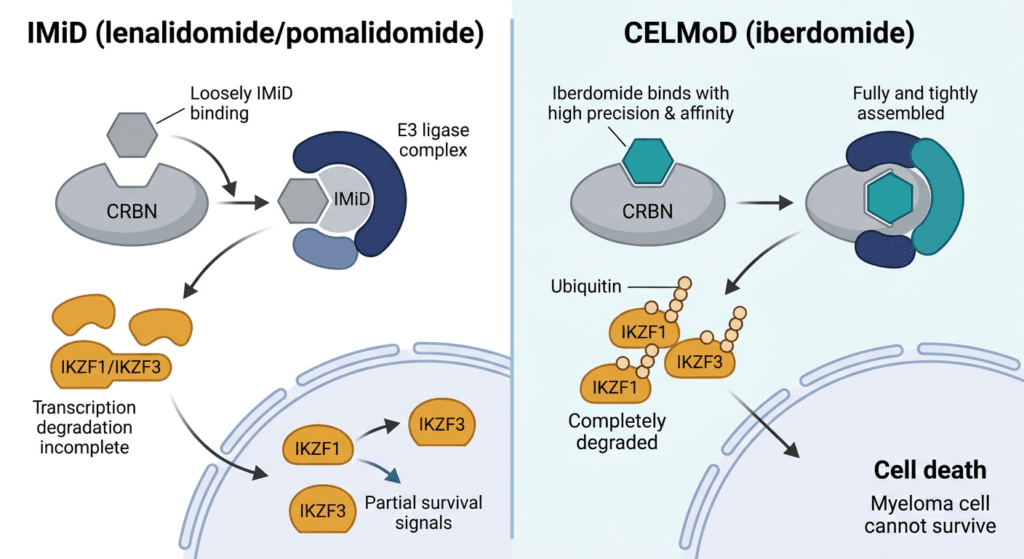
Immunomodulatory drugs (IMiDs) including thalidomide, lenalidomide (Revlimid), and pomalidomide (Pomalyst, covered in HED’s LOE series) are the backbone of myeloma therapy. Their anti-myeloma mechanism was not fully understood for years but is now known to operate through cereblon (CRBN), a substrate receptor of the CRL4 E3 ubiquitin ligase complex.
IMiDs bind to cereblon and redirect the E3 ligase to ubiquitinate and degrade Ikaros (IKZF1) and Aiolos (IKZF3), two transcription factors that myeloma cells depend on for proliferation and survival. Without Ikaros and Aiolos, myeloma cells cannot sustain the gene expression programs that keep them alive. Lenalidomide and pomalidomide produce myeloma cell death through this targeted protein degradation mechanism.
The limitation of IMiDs: their binding affinity for cereblon is modest relative to their maximum possible potency. Additionally, long-term IMiD exposure drives acquired resistance through cereblon mutations and downregulation, reducing the drug’s ability to continue directing protein degradation. Most patients who progress through multiple lines of myeloma therapy become IMiD-refractory.
How CELMoDs differ
Cereblon E3 ligase modulators (CELMoDs) were designed to overcome these limitations. Iberdomide and mezigdomide (another CELMoD in BMS’s pipeline) bind to cereblon with substantially higher affinity and precision than IMiDs, producing:
Deeper and faster Ikaros and Aiolos degradation: CELMoDs engage the E3 ubiquitin ligase more efficiently, directing faster ubiquitination and proteasomal degradation of the target proteins. This translates into more complete suppression of myeloma cell survival signals at clinically relevant doses.
Activity in IMiD-refractory disease: Because CELMoDs bind cereblon through a distinct and more optimized interaction, they retain activity in some patients whose myeloma has become resistant to lenalidomide or pomalidomide, either through cereblon mutations or through mechanisms that reduce IMiD efficacy. This is the therapeutic rationale for CELMoDs in patients who have already received IMiD-based therapy.
Oral administration: Like IMiDs, iberdomide is an oral capsule taken once daily, maintaining the convenience of oral myeloma therapy.
Selective protein degradation: The precision of CELMoD cereblon engagement allows selective degradation of target proteins without the broader off-target effects that limit IMiD tolerability. Iberdomide has a cleaner selectivity profile against non-target proteins than earlier IMiDs.
The CELMoD mechanism represents the next chapter in the protein degradation approach to myeloma that IMiDs pioneered. While the molecular target (cereblon-mediated IKZF1/IKZF3 degradation) is shared, the pharmacological precision and potency of CELMoDs are meaningfully improved.
The EXCALIBER-RRMM Trial: Full Data
Design
EXCALIBER-RRMM (NCT04975997) is a Phase 3, two-stage, randomized, multicenter, open-label trial evaluating ZDd versus DVd in adults with RRMM. The two-stage design included a dose optimization phase (Stage 1) that established the recommended 1 mg iberdomide dose, followed by the main efficacy evaluation (Stage 2) at that dose.
The primary efficacy population included the first 420 patients randomized to ZDd (iberdomide 1 mg plus Darzalex Faspro plus dexamethasone; n=207) or DVd (daratumumab plus bortezomib plus dexamethasone; n=213) across both stages at the 1 mg iberdomide dose.
Eligibility required 1 to 2 prior lines of therapy. Importantly, patients with disease refractory to prior anti-CD38 monoclonal antibody therapy or prior bortezomib were excluded, which is an important boundary condition for the approved indication. The trial is ongoing to assess the primary endpoint of PFS.
Primary efficacy results
| Endpoint | ZDd (iberdomide plus DarFaspro plus dex; n=207) | DVd (daratumumab plus bortezomib plus dex; n=213) | Result |
|---|---|---|---|
| MRD-negative CR at any time (primary, efficacy-evaluable) | 41% (n=85; 95% CI 34% to 48%) | 21% (n=44; 95% CI 15% to 27%) | p less than 0.0001; near doubling |
| Median follow-up | 16 months | 16 months | — |
| PFS (dual primary endpoint) | Trial ongoing | Trial ongoing | Required for confirmatory full approval |
Sources: BMS press release. August 13, 2026. FDA accelerated approval announcement. EXCALIBER-RRMM NCT04975997.
The 41% MRD-negative CR rate with ZDd versus 21% with DVd is a striking result. Nearly doubling the rate of patients achieving undetectable myeloma at one-in-a-million sensitivity is a pharmacodynamically meaningful signal. In a disease where depth of response is directly linked to duration of control, this magnitude of difference provides a compelling mechanistic rationale for the accelerated approval, even in the absence of mature PFS data.
Why the MRD-negative CR endpoint is and is not the whole story
The FDA’s acceptance of MRD-negative CR as the basis for accelerated approval is itself a regulatory landmark for the myeloma field. As described in the approval framework, MRD negativity is among the deepest measures of response in multiple myeloma and is considered predictive of improved progression-free survival.
That predictive value is the basis for the surrogate endpoint acceptance. Multiple prospective and retrospective analyses have demonstrated that achieving MRD negativity correlates with longer PFS and OS in myeloma across treatment contexts. The FDA determined this association was sufficiently robust to support accelerated approval while PFS data mature.
What the MRD-negative CR data do not yet tell us: whether the deeper MRD negativity with ZDd versus DVd translates into longer PFS, and whether longer PFS translates into longer OS. The EXCALIBER-RRMM trial continues, with PFS as the ongoing primary endpoint whose results will determine whether the accelerated approval converts to full traditional approval. As with all accelerated approvals, continued marketing authorization for this indication may be contingent on that verification.
What MRD-Negative CR Means for Patients in Plain Terms
For patients receiving myeloma treatment, MRD negativity means that when a specialized test examines bone marrow or blood samples at extremely high sensitivity, no myeloma cells can be found. This is a deeper level of response than a complete response by standard criteria (which confirms no M-protein is detectable by standard protein tests) because it uses next-generation sequencing or flow cytometry to search for even a single myeloma cell among a million normal ones.
Patients who achieve MRD-negative CR have the most complete suppression of myeloma that current technology can measure. The practical significance: studies across many myeloma trials show that patients who achieve MRD negativity stay in remission longer than those who do not, even among patients who both achieved a standard complete response. It is the most sensitive available indicator of how completely the treatment has suppressed the myeloma clone.
ZDd achieving MRD-negative CR in 41% of patients compared to 21% with DVd means that among every 100 patients treated, approximately 20 more patients achieved this deepest level of response with ZDd. Whether those additional 20 patients will remain in remission longer as a result is what the ongoing PFS analysis will determine.
The Comparator: Why DVd Is a Meaningful Standard
The choice of DVd (daratumumab plus bortezomib plus dexamethasone) as the comparator arm is clinically appropriate and makes the ZDd result meaningful. DVd is a well-established, effective regimen for relapsed myeloma that combines the anti-CD38 antibody with a proteasome inhibitor, one of the most active drug classes in myeloma. It is not a weak control arm chosen to make ZDd look good by comparison. Achieving a near doubling of MRD-negative CR over DVd, a genuinely effective regimen, represents a significant pharmacological advance.
The inclusion of daratumumab in both arms is notable: ZDd replaces the bortezomib component of DVd with iberdomide, maintaining the anti-CD38 backbone and asking whether an oral CELMoD is more effective than a proteasome inhibitor when partnered with daratumumab. The answer from the MRD data is a clear yes.
Where ZDd Fits in the Myeloma Treatment Landscape
Myeloma therapy is organized around triplet regimens, typically combining an anti-CD38 antibody (daratumumab or isatuximab), a proteasome inhibitor (bortezomib, carfilzomib, ixazomib), and an IMiD (lenalidomide or pomalidomide) or dexamethasone backbone, depending on the line of therapy and prior drug exposure.
ZDd introduces a CELMoD into this framework, replacing the IMiD component with a more potent protein degrader while maintaining the anti-CD38 backbone. The approved indication covers patients who have received at least one prior line including both a proteasome inhibitor and an immunomodulatory agent, which encompasses the majority of patients who have progressed on standard first-line therapy.
The exclusion of anti-CD38-refractory patients from EXCALIBER-RRMM is an important practical consideration. Patients whose disease progressed on or within 60 days of completing a daratumumab-containing regimen are not represented in the trial population and are excluded from the indication. ZDd is positioned for patients at first or second relapse who have not already become refractory to CD38-directed therapy.
As Dr. Sagar Lonial, Professor and Chair of Hematology and Medical Oncology at Winship Cancer Institute, Emory University, and one of the EXCALIBER-RRMM investigators, noted: the FDA approval of iberdomide marks the anticipated arrival of a new therapeutic class for relapsed or refractory multiple myeloma and has the potential to make a meaningful difference for patients.
For related HED coverage on the myeloma treatment landscape and anti-CD38 therapy, see our post on Sarclisa Escena (isatuximab-irfc subcutaneous), the first anticancer drug approved for administration via an on-body injector, and our LOE series post on Pomalyst (pomalidomide) and what generic pomalidomide means for the IMiD market.
Safety: Boxed Warnings, REMS, and Key Prescribing Considerations
Boxed warnings
Embryo-fetal toxicity: Iberdomide, like all IMiD and CELMoD agents acting through cereblon, is highly teratogenic and can cause severe birth defects including limb abnormalities (the same mechanism that caused the thalidomide tragedy). Zenbexus is available only through a restricted distribution program, the ZENBEXUS REMS (Risk Evaluation and Mitigation Strategy), which requires:
- Females of reproductive potential: negative pregnancy test before initiating, weekly pregnancy testing during treatment, and monthly pregnancy testing thereafter. Must use two forms of effective contraception or abstain.
- Males: must use condoms during treatment and for a defined period after the last dose, even if they have had a vasectomy.
- Prescribers and pharmacies must be certified in the REMS program before dispensing.
Venous and arterial thromboembolism: Cereblon-modulating agents, including IMiDs and now iberdomide, increase the risk of blood clots including deep vein thrombosis, pulmonary embolism, and arterial thrombotic events. Thromboprophylaxis is required: aspirin, low-molecular-weight heparin, or other anticoagulants as appropriate for individual patient risk. The DVd comparator arm also carries this risk through the daratumumab component, but the CELMoD further amplifies it.
Key warnings and precautions
Neutropenia: Grade 3 or higher neutropenia was the most common severe adverse event in the CELMoD program. CBC monitoring before each cycle and dose modification for clinically significant neutropenia are required. G-CSF support may be needed.
Infections: Immunosuppression from the combined effects of iberdomide, daratumumab, and dexamethasone increases susceptibility to infections including bacterial, viral, and opportunistic infections. Antiviral prophylaxis (for herpes zoster reactivation) and standard myeloma infection prevention measures apply.
Secondary malignancies: As with other myeloma regimens involving immunomodulatory agents, an increased risk of secondary primary malignancies has been observed. Routine monitoring is recommended.
Dosing
Iberdomide 1 mg orally once daily on days 1 to 21 of each 28-day cycle. Taken without food. Darzalex Faspro at standard subcutaneous dosing (1,800 mg daratumumab). Dexamethasone 40 mg weekly (20 mg for patients aged 75 or older). Cycle length and schedule adjustments for adverse events follow the prescribing information.
Sources
FDA accelerated approval announcement: FDA grants accelerated approval to iberdomide with daratumumab and hyaluronidase-fihj and dexamethasone for multiple myeloma. FDA.gov. August 13, 2026.
BMS news page: U.S. FDA Grants Accelerated Approval. news.bms.com. August 13, 2026.
Drugs.com approval news: FDA Grants Accelerated Approval to Zenbexus (iberdomide) for Multiple Myeloma. drugs.com. August 13, 2026.
PharmExec (MRD-negative CR endpoint data, DVd comparator, first approval by MRD-negative CR): FDA Grants Accelerated Approval to Zenbexus Plus Daratumumab for Multiple Myeloma. pharmexec.com. August 2026.
Pharmacy Times (full safety profile, REMS details, neutropenia, VTE boxed warning): FDA Grants Accelerated Approval to Iberdomide Combination for Multiple Myeloma. pharmacytimes.com. August 2026.
International Myeloma Foundation (MRD-negative CR rates, first approval by this endpoint, patient context): FDA Accelerated Approval for Iberdomide plus Daratumumab-Dex for RRMM. myeloma.org. August 2026.
HealthTree (CELMoD class context, Dr. Lonial quote, exclusion criteria): FDA Approves Iberdomide for Multiple Myeloma. healthtree.org. August 2026.
ONS (EXCALIBER-RRMM exclusion criteria, DVd comparator details): FDA Grants Accelerated Approval to Iberdomide with Daratumumab. ons.org. August 2026.
EXCALIBER-RRMM trial registration: NCT04975997. ClinicalTrials.gov.
EXCALIBER-RRMM Future Oncology publication: Lonial S et al. EXCALIBER-RRMM: a phase III trial of iberdomide, daratumumab, and dexamethasone in relapsed/refractory multiple myeloma. Future Oncol. 2025;21(14):1761-1769. doi:10.1080/14796694.2025.2501920.
MRD assessment role in multiple myeloma: Szalat RE, Anderson KC, Munshi NC. Role of minimal residual disease assessment in multiple myeloma. Haematologica. 2024;109(7):2049-2059. doi:10.3324/haematol.2023.284662.
Multiple myeloma overview: Multiple Myeloma. StatPearls. NCBI.
Zenbexus prescribing information: ZENBEXUS (iberdomide) Prescribing Information. Bristol Myers Squibb. 2026.
Zenbexus approval history: Zenbexus FDA Approval History. drugs.com.
Patient resources: Multiple Myeloma Research Foundation: 1-888-841-6673 | International Myeloma Foundation: 1-800-452-CURE | Leukemia and Lymphoma Society | BMS Zenbexus patient support and REMS information
| Disclaimer: Health Evidence Digest provides general information about FDA approvals and health research for educational purposes. This content is not a substitute for professional medical advice. Zenbexus (iberdomide) received accelerated approval based on MRD-negative complete response as a surrogate endpoint; continued approval may be contingent on verification of clinical benefit through the ongoing PFS primary endpoint in EXCALIBER-RRMM. Zenbexus carries boxed warnings for embryo-fetal toxicity and venous and arterial thromboembolism, and is available only through the ZENBEXUS REMS program. All treatment decisions for relapsed or refractory multiple myeloma should be made in collaboration with a board-certified hematologist or medical oncologist experienced in myeloma management. |
|---|
Leave a Reply