
| The essentials: On August 5, 2026, the FDA approved Orzeyful (oveporexton, Takeda) for the treatment of narcolepsy type 1 (NT1, narcolepsy with cataplexy) in adults. Orzeyful is the first and only orexin receptor 2 (OX2R)-selective agonist approved for any indication and the first therapy designed to directly restore the orexin signaling that is lost in NT1, rather than treating individual symptoms through other neurotransmitter systems. What narcolepsy type 1 is: a rare, lifelong autoimmune neurological disorder caused by the selective destruction of hypothalamic neurons that produce orexin (also called hypocretin), a neuropeptide that stabilizes wakefulness and suppresses REM sleep. NT1 affects approximately 1 in 2,000 people in the United States. The core symptoms are excessive daytime sleepiness and cataplexy (sudden muscle weakness triggered by emotion), along with sleep paralysis, hypnagogic and hypnopompic hallucinations, and disrupted nocturnal sleep. All five are direct consequences of orexin deficiency. What oveporexton does: it selectively binds to and activates OX2R, the receptor normally activated by orexin in the hypothalamus and throughout wake-promoting neural circuits. By restoring OX2R signaling, oveporexton mimics the wake-stabilizing and REM-suppressing effects of the orexin the patient’s own neurons no longer produce. The clinical basis: two Phase 3 randomized, double-blind, placebo-controlled 12-week trials in 273 adults with NT1. FirstLight (NCT06470828, n=168; 19 countries): high dose (2 mg twice daily), low dose (1 mg twice daily), and placebo. RadiantLight (NCT06505031, n=105): high dose (2 mg twice daily) and placebo. Primary endpoint (both trials): change from baseline in mean sleep latency on the Maintenance of Wakefulness Test (MWT) at week 12. Both trials met the primary endpoint: statistically significant improvement in MWT versus placebo at 2 mg twice daily (p less than 0.001). Most patients treated with 2 mg twice daily achieved MWT wakefulness levels within the normal range (at or above 20 minutes). Nearly 85% achieved Epworth Sleepiness Scale (ESS) scores at or below 10 (within the healthy reference range). Weekly cataplexy rate reduction: incidence rate ratio 0.25 (95% CI 0.15 to 0.42; p less than 0.001) in RadiantLight. ESS improvement LS mean minus 9.53 (95% CI minus 11.10 to minus 7.97; p less than 0.001) in RadiantLight. NSS-CT (Narcolepsy Severity Scale for Clinical Trials) improvement LS mean minus 18.11 (p less than 0.001). SF-36 MCS improvement 9.32 (p less than 0.001); PCS 5.01 (p less than 0.001). Phase 2b NEJM publication (NCT05687903): dose-dependent MWT gains of 12.5 to 25.4 minutes versus minus 1.2 minutes for placebo. Regulatory designations: Priority Review. DEA scheduling: pending (required before commercial launch; Takeda expects to make Orzeyful available via specialty pharmacy following completion of DEA scheduling). Most common adverse reactions (greater than 15% in trials): insomnia (57.1% in RadiantLight 2 mg arm), urinary frequency (61.4%), urinary urgency (14.3%), and hypersalivation. Key drug interaction contraindication: strong CYP3A inhibitors. Dosing: 2 mg orally twice daily, taken at least 3 hours apart. Pediatric: efficacy not established in patients under 16. |
|---|
Every existing treatment for narcolepsy type 1 is a workaround. Stimulants increase dopamine and norepinephrine to drive wakefulness. Sodium oxybate consolidates nocturnal sleep and suppresses cataplexy through GABA mechanisms. Pitolisant blocks histamine H3 autoreceptors to increase histamine release. Each addresses one or more of the downstream consequences of the disease, and each helps meaningfully, but none of them replaces what NT1 has actually destroyed: the orexin-producing neurons of the hypothalamus, and the wake-stabilizing signal those neurons maintained across every hour of every day.
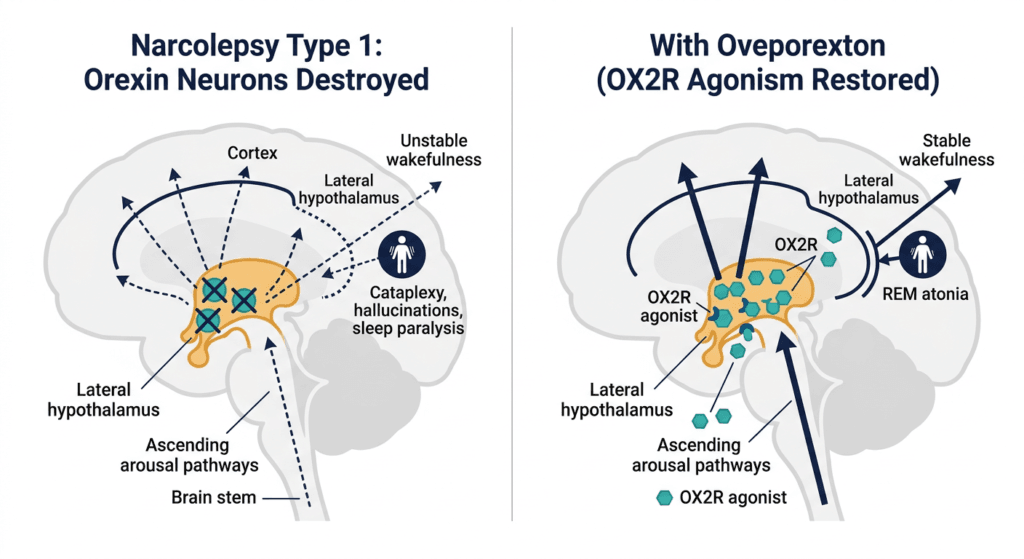
The mechanism behind Orzeyful is the first attempt to fill that gap directly. Rather than routing around the missing orexin signal through other neurotransmitter systems, oveporexton activates the OX2R receptor that orexin normally activates, in the same neural circuits, with the same downstream effects on wakefulness and REM suppression. It does not restore the neurons. It restores the signal those neurons were providing.
The Phase 3 FirstLight and RadiantLight trials enrolled 273 adults with NT1 across 19 countries and demonstrated that oveporexton produces clinically meaningful improvements not just in excessive daytime sleepiness and cataplexy, but across the full symptom range of the disease: hallucinations, sleep paralysis, disrupted nocturnal sleep, cognition, and quality of life. Most patients treated with the approved 2 mg twice-daily dose achieved wakefulness levels within the normal range on the Maintenance of Wakefulness Test. Nearly 85% achieved ESS scores in the healthy reference range.
The drug awaits DEA controlled substance scheduling before it can be dispensed commercially. That scheduling decision, expected within months of the August 5 FDA approval, will determine how it is prescribed and accessed in clinical practice.
What Narcolepsy Type 1 Is: The Immunological Destruction of Wake Circuitry
Narcolepsy type 1 is a rare, lifelong neurological disorder affecting approximately 1 in 2,000 people in the United States, with an estimated 200,000 affected Americans. It is classified as a hypersomnia disorder, but it is more accurately a disorder of wake-sleep state instability: the circuitry that keeps wakefulness stable during the day and prevents REM sleep from intruding at inappropriate times is selectively destroyed.
The disease is caused by the autoimmune destruction of orexin-producing neurons in the lateral hypothalamus, a discrete population of approximately 70,000 neurons in the human brain whose axons project throughout the CNS to reinforce wakefulness and maintain REM sleep suppression during the day. Patients with NT1 lose 85 to 95% of these neurons, resulting in cerebrospinal fluid (CSF) orexin levels at or below 110 pg/mL, the diagnostic threshold.
The trigger for this autoimmune attack is not fully understood but involves genetic susceptibility (the HLA-DQB1*06:02 allele is present in more than 90% of NT1 patients), environmental exposures, and possible molecular mimicry between certain influenza strains or vaccines and orexin neurons. The neuronal loss is permanent: orexin levels in NT1 do not recover over time.
The five symptoms and their shared biological origin
All five major symptoms of NT1 arise directly from orexin deficiency and can be understood as consequences of two core physiological failures:
Excessive daytime sleepiness (EDS): Without orexin reinforcing the ascending arousal pathways from the brainstem to the cortex, wakefulness becomes unstable. Patients experience an overwhelming, persistent urge to sleep throughout the day, sleep attacks that cannot be resisted, and cognitive fog that accompanies even awake periods. EDS is present in 100% of NT1 patients and is typically the most disabling symptom.
Cataplexy: The most pathognomonic symptom of NT1, cataplexy involves sudden, brief episodes of bilateral muscle weakness triggered by strong positive emotions, most commonly laughter, excitement, or surprise. During a cataplectic attack, which typically lasts seconds to a few minutes, the patient remains conscious but cannot move, due to the same atonic state that normally prevents acting out dreams during REM sleep. Cataplexy occurs because, without orexin suppressing the REM atonia circuitry, strong emotional signals can accidentally trigger the REM atonia mechanism during wakefulness.
Hypnagogic and hypnopompic hallucinations: Dream-like hallucinations occurring at sleep onset (hypnagogic) or awakening (hypnopompic), caused by REM dreaming intruding into transitional states between sleep and wakefulness.
Sleep paralysis: Brief inability to move or speak at sleep onset or awakening, again caused by REM atonia crossing into the wake state.
Disrupted nocturnal sleep: Despite overwhelming daytime sleepiness, most NT1 patients also have fragmented nighttime sleep, with frequent awakenings, vivid dreams, and difficulty maintaining sleep stages. Orexin normally stabilizes sleep architecture in addition to promoting wakefulness.
The first-line treatments that have existed for NT1, stimulants for EDS and sodium oxybate for cataplexy and nocturnal sleep, typically require separate medications to address the different symptom domains and do not correct the underlying orexin deficiency. Current pharmacological approaches for NT1 primarily focus on symptom management, including improving wakefulness and reducing cataplexy. However, these treatments do not directly address the underlying pathophysiology of orexin deficiency.
The Orexin System and Why OX2R Agonism Is the Right Target
Orexin (also called hypocretin) exists as two neuropeptides, orexin A and orexin B, both cleaved from the precursor prepro-orexin. They bind to two G-protein-coupled receptors: OX1R (orexin receptor 1) and OX2R (orexin receptor 2). Orexin A binds both receptors with approximately equal affinity. Orexin B binds preferentially to OX2R.
The two receptors have distinct but overlapping distributions and functions. OX1R is more prominent in the locus coeruleus (norepinephrine pathways) and dorsal raphe. OX2R is more prominent in the histaminergic tuberomammillary nucleus, the lateral hypothalamus itself, and the pontine reticular formation, the regions most directly responsible for the integrated wake-stabilization function of orexin. OX2R signaling is considered the dominant contributor to orexin’s wake-promoting and REM-suppression effects.
Oveporexton is selective for OX2R over OX1R, a design choice that concentrates its pharmacological activity on the receptor most responsible for the physiological functions lost in NT1, while reducing activity at OX1R, which is more associated with sympathetic arousal and stress responses that could contribute to cardiovascular or anxiety-related adverse effects.
The biological effect of OX2R agonism with oveporexton: it activates the wake-stabilizing neural circuits that orexin normally maintains, reinforcing the ascending arousal pathways from the brainstem, suppressing inappropriate REM intrusion, and stabilizing the boundary between wakefulness and sleep. For NT1 patients, this is pharmacologically equivalent to restoring a portion of the orexin signal their own neurons no longer produce.
This represents a conceptual shift from the existing treatment paradigm. Existing NT1 treatments work despite the absence of orexin; oveporexton works because it mimics orexin’s action at the relevant receptor.
The Phase 3 Trials: FirstLight and RadiantLight
Design
FirstLight (NCT06470828) enrolled 168 adults with NT1 (diagnosis per ICSD-3 or ICSD-3-TR, supported by polysomnography, multiple sleep latency testing, or CSF orexin at or below 110 pg/mL; ESS at or above 11; at or above 4 partial or complete cataplexy episodes per week) randomized to one of three dosing arms: oveporexton 2 mg twice daily (high dose), oveporexton 1 mg twice daily (low dose), or placebo. RadiantLight (NCT06505031) enrolled 105 adults with the same eligibility criteria randomized 2:1 to oveporexton 2 mg twice daily or placebo. Both were double-blind, placebo-controlled, 12-week trials conducted across 19 countries, with enrollment completed within 6 months.
The primary endpoint in both trials was change from baseline in mean sleep latency on the Maintenance of Wakefulness Test (MWT) at week 12. The MWT measures how long a person can stay awake in a quiet, dimly lit room during a series of 40-minute test periods; a longer latency indicates better ability to maintain wakefulness. Normal MWT sleep latency is generally considered at or above 20 minutes; NT1 patients typically have severely reduced MWT latencies at baseline.
Key secondary endpoints included change from baseline in ESS total score, weekly cataplexy rate (WCR), Narcolepsy Severity Scale for Clinical Trials (NSS-CT) total score, and SF-36 quality-of-life measures.
Results at week 12
Both trials met their primary endpoints with statistically significant improvement in MWT versus placebo at 2 mg twice daily (p less than 0.001 in both). The clinical magnitude of the benefit is captured across both the primary and secondary endpoints:
| Endpoint | Oveporexton 2 mg (RadiantLight) | Placebo | Result |
|---|---|---|---|
| MWT mean sleep latency (primary) | Statistically significant improvement | Reference | p less than 0.001; most patients reached normal range (at or above 20 min) |
| ESS change from baseline (key secondary) | LS mean minus 9.53 (95% CI minus 11.10 to minus 7.97) | Reference | p less than 0.001 |
| Weekly cataplexy rate (key secondary) | Incidence rate ratio 0.25 (95% CI 0.15 to 0.42) | Reference | p less than 0.001; 75% reduction |
| NSS-CT total score (key secondary) | LS mean minus 18.11 (95% CI minus 21.25 to minus 14.96) | Reference | p less than 0.001 |
| SF-36 Mental Component Summary | LS mean plus 9.32 | Reference | p less than 0.001 |
| SF-36 Physical Component Summary | LS mean plus 5.01 | Reference | p less than 0.001 |
| Patients achieving ESS at or below 10 (healthy range) | Approximately 85% | — | First-class drug to bring most patients into healthy reference range |
| Improvements in hallucinations and sleep paralysis | Significant | Reference | Broad multidimensional disease control |
Sources: RadiantLight ATS 2026 abstract. AJRCCM. 2026;212(Supplement 1). NeurologyLive Phase 3 data summary. FirstLight NCT06470828. RadiantLight NCT06505031.
The headline finding from the perspective of clinical practice: the 75% reduction in weekly cataplexy rate (incidence rate ratio 0.25) and the near-normalization of MWT sleep latency together demonstrate that oveporexton addresses both of NT1’s defining symptom domains from a single mechanistic intervention, something that has not been achievable from any prior NT1 therapy without combining multiple medications.
The 85% of patients reaching ESS at or below 10 by week 12 is striking because it means the majority of trial participants, starting from ESS scores at or above 11 (a threshold indicating pathological sleepiness), achieved subjective sleepiness levels within the normal healthy reference range after 12 weeks of treatment. The NSS-CT and SF-36 data confirm that this symptom improvement translated into meaningful improvements in narcolepsy-specific functioning and health-related quality of life.
Phase 2b NEJM data: the dose-finding foundation
The Phase 3 program was preceded by Phase 2b (NCT05687903), published in the New England Journal of Medicine, which enrolled 112 adults with NT1 randomized to one of four dosing arms or placebo for 8 weeks. The trial showed dose-dependent improvement across patients, with mean MWT changes ranging from 12.5 to 25.4 minutes across active arms compared with minus 1.2 minutes for placebo (adjusted p at or below 0.001 for all comparisons). This dose-dependent pharmacodynamic gradient confirmed the mechanistic connection between OX2R agonism and wakefulness promotion and guided the 2 mg twice-daily dose selection for the pivotal Phase 3 program.
Safety: What Prescribers and Patients Need to Know
The safety profile of oveporexton across the FirstLight and RadiantLight trials reflects the pharmacological consequences of OX2R agonism, with the most distinctive adverse events being those that are directly mechanistically related to activation of wake-promoting and autonomic neural circuits.
Most common adverse events
Adverse events were most commonly insomnia, urinary frequency/urgency, and hypersalivation. Rates from RadiantLight:
| Adverse event | Oveporexton 2 mg (n=70) | Placebo (n=35) |
|---|---|---|
| Any TEAE | 85.7% (60 patients) | 42.9% (15 patients) |
| Urinary frequency | 61.4% | Not reported at this rate |
| Insomnia | 57.1% | — |
| Urinary urgency | 14.3% | — |
| Serious TEAEs | None | None |
The high rates of urinary frequency (61.4%) and insomnia (57.1%) with oveporexton 2 mg are pharmacologically expected. OX2R activation has effects on smooth muscle and autonomic nervous system function that explain the urinary symptoms. Insomnia reflects the wakepromoting mechanism extending into the night: OX2R agonism that keeps patients awake during the day may maintain alertness at bedtime, particularly if the last dose is taken too close to sleep time. The prescribing information specifies that doses should be taken at least 3 hours apart, with the second dose taken several hours before bedtime.
Hypersalivation (excessive salivation) is a less mechanistically obvious but consistently reported adverse event with OX2R agonists and is thought to reflect autonomic OX2R expression in salivary gland-related neural circuits.
No serious TEAEs occurred in either trial. The adverse events were predominantly mild and related to the mechanism, not to systemic toxicity.
Key safety considerations
CYP3A inhibitors (contraindication): Oveporexton is metabolized primarily through CYP3A4. Concomitant strong CYP3A inhibitors (ketoconazole, itraconazole, clarithromycin, ritonavir, and others) substantially increase oveporexton plasma exposure, which would amplify both efficacy and adverse effects. Strong CYP3A inhibitors are contraindicated with Orzeyful. Patients on these agents should not receive oveporexton without discussion of alternative therapies.
CYP3A inducers: Strong CYP3A inducers (rifampin, carbamazepine, phenytoin, St. John’s wort) reduce oveporexton exposure and may reduce efficacy. The clinical significance should be evaluated for each patient.
Pediatric use: Efficacy has not been established in patients under 16 years of age, and the approval covers adults only. Narcolepsy type 1 commonly begins in adolescence and childhood, and the unmet need in pediatric patients is significant; this remains an area for ongoing investigation.
DEA scheduling: Orzeyful is a CNS-active drug and requires DEA controlled substance scheduling before it can be dispensed commercially. The DEA scheduling process following FDA approval typically takes several weeks to months. Takeda expects to make Orzeyful available via specialty pharmacy following completion of the DEA scheduling process. How the DEA classifies it, and whether it receives a lower schedule than traditional stimulants given its distinct mechanism and adverse event profile, will affect prescribing logistics.
How Orzeyful Fits in the Current NT1 Treatment Landscape
NT1 has several approved treatments, none of which previously addressed the underlying orexin deficiency:
| Drug | Mechanism | Addresses | Route | Schedule |
|---|---|---|---|---|
| Amphetamines, methylphenidate | DAT/NET reuptake inhibition and release | EDS only | Oral | Schedule II |
| Sodium oxybate (Xyrem, Lumryz) | GABA-B agonism | Cataplexy and nocturnal sleep (and EDS with Lumryz) | Oral (taken at night) | Schedule III |
| Pitolisant (Wakix) | H3 receptor antagonist/inverse agonist | EDS and cataplexy | Oral | Non-scheduled |
| Solriamfetol (Sunosi) | DAT/NET reuptake inhibition | EDS | Oral | Schedule IV |
| Modafinil/armodafinil | Unknown (dopaminergic and histaminergic) | EDS | Oral | Schedule IV |
| Orzeyful (oveporexton) | OX2R selective agonist | EDS, cataplexy, hallucinations, sleep paralysis, disrupted nocturnal sleep — full symptom range | Oral | Pending DEA scheduling |
The most important clinical distinction in the table is the last column under “Addresses”: Orzeyful is the first NT1 therapy with clinical evidence supporting improvement across the full range of NT1 symptoms from a single mechanism, rather than targeting individual symptom domains. Whether this translates into clinical superiority over well-optimized combinations of existing agents in individual patients will emerge from clinical experience and post-marketing studies. But as a first approved disease-mechanism-targeting therapy, it changes the conceptual framework of NT1 treatment.
As Dr. Emmanuel Mignot of Stanford University, principal investigator for FirstLight, described: oveporexton brings us a major step closer to having the first orexin therapy that addresses the underlying cause of narcolepsy type 1.
What This Means for Sleep Medicine Clinicians and Patients
For sleep medicine clinicians and neurologists
Orzeyful adds a mechanistically unique option to NT1 management that was not previously available. Its OX2R-selective mechanism is distinct from stimulants, sodium oxybate, pitolisant, and all other existing agents. The clinical profile, strong improvement in both wakefulness and cataplexy simultaneously, with additional benefits across hallucinations, sleep paralysis, and nocturnal sleep, addresses a longstanding limitation of NT1 pharmacotherapy that required separate agents for separate symptom domains.
The practical challenges to navigate before prescribing: the DEA scheduling outcome and the specialty pharmacy distribution model will shape the workflow. The CYP3A inhibitor contraindication will require medication review in what is often a polypharmacy patient population. The high rates of insomnia and urinary frequency need to be proactively discussed with patients as likely early adverse effects related to the mechanism, not unexpected toxicity, and dosing timing guidance (at least 3 hours between doses, second dose well before bedtime) should be emphasized.
The 85% of trial patients reaching ESS at or below 10 by week 12 is an efficacy benchmark that exceeds what most existing NT1 therapies produce as monotherapy in real-world practice. For patients who have not achieved adequate sleepiness control on existing regimens, or whose cataplexy has remained poorly controlled alongside EDS treatment, Orzeyful represents a genuinely new option.
For patients with NT1
If you have narcolepsy type 1 and your current treatment leaves residual sleepiness, cataplexy, hallucinations, sleep paralysis, or disrupted nighttime sleep, Orzeyful may be worth discussing with your sleep specialist or neurologist after it becomes commercially available following DEA scheduling.
Orzeyful will be available through specialty pharmacy rather than standard retail pharmacy channels. Your clinician will need to submit a prescription through the specialty pharmacy network once the DEA scheduling and commercial launch are complete. Takeda has announced that patients and providers can sign up for availability updates through the Orzeyful website.
The Narcolepsy Network (narcolepsynetwork.org; 1-888-292-6522) and the Wake Up Narcolepsy patient advocacy organization maintain current information on NT1 treatment options, clinical trials, and peer community support.
Sources
FDA approval announcement: FDA approves oveporexton for narcolepsy type 1. FDA.gov. August 5, 2026.
Takeda FDA approval press release: U.S. FDA Approves Takeda’s ORZEYFUL (oveporexton), the First and Only Medicine to Treat the Underlying Cause of Narcolepsy Type 1. BusinessWire. August 5, 2026.
Takeda newsroom announcement: FDA Approves ORZEYFUL for Adults With Narcolepsy Type 1. takeda.com. August 5, 2026.
Drugs.com approval news: FDA Approves Orzeyful (oveporexton) to Treat the Underlying Cause of Narcolepsy Type 1. drugs.com. August 5, 2026.
NeurologyLive (full Phase 3 design, phase 2b NEJM data, mechanism, DEA scheduling context): FDA Approves Orexin Agonist Oveporexton for Narcolepsy Type 1. neurologylive.com. August 2026.
HCPLive (full endpoint data, 85% ESS normalization, broad symptom improvement): FDA Approves Oveporexton (Orzeyful) for Narcolepsy Type 1. hcplive.com. August 2026.
Pharmacy Times (CYP3A contraindication, pediatric limitation, specialty pharmacy distribution): FDA Approves Oveporexton for Narcolepsy Type 1. pharmacytimes.com. August 2026.
PharmExec (OX2R selectivity rationale, commercial context): FDA Approves Orzeyful for Narcolepsy Type 1 in Adults. pharmexec.com. August 2026.
Drug Topics (specialty pharmacy distribution, first disease-mechanism-targeting drug): FDA Approves Orzeyful, First Drug Targeting Underlying Cause of Narcolepsy. drugtopics.com. August 2026.
VJ Neurology (full multidimensional symptom improvement including hallucinations and sleep paralysis): FDA approves oveporexton for the treatment of narcolepsy type 1 in adults. vjneurology.com. August 2026.
NeurologyLive Phase 3 topline results (July 2025): Orexin-Targeting Agent TAK-861 Meets All End Points in Phase 3 FirstLight and RadiantLight Studies. neurologylive.com.
Takeda Phase 3 positive results press release: Takeda Announces Positive Results from Two Pivotal Phase 3 Studies of Oveporexton (TAK-861) in Narcolepsy Type 1. takeda.com. July 14, 2025.
Takeda World Sleep 2025 data presentation: Takeda Presents Orexin Data from Landmark Oveporexton Phase 3 Program at World Sleep 2025. takeda.com. September 8, 2025.
RadiantLight ATS 2026 abstract (exact ESS, WCR, NSS-CT, SF-36 data): C21-01 Efficacy and Safety of Oveporexton (TAK-861) for NT1: Results From the Phase 3 RadiantLight Study. AJRCCM. 2026;212(Supplement 1).
Neurology Advisor (trial enrollment criteria, 85% ESS data): FDA Grants Priority Review to Oveporexton for Narcolepsy Type 1. neurologyadvisor.com.
Phase 2b trial registration: NCT05687903. ClinicalTrials.gov.
FirstLight trial registration: NCT06470828. ClinicalTrials.gov.
RadiantLight trial registration: NCT06505031. ClinicalTrials.gov.
Narcolepsy type 1 overview: Narcolepsy. StatPearls. NCBI.
Orzeyful prescribing information: ORZEYFUL (oveporexton) Prescribing Information. Takeda Pharmaceuticals America Inc. 2026.
Orzeyful approval history: Orzeyful FDA Approval History. drugs.com.
Patient resources: Narcolepsy Network: 1-888-292-6522 | Wake Up Narcolepsy | Project Sleep | Takeda Orzeyful patient sign-up for availability updates | American Academy of Sleep Medicine: sleepeducation.org
| Disclaimer: Health Evidence Digest provides general information about FDA approvals and health research for educational purposes. This content is not a substitute for professional medical advice. Orzeyful (oveporexton) is not yet commercially available pending DEA controlled substance scheduling, which is expected to complete within months of the August 5, 2026 FDA approval. Strong CYP3A inhibitors are contraindicated with oveporexton. The efficacy of Orzeyful in patients under 16 years of age has not been established. Treatment decisions for narcolepsy type 1 should be made in close collaboration with a board-certified sleep medicine physician or neurologist experienced in the diagnosis and management of central hypersomnia disorders. |
|---|
Leave a Reply