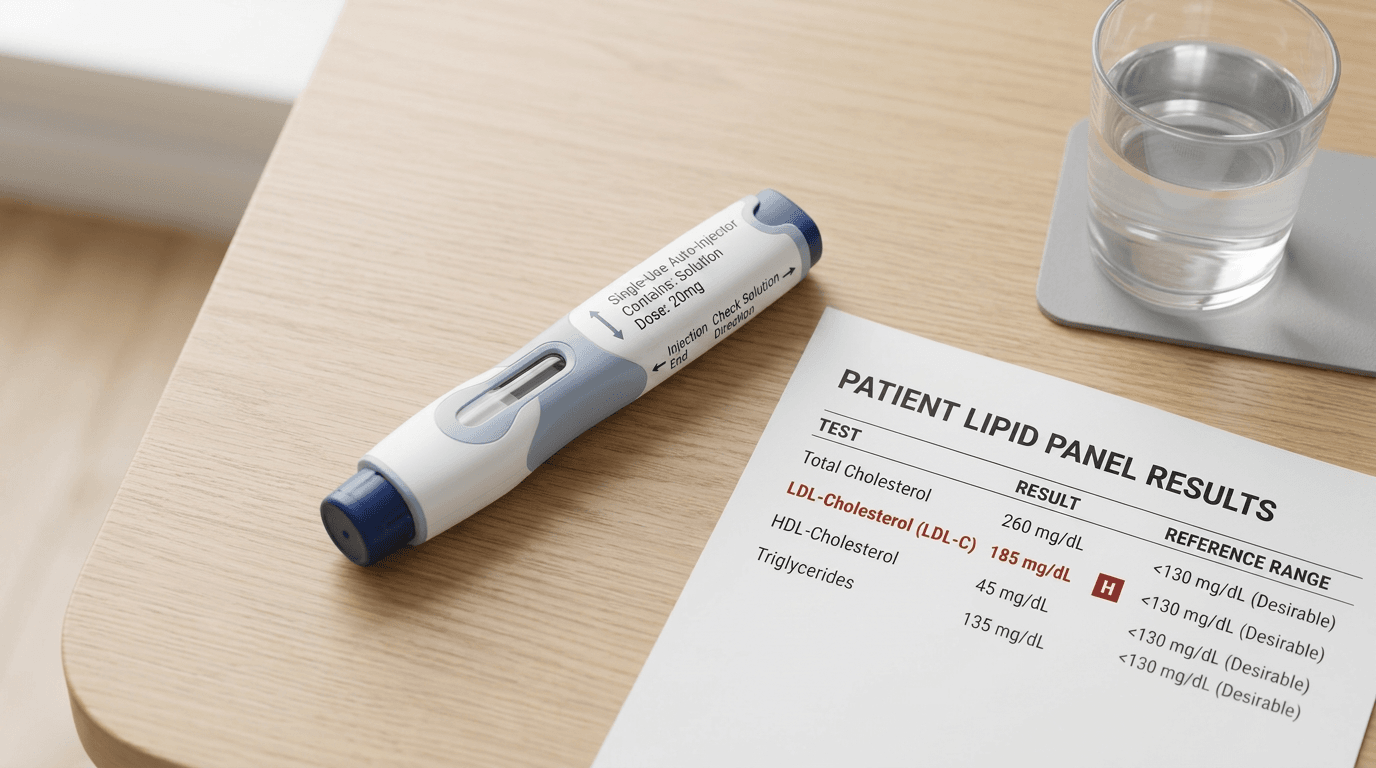
| The essentials: On August 17, 2026, the FDA approved two updates to Lerochol (lerodalcibep-liga, LIB Therapeutics): a new autoinjector dosage form for once-monthly self-administration, and updated labeling that explicitly links LDL-C lowering with statins or monoclonal antibody PCSK9 inhibitors to reduced risk of major adverse cardiovascular events (MACE) in adults at increased cardiovascular risk. Neither action changes the active molecule, the dosing regimen, or the approved indication. This is Lerochol’s second FDA action since its original approval on December 12, 2025. The autoinjector launches at the same $199 per month cash price as the existing pre-filled syringe, well below the approximately $14,000 annual list price at which alirocumab (Praluent) and evolocumab (Repatha) first launched in 2015. What lerodalcibep is: a third-generation PCSK9 inhibitor using a novel molecular format, an adnectin-PCSK9 inhibitor fusion protein, rather than the large monoclonal antibody format of evolocumab and alirocumab. This smaller molecule format enables once-monthly dosing (versus every 2 weeks for evolocumab and alirocumab), a smaller injection volume, and extended room-temperature stability of up to 3 months, enabling home storage and travel without cold-chain requirements. The clinical evidence base (LIBerate Phase 3 program, more than 2,900 patients): sustained LDL-C reductions of at least 60% in patients with cardiovascular disease or at very high/high risk; at least 59% in patients with HeFH; 72-week open-label extension with no treatment-related serious adverse events. The updated label now includes language consistent with outcomes trial consensus that LDL-C lowering with statins or monoclonal antibody PCSK9 inhibitors, added to statins, reduces MACE risk in adults at increased risk. Lerochol itself does not have a completed cardiovascular outcomes trial. The label language references the class effect established by the FOURIER (evolocumab) and ODYSSEY OUTCOMES (alirocumab) trials. This mirrors the approach taken in the HED post on Lipfendra (the first oral PCSK9 inhibitor, approved July 2026): class-based CV outcomes inference while a dedicated outcomes trial for lerodalcibep is conducted. Storage: refrigerated storage or room temperature up to 25°C for up to 3 months. Common adverse reactions: injection site reactions, flu-like symptoms (nasopharyngitis, upper respiratory tract infections), myalgia. No myocarditis or serious treatment-related adverse events in the long-term extension. |
|---|
PCSK9 inhibitors have been among the most effective LDL-C lowering drugs ever developed, capable of reducing LDL-C by 50 to 60% or more on top of maximally tolerated statin therapy. They have also, for most of their existence, been among the most expensive and the most underused: a 2015 launch at approximately $14,000 per year, combined with strict prior authorization requirements, meant that the majority of eligible patients never received them.
That access problem drove the development of multiple alternative approaches to PCSK9 inhibition: inclisiran’s twice-yearly dosing, the small molecule approach of Lipfendra (approved in July 2026 and covered in an earlier HED post), and lerodalcibep’s third-generation protein format. Lerochol, approved December 2025 and now adding an autoinjector and strengthened label language, represents one of the most practical and affordable entries into the PCSK9 landscape: once-monthly dosing, room-temperature storage, and a $199/month direct cash price.
The August 17 actions add two things that matter for clinical practice. The autoinjector makes self-administration more accessible for patients who find prefilled syringes technically or psychologically challenging. And the updated label language, which now explicitly connects lerodalcibep’s LDL-C lowering to cardiovascular risk reduction through the class evidence base, removes a gap in the prescribing information that required clinicians to infer the cardiovascular benefit rather than reading it directly in the label.
What Lerodalcibep Is: Third-Generation PCSK9 Inhibition
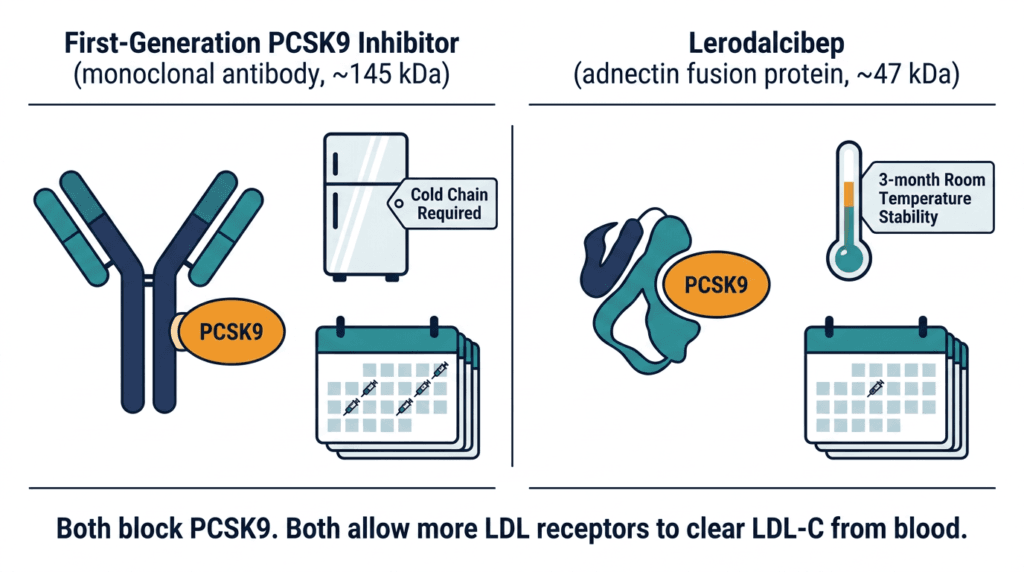
As covered in HED’s earlier post on Lipfendra (orforglipron, the first oral PCSK9 inhibitor), the PCSK9 protein directs the degradation of LDL receptors on liver cell surfaces, preventing them from clearing LDL-C from the bloodstream. Blocking PCSK9 allows more LDL receptors to remain on the cell surface, substantially increasing LDL-C clearance and lowering blood LDL-C levels.
The first-generation PCSK9 inhibitors, evolocumab (Repatha) and alirocumab (Praluent), are large monoclonal antibodies (approximately 145 kDa) that bind PCSK9 in the bloodstream. Their size drives several practical limitations: they require every-2-week subcutaneous injection, relatively large injection volumes, and refrigerated storage.
Lerodalcibep is structurally different. It is an adnectin-PCSK9 inhibitor fusion protein, combining an adnectin (a small fibronectin-based protein scaffold approximately 10 kDa) that binds PCSK9 with high affinity, fused to a human serum albumin-binding domain that extends its circulating half-life to approximately 14 days, enabling once-monthly rather than every-2-week dosing. The total molecular weight is approximately 47 kDa, substantially smaller than monoclonal antibodies.
This molecular architecture produces a set of practical advantages:
Once-monthly dosing: 300 mg subcutaneously once per month, self-administered at home. This is half the injection frequency of evolocumab and alirocumab and matches the practical convenience of inclisiran (though inclisiran is clinician-administered every 6 months).
Small injection volume: The compact molecule size allows a low injection volume, reducing injection site discomfort compared to larger-volume biologic injections.
Room-temperature stability: Up to 3 months at room temperature (up to 25°C), avoiding the cold-chain logistics that complicate travel and home storage for refrigerator-dependent biologics. Patients can keep Lerochol at room temperature and take it with them on extended trips without packing a cooler.
No food or drug interaction concerns: Unlike the oral PCSK9 inhibitor Lipfendra, which requires consideration of CYP3A4 drug interactions and carries a simvastatin dose restriction, lerodalcibep is an injectable biologic without the same drug interaction profile.
The Autoinjector: What It Changes and What It Does Not
The original Lerochol approval in December 2025 provided the drug in a prefilled syringe format requiring manual injection. The August 17, 2026 approval adds an autoinjector device, a spring-loaded prefilled injection device that delivers the dose with a button press without requiring the patient to manually depress a plunger or to see or handle the needle directly.
The clinical significance of an autoinjector versus a prefilled syringe is primarily adherence and patient experience. For many patients managing long-term injectable therapy, particularly those with needle anxiety, arthritis or hand weakness, or limited experience with self-injection, a button-press autoinjector is substantially more accessible than a conventional syringe. The device conceals the needle, simplifies the injection motion, and reduces the technical complexity of the administration step.
This is the same design principle behind the BESREMi Pen for ropeginterferon (covered in HED’s Besremi post) and the Kevzara and other autoinjector formats for biologics: the drug does not change, but the device reduces the practical barriers that contribute to missed or discontinued doses.
As Kristen Miller, Vice President, Brand Communications at LIB Therapeutics noted: “Innovation in PCSK9 inhibition cannot stop at the molecule, because how a medicine for life-long therapy fits into a patient’s life is what determines whether they stick with it over the long haul. The monthly dosing by autoinjector is completed in seconds, does not interfere with any oral medications, require overnight fasting, or limit the timing of food and beverage consumption. These features, along with the extended room temperature storage, mean LEROCHOL fits into patients’ lives and not the other way around.” TCTMD
The autoinjector launches at the same $199 per month direct cash price as the prefilled syringe. Both device options remain available.
The Updated Label: What the New Cardiovascular Risk Language Says and Why It Matters
The second element of the August 17 approval is an updated indication that adds explicit language linking lerodalcibep’s LDL-C lowering to cardiovascular risk reduction.
Labeling now reflects outcomes-trial consensus that LDL-C lowering with statins or monoclonal antibody PCSK9 inhibitors, added to statins, reduces MACE risk in adults at increased risk. Libtherapeutics
This language references the cardiovascular outcomes evidence established by the FOURIER trial (evolocumab) and ODYSSEY OUTCOMES trial (alirocumab), both of which demonstrated that adding a PCSK9 inhibitor to maximally tolerated statin therapy reduces the risk of major adverse cardiovascular events (MACE) including heart attack, stroke, and cardiovascular death. Lerodalcibep does not yet have a completed dedicated cardiovascular outcomes trial.
The practical significance of this label update for prescribers: the prescribing information now explicitly supports the clinical inference that prescribing lerodalcibep to reduce LDL-C in high-risk patients is intended to reduce cardiovascular events, not merely to achieve a biomarker goal. This strengthens the regulatory basis for prescribing Lerochol to patients at elevated cardiovascular risk and provides clearer documentation for payer prior authorization requests.
This mirrors the situation described in HED’s earlier post on Lipfendra (oral PCSK9 inhibitor): the drug reduces LDL-C convincingly, the cardiovascular outcomes evidence for the drug specifically is pending, and the prescribing is supported by the strong class-effect evidence while dedicated outcomes trial data mature. For lerodalcibep, that outcomes trial is the LIBerate-OUTcomes study, which is ongoing.
The LIBerate Clinical Trial Program: The Evidence Foundation
The December 2025 original approval and the August 2026 label update both rest on the Phase 3 LIBerate program, which enrolled more than 2,900 patients across multiple trials:
| Trial | Population | LDL-C reduction | Duration |
|---|---|---|---|
| LIBerate-CVD | Adults with established cardiovascular disease | At least 60% sustained reduction | 52 weeks (registration); 72-week OLE |
| LIBerate-HR | Adults without CVD at very high or high risk | At least 60% sustained reduction | 52 weeks (registration); 72-week OLE |
| LIBerate-HeFH | Adults with heterozygous familial hypercholesterolemia | At least 59% sustained reduction | 52 weeks (registration); 72-week OLE |
Source: LIB Therapeutics original approval press release. December 15, 2025.
The LDL-C reductions across these populations are clinically robust and sustained over the full 52-week registration period. The 72-week open-label extension showed no treatment-related serious adverse events in over 2,400 continued participants, supporting the long-term safety profile.
These reductions compare favorably with the approximately 59% LDL-C reductions achieved by evolocumab in FOURIER and approximately 62% by alirocumab in ODYSSEY OUTCOMES, confirming that lerodalcibep’s LDL-C lowering efficacy is within the same class range as the established injectable PCSK9 inhibitors.
The $199/Month Pricing: Why It Is Clinically Important
When alirocumab and evolocumab launched in 2015, their approximately $14,000 annual list price prompted payers and pharmacy benefit managers to impose strict prior authorization protocols. A 2015 Institute for Clinical and Economic Review draft benchmark concluded those medications would need to fall to $2,177 annually, an 85% discount, to meet standard cost-effectiveness thresholds.
At $199 per month ($2,388 per year), lerodalcibep meets and exceeds that cost-effectiveness threshold. It is priced below the ICER-recommended threshold that was identified as the level at which PCSK9 inhibitors would be cost-effective for the populations most likely to benefit.
The practical consequences for prescribing: the cost barrier that has historically required prior authorization, step therapy requirements, and multiple rejections before PCSK9 inhibitor access has been substantially lower with Lerochol’s pricing than with the established agents. Patients paying cash or whose insurance does not cover PCSK9 inhibitors have a real-world access option at $199/month that did not exist with evolocumab or alirocumab at their list prices.
For context within the PCSK9 landscape as it now stands:
- Evolocumab (Repatha) and alirocumab (Praluent): both now available at substantially reduced net prices compared to 2015 list, with patient assistance programs, but list prices remain substantially higher than $199/month
- Inclisiran (Leqvio): clinician-administered, every 6 months, priced at a different tier
- Lerochol (lerodalcibep): $199/month cash, self-administered monthly
- Lipfendra (oral PCSK9 inhibitor, approved July 2026): $149/month self-pay at LillyDirect, oral daily tablet
The PCSK9 inhibitor market in August 2026 looks very different from its 2015 origins. With multiple mechanisms (monoclonal antibody, siRNA, small molecule, adnectin fusion protein), multiple dosing frequencies (every 2 weeks, monthly, every 6 months, daily), and prices ranging from $149 to $2,388 annually at self-pay, the access problem that defined PCSK9 inhibitor therapy for a decade is meaningfully reduced.
Where Lerochol Fits in the Current PCSK9 Landscape
With multiple approved options now available, understanding how lerodalcibep is positioned relative to alternatives helps clinicians and patients make informed choices:
| Drug | Route | Frequency | Storage | Self-pay price | CV outcomes trial |
|---|---|---|---|---|---|
| Repatha (evolocumab) | SC injection | Every 2 weeks or monthly | Refrigerated | Higher; varies by plan | Yes (FOURIER) |
| Praluent (alirocumab) | SC injection | Every 2 weeks or monthly | Refrigerated | Higher; varies by plan | Yes (ODYSSEY OUTCOMES) |
| Leqvio (inclisiran) | SC injection (clinician) | Every 6 months | Refrigerated | Clinician-administered; Part B | No (ongoing) |
| Lerochol (lerodalcibep) | SC injection (self) | Once monthly | Room temp up to 3 months | $199/month | No (LIBerate-OUTcomes ongoing) |
| Lipfendra (enlicitide) | Oral tablet | Once daily | Room temp | $149/month | No (CORALreef Outcomes ongoing) |
The unique combination of monthly self-administration, room-temperature storage, and $199/month cash pricing positions Lerochol distinctly in the market, particularly for patients who find every-2-week injections burdensome, who have cold-chain storage challenges, or for whom the cost of evolocumab and alirocumab has been a barrier.
The absence of a completed cardiovascular outcomes trial for lerodalcibep is the most important limitation in its label relative to evolocumab and alirocumab, both of which have established MACE reduction in large randomized outcomes trials. The updated label language acknowledges and incorporates the class-level evidence, but physicians and patients making cardiovascular risk reduction decisions should understand that the outcomes evidence for lerodalcibep specifically is still being generated.
Safety: What the Prescribing Information Covers
The safety profile of lerodalcibep from the LIBerate program is consistent with the injectable PCSK9 inhibitor class and is generally favorable.
Most common adverse reactions (occurring more frequently than placebo): injection site reactions (redness, bruising, pain at the injection site), flu-like symptoms including nasopharyngitis and upper respiratory tract infections, and myalgia. These are predominantly mild and consistent with the subcutaneous biologic class effect.
No treatment-related serious adverse events were reported in the 72-week open-label extension study covering more than 2,400 participants. No myocarditis or cardiovascular safety concerns were identified.
Immunogenicity: As with all biologic proteins, anti-drug antibodies can develop. The rate and clinical significance of immunogenicity in the LIBerate program was consistent with the class.
Embryo-fetal risk: As with all PCSK9 inhibitors, the potential for fetal harm should be discussed with patients of reproductive potential, and the benefit-risk discussion should inform contraception counseling.
No boxed warnings apply to lerodalcibep.
What This Means for Clinicians and Patients
For primary care physicians and cardiologists
The autoinjector addition and label update do not change the clinical calculus for prescribing Lerochol versus existing PCSK9 inhibitors in significant ways, but they do address two practical barriers. The autoinjector is a real-world adherence support, particularly for patients whose concern about self-injection has been a practical barrier. The updated CV risk label language removes the need for clinicians to step outside the prescribing information to justify the cardiovascular risk reduction rationale for prescribing.
The $199/month pricing remains the most clinically distinctive feature of this drug. For patients who have been unable to access or afford evolocumab or alirocumab through their insurance, or who prefer a cash-pay option that bypasses prior authorization processes, Lerochol at $199/month represents a real access pathway.
The absence of a dedicated completed cardiovascular outcomes trial for lerodalcibep should be communicated transparently to patients, particularly those with established ASCVD whose primary motivation for PCSK9 inhibition is event reduction rather than solely LDL-C goal achievement. For those patients, the class evidence is compelling and the label now explicitly references it, but the drug-specific outcomes data are not yet available.
For patients managing high LDL-C
If you have high LDL-C that has not reached goal on statins and lifestyle modification, and you or your provider have been considering a PCSK9 inhibitor, Lerochol’s once-monthly autoinjector at $199/month is worth discussing. The monthly injection schedule means 12 injections per year. The room-temperature stability for up to 3 months means you do not need to plan your travel around keeping the medication refrigerated. The autoinjector format means the injection itself takes seconds and does not require you to handle the needle directly.
For patients who would prefer to take a daily pill instead of a monthly injection, HED’s earlier post on Lipfendra (enlicitide, the first oral PCSK9 inhibitor) covers that option, available at $149/month through LillyDirect.
The National Lipid Association (lipid.org) and the American Heart Association maintain current patient resources on cholesterol management, cardiovascular risk, and treatment options.
Sources
LIB Therapeutics autoinjector press release: U.S. Food and Drug Administration Approves an Autoinjector Version of LEROCHOL (lerodalcibep-liga) and Updated Indication. BusinessWire. August 17, 2026.
Drugs.com approval news: U.S. Food and Drug Administration Approves an Autoinjector Version of Lerochol (lerodalcibep-liga) and Updated Indication. drugs.com. August 17, 2026.
AJMC (autoinjector pricing $199/month, label update context, ICER cost-effectiveness history): FDA Clears Lerodalcibep-Liga Autoinjector, Widens LDL-C Indication. ajmc.com. August 17, 2026.
Drug Topics (autoinjector details, label language on CV risk, Kristen Miller quote, LIBerate program summary): FDA Approves Autoinjector of Lerodalcibep-Liga With Updated Indication. drugtopics.com. August 17, 2026.
Patient Care Online (Kristen Miller quote, monthly autoinjector context, EMA submission): FDA Approves Lerodalcibep Autoinjector for Hypercholesterolemia, Updated Indication. patientcareonline.com. August 17, 2026.
LIB Therapeutics original approval press release (December 2025): U.S. Food and Drug Administration Approves LIB Therapeutics’ LEROCHOL (lerodalcibep-liga) for Adults with Elevated LDL Cholesterol. libtherapeutics.com. December 15, 2025.
AJMC original approval (December 2025, LIBerate program data): FDA Approves Once-Monthly PCSK9 Injection for LDL-C Reduction. ajmc.com. December 15, 2025.
Pharmacy Times original approval (LDL-C reduction percentages by population): FDA Approves Lerodalcibep for Hypercholesterolemia and Heterozygous Familial Hypercholesterolemia. pharmacytimes.com. December 2025.
NLA original approval (mechanism, 72-week OLE safety, room-temperature stability): FDA Approves LIB Therapeutics’ LEROCHOL for Adults with Elevated LDL Cholesterol. lipid.org. December 15, 2025.
TCTMD original approval (quote from Dean Kereiakes, access barriers addressed): FDA Approves Lerodalcibep for Adults With Hypercholesterolemia. tctmd.com. December 15, 2025.
Patient Care Online original approval (third-generation positioning, Raal HeFH trial reference): FDA Approves Lerodalcibep, Third-Generation PCSK9 Inhibitor. patientcareonline.com. December 2025.
PCSK9 biology and LDL receptor pathway: PCSK9 and LDL Receptor Regulation. PMC9290282.
Lerochol prescribing information: LEROCHOL (lerodalcibep-liga) Prescribing Information. LIB Therapeutics. 2026.
Lerochol approval history: Lerochol FDA Approval History. drugs.com.
Patient resources: National Lipid Association | American Heart Association cholesterol resources | Family Heart Foundation (HeFH resources) | LIB Therapeutics Lerochol patient support
| Disclaimer: Health Evidence Digest provides general information about FDA approvals and health research for educational purposes. This content is not a substitute for professional medical advice. The updated Lerochol label language references cardiovascular risk reduction based on class-level outcomes evidence from trials of other PCSK9 inhibitors; lerodalcibep does not yet have a completed dedicated cardiovascular outcomes trial. Decisions about initiating PCSK9 inhibitor therapy, including the choice among available agents, should be made in consultation with a qualified healthcare provider who can evaluate individual LDL-C levels, cardiovascular risk, current medications, and treatment goals. |
|---|
Leave a Reply