
| The essentials: On July 14, 2026, the FDA granted traditional (full) approval to Retevmo (selpercatinib, Eli Lilly and Company) for adult and pediatric patients aged 2 years and older with locally advanced or metastatic solid tumors with a RET gene fusion, as detected by an FDA-approved test, that have progressed on or following prior systemic treatment or who have no satisfactory alternative treatment options. This is a regulatory conversion from accelerated to traditional approval. It does not change the indication, the population, or the drug. What changed is the evidentiary threshold: accelerated approval was granted in 2022 based on overall response rate and duration of response as surrogate endpoints. Traditional approval requires confirmatory evidence demonstrating actual clinical benefit. The conversion confirms that the response rates observed in LIBRETTO-001 represent genuine clinical benefit rather than a surrogate that might not translate to meaningful outcomes. Timeline of the tissue-agnostic indication: accelerated approval for adult patients: September 21, 2022. Pediatric extension (accelerated approval for ages 2 and older): May 29, 2024. Traditional (full) approval covering both adults and children aged 2 and older: July 14, 2026. Primary evidence base (tissue-agnostic, non-NSCLC/non-thyroid solid tumors): LIBRETTO-001 (NCT03157128), multicenter, open-label, multi-cohort Phase 1/2 trial. Efficacy analysis set for traditional approval: 75 patients with RET fusion-positive solid tumors other than NSCLC and thyroid cancer. ORR: 47% (95% CI 35% to 59%). Median DOR: 24.5 months (95% CI 11.2 to 49.1). Pediatric evidence: LIBRETTO-121 (NCT03899792), demonstrating responses in congenital infantile fibrosarcoma, spindle cell sarcoma, and RET fusion-positive thyroid cancer. Supported by: established traditional approval data in NSCLC (LIBRETTO-001 NSCLC cohort, original May 2020 approval) and thyroid cancer (traditional approval in medullary thyroid cancer May 2020; RET fusion-positive thyroid cancer traditional approval 2022). What this means for prescribing: no change in the indication, patient eligibility, required RET testing, or dosing. The conversion to traditional approval removes the post-marketing requirement to verify clinical benefit in a confirmatory trial, because that verification has been provided. |
|---|
The accelerated approval program is one of the FDA’s most powerful tools for getting effective drugs to patients with serious diseases faster. But it comes with a condition: the drug is approved based on a surrogate endpoint (typically tumor response rate, a measure of whether the tumor shrinks) that is reasonably likely to predict clinical benefit, and continued approval depends on completing a confirmatory trial that demonstrates the actual clinical benefit, whether patients live longer, function better, or have improved quality of life.
When a drug converts from accelerated to traditional approval, it means the confirmatory standard has been met. The FDA has reviewed the totality of evidence and concluded that the benefit originally inferred from surrogate response data is, in fact, real and established. The drug’s position in therapy is strengthened. The post-marketing obligation to verify is fulfilled. The label revision reflects a regulatory maturation, not a discovery.
For Retevmo (selpercatinib, Eli Lilly), this conversion arrived on July 14, 2026, for its tissue-agnostic indication covering RET fusion-positive solid tumors other than the NSCLC and thyroid cancer indications that already held full traditional approval. The drug had been treating patients under accelerated approval in this broader solid tumor population since September 2022. The 47% response rate and 24.5-month median duration of response in the LIBRETTO-001 non-NSCLC/non-thyroid cohort, combined with accumulated clinical experience and responses observed in pediatric patients across rare histologies in LIBRETTO-121, provided the confirmatory evidence base the FDA required.
This post covers what RET gene fusions are and why they matter across cancer types, how selpercatinib works as a selective RET inhibitor, what the complete Retevmo approval history looks like, what the LIBRETTO-001 and LIBRETTO-121 data show, what the regulatory distinction between accelerated and traditional approval means in practice, and what the conversion means for the clinicians and patients who have been using this drug.
What RET Is and Why a Gene Fusion Changes Everything
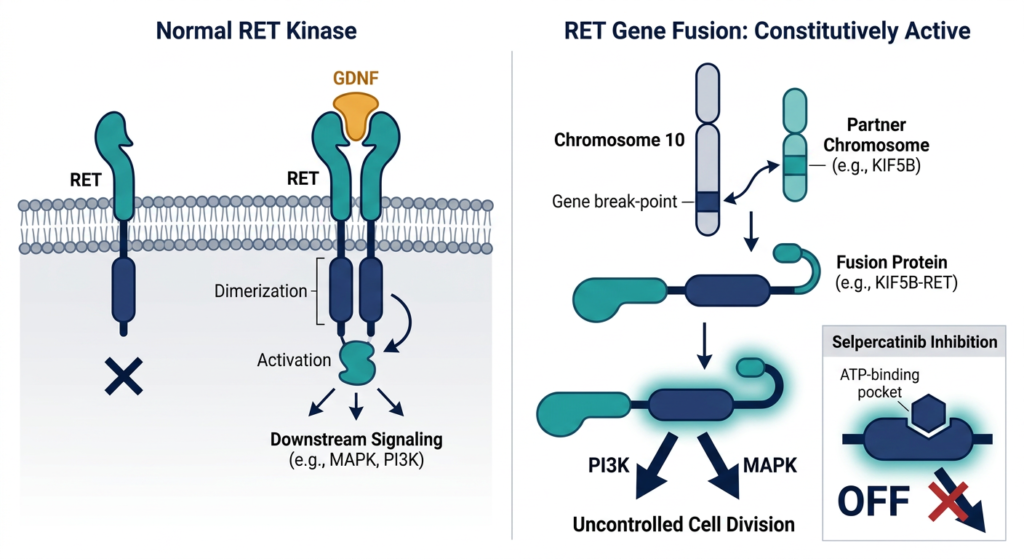
RET (Rearranged during Transfection) is a proto-oncogene encoding a receptor tyrosine kinase expressed in cells derived from the neural crest, including thyroid parafollicular cells (C cells), renal collecting duct cells, and neurons of the enteric nervous system. In normal cells, the RET kinase requires its ligand (glial cell line-derived neurotrophic factor, GDNF, and related proteins) to activate. Ligand binding triggers receptor dimerization and autophosphorylation, initiating downstream signaling through RAS/MAPK, PI3K/AKT/mTOR, and JAK/STAT pathways that regulate cell growth and survival.
Two types of oncogenic RET alterations drive human cancers: activating point mutations, which constitutively activate RET without requiring ligand binding, and gene fusions, in which chromosomal rearrangements fuse the RET kinase domain to the promoter and partial coding sequence of a partner gene.
RET gene fusions create chimeric proteins in which the kinase domain of RET is constitutively active, continuously signaling for cell proliferation and survival regardless of ligand availability. The fusion partner determines the specific structural features of the chimeric protein (including its dimerization properties and intracellular localization), but in all cases the downstream consequence is uncontrolled kinase activity driving tumor growth.
RET fusions are found across multiple tumor types:
- Non-small cell lung cancer (approximately 1 to 2% of NSCLC): the most common solid tumor context; typically KIF5B-RET or CCDC6-RET fusions
- Thyroid cancer: highly prevalent in papillary thyroid cancer (approximately 10 to 20% of cases) and relevant in other thyroid malignancies
- Pancreatic cancer, colorectal cancer, salivary gland tumors, ovarian cancer, breast cancer, and multiple other histologies: lower individual prevalence but collectively encompassing thousands of patients annually
The tissue-agnostic indication covers this last category: any advanced solid tumor with a confirmed RET gene fusion, regardless of the cancer type in which it occurs, provided the patient has received prior systemic therapy or has no satisfactory alternative treatment options.
The tissue-agnostic regulatory framework reflects a broader shift in oncology toward molecular characterization of cancer over purely anatomic characterization. A RET fusion-positive pancreatic cancer and a RET fusion-positive NSCLC are different diseases in terms of their tissue of origin, their natural history, and their treatment history, but they share the molecular driver that makes them susceptible to RET inhibition. The shared molecular vulnerability justifies a shared approval across tumor types.
How Selpercatinib Works: Selective RET Inhibition
Selpercatinib is an oral, highly selective RET kinase inhibitor designed to potently inhibit both wild-type RET and the common oncogenic RET alterations (fusions and point mutations including RET M918T, the most common mutation in medullary thyroid cancer) while minimizing activity against off-target kinases.
The selectivity design philosophy distinguishes selpercatinib from earlier multi-kinase inhibitors (such as cabozantinib and vandetanib) that had incidental RET activity alongside activity against VEGFR, MET, and other kinases. Those earlier agents’ off-target activity contributed to high rates of adverse events, particularly cardiovascular and dermatological toxicities, and limited the depth and duration of RET-specific therapeutic benefit achievable in clinical practice.
Selpercatinib occupies the ATP-binding pocket of the RET kinase domain in a way that locks the enzyme in an inactive conformation. The drug is also designed to address known resistance mutations: at concentrations achievable in the clinic, it maintains activity against several RET mutations that confer resistance to earlier-generation RET inhibitors, including V804M and V804L (the “gatekeeper” mutations).
The high selectivity translates into an adverse event profile that differs from multi-kinase inhibitors. The most common adverse reactions in LIBRETTO-001 (occurring in 25% or more of the full safety population, n=796) were edema, diarrhea, fatigue, dry mouth, hypertension, abdominal pain, constipation, rash, nausea, and headache. These are largely manageable with dose modification and supportive care, and the rates of severe (grade 3 or 4) events are substantially lower than with the older multi-kinase inhibitors used in RET-altered thyroid cancer.
Retevmo’s Full Approval History: A Cumulative Story
Understanding the July 2026 traditional approval requires context for Retevmo’s complete regulatory trajectory. The drug now holds multiple distinct approved indications accumulated over six years.
| Indication | Approval type | Date | Trial basis |
|---|---|---|---|
| RET fusion-positive NSCLC (adults) | Accelerated | May 8, 2020 | LIBRETTO-001 NSCLC cohort |
| RET-mutant medullary thyroid cancer (adults) | Accelerated | May 8, 2020 | LIBRETTO-001 MTC cohort |
| RET fusion-positive thyroid cancer (adults) | Accelerated | May 8, 2020 | LIBRETTO-001 thyroid cohort |
| RET fusion-positive NSCLC (adults) | Traditional (full) | March 25, 2022 | LIBRETTO-431 Phase 3 versus chemo |
| RET-mutant MTC and RET fusion-positive thyroid cancer (adults and pediatric ages 12 and older) | Traditional (full) | October 19, 2022 | LIBRETTO-001 confirmed data |
| RET fusion-positive solid tumors, all types (adults) | Accelerated | September 21, 2022 | LIBRETTO-001 non-NSCLC/non-thyroid ORR/DOR |
| RET-mutant MTC and RET fusion-positive thyroid cancer (pediatric ages 2 and older) | Accelerated | May 29, 2024 | LIBRETTO-121 pediatric data |
| RET fusion-positive solid tumors, all types (adults and pediatric ages 2 and older) | Traditional (full) | July 14, 2026 | LIBRETTO-001 confirmed; LIBRETTO-121 supported |
The July 2026 action completes the regulatory maturation of the tissue-agnostic indication and extends full traditional approval to the pediatric population (ages 2 and older) that had previously held only accelerated approval.
The Evidence Base: LIBRETTO-001 and LIBRETTO-121
LIBRETTO-001: The backbone of the tissue-agnostic indication
LIBRETTO-001 (NCT03157128) is an international, non-randomized, open-label, multi-cohort Phase 1/2 basket trial evaluating selpercatinib across all RET-altered solid tumors. The trial enrolled both RET fusion-positive and RET-mutant cancers across multiple tumor types and is the primary evidence source for most of Retevmo’s approved indications.
The efficacy analysis supporting the traditional approval conversion for the tissue-agnostic indication focused on 75 patients with RET fusion-positive solid tumors excluding NSCLC and thyroid cancer (the tumor types with separate, fully established approval pathways). This population included cancers of the pancreas, colon, rectum, salivary gland, ovary, breast, and other sites, all unified by the presence of a confirmed RET gene fusion.
| Efficacy endpoint | Result |
|---|---|
| Population (non-NSCLC, non-thyroid RET fusion-positive solid tumors) | n=75 |
| Overall response rate (ORR) | 47% (95% CI 35% to 59%) |
| Complete response rate | Included in the 47% ORR |
| Median duration of response (DOR) | 24.5 months (95% CI 11.2 to 49.1) |
Source: LIBRETTO-001. NCT03157128. FDA traditional approval summary July 14, 2026.
A 47% ORR and 24.5-month median DOR in a pan-tumor, pretreated population with diverse histologies is a clinically meaningful and durable response. The median DOR of nearly 2 years means that among the patients who responded, approximately half maintained that response beyond 24 months. In the context of heavily pretreated advanced solid tumors, which typically show short-duration responses to available cytotoxic chemotherapy, this durability distinguishes the targeted RET inhibitor approach from standard cytotoxic alternatives.
The supporting efficacy evidence from the NSCLC and thyroid cancer cohorts in LIBRETTO-001, both of which carry traditional approval, provides additional confirmation that selpercatinib’s anti-tumor activity is a real, consistent pharmacological phenomenon rather than a statistical artifact of small-cohort data.
LIBRETTO-121: The pediatric evidence base
LIBRETTO-121 (NCT03899792) is a multicenter, open-label, multi-cohort trial evaluating selpercatinib specifically in pediatric and young adult patients with RET-altered cancers. The trial evaluated patients with locally advanced refractory RET fusion-positive solid tumors who were unresponsive to available therapies or had no standard systemic curative therapy.
The evidence from LIBRETTO-121 supporting the July 2026 traditional approval included:
- One patient with congenital infantile fibrosarcoma: response observed
- One patient with spindle cell sarcoma: response observed
- Patients with RET fusion-positive thyroid cancer: responses observed
Congenital infantile fibrosarcoma and spindle cell sarcoma are rare pediatric tumors that carry ETV6-NTRK3 or other fusions in many cases, but the subset with RET fusions represents an ultra-rare population with very limited treatment options. A documented response in even a single patient with a rare pediatric sarcoma histology is clinically meaningful in a disease where treatment options are severely constrained.
The pediatric dosing framework for selpercatinib in LIBRETTO-121 includes weight-based dosing for children under 50 kg and adult dosing (160 mg twice daily) for patients at or above 50 kg or aged 12 and older meeting weight criteria. The prescribing information specifies dosing tables by weight for the pediatric population.
The Accelerated to Traditional Approval Conversion: What It Means and Why It Matters
Accelerated approval is a regulatory pathway created to make drugs available earlier for serious conditions with unmet medical need, based on surrogate endpoints that are “reasonably likely to predict” clinical benefit. Response rate is the most commonly used surrogate: if a tumor shrinks, the inference is that the patient will likely benefit clinically, even if survival data are not yet mature.
The limitation of accelerated approval is exactly that: it is based on an inference. A tumor can shrink and still not provide meaningful clinical benefit if the response is short, if the toxicity is prohibitive, or if the shrinkage does not translate into longer survival or better function. These are the cases where confirmatory trials sometimes reveal that the surrogate did not predict the expected clinical benefit, and the drug’s accelerated approval is subsequently withdrawn.
The conversion to traditional approval is the opposite event: it means the FDA has reviewed additional evidence demonstrating that the drug delivers genuine clinical benefit. For selpercatinib, the combination of the extended response durations observed in LIBRETTO-001 (median DOR of 24.5 months across the diverse non-NSCLC/non-thyroid cohort), the fully established traditional approval in NSCLC and thyroid cancer, and the pediatric response data in LIBRETTO-121 together provided the evidentiary confirmation required.
The practical implications of the conversion for patients and prescribers:
The indication does not change. The patient population, dosing, and required testing are identical before and after the conversion.
The regulatory confidence in the drug’s benefit is strengthened. Traditional approval removes the qualifier from the label indicating that continued approval may depend on a confirmatory trial. The clinical benefit is established.
The post-marketing verification requirement is fulfilled. Under accelerated approval, sponsors are legally required to conduct and submit confirmatory trial data. That obligation is discharged when traditional approval is granted.
Payer coverage is sometimes affected. Some commercial payers treat accelerated-approval drugs with greater scrutiny in prior authorization decisions, viewing them as having a higher evidentiary uncertainty. Traditional approval can support broader formulary access and simpler authorization pathways in some systems.
RET Testing: A Required Prerequisite
The tissue-agnostic indication for Retevmo requires RET gene fusion detection using an FDA-approved test. This testing requirement is embedded in the indication language: “locally advanced or metastatic solid tumors with a RET gene fusion, as detected by an FDA-approved test.”
For oncologists managing patients with advanced solid tumors: comprehensive genomic profiling (CGP) panels, which assess for RET fusions alongside hundreds of other clinically relevant alterations in a single assay, are the most efficient approach to RET testing in practice. Major approved CGP tests include Foundation Medicine’s FoundationOne CDx and Liquid CDx platforms, MSKCC’s MSK-IMPACT, and others. RNA-based sequencing is particularly important for RET fusion detection because DNA-based sequencing may miss some intronic fusion breakpoints; laboratories offering solid tumor profiling should ideally include RNA-based detection for fusion genes.
Patients whose tumors have not previously undergone molecular profiling and who are progressing on first-line therapy should be considered for testing at the earliest opportunity, because tissue requirements for a repeat biopsy may limit testing access later in the disease course. Cell-free DNA (liquid biopsy) is also available and can detect RET fusions from a blood draw, though with lower sensitivity than tissue testing for some rare fusion partners.
Safety: What the Prescribing Information Covers
The safety profile of selpercatinib from LIBRETTO-001 is well-characterized across the approximately 796-patient full safety population with advanced solid tumors. The July 14, 2026 conversion does not change the safety profile or the warnings; it confirms the established benefit-risk assessment.
Most common adverse reactions (25% or more in the full safety population): edema, diarrhea, fatigue, dry mouth, hypertension, abdominal pain, constipation, rash, nausea, and headache.
Most common grade 3 or 4 laboratory abnormalities (5% or more): decreased lymphocytes, increased ALT, increased AST, decreased sodium, and decreased calcium.
Key warnings and precautions:
| Warning | Rate/detail | Management |
|---|---|---|
| Hepatotoxicity | ALT or AST elevation; monitor before initiating and periodically | Monitor liver enzymes; dose interrupt or discontinue for significant elevation |
| ILD/pneumonitis | Potentially fatal | Monitor for pulmonary symptoms; hold for grade 2; permanently discontinue for grade 3 or 4 |
| Hypertension | Grade 3 or higher in approximately 20% | Monitor blood pressure; antihypertensive medications as needed; dose modification for uncontrolled hypertension |
| QT interval prolongation | Grade 3 or higher in approximately 5% | ECG at baseline and periodically; electrolyte monitoring and replacement |
| Hemorrhagic events | Monitor | Withhold for grade 3 or higher bleeding; discuss with prescribing information for resumption |
| Hypersensitivity | Reported | Manage per prescribing information; may require corticosteroids |
| Tumor lysis syndrome | Particularly in rapidly proliferating tumors | Monitor laboratory values; hydration |
| Impaired wound healing | Withhold before and after surgery | See prescribing information for timing guidance around elective procedures |
| Hypothyroidism | Monitor TSH periodically | Replace thyroid hormone as clinically indicated |
| Embryo-fetal toxicity | Selpercatinib can cause fetal harm | Effective contraception during treatment and for specified time after last dose |
| Slipped capital femoral epiphysis (pediatric) | Monitor for hip or knee pain in pediatric patients | A specific pediatric warning added with the 2024 pediatric expansion |
The pediatric-specific warning for slipped capital femoral epiphysis (SCFE), a disruption of the growth plate at the femoral head, was added to the prescribing information with the 2024 pediatric expansion and remains in place with the 2026 traditional approval. Pediatric patients receiving selpercatinib should be monitored for hip or knee pain, and any such complaint should prompt orthopedic evaluation.
Retevmo’s Current Complete Indication Coverage
After July 14, 2026, Retevmo (selpercatinib) holds the following approved indications:
| Indication | Population | Approval status |
|---|---|---|
| RET fusion-positive NSCLC | Adults | Traditional (full) |
| RET-mutant medullary thyroid cancer | Adults and pediatric ages 2 and older | Traditional (full) |
| RET fusion-positive thyroid cancer | Adults and pediatric ages 2 and older | Traditional (full) |
| RET fusion-positive solid tumors (any type) | Adults and pediatric ages 2 and older | Traditional (full), July 14, 2026 |
All indications now hold traditional approval. Retevmo has no remaining accelerated approval indications. The regulatory maturation of the drug is complete across its full clinical scope.
What This Means for Oncologists and Patients
For oncologists managing patients with advanced solid tumors
The practical implication for clinical practice is modest because the indication, the patient population, and the drug are unchanged. What the traditional approval provides is regulatory confirmation of clinical benefit, which strengthens the position of selpercatinib in treatment guidelines and may support broader formulary access in payer systems that treat accelerated-approval drugs differently.
For patients currently receiving selpercatinib under the prior accelerated approval: nothing changes about their treatment. The drug they are taking is the same; the benefit they are receiving is now confirmed rather than inferred.
For oncologists identifying new patients with RET fusion-positive solid tumors (outside of NSCLC and thyroid cancer): the traditional approval removes any label-language qualifier about provisional status. The evidence base is established. The indication is full.
The response rate of 47% and median DOR of 24.5 months represent the expected clinical outcomes in a heavily pretreated pan-tumor population. Individual patient outcomes will vary based on tumor histology, prior treatment burden, performance status, and specific RET fusion partner, but these numbers provide a reasonable framework for pre-treatment counseling.
For patients with rare RET fusion-positive cancers
The tissue-agnostic nature of this indication remains one of its most important features for patients. A patient with RET fusion-positive pancreatic cancer or colon cancer does not have a separate lung cancer drug or a thyroid cancer drug being offered off-label. They have a drug approved specifically for their cancer type, based on the molecular driver their tumor carries, regardless of where in the body the tumor originated. That clarity matters for insurance coverage, for informed consent, and for the patient’s understanding of why this specific drug was recommended.
The full traditional approval now reinforces that position. For patients who were told in 2022 or 2023 that they were receiving a drug under accelerated approval pending confirmatory data, the July 2026 update means that confirmatory standard has been met. The benefit is established.
For related HED coverage on precision oncology and targeted kinase inhibitor approvals, see our post on Revtorpyk (gedatolisib) becoming the first approved targeted therapy for PIK3CA wild-type HR+/HER2- breast cancer and our post on daraxonrasib (RMC-6236) generating a standing ovation at ASCO 2026 for its Phase 3 results in KRAS-driven pancreatic cancer.
Sources
FDA traditional approval announcement: FDA grants traditional approval to selpercatinib for locally advanced or metastatic RET fusion-positive solid tumors. FDA.gov. July 14, 2026. Full announcement at FDA.gov. Eli Lilly and Company
CancerNetwork coverage (trial support overview): FDA Traditionally Approves Selpercatinib in RET+ Solid Tumors. cancernetwork.com. July 2026.
OncLive (ORR 47% and DOR 24.5 months data): FDA Awards Traditional Approval to Selpercatinib for RET+ Advanced Solid Tumors. onclive.com. July 2026.
Healio (n=75 population, LIBRETTO-001 cohort detail): FDA grants traditional approval to Retevmo for RET fusion-positive solid tumors. healio.com. July 2026.
CURE (patient-focused conversion explanation, LIBRETTO-121 histologies): FDA Grants Traditional Approval to Retevmo for RET Fusion-Positive Solid Tumors. curetoday.com. July 2026.
ASCO Post (complete indication language, LIBRETTO-121 context): FDA Grants Traditional Approval to Selpercatinib for Locally Advanced or Metastatic RET Fusion-Positive Solid Tumors. ascopost.com. July 2026.
Oncology Nursing News (regulatory conversion context): FDA Grants Traditional Approval to Selpercatinib for RET-Fusion Solid Tumors. oncnursingnews.com. July 2026.
Lilly accelerated approval press release (September 2022): FDA Approves Lilly’s Retevmo (selpercatinib), the First and Only RET Inhibitor for Adults with Advanced or Metastatic Solid Tumors with a RET Gene Fusion. Eli Lilly. September 21, 2022.
LIBRETTO-001 FDA review article (PMC): FDA accelerated approval summary for selpercatinib RET fusion-positive solid tumors (2022). PMC10524590.
LIBRETTO-001 trial registration: NCT03157128. ClinicalTrials.gov.
LIBRETTO-121 trial registration: NCT03899792. ClinicalTrials.gov.
Drugs.com approval news: FDA Grants Traditional Approval to Retevmo (selpercatinib) for Locally Advanced or Metastatic RET Fusion-Positive Solid Tumors. drugs.com. July 14, 2026.
Retevmo prescribing information: RETEVMO (selpercatinib) Prescribing Information. Eli Lilly and Company. 2026.
Retevmo approval history: Retevmo FDA Approval History. drugs.com.
Patient resources: LUNGevity Foundation: RET+ resources | Thyroid Cancer Alliance | RET Research Foundation | ClinicalTrials.gov: search selpercatinib | Lilly Cares patient support for Retevmo
| Disclaimer: Health Evidence Digest provides general information about FDA approvals and health research for educational purposes. This content is not a substitute for professional medical advice. The July 14, 2026 traditional approval of Retevmo (selpercatinib) for RET fusion-positive solid tumors reflects a regulatory conversion from accelerated to traditional approval; the indication, population, dosing, and required testing are unchanged. RET gene fusion testing using an FDA-approved test is required before initiating treatment. Decisions about selpercatinib therapy should be made in close collaboration with a board-certified medical oncologist experienced in molecular-targeted therapy and familiar with the tumor type in question. |
|---|
Leave a Reply