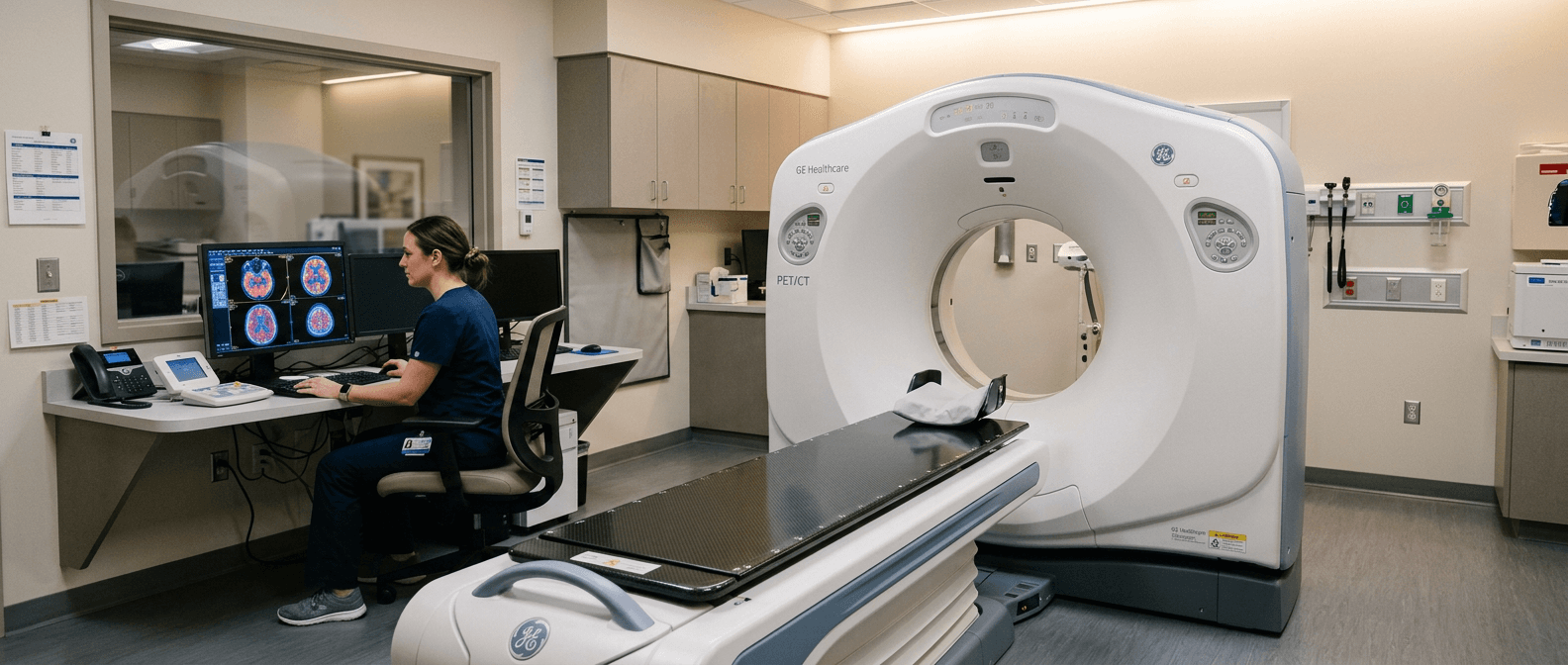
| The essentials: On August 13 to 14, 2026, the FDA approved Tauklarify (florquinitau F 18 injection, Lantheus Holdings) for positron emission tomography (PET) of the brain in adults with cognitive impairment who are being evaluated for Alzheimer’s disease to identify patients with tau neurofibrillary tangle (NFT) pathology. Tauklarify was previously known as MK-6240 during its clinical development phase. Tauklarify is the second FDA-approved tau PET imaging agent in the United States, joining flortaucipir F 18 (Tauvid, Eli Lilly/Avid Radiopharmaceuticals), which received FDA approval in 2020 as the first tau PET tracer. The approval rests on two blinded-read studies drawn from three clinical trials involving more than 500 subjects. Independent readers analyzed the tau PET images without knowledge of the subjects’ clinical histories or amyloid PET results. Readers characterized each scan as positive or negative for tau neurofibrillary tangle pathology using a standardized visual interpretation method. Key reader agreement data: Study 1 positive percent agreement 80% to 88% across readers. Study 2 positive percent agreement 68% to 82% across readers. Safety: assessed in 1,734 subjects receiving approximately 185 MBq (5 mCi) intravenously. Most common adverse reactions: headache (0.7%), nausea (0.2%), injection site reactions (0.1%), dizziness (0.1%), abdominal discomfort (0.1%). All adverse reactions occurred in less than 1% of subjects. Important limitation of use: the safety and effectiveness of Tauklarify have not been established for the evaluation of non-Alzheimer’s disease tauopathies. Regulatory designations: Fast Track Designation. Lantheus acquired the rights to MK-6240 from Enigma Biomedical USA in 2023 and collaborated with Enigma Biomedical through approval. Clinical context: Lantheus frames Tauklarify as one of several complementary diagnostic tools, alongside amyloid PET, blood-based biomarkers, and CSF analysis, intended to guide Alzheimer’s diagnosis and treatment selection as more disease-modifying therapies, including anti-tau therapies, enter clinical practice. The drug’s approval coincides with the NIH-funded CLARiTI study (a 5-year multisite investigation across all 37 Alzheimer’s Disease Research Centers) for which Lantheus is supplying MK-6240. Tauklarify has not been reviewed by the broader commercial market yet: Lantheus is evaluating the path toward broader commercial availability following the approval. Corporate context: Lantheus recently announced a deal to be acquired by rival Curius for approximately $8 billion. |
|---|
Alzheimer’s disease is not a single moment. It is a process that unfolds over decades, beginning with the earliest accumulation of pathological proteins in the brain, progressing through measurable but clinically silent biological changes, and only eventually producing the cognitive symptoms that bring most patients to a physician’s attention. By the time memory loss is obvious, the disease has typically been active for 15 to 20 years.
Understanding where a patient is in that process, and which pathological changes are present, has become increasingly important as treatment options for Alzheimer’s disease evolve. As HED covered in August 2026, Leqembi Iqlik received approval for at-home subcutaneous initiation dosing, bringing the first disease-modifying anti-amyloid therapy one step closer to practical reach for patients with early Alzheimer’s disease. Anti-amyloid therapy requires not just the clinical diagnosis but the biological confirmation that amyloid pathology is present. And as the disease-modifying pipeline continues to fill with approaches targeting tau rather than amyloid, the ability to characterize tau pathology with the same precision becomes the next diagnostic imperative.
Tauklarify (florquinitau F 18, Lantheus) is designed specifically for that purpose: a PET imaging agent that binds to tau neurofibrillary tangles in the brain, producing a scan that visualizes both the presence and the anatomical distribution of tau pathology. It does not diagnose Alzheimer’s disease by itself. But it provides information that amyloid PET cannot: the staging of disease progression, the correlation between tau spread and clinical symptom severity, and ultimately the ability to select and monitor patients for tau-directed therapies as those therapies approach approval.
The Two Pathological Hallmarks of Alzheimer’s Disease and Why Both Matter
Alzheimer’s disease is defined neuropathologically by two protein abnormalities that accumulate in the brain years to decades before clinical symptoms appear:
Amyloid beta plaques: Aggregations of misfolded amyloid beta protein that deposit between neurons as extracellular plaques. Amyloid accumulation begins 15 to 20 years before cognitive symptoms appear. Amyloid PET imaging with approved tracers (florbetapir, florbetaben, flutemetamol, and Locametz for PSMA) can visualize amyloid burden and confirm or exclude amyloid pathology as part of the diagnostic workup. Anti-amyloid therapies including Leqembi and donanemab target this pathology.
Tau neurofibrillary tangles: Aggregations of hyperphosphorylated tau protein that accumulate inside neurons. Normal tau stabilizes the microtubule cytoskeleton of neurons. When tau becomes hyperphosphorylated, it dissociates from microtubules, misfolds, and aggregates into paired helical filaments that form neurofibrillary tangles (NFTs) inside the neuron’s cell body and processes. Tau NFTs are directly toxic to neurons and are strongly correlated with neuronal death.
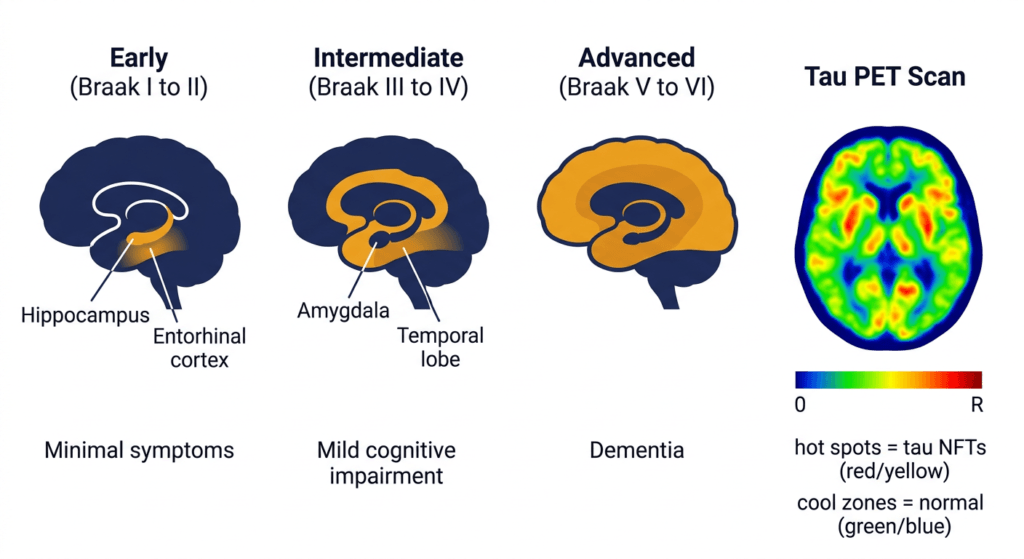
The relationship between the two pathologies is sequential and important for clinical practice. Amyloid accumulation typically precedes tau NFT formation by many years, though the mechanism connecting the two is not fully understood. Tau pathology follows a stereotyped anatomical staging pattern described by Braak and Braak: beginning in the transentorhinal cortex and hippocampus (Braak stages I to II), spreading to limbic regions (stages III to IV), and eventually spreading across the neocortex (stages V to VI). This anatomical progression of tau NFTs correlates closely with the progression of clinical symptoms: patients with Braak stage I to II tau pathology have minimal symptoms, while patients with Braak stage V to VI have severe dementia.
This is why tau PET provides information that amyloid PET does not. Amyloid positivity tells you the disease process is underway. Tau PET tells you how far along the process has progressed and which brain regions are affected. Together, they provide a biological characterization of the disease stage that clinical assessment alone cannot match.
The Tau PET Landscape: What Tauklarify Adds
The first FDA-approved tau PET agent, flortaucipir F 18 (Tauvid, Eli Lilly/Avid Radiopharmaceuticals), was approved in May 2020 for estimating the density and distribution of aggregated tau NFTs in adults with cognitive impairment.
Tauklarify is the second approved tau PET tracer. Both are F18-labeled radioligands that bind to aggregated tau in neurofibrillary tangle form and produce a PET signal proportional to the density of tau pathology at each brain location. The two agents differ in their specific binding characteristics, pharmacokinetics, and the standardized visual interpretation approaches validated for each:
Flortaucipir (Tauvid): Binds to tau NFTs; approved 2020; the most extensively studied tau PET tracer with the largest published clinical evidence base including multiple large phase 2 and 3 clinical trials.
Florquinitau (Tauklarify): Also binds to tau NFTs; approved August 2026; developed with a different chemical scaffold designed to optimize binding characteristics and imaging quality. Extensively validated in the CLARiTI NIH study infrastructure and in more than 500 subjects across the FDA pivotal studies.
The availability of two approved tau tracers matters for supply chain resilience, site-specific manufacturing logistics, and potentially for clinical scenarios where one tracer’s pharmacokinetic profile provides a practical advantage. The clinical interpretation framework for both agents uses standardized regional brain uptake patterns to characterize tau positivity.
How Tau PET Imaging Works: The Technical Framework
Tauklarify is administered as a single intravenous dose of approximately 185 MBq (5 mCi) in a low volume. After injection, the F18-labeled compound circulates through the bloodstream and crosses the blood-brain barrier, where it binds with high affinity to aggregated tau in neurofibrillary tangle form. Regions with high tau NFT burden retain more tracer; regions with low or no tau pathology clear the tracer normally.
After a waiting period to allow non-specific tracer clearance, the patient undergoes PET brain imaging. The scanner detects the positron emissions from the F18 decay at each brain location, producing a 3-dimensional map of tau-binding signal intensity across the brain. A trained reader, typically a radiologist or nuclear medicine physician, interprets the scan using a standardized visual interpretation methodology that characterizes each brain region as positive or negative for tau pathology.
The regional pattern of tau signal provides staging information consistent with the Braak staging framework: medial temporal lobe signal indicates early-stage tau, while parietal and frontal cortical involvement indicates later-stage disease. This staging information is clinically meaningful because it correlates with the severity of cognitive impairment and with the expected trajectory of decline.
Important limitation: Tauklarify detects tau neurofibrillary tangle pathology consistent with Alzheimer’s disease tau staging. The label specifically notes that safety and effectiveness have not been established for non-Alzheimer’s disease tauopathies. Other neurodegenerative diseases including progressive supranuclear palsy (PSP), corticobasal degeneration (CBD), and frontotemporal dementia with tau pathology also involve abnormal tau accumulation, but often with different tau isoforms, different anatomical distributions, and different binding characteristics for current tau PET tracers. A tau-positive scan with Tauklarify indicates Alzheimer’s pattern tau pathology specifically, not tau pathology from other conditions.
The FDA Approval Evidence: What the Pivotal Studies Showed
The FDA based its decision on two blinded-read studies drawn from three clinical trials involving more than 500 participants. Independent readers who were unaware of patients’ clinical histories or amyloid PET results interpreted the scans.
The two pivotal studies evaluated whether trained readers could reliably and reproducibly identify tau-positive versus tau-negative PET scans using the Tauklarify standardized visual interpretation methodology. This reader study design is standard for diagnostic imaging agents and reflects the primary regulatory question: not whether the scan predicts patient outcomes (that requires longitudinal studies), but whether trained readers can reliably characterize the scan’s findings with meaningful agreement.
Both showed high rates of agreement across readers: Study 1 had an 80% to 88% positive percent agreement, and Study 2 had a 68% to 82% positive percent agreement.
The trial populations included individuals with mild cognitive impairment and mild Alzheimer’s disease dementia, spanning the early Alzheimer’s disease spectrum that is most clinically relevant for the diagnostic workup that Tauklarify supports.
These inter-reader agreement rates reflect the real-world variability inherent in visual scan interpretation. The 80 to 88% agreement range in Study 1 represents stronger reader concordance; the 68 to 82% range in Study 2 indicates somewhat more variability, which is common when scan populations include more borderline or challenging cases. Standardized training, regional cutoff values, and quantitative software support tools can improve inter-reader reliability in clinical practice.
Safety across 1,734 subjects at the clinical dose of approximately 185 MBq (5 mCi) showed an excellent profile: headache in 0.7% of subjects, nausea in 0.2%, injection site reactions in 0.1%, dizziness in 0.1%, and abdominal discomfort in 0.1%. No serious adverse reactions were identified in the safety population.
How Tauklarify Fits Into the Evolving Alzheimer’s Diagnostic Framework
The diagnosis of Alzheimer’s disease has been transformed by the availability of biomarker-based diagnostics. The 2023 Alzheimer’s Association revised diagnostic criteria (AA/NIA 2023) define Alzheimer’s disease biologically, based on the presence of amyloid and tau pathology, rather than solely on clinical symptoms. This framework places tau PET as a core component of a complete Alzheimer’s disease biological characterization.
The practical clinical diagnostic framework now integrates multiple biomarker tools:
Blood-based biomarkers: Plasma phospho-tau 217 (p-tau217), p-tau181, amyloid 42/40 ratio, and GFAP tests that can identify patients with high probability of Alzheimer’s pathology from a blood draw, often as a first-line screen before more costly imaging.
Amyloid PET: Visualizes amyloid burden across the brain; confirms or excludes amyloid pathology; required before initiating anti-amyloid therapies like Leqembi.
Tau PET: Visualizes tau NFT distribution and burden; provides disease staging information; required for clinical trial enrollment in many tau-directed therapeutic trials; increasingly used in clinical practice to characterize disease stage.
CSF analysis: Measures amyloid 42/40 ratio and p-tau to assess both amyloid and tau pathology biochemically; invasive but accurate; used when PET is unavailable or for confirmation.
Tauklarify sits in the tau PET position in this framework, providing the anatomical staging of tau pathology that blood tests and amyloid PET cannot provide. As Lantheus CEO Mary Anne Heino noted, as the field continues to advance, clinicians are seeking a more complete understanding of this disease, with tau PET imaging providing information that complements amyloid PET and other diagnostic tools.
The CLARiTI study (5-year NIH multisite investigation across all 37 Alzheimer’s Disease Research Centers), for which Lantheus is supplying Tauklarify, will generate one of the largest prospective datasets linking tau PET findings to clinical outcomes in real-world Alzheimer’s disease populations. This study will help establish the longitudinal prognostic value of tau PET in clinical practice.
Why Tau PET Is Becoming More Important Now
The clinical value of tau PET imaging is increasing in direct proportion to the number of anti-tau therapies in the pipeline. Today, more than 30 therapeutic programs targeting tau are in active clinical development, including antibodies targeting tau aggregates, tau vaccines, antisense oligonucleotides targeting tau mRNA, and small molecules inhibiting tau aggregation.
For these therapies to be appropriately developed and deployed, patient selection by tau PET status is essential. A patient with no tau pathology on PET would not be expected to benefit from an anti-tau therapy; a patient with moderate hippocampal tau but minimal cortical spread is in a different disease stage and prognosis than one with widespread cortical tau. The FDA’s approval of a second tau PET tracer expands the imaging infrastructure that these trials and eventual anti-tau therapy approvals will require.
The connection to HED’s recent Leqembi post is direct: Leqembi targets amyloid, and its anti-amyloid mechanism removes the upstream pathology. But tau pathology, once established, does not appear to reverse with amyloid removal. Understanding how much tau pathology is present before and during anti-amyloid therapy, and how tau burden correlates with clinical response, are among the most important open questions in Alzheimer’s disease pharmacology. Tau PET tools like Tauklarify are part of the infrastructure that will answer those questions.
What This Means for Neurologists, Geriatricians, and Patients
For clinicians evaluating patients for Alzheimer’s disease
Tauklarify provides a second FDA-approved tau PET option alongside flortaucipir (Tauvid). The practical availability of Tauklarify for routine clinical use will depend on the commercial deployment decisions Lantheus makes following the approval, which the company has characterized as under evaluation. Initial deployment may focus on research settings and Alzheimer’s Disease Research Center sites participating in CLARiTI before broader commercial rollout.
For clinical settings where tau PET is already being used, Tauklarify provides an additional sourcing option. For settings newly considering tau PET, both approved agents require trained readers using the specific standardized interpretation methodology validated for each tracer. Cross-tracer interpretation methods are not established, and quantitative software tools are tracer-specific.
The complementary role of tau PET alongside amyloid PET should inform how these studies are ordered in practice: amyloid PET first to confirm Alzheimer’s pathology is present, followed by tau PET for staging and prognosis. In some clinical scenarios (patients who are amyloid-negative on a prior scan but have strong clinical suspicion for Alzheimer’s), tau PET may also help resolve diagnostic uncertainty.
For patients and families
If you or a family member is undergoing evaluation for Alzheimer’s disease, a tau PET scan may be recommended as part of a comprehensive diagnostic workup to determine whether tau neurofibrillary tangles are present and how they are distributed in the brain. This information helps characterize how far the Alzheimer’s disease process has progressed and may influence treatment decisions, including eligibility for disease-modifying therapies and clinical trials.
A positive tau PET scan does not by itself mean a specific course of action is required. It is one piece of diagnostic information, interpreted alongside clinical assessment, cognitive testing, amyloid PET results, and other biomarkers, to inform a complete picture of the disease.
For related HED coverage on Alzheimer’s disease diagnostics and treatment, see our post on Leqembi Iqlik (lecanemab-irmb subcutaneous) receiving FDA approval for at-home initiation dosing in early Alzheimer’s disease, which covers the anti-amyloid mechanism and the role of amyloid PET confirmation in treatment selection.
The Alzheimer’s Association (alz.org; 1-800-272-3900) and the Alzheimer’s Drug Discovery Foundation maintain current resources on Alzheimer’s disease diagnosis, biomarker testing, treatment options, and clinical trial opportunities.
Sources
Lantheus FDA approval press release: Lantheus Announces FDA Approval of TAUKLARIFY (Florquinitau F 18 Injection), an F18-Labeled Tau PET Imaging Agent for Alzheimer’s Disease. GlobeNewswire. August 14, 2026.
Lantheus investor relations: Lantheus Announces FDA Approval of TAUKLARIFY. lantheusholdings.gcs-web.com. August 14, 2026.
Drugs.com approval news: FDA Approves Tauklarify (florquinitau F 18 injection), an F18-Labeled Tau PET Imaging Agent for Alzheimer’s Disease. drugs.com. August 14, 2026.
Psychiatric Times (reader agreement data, adverse reaction profile): FDA Approves Tauklarify (MK-6240) For Tau Pathology Detection in Alzheimer Disease. psychiatrictimes.com. August 2026.
NeurologyLive (CLARiTI study context, 30 anti-tau programs in pipeline, fast track history): FDA Approves Tau PET Tracer MK-6240 for Alzheimer Diagnostic Workup. neurologylive.com. August 2026.
VINnews (three clinical trials, more than 500 subjects basis, 1,734 safety subjects, Enigma Biomedical acquisition): FDA Approves Tauklarify as New Tau Imaging Agent for Alzheimer’s Evaluation. vinnews.com. August 2026.
Radiology Business (Mary Anne Heino quote, Curius acquisition context, CLARiTI supply): FDA approves new Alzheimer’s PET imaging agent from Lantheus. radiologybusiness.com. August 2026.
AuntMinnie (F18 binding characteristics, Enigma Biomedical 2023 acquisition detail): Lantheus wins FDA approval for tau PET imaging agent. auntminnie.com. August 2026.
Investing.com (185 MBq dose, Pharma Solutions commercial path): FDA approves Lantheus’ tau imaging agent for Alzheimer’s disease. investing.com. August 2026.
Lantheus NDA acceptance announcement (October 2025): Lantheus Announces FDA Acceptance of New Drug Application for MK-6240. lantheusholdings.gcs-web.com. October 2025.
Lantheus 10-Q (pivotal study co-primary endpoints, NDA submission basis): Form 10-Q FY2026. SEC.gov.
Tauvid (flortaucipir) original tau PET approval (2020): FDA approves first drug to image tau pathology in patients being evaluated for Alzheimer’s disease. FDA.gov.
Tau and amyloid pathology in Alzheimer’s disease: Amyloid Beta and Alzheimer’s Disease. PMC7232739.
NIA Alzheimer’s disease overview: Alzheimer’s Disease Fact Sheet. NIA.
Tauklarify prescribing information: TAUKLARIFY (florquinitau F 18 injection) Prescribing Information. Lantheus Holdings. 2026.
Tauklarify approval history: Tauklarify FDA Approval History. drugs.com.
Patient resources: Alzheimer’s Association: 1-800-272-3900 | Alzheimer’s Drug Discovery Foundation | BrightFocus Foundation | Lantheus Tauklarify information
| Disclaimer: Health Evidence Digest provides general information about FDA approvals and health research for educational purposes. This content is not a substitute for professional medical advice. Tauklarify (florquinitau F 18 injection) is a radiodiagnostic imaging agent indicated for PET imaging only; it is not a therapeutic drug. The safety and effectiveness of Tauklarify have not been established for the evaluation of non-Alzheimer’s disease tauopathies. Tau PET imaging results should be interpreted by trained, qualified nuclear medicine physicians or radiologists using the approved standardized interpretation methodology and in the full clinical context, including amyloid PET results, cognitive testing, and clinical assessment. |
|---|
Leave a Reply