Tag: FDA approvals

  • Hympavzi Just Became Available to Children as Young as 6 and to Patients With Hemophilia Inhibitors — Two of the Groups Who Have Needed It Most. Here Is What the BASIS Trial Data Shows.

    Hympavzi Just Became Available to Children as Young as 6 and to Patients With Hemophilia Inhibitors — Two of the Groups Who Have Needed It Most. Here Is What the BASIS Trial Data Shows.

    The essentials: On June 8, 2026, the FDA approved an expanded indication for Hympavzi (marstacimab-hncq, Pfizer) to include two additional patient populations: patients aged 12 years and older with hemophilia A or B who have inhibitors, and pediatric patients aged 6 to 11 years with hemophilia A or B with or without inhibitors. Hympavzi was originally approved in October 2024 for patients aged 12 years and older without inhibitors. The complete current indication: routine prophylaxis to prevent or reduce bleeding episodes in adults and pediatric patients aged 6 years and older with hemophilia A (congenital factor VIII deficiency) or hemophilia B (congenital factor IX deficiency), with or without inhibitors. First-in-class designations from the expanded approval: Hympavzi is now the first subcutaneous non-factor therapy available for children aged 6 to 11 years with hemophilia B. Mechanism: Hympavzi targets the Kunitz 2 domain of tissue factor pathway inhibitor (TFPI), a natural anticoagulant that brakes the initiation of coagulation. By inhibiting TFPI, marstacimab restores the coagulation pathway in a way that works regardless of whether the patient is deficient in factor VIII or factor IX, and regardless of whether inhibitory antibodies are present against those factors. This is why it works in both hemophilia A and B, and in patients with inhibitors. The clinical basis: Phase 3 BASIS trial (NCT03938792) inhibitor cohort and Phase 3 BASIS KIDS trial (NCT05611801). BASIS inhibitor cohort: 93% reduction in mean treated annualized bleeding rate (ABR) versus on-demand bypassing agent therapy (1.4 [95% CI 0.9 to 2.3] versus 19.8 [95% CI 16.1 to 24.3]; ratio 0.07 [95% CI 0.04 to 0.12]; p less than 0.0001). BASIS KIDS (ages 6 to 17): mean ABR 1.8 versus historical model-based mean ABR 3.6 with prior routine prophylaxis. Pediatric inhibitor subgroup (ages 6 to under 18; n=14): mean ABR 1.4 (99% CI 0.5 to 4.5) versus historical mean ABR 18.9 (99% CI 14.2 to 25.2). Ages 6 to 11 cohort (n=7): mean ABR 1.3 (99% CI 0.5 to 3.4). Warnings: thromboembolic events occurred in 2 of 259 patients in the open-label extension study; hypersensitivity reactions; embryo-fetal toxicity; increased laboratory values of fibrin D-dimer and prothrombin fragment 1.2. Dosing: once weekly subcutaneous injection; available as 75 mg/0.5 mL and 150 mg/mL prefilled syringe or autoinjector pen. No routine treatment-related laboratory monitoring required.

    Hemophilia is, at its core, a disease of imbalance. The coagulation cascade that allows blood to clot and stop bleeding is a tightly regulated system of amplification, and in hemophilia A or B, a critical amplifier is missing or deficient. The consequences, when left untreated or inadequately treated, are relentless: joint bleeds that destroy cartilage and deform limbs, muscle hemorrhages that compress nerves and blood vessels, and intracranial bleeding that can be fatal. For patients with a specific complication called inhibitors, even the standard replacement therapy stops working, leaving them in a position where a category of medications designed to save their lives has become ineffective against their own immune response.

    Hympavzi (marstacimab-hncq), originally approved in October 2024, takes an entirely different approach to hemophilia prophylaxis. Rather than replacing the deficient clotting factor, it blocks a natural brake on the coagulation system: tissue factor pathway inhibitor (TFPI). On June 8, 2026, the FDA expanded Hympavzi’s approved indication to two of the groups most in need of this approach: patients with hemophilia A or B who have inhibitors (where factor replacement therapy either cannot work or works inadequately), and children aged 6 to 11 years, the youngest pediatric age group that can benefit from a once-weekly subcutaneous prophylactic therapy.

    This post covers what hemophilia is, why inhibitors represent such a significant clinical challenge, how the TFPI mechanism works and why it is effective across both hemophilia types and inhibitor-positive patients, what the BASIS and BASIS KIDS trial data shows, and what the expanded approval means for families and clinicians managing these patients.


    What Hemophilia Is: A Brief Overview

    Hemophilia is a rare, X-linked recessive bleeding disorder caused by deficiency or dysfunction of specific coagulation factors. Two major types are recognized:

    Hemophilia A is caused by deficiency or dysfunction of factor VIII (FVIII). It is the more common type, affecting approximately 1 in 5,000 male births.

    Hemophilia B is caused by deficiency or dysfunction of factor IX (FIX). It affects approximately 1 in 25,000 male births.

    Both conditions result in a dysfunctional coagulation cascade, the sequential activation of clotting proteins that ultimately converts fibrinogen to fibrin and forms a stable blood clot. Without adequate FVIII or FIX activity, the intrinsic pathway of coagulation cannot amplify adequately, resulting in delayed, insufficient clot formation. Minor injuries that healthy individuals handle without consequence become prolonged bleeding events in hemophilia. Spontaneous joint and muscle bleeds, which occur without obvious trauma, are a hallmark of severe hemophilia and are responsible for the progressive arthropathy (joint destruction) that historically defined the long-term morbidity of the disease.

    The standard of care for moderate to severe hemophilia has been prophylactic factor replacement: infusing FVIII or FIX concentrate on a scheduled basis, typically two to three times per week for IV formulations or less frequently for extended half-life products, to maintain factor levels high enough to prevent spontaneous bleeding. This approach has dramatically improved outcomes over the past four decades. It requires, however, venous access and intravenous administration, which is particularly challenging in young children whose veins are small and who may require port placement.

    The inhibitor problem

    Inhibitors are neutralizing antibodies against the infused clotting factor, most commonly FVIII in hemophilia A. They develop in approximately 30% of patients with severe hemophilia A and in a smaller proportion of hemophilia B patients, typically early in treatment. When inhibitors are present, the infused factor is rapidly neutralized before it can participate in clotting, and standard prophylaxis becomes ineffective.

    Managing hemophilia with inhibitors has historically required bypassing agents, products that activate the coagulation cascade at steps downstream of where FVIII and FIX normally act: recombinant factor VIIa (NovoSeven) and activated prothrombin complex concentrate (aPCC, FEIBA). These agents work differently from standard factor replacement and are less precisely dosed, making achieving predictable bleeding protection more challenging. Their use is also expensive, requires intravenous administration, and when used on-demand (only when bleeding occurs) rather than prophylactically, leaves patients with significant residual bleeding burden.

    Why non-factor therapies are a breakthrough for inhibitor patients The development of non-factor hemostatic therapies, which restore hemostasis by mechanisms that bypass the deficient factor entirely, represents one of the most significant advances in hemophilia management in decades. Emicizumab (Hemlibra), approved in 2017 for hemophilia A with inhibitors, was the first such therapy and demonstrated dramatic reductions in bleeding rates in a population that had previously had very limited prophylactic options. It works by bridging FIXa and FX, mimicking the co-factor function of FVIII specifically. However, because emicizumab bridges FIXa (factor IX in activated form), it works only in hemophilia A: it provides no benefit in hemophilia B because FIX is not a bridging partner for its mechanism. Marstacimab’s TFPI inhibition mechanism is active in both hemophilia A and hemophilia B regardless of inhibitor status, because it restores hemostasis upstream of where either FVIII or FIX deficiency disrupts the cascade. This is why Hympavzi’s expanded indication covers both hemophilia types and both inhibitor-positive and inhibitor-negative patients.

    The Science: How Marstacimab Works

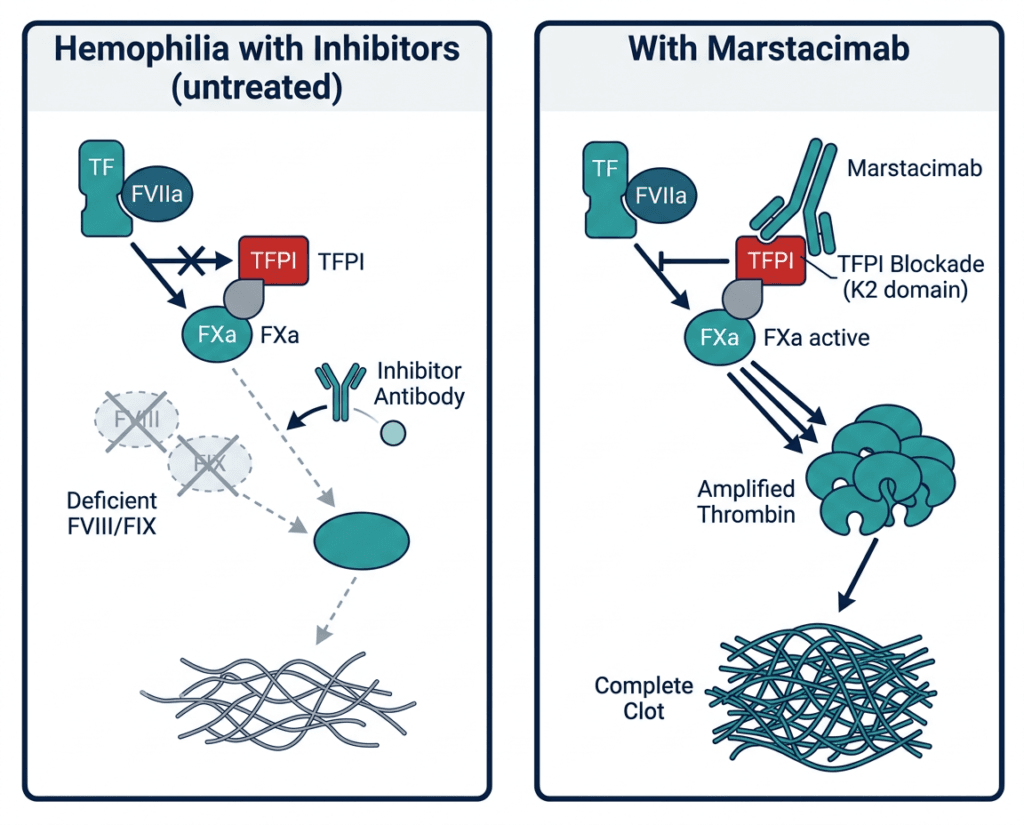
    Tissue factor pathway inhibitor (TFPI) is a naturally occurring anticoagulant protein. It functions as a feedback inhibitor of the extrinsic pathway of coagulation: after tissue factor and factor VIIa initiate clotting in response to vascular injury, TFPI rapidly inhibits the TF-FVIIa-FXa complex, effectively braking the initial clotting signal after it has had time to initiate.

    In healthy individuals, this brake is appropriate. The extrinsic pathway generates only a small initial burst of thrombin, and the intrinsic pathway (which requires FVIII and FIX) amplifies this initial signal to generate the large amounts of thrombin needed for stable clot formation. When FVIII or FIX is deficient, the initial thrombin burst generated by the extrinsic pathway is inadequate, and the amplification step through the intrinsic pathway cannot compensate. TFPI’s braking of the extrinsic pathway further limits the already insufficient hemostatic response.

    Marstacimab is a human monoclonal antibody that targets the Kunitz 2 (K2) domain of TFPI with high specificity. The K2 domain is the site through which TFPI inhibits FXa, a critical downstream clotting protein. By blocking the K2 domain, marstacimab prevents TFPI from inhibiting FXa as efficiently. This allows the coagulation cascade to generate more thrombin from the extrinsic pathway initiation step, partially compensating for the deficient intrinsic amplification. The result is a shift in the coagulation balance toward clot formation even in the absence of adequate FVIII or FIX.

    Critically, this mechanism functions regardless of:

    • Whether the patient is deficient in FVIII (hemophilia A) or FIX (hemophilia B)
    • Whether inhibitory antibodies are present against FVIII or FIX
    • The severity of the underlying factor deficiency

    Because marstacimab acts on a checkpoint in the coagulation cascade that is common to both hemophilia types and is entirely upstream of where inhibitors act against replacement factors, it provides hemostatic coverage across the full breadth of the expanded indication.

    The Original Approval and What the Expansion Adds

    Original approval (October 2024)

    Hympavzi was initially approved in October 2024 for routine prophylaxis in patients aged 12 years and older with hemophilia A without FVIII inhibitors or hemophilia B without FIX inhibitors, based on the Phase 3 BASIS trial in the non-inhibitor cohort.

    The June 2026 expansion

    The June 8, 2026 expansion adds two critically important populations:

    Population 1: Patients aged 12 years and older with hemophilia A or B who have inhibitors. This is the group with the most limited treatment options prior to this approval, for whom on-demand bypassing agents were often the only recourse for bleeding management.

    Population 2: Pediatric patients aged 6 to 11 years with hemophilia A or B, with or without inhibitors. This extends Hympavzi’s reach to younger children, a population in whom venous access for IV therapy is a significant practical challenge, and for whom a once-weekly subcutaneous injection is potentially far more manageable than frequent IV infusions.

    Together, the expanded and original indications give Hympavzi a single consolidated label: routine prophylaxis for adults and pediatric patients aged 6 years and older with hemophilia A or B, with or without inhibitors.


    The Clinical Evidence: BASIS Inhibitor Cohort and BASIS KIDS

    BASIS trial (NCT03938792): the inhibitor cohort data

    BASIS (NCT03938792) was a Phase 3, global, open-label trial evaluating marstacimab in patients with hemophilia A or B with and without inhibitors. The trial included an inhibitor cohort of patients who had previously received on-demand (OD) bypassing agent therapy for bleeding episodes. This population represents the clinical severity of inhibitor disease: patients who had not been on prophylaxis and were relying on reactive treatment when bleeds occurred.

    The primary efficacy comparison in the inhibitor cohort was marstacimab prophylaxis versus on-demand bypassing agent therapy. The results were striking:

    OutcomeMarstacimab prophylaxisOn-demand bypassing agent (historical)Comparison
    Mean treated annualized bleeding rate (ABR)1.4 (95% CI 0.9 to 2.3)19.8 (95% CI 16.1 to 24.3)93% reduction; ratio 0.07 (95% CI 0.04 to 0.12); p less than 0.0001

    Source: Clinical Advisor. Hympavzi Gains Expanded FDA Approval for Hemophilia A and B. June 2026. Hematology Advisor. June 2026. Pfizer press release, June 8, 2026.

    A 93% reduction in mean treated annualized bleeding rate compared to on-demand bypassing therapy is a clinically substantial finding. Patients going from a mean treated ABR of approximately 19.8 bleeds per year to 1.4 bleeds per year is a transformation in disease burden. The most devastating consequence of hemophilia with inhibitors has always been the inability to prevent spontaneous joint bleeds because on-demand therapy, by definition, does not begin until bleeding has already started. Each prevented bleed under prophylaxis is a joint or muscle or organ that did not bleed.

    This comparison is against on-demand therapy because patients in the inhibitor cohort had not previously been on prophylaxis. An interpretive note: comparing against on-demand is a favorable comparison for the active treatment; a head-to-head comparison against existing prophylactic bypassing agent regimens would be more demanding. Nonetheless, the magnitude of the reduction is substantial and clinically meaningful.

    BASIS KIDS trial (NCT05611801): the pediatric data

    BASIS KIDS (NCT05611801) was a Phase 3, global, open-label trial evaluating the safety and efficacy of marstacimab in children aged 1 to 17 years with hemophilia A or B, with or without inhibitors. Interim results from this trial supported the FDA’s expanded approval for the 6-to-11-year age group.

    PopulationMean ABR with marstacimabComparison (historical model-based)
    Ages 6 to 17, all patients (overall BASIS KIDS)1.83.6 (prior routine prophylaxis)
    Ages 6 to under 18 with inhibitors (n=14)1.4 (99% CI 0.5 to 4.5)18.9 (99% CI 14.2 to 25.2)
    Ages 6 to 11 cohort (n=7)1.3 (99% CI 0.5 to 3.4)

    Source: Clinical Advisor. CheckRare. BASIS KIDS NCT05611801.

    The pediatric inhibitor subgroup data is particularly notable: children with hemophilia and inhibitors achieved a mean ABR of 1.4 with marstacimab prophylaxis compared to a historical model-based mean of 18.9 with on-demand bypassing therapy. For the youngest cohort (ages 6 to 11), the mean ABR of 1.3 indicates that the same degree of bleeding rate reduction is achievable in younger children.

    The comparison in BASIS KIDS against historical model-based rates (rather than a randomized parallel arm) is appropriate for a pediatric rare disease trial, where randomizing young children to a control arm receiving inferior therapy would be ethically difficult and practically challenging. The historical modeling approach uses well-characterized natural history data from the hemophilia population to provide a reference benchmark.


    What Makes This Approval Particularly Significant

    The hemophilia B inhibitor gap

    The most significant first-in-class designation from this expansion is that Hympavzi is now the first subcutaneous non-factor therapy available for children aged 6 to 11 years with hemophilia B. This deserves specific explanation.

    Emicizumab (Hemlibra), the landmark non-factor therapy approved for hemophilia A with inhibitors in 2017, works by bridging activated factor IXa and factor X, mimicking the cofactor function of FVIII. This mechanism is specific to hemophilia A: it does not provide any benefit in hemophilia B because factor IXa is not the relevant enzyme that needs a cofactor. Patients with hemophilia B and inhibitors have therefore had no approved subcutaneous prophylactic non-factor therapy option. For them, marstacimab’s TFPI inhibition mechanism, which is indifferent to whether the underlying deficiency is in FVIII or FIX, represents the first approval in this category.

    Once-weekly subcutaneous administration without routine laboratory monitoring

    Hympavzi is administered once weekly by subcutaneous injection. The therapy does not require routine treatment-related laboratory monitoring, which distinguishes it from many hemophilia treatments that require regular factor level measurement or trough level testing to guide dosing. For families managing pediatric hemophilia, reducing the blood draw burden alongside simplifying the injection schedule to once weekly is a meaningful quality-of-life improvement.

    Patients aged 12 years and older may self-inject after proper training. For children aged 6 to 11, caregiver administration is expected.


    Safety: What the Prescribing Information Covers

    The prescribing information for Hympavzi includes several important warnings:

    Thromboembolic events: Two thromboembolic events occurred among 259 patients in the open-label extension study. Because marstacimab shifts the coagulation balance toward clot formation by removing the TFPI brake on the extrinsic pathway, the theoretical risk of thrombosis is inherent to its mechanism of action. Monitor patients for signs and symptoms of thromboembolic events. The absolute rate was low (2 of 259 patients in the extension), but the mechanism-based concern means clinical vigilance is appropriate.

    Laboratory changes: Increases in fibrin D-dimer and prothrombin fragment 1.2 have been observed with marstacimab. These are laboratory markers of coagulation activation and fibrin turnover. They are consistent with the drug’s mechanism (enhanced coagulation pathway activity) but require awareness in clinical monitoring. Do not interpret elevated D-dimer as diagnostic for thrombosis without clinical correlation in patients receiving marstacimab.

    Hypersensitivity reactions: As with all monoclonal antibodies, hypersensitivity reactions including anaphylaxis may occur. Patients should be informed of the symptoms and instructed to seek immediate medical attention if they occur.

    Embryo-fetal toxicity: Based on the mechanism of action (promoting coagulation), there is a potential for fetal harm. Females of reproductive potential should use effective contraception during treatment.

    Common adverse reactions (2% or greater): Injection site reactions, headache, pyrexia, arthralgia, diarrhea, pruritus, and rash.


    What This Means for Patients and Families

    For patients with hemophilia A or B who have inhibitors

    This is the population for whom this expansion matters most urgently. Inhibitor-positive patients, particularly those with hemophilia B inhibitors, have had no approved subcutaneous non-factor prophylactic therapy before this date. The BASIS inhibitor cohort’s 93% reduction in treated ABR compared to on-demand bypassing therapy represents a shift from a reactive management strategy to an active preventive one, with the bleed rate reduction that entails.

    If you or a family member has hemophilia with inhibitors and has been managed with on-demand bypassing agents, a conversation with your hematologist about whether Hympavzi is an appropriate prophylactic option is warranted.

    For families of children aged 6 to 11

    For young children with hemophilia, IV access for factor infusions has historically been the most practically difficult aspect of management, often requiring port placement and the risks that entails. A once-weekly subcutaneous injection administered by a caregiver at home, without routine blood draws for monitoring, represents a materially simpler treatment paradigm for this age group. The BASIS KIDS data showing a mean ABR of 1.3 in the 6-to-11 cohort supports the clinical adequacy of this approach.

    For children with hemophilia B specifically, this is the first approved subcutaneous non-factor prophylactic therapy in this age group, filling a gap that emicizumab’s mechanism could not address.

    For clinicians managing hemophilia

    The complete current Hympavzi indication covers hemophilia A and B, with or without inhibitors, in patients aged 6 years and older. This is a single once-weekly subcutaneous platform applicable across the majority of the hemophilia population. For patients who are appropriate candidates, the elimination of routine treatment-related laboratory monitoring removes a significant ongoing management burden.

    The thromboembolic warning and the D-dimer/prothrombin fragment 1.2 elevations associated with marstacimab require clinical awareness, particularly in patients who may develop thrombotic risk factors over time (surgery, immobilization, pregnancy). Risk-benefit discussions individualized to each patient’s circumstances remain the appropriate framework.

    For related HED coverage on other rare hematologic disease approvals in 2026, see our post on KRESLADI, the first gene therapy approved for severe leukocyte adhesion deficiency type I and our post on Decnupaz (pivekimab sunirine) approved for blastic plasmacytoid dendritic cell neoplasm.


    Sources

    Pfizer FDA approval press release: U.S. FDA Approves Pfizer’s HYMPAVZI for the Treatment of Two Additional Hemophilia A or B Patient Populations with Significant Medical Need. Pfizer. June 8, 2026.

    Drugs.com approval news: U.S. FDA Approves Pfizer’s Hympavzi for the Treatment of Two Additional Hemophilia A or B Patient Populations with Significant Medical Need. drugs.com. June 8, 2026.

    BioPharm International clinical coverage: FDA Expands Pfizer’s Hympavzi Approval to Pediatric Hemophilia Patients and Those with Inhibitors. biopharminternational.com. June 2026.

    Hematology Advisor (BASIS inhibitor data): Hympavzi Gains Expanded FDA Approval for Hemophilia A and B. hematologyadvisor.com. June 2026.

    Clinical Advisor detailed summary: Hympavzi Gains Expanded FDA Approval for Hemophilia A and B. clinicaladvisor.com. June 2026.

    Conexiant clinical summary: FDA Expands Marstacimab Indication in Hemophilia A and B. conexiant.com. June 2026.

    CheckRare clinical coverage: FDA Expands Approval of Hympavzi (Marstacimab) for Patients With Hemophilia. checkrare.com. June 2026.

    BASIS trial registration: NCT03938792. ClinicalTrials.gov.

    BASIS KIDS trial registration: NCT05611801. ClinicalTrials.gov.

    Priority Review grant (sBLA): FDA Grants Priority Review for HYMPAVZI sBLA. Pfizer. 2026.

    Hympavzi original approval (October 2024): Hympavzi FDA Approval History. drugs.com.

    Hympavzi prescribing information: HYMPAVZI (marstacimab-hncq) Prescribing Information. Pfizer. 2026.

    TFPI biology and marstacimab mechanism: Tissue Factor Pathway Inhibitor. PMC6126283.

    Coagulation cascade: Coagulation Studies. StatPearls. NCBI.

    Hemophilia A overview: Hemophilia A. StatPearls. NCBI.

    Hemophilia B overview: Hemophilia B. StatPearls. NCBI.

    Hemophilia inhibitors: Factor VIII Inhibitors in Hemophilia A. PMC7155173.

    CDC hemophilia overview: Hemophilia. CDC.

    Patient resources: National Hemophilia Foundation | World Federation of Hemophilia | Pfizer Hympavzi patient support

    Disclaimer: Health Evidence Digest provides general information about FDA approvals and health research for educational purposes. This content is not a substitute for professional medical advice. Hemophilia management is complex and requires individualized assessment by a hematologist experienced in bleeding disorders. Decisions about switching to or initiating Hympavzi should be made in consultation with a treating hematologist who can assess the patient’s inhibitor status, bleeding history, current prophylaxis regimen, and individual risk-benefit profile.
  • The Only Oral Carbapenem in the World Just Got FDA Approved. Here Is What Utebzi Is and Why It Changes How Drug-Resistant Urinary Tract Infections Can Be Treated.

    The Only Oral Carbapenem in the World Just Got FDA Approved. Here Is What Utebzi Is and Why It Changes How Drug-Resistant Urinary Tract Infections Can Be Treated.

    The essentials: On June 17, 2026, the FDA approved Utebzi (tebipenem pivoxil, GSK/Spero Therapeutics) for the treatment of complicated urinary tract infections (cUTI), including pyelonephritis, caused by susceptible microorganisms in adult patients who have limited or no alternative oral treatment options. This is the first and only oral carbapenem antibiotic approved anywhere in the United States. Previously, every carbapenem available to U.S. clinicians required intravenous administration, meaning that patients with drug-resistant cUTIs requiring carbapenem-level coverage had no oral option and needed hospitalization, a peripherally inserted central catheter (PICC) line, or infusion center visits. Approved organisms: Escherichia coli, Klebsiella pneumoniae, Enterobacter cloacae species complex, Klebsiella oxytoca, and Enterococcus faecalis. The clinical basis: Phase 3 PIVOT-PO trial (NCT06059846), 1,690 hospitalized adults with cUTI or acute pyelonephritis, double-blind, randomized 1:1 oral tebipenem pivoxil versus intravenous imipenem-cilastatin. Trial stopped early for efficacy at interim analysis (May 2025). Primary endpoint: overall response (composite of clinical cure plus microbiological eradication) at test-of-cure visit. Result: 58.5% (261/446) with tebipenem pivoxil versus 60.2% (291/483) with IV imipenem-cilastatin (adjusted difference −1.3%; 95% CI −7.5% to 4.8%), meeting non-inferiority. ESBL-producing Enterobacterales subgroup: composite response 52.2% versus 56.8% with IV imipenem-cilastatin. Regulatory designations: Qualified Infectious Disease Product (QIDP), Fast Track. Regulatory history: GSK resubmitted the NDA in December 2025 after an earlier Complete Response Letter; PIVOT-PO data supported the resubmission. Dosing: 600 mg (two 300 mg tablets) orally every 6 hours for 7 to 10 days, with or without food. Important dosing limits: dose adjustment required for eGFR 15 to below 60 mL/min; use not recommended in patients with eGFR above 150 mL/min due to predicted reduced tebipenem exposure.

    For the past several decades, carbapenems have represented the antibiotic class of last resort in infectious disease medicine. When bacteria have developed resistance to penicillins, cephalosporins, and fluoroquinolones, carbapenems are frequently the agents that still work. They are critically important, routinely used in hospitalized patients with serious infections, and until June 17, 2026, every single carbapenem available in the United States required intravenous administration.

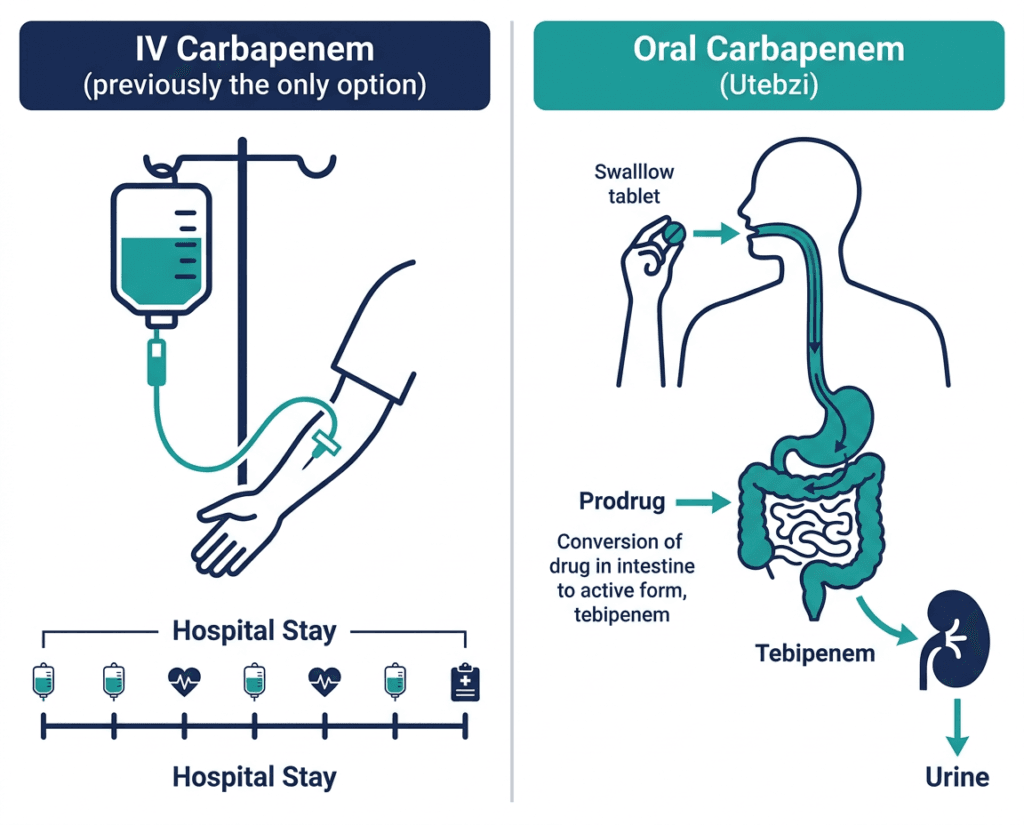
    That meant something specific and consequential for patients with complicated urinary tract infections caused by multidrug-resistant organisms: no matter how well they felt, no matter how stable their condition, they needed a hospital bed, an IV line, or an outpatient infusion arrangement to receive the only effective treatment available to them. The United States has more than 3 million cUTI cases treated annually, and a substantial proportion involve organisms resistant to standard oral agents. For those patients, the arrival of an oral carbapenem is not a minor convenience. It is a clinically meaningful expansion of outpatient treatment options.

    Utebzi (tebipenem pivoxil, GSK/Spero Therapeutics) was approved June 17, 2026, as the first oral carbapenem in the U.S. for cUTI in patients with limited or no alternative oral treatment options. The Phase 3 PIVOT-PO trial compared oral tebipenem pivoxil head-to-head against intravenous imipenem-cilastatin, the gold-standard IV carbapenem, and stopped early for efficacy. This post covers what complicated UTIs are, how carbapenems work and why an oral formulation required a novel prodrug approach, what PIVOT-PO data showed, what the regulatory backstory was, and what this approval means for patients and clinicians managing resistant gram-negative infections.


    What Complicated Urinary Tract Infections Are and Why Drug Resistance Makes Them Harder to Treat

    Complicated urinary tract infections are defined by the presence of structural or functional abnormalities in the urinary tract, or by host factors that impair the normal defenses against infection. They include pyelonephritis (kidney infection), infections associated with urinary catheters or stents, infections in patients with obstructive uropathy or neurogenic bladder, and infections in immunocompromised hosts. Unlike uncomplicated UTIs, which can typically be treated with short courses of oral antibiotics in otherwise healthy outpatient women, cUTIs require more intensive management, longer treatment courses, and often hospitalization.

    The most common organisms causing cUTI are gram-negative Enterobacterales, principally E. coli and Klebsiella pneumoniae. These same organisms are at the center of one of the most serious antimicrobial resistance crises in contemporary medicine.

    Extended-spectrum beta-lactamase (ESBL)-producing Enterobacterales have developed enzymes that inactivate most penicillins and cephalosporins. They are resistant to trimethoprim-sulfamethoxazole in many cases and frequently resistant to fluoroquinolones. In the PIVOT-PO trial, approximately 35 to 39% of Enterobacterales isolates in both arms were ESBL producers, reflecting the real-world prevalence of this resistance pattern in hospitalized patients with cUTI. For patients whose infection is caused by an ESBL-producing organism, the standard outpatient oral antibiotics (ciprofloxacin, trimethoprim-sulfamethoxazole, nitrofurantoin) are often not options. Until now, that left no oral carbapenem alternative.

    Carbapenem-resistant Enterobacterales (CRE), which are resistant even to standard IV carbapenems, are designated by the CDC as an urgent threat. Utebzi’s approved indication specifically covers susceptible organisms, meaning it is not intended for CRE infections where even IV carbapenems would fail. Its value is in the ESBL-producing and fluoroquinolone-resistant Enterobacterales space, where it provides a first oral carbapenem-class option.


    The Science: How Tebipenem Works and Why an Oral Carbapenem Required a Prodrug Approach

    Carbapenem mechanism of action

    Carbapenems belong to the beta-lactam antibiotic class, which also includes penicillins and cephalosporins. All beta-lactams share a core mechanism: they bind to penicillin-binding proteins (PBPs) in bacterial cell walls, inhibiting the transpeptidation reaction that cross-links the peptidoglycan strands that give the cell wall its structural integrity. Without proper peptidoglycan cross-linking, the bacterial cell wall cannot withstand osmotic pressure, the cell lyses, and the bacterium dies.

    What distinguishes carbapenems from other beta-lactams is their stability against beta-lactamase enzymes. Most gram-negative bacteria that cause serious infections produce beta-lactamases, enzymes that hydrolyze the beta-lactam ring of penicillins and cephalosporins, rendering those antibiotics inactive. Carbapenems have a unique bicyclic structure that makes them resistant to the most common beta-lactamases, including ESBLs. This is why carbapenems remain active where penicillins and cephalosporins have failed, and it is the mechanistic basis for their clinical importance as last-resort antibiotics.

    Tebipenem specifically exhibits broad-spectrum activity against gram-negative Enterobacterales by binding with high affinity to PBP2 and PBP3, the penicillin-binding proteins primarily responsible for cell wall elongation and septation during bacterial cell division. Its activity is bactericidal and is optimized against the organisms most commonly implicated in cUTI.

    Why carbapenems were IV-only until now: the oral bioavailability problem

    The reason all previously approved carbapenems required intravenous administration is oral bioavailability. Carbapenem molecules are hydrophilic (water-loving) and polar, characteristics that make them excellent at distributing through aqueous tissues but also make it difficult for them to cross the lipid-rich intestinal epithelium and reach the bloodstream when swallowed. Most carbapenem molecules taken orally would simply pass through the gut without being absorbed.

    Tebipenem pivoxil solves this through a prodrug strategy. “Tebipenem pivoxil” is the prodrug form: the active carbapenem molecule tebipenem is chemically modified with a pivoxil ester group that makes the compound more lipophilic (fat-soluble) and significantly improves oral absorption across the intestinal epithelium. After absorption, intestinal esterases rapidly cleave the pivoxil ester, releasing the active tebipenem molecule into systemic circulation. The active tebipenem then distributes into renal tissue and urine, where it achieves the concentrations needed to kill the causative organisms.

    This prodrug approach is the same chemical strategy used in several other orally administered antibiotics, most notably the cephalosporin prodrugs cefuroxime axetil and cefpodoxime proxetil, where ester modification similarly improves gut absorption of molecules that would otherwise be poorly bioavailable. For carbapenems, engineering this chemistry without compromising the stability of the beta-lactam ring and without producing a molecule with unfavorable pharmacokinetics was a substantial pharmaceutical development challenge.

    Why the pivoxil ester matters beyond oral bioavailability The pivoxil moiety that enables tebipenem’s oral absorption is the same group used in pivampicillin and pivmecillinam, and its hydrolysis releases pivalic acid as a byproduct. Pivalate can conjugate with carnitine and impair carnitine metabolism, particularly with long-term or repeated use. This class effect of pivoxil-containing antibiotics is relevant for patients receiving concurrent carnitine supplementation and for patients with carnitine metabolism disorders. The short course of Utebzi (7 to 10 days) limits this concern in most clinical settings, but it is worth noting as a mechanistic consideration of the prodrug chemistry.

    The PIVOT-PO Trial: Design and Full Results

    Design

    PIVOT-PO (NCT06059846) was a global, randomized, double-blind, non-inferiority Phase 3 trial enrolling 1,690 hospitalized adult patients with cUTI or acute pyelonephritis. The double-blind design was maintained using a double-dummy approach: patients in each arm received both an active oral tablet and a matching IV placebo, or an active IV infusion and a matching oral placebo tablet, maintaining blinding while comparing true oral versus true IV administration.

    Randomization: 1:1 to:

    • Tebipenem pivoxil 600 mg orally (two 300 mg tablets) every 6 hours for 7 to 10 days
    • Imipenem-cilastatin 500 mg intravenously every 6 hours for 7 to 10 days (standard of care comparator)

    Imipenem-cilastatin (Primaxin) was chosen as the comparator because it is a well-established IV carbapenem with robust efficacy data in cUTI, appropriate as the active reference standard for a non-inferiority comparison against an oral carbapenem.

    Primary endpoint: Overall response at the test-of-cure (TOC) visit, defined as a composite of clinical cure plus microbiological eradication in the intent-to-treat (ITT) efficacy cohort.

    The trial was stopped early for efficacy at a planned interim analysis in May 2025, indicating that the pre-specified criteria for early stopping based on demonstrated non-inferiority were met ahead of the planned full enrollment.

    Primary endpoint results

    OutcomeTebipenem pivoxil (oral)Imipenem-cilastatin (IV)Comparison
    Overall response (clinical cure plus microbiological eradication) at TOC58.5% (261/446)60.2% (291/483)Adjusted difference −1.3% (95% CI −7.5% to 4.8%)
    Non-inferiority demonstratedYesReferenceLower CI bound within pre-specified margin

    Source: Spero Therapeutics/GSK press release. GlobeNewswire. June 17, 2026. PIVOT-PO NCT06059846. Presented at IDWeek 2025.

    The adjusted difference of −1.3 percentage points, with a 95% confidence interval ranging from −7.5% to +4.8%, demonstrates that oral tebipenem pivoxil was non-inferior to intravenous imipenem-cilastatin in achieving the composite endpoint of clinical cure plus microbiological eradication. The upper bound of the confidence interval is positive (favoring oral tebipenem in the best-case scenario) and the lower bound remains within whatever non-inferiority margin was pre-specified. This is the evidentiary standard the FDA required to demonstrate that oral tebipenem delivers comparable efficacy to the IV comparator.

    ESBL-producing pathogen subgroup

    In the PIVOT-PO trial, 35.1% of Enterobacterales isolates in the tebipenem arm and 38.9% in the imipenem arm were ESBL producers, reflecting the real-world prevalence of ESBL-producing cUTI in hospitalized patients. Among patients infected with ESBL-producing organisms, the composite response rates at TOC were 52.2% with tebipenem pivoxil and 56.8% with IV imipenem-cilastatin. Comparable response rates were also observed among patients infected with fluoroquinolone-not-susceptible and trimethoprim-sulfamethoxazole-resistant Enterobacterales.

    This subgroup data is clinically important because the ESBL-producing patient population represents precisely the group for whom no oral treatment was previously available. That composite response rates in this resistance-characterized subgroup were broadly consistent with the overall ITT population supports the use of tebipenem pivoxil specifically in these patients.

    Safety in PIVOT-PO

    The safety profile of tebipenem pivoxil was consistent with the carbapenem class. The most common adverse events were diarrhea and headache. Additional adverse events reported included mild to moderate nausea, abdominal pain, transaminase elevations, and Clostridioides difficile-associated diarrhea (CDAD), which is a class effect associated with broad-spectrum antibiotics. No new or unexpected safety signals were identified.


    The Regulatory Backstory: A Prior CRL and the Path to Approval

    The path to Utebzi’s June 2026 approval was not linear. GSK and Spero had submitted an earlier NDA for tebipenem pivoxil for cUTI, supported by a prior Phase 3 trial. That application received a Complete Response Letter from the FDA, which identified deficiencies that needed to be addressed before approval could be granted. The PIVOT-PO trial, which compared oral tebipenem directly against intravenous imipenem-cilastatin (a more demanding head-to-head non-inferiority design than the prior trial), was specifically designed and conducted to address the FDA’s concerns and generate the evidence package required for resubmission.

    GSK filed the NDA resubmission in December 2025, supported by the PIVOT-PO data that had been presented at IDWeek 2025 weeks prior. The PDUFA date was set for June 18, 2026, and the FDA approved one day ahead of the deadline on June 17, 2026.

    The tebipenem pivoxil program has received QIDP (Qualified Infectious Disease Product) designation and Fast Track designation from the FDA, both reflecting the agency’s recognition of the serious unmet need in drug-resistant cUTI.


    Approved Organisms, Dosing, and Critical Prescribing Guidance

    Approved organisms

    Utebzi is approved for cUTI caused by the following susceptible organisms:

    • Escherichia coli
    • Klebsiella pneumoniae
    • Enterobacter cloacae species complex
    • Klebsiella oxytoca
    • Enterococcus faecalis

    Culture and susceptibility testing are essential before prescribing. Utebzi is indicated for organisms confirmed or strongly suspected to be susceptible. It is not effective against CRE (carbapenem-resistant Enterobacterales), and empiric use without culture data should be guided by institutional stewardship protocols and local epidemiology.

    Dosing

    ParameterDetails
    Standard dose600 mg (two 300 mg tablets) orally every 6 hours
    Duration7 to 10 days
    AdministrationWith or without food
    Renal adjustmentRequired for eGFR 15 to below 60 mL/min; consult full prescribing information for specific dose
    eGFR above 150 mL/minUse not recommended (predicted reduced tebipenem exposure may reduce efficacy; if necessary, monitor clinical response closely)
    Not recommendedeGFR below 15 mL/min (end-stage renal disease without dialysis); data insufficient

    The eGFR above 150 mL/min restriction is an unusual and clinically notable prescribing caution. Patients with hyperfiltration (augmented renal clearance), which can occur in younger patients, pregnant patients, and critically ill patients with preserved kidney function, may clear tebipenem faster than typical patients, potentially reducing urinary drug concentrations below the threshold needed for bactericidal activity. This pharmacokinetic consideration is specific to a renally-excreted antibiotic being used for a urinary tract indication and should be considered when prescribing in patients whose renal function is known to be substantially above normal.

    Antibiotic stewardship

    Consistent with antimicrobial stewardship principles, Utebzi should be used only to treat infections proven or strongly suspected to be caused by susceptible bacteria. The approved labeling specifically addresses this: use should follow culture and susceptibility data whenever possible, and empiric use should be reserved for patients with strong clinical suspicion of a resistant organism based on prior culture history, risk factors, or local epidemiology.


    What This Approval Means in Clinical Practice

    Before June 17, 2026, a hospitalized patient with pyelonephritis caused by an ESBL-producing E. coli, who was otherwise stable and could be managed as an outpatient, had essentially no oral option. Every carbapenem required IV access. Sending such a patient home required either arranging home IV infusion (expensive, logistically complex, and uncomfortable for the patient) or keeping them in the hospital longer than their clinical condition strictly required (expensive and exposing them to hospital-acquired infection risk).

    As Dr. Debra L. Fromer, MD, of Hackensack Meridian Health, explained: the advent of an oral carbapenem reduces the strain on the healthcare system by enabling earlier discharge and allowing outpatient treatment of patients who previously required hospitalization or PICC line placement. A pill taken at home every 6 hours is not identical in convenience to a once-daily oral antibiotic, but compared to an IV infusion it is transformative for appropriate patients.

    The key phrase in the approved indication is “limited or no alternative oral treatment options.” Utebzi is not positioned as a first-line or empiric therapy for all cUTIs. It is a targeted option for the resistance gap: patients with culture-confirmed or highly suspected resistant organisms where standard oral agents have failed or are expected to fail. The approved patient population is specific, the culture requirement is clinical standard, and the antibiotic stewardship framing is appropriately conservative.

    For patients with cUTI or recurrent UTI who are managing resistant infections: Utebzi is a prescription medication that requires a clinician experienced in managing complicated UTIs. The starting point for access is a discussion with a urologist, urogynecologist, or infectious disease specialist who can review culture results and determine whether tebipenem pivoxil is appropriate for the specific organism and clinical situation.

    For related HED coverage on other resistant-organism antibiotic approvals in 2026, see our post on Zaynich (cefepime-zidebactam), the first antibiotic combination in which the beta-lactamase inhibitor also independently targets PBP2, approved for drug-resistant cUTI just weeks earlier.


    Sources

    FDA approval / GSK press release: Utebzi (tebipenem pivoxil) approved in the US for adults with complicated urinary tract infections. GSK. June 17, 2026.

    Spero Therapeutics press release: Utebzi (tebipenem pivoxil) approved in the US for adults with complicated urinary tract infections. Spero Therapeutics/GlobeNewswire. June 17, 2026.

    Drugs.com approval news: FDA Approves Utebzi (tebipenem pivoxil) for Adults with Complicated Urinary Tract Infections. drugs.com. June 17, 2026.

    Utebzi approval history: Utebzi FDA Approval History. drugs.com.

    Urology Times clinical coverage (with Dr. Fromer quote): FDA approves tebipenem pivoxil for complicated urinary tract infections. urologytimes.com. June 2026.

    AJMC detailed trial coverage: FDA Approves First Oral Carbapenem Antibiotic for Complicated UTIs. ajmc.com. June 2026.

    Renal and Urology News clinical summary: Utebzi Approved as First Oral Carbapenem Antibiotic for cUTIs. renalandurologynews.com. June 2026.

    Contagion Live detailed coverage: FDA Approves Tebipenem Pivoxil as First Oral Carbapenem For Complicated Urinary Tract Infections. contagionlive.com. June 2026.

    Contemporary OB/GYN clinical coverage: FDA approves tebipenem pivoxil as first oral carbapenem antibiotic for complicated urinary tract infections. contemporaryobgyn.net. June 2026.

    PIVOT-PO trial registration: NCT06059846. ClinicalTrials.gov.

    Complicated UTI overview: Complicated Urinary Tract Infections. StatPearls. NCBI.

    Beta-lactam antibiotics and PBPs: Beta-Lactam Antibiotics. StatPearls. NCBI.

    ESBL and beta-lactamases: Beta-Lactamase Inhibitors. PMC7279573.

    Enterobacterales infections: Gram-Negative Bacterial Infections. StatPearls. NCBI.

    C. diff associated diarrhea: Clostridioides Difficile. StatPearls. NCBI.

    CRE threat designation: Antibiotic Resistance Threats in the United States. CDC.

    Antibiotic stewardship core elements: Core Elements of Antibiotic Stewardship. CDC.

    QIDP and GAIN Act: GAIN Act FAQ. FDA.gov.

    Fast Track designation: Fast Track. FDA.gov.

    CRL overview: FDA Drug Review Process. FDA.gov.

    Utebzi prescribing information: UTEBZI (tebipenem pivoxil) Prescribing Information. GSK. 2026.

    Disclaimer: Health Evidence Digest provides general information about FDA approvals and health research for educational purposes. This content is not a substitute for professional medical advice, diagnosis, or treatment. Utebzi is a prescription antibiotic indicated specifically for adult patients with complicated urinary tract infections caused by susceptible organisms who have limited or no alternative oral treatment options. Antibiotic selection should be guided by culture and susceptibility data and made in consultation with a qualified healthcare provider.
  • Every Gadolinium MRI Contrast Agent Exposes Patients to Gadolinium Deposition Risk. Ambelvist Just Became the First Approved in the U.S. That Does It With 60% Less Gadolinium. Here Is What the Science and the QUANTI Trial Data Show.

    Every Gadolinium MRI Contrast Agent Exposes Patients to Gadolinium Deposition Risk. Ambelvist Just Became the First Approved in the U.S. That Does It With 60% Less Gadolinium. Here Is What the Science and the QUANTI Trial Data Show.

    The essentials: On June 12, 2026, the FDA approved Ambelvist (gadoquatrane, Bayer) for use with MRI to detect and visualize lesions with abnormal vascularity in the central nervous system (brain, spine, and associated tissues) and the body (head and neck, thorax, abdomen, pelvis, and musculoskeletal system) in adult and pediatric patients, including term neonates. What makes it distinctive: gadoquatrane is a next-generation macrocyclic gadolinium-based contrast agent (mGBCA) with a novel tetrameric structure that achieves high image quality at substantially reduced gadolinium doses. With this approval, Ambelvist becomes the lowest-dose macrocyclic GBCA approved in the United States. Recommended dose: 0.01 mmol/kg actual body weight, which delivers 0.04 mmol Gd/kg body weight. This represents 60% less gadolinium than the standard macrocyclic GBCAs dosed at 0.1 mmol Gd/kg body weight, and 20% less gadolinium than gadopiclenol (Vueway), which delivers 0.05 mmol Gd/kg. The clinical basis: Phase 3 QUANTI program (three studies: QUANTI CNS, QUANTI OBR, and QUANTI Pediatric), 808 patients including 93 children, across 15 countries. QUANTI CNS and QUANTI OBR were randomized, double-blind, active-comparator crossover trials. Key results: gadoquatrane met the primary endpoint of non-inferiority to comparator mGBCAs (gadobutrol, gadoterate, gadoteridol) in visualization parameters and lesion detection using 60% less gadolinium. Post-contrast MRI with gadoquatrane was superior to unenhanced MRI alone. In descriptive analyses, visualization scores and lesion counts per blinded independent reader were comparable to comparator mGBCAs dosed at 0.1 mmol Gd/kg. No new safety signals. Boxed warnings: intrathecal administration risk; nephrogenic systemic fibrosis (NSF). Contraindicated in patients with a history of severe hypersensitivity reactions to gadoquatrane.

    Every year, more than 40 million MRI examinations with contrast are performed in the United States. The contrast agents used in the majority of those scans are gadolinium-based, and they are among the most important diagnostic tools in modern medicine. They light up tumors, strokes, vascular malformations, inflammatory lesions, and infections in brain tissue, spinal cord, joints, liver, and virtually every region of the body, making otherwise invisible pathology visible and informing clinical decisions that affect surgical planning, treatment selection, and disease monitoring.

    Gadolinium-based contrast agents are also, as the FDA has required to be prominently stated in prescribing information since 2017, associated with gadolinium retention: gadolinium is retained for months or years in several organs, including the brain, even in patients with normal kidney function. The clinical significance of that retention in patients without renal impairment has not been definitively established, but the concern is real enough that the FDA, the American College of Radiology, and radiological societies worldwide have consistently encouraged the use of the lowest gadolinium dose that provides the necessary diagnostic information.

    Ambelvist (gadoquatrane, Bayer), approved June 12, 2026, is the first MRI contrast agent to reach that lowest-dose standard among the macrocyclic class in the United States. Its novel tetrameric molecular structure achieves high image quality at 60% less gadolinium than standard macrocyclic agents, and clinical trial data demonstrated equivalent diagnostic performance to comparator agents dosed at 2.5 times the gadolinium content.

    This post covers what gadolinium-based contrast agents do and why gadolinium retention matters, how gadoquatrane’s tetrameric structure produces high-quality imaging at lower gadolinium doses, what the QUANTI Phase 3 program showed, what the safety profile means in practice, and where Ambelvist fits in the current MRI contrast landscape.


    What Gadolinium-Based Contrast Agents Do and Why Gadolinium Retention Is a Clinical Concern

    How contrast-enhanced MRI works

    MRI produces images by detecting the radiofrequency signals emitted by hydrogen nuclei (protons) in water and fat molecules as they return to equilibrium after being excited by a magnetic field and radiofrequency pulses. The speed of that return, characterized by relaxation times called T1 and T2, varies across different tissue types and creates the intrinsic contrast that makes MRI valuable even without exogenous contrast agents.

    Gadolinium-based contrast agents (GBCAs) enhance this further. Gadolinium (Gd) is a paramagnetic metal ion that shortens the T1 relaxation time of nearby water protons, causing tissues that take up the contrast agent to appear brighter on T1-weighted MRI sequences. The enhancement is selective: gadolinium distributes into tissues with abnormal vascularity or disrupted blood-brain barrier, which is precisely the characteristic of tumors, inflammatory lesions, abscesses, demyelinating plaques, and vascular malformations. Normal brain parenchyma is protected by an intact blood-brain barrier and does not enhance.

    This is why contrast-enhanced MRI is so diagnostically powerful: the gadolinium signal provides a spatial map of pathological vascular abnormality superimposed on the exquisite anatomical detail of the unenhanced MRI sequence.

    Why gadolinium retention matters

    Since the first GBCA was introduced in 1988, these agents have generally been considered safe for patients with normal renal function. That perception began to evolve in 2006 when nephrogenic systemic fibrosis (NSF), a serious and potentially fatal fibrosing condition, was firmly linked to GBCA administration in patients with severely impaired renal function. NSF is now largely eliminated through screening practices and the preferential use of more stable macrocyclic GBCAs over less stable linear agents.

    A separate and distinct concern emerged around 2014 when researchers identified gadolinium deposition in brain tissue in patients with normal renal function who had received multiple GBCA-enhanced MRI scans. Signal changes in the dentate nucleus and globus pallidus on T1-weighted MRI were found to correlate with cumulative gadolinium exposure. This deposition occurs with all GBCAs but is substantially greater with linear agents than with macrocyclic agents. At equivalent doses, macrocyclic GBCAs show the lowest and most similar retention profiles among all GBCA classes, because their cyclic molecular cage structure holds gadolinium more tightly and releases it less readily than the open-chain structure of linear agents.

    The clinical consequences of gadolinium deposition in the brain of patients with normal renal function have not been definitively established, but the regulatory response has been clear: minimize gadolinium dose while preserving diagnostic quality. The ACR Manual on Contrast Media recommends using the lowest gadolinium dose necessary to provide adequate diagnostic information.

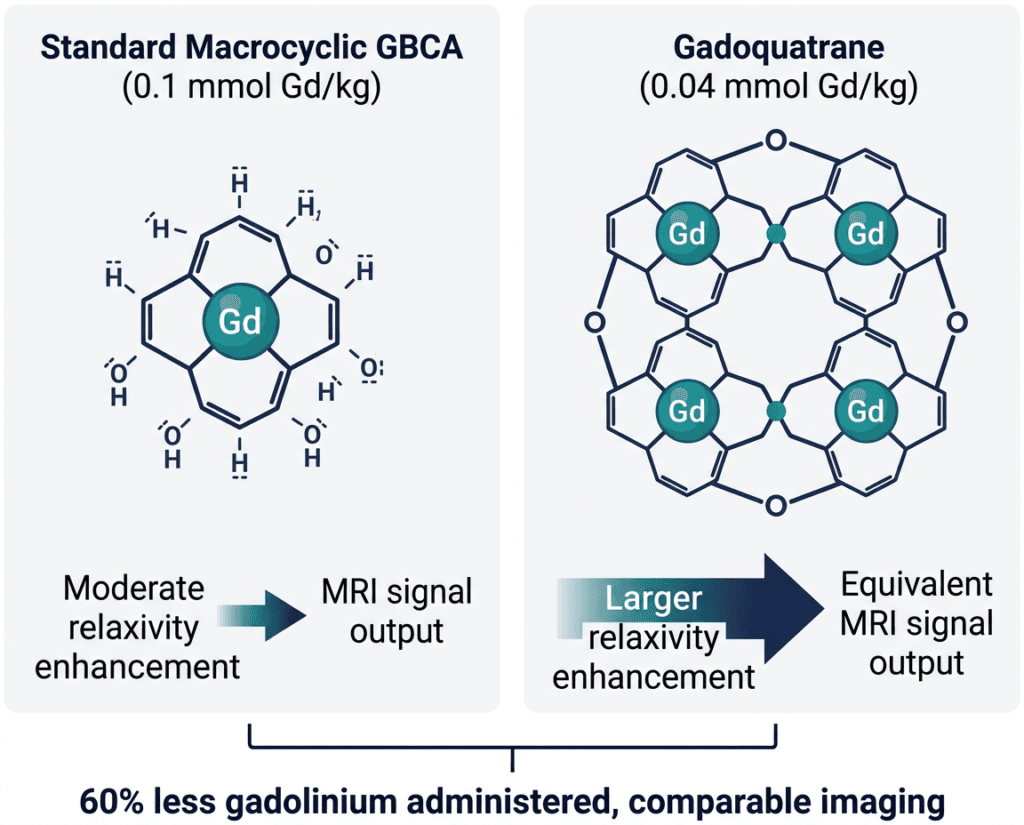
    The gadolinium problem in plain terms Every dose of gadolinium-based contrast agent leaves some gadolinium behind in the body, including in the brain. The macrocyclic cage structure of agents like gadobutrol, gadoterate, and gadoteridol holds gadolinium more tightly, reducing this retention compared to linear agents. But even macrocyclic agents deposit some gadolinium at standard doses. The logical next step, which gadoquatrane’s development pursued, was to engineer a macrocyclic agent that achieves equivalent image quality using substantially less gadolinium. Less gadolinium administered means less gadolinium available for retention, regardless of the agent’s stability profile. The tetrameric structure of gadoquatrane was designed specifically to achieve this: four times the relaxivity enhancement per gadolinium atom, enabling a 60% dose reduction while maintaining comparable imaging performance.

    How Gadoquatrane Works: The Tetrameric Structure and High Relaxivity

    The key to understanding why gadoquatrane can deliver equivalent diagnostic performance at 60% less gadolinium than standard macrocyclic agents lies in its molecular architecture.

    Conventional GBCAs, including the macrocyclic agents gadobutrol (Gadavist), gadoterate (Dotarem), and gadoteridol (ProHance), are monomeric molecules: one gadolinium ion chelated by one organic ligand. The magnetic effect of a single gadolinium ion on surrounding water protons, measured as relaxivity, is determined by how efficiently the paramagnetic gadolinium shortens the T1 relaxation time of nearby water molecules in a given concentration and magnetic field strength.

    Gadoquatrane has a tetrameric structure: four gadolinium-chelate units are covalently linked in a single molecular framework. This arrangement substantially increases the molecule’s relaxivity. Each gadoquatrane molecule carries four gadolinium ions, and the molecular size and tumbling rate created by this tetrameric architecture are optimized for more efficient interaction with surrounding water protons. The result is that each molecule of gadoquatrane produces greater T1 enhancement per unit of gadolinium than conventional monomeric GBCAs.

    This higher relaxivity per gadolinium atom is what allows gadoquatrane to produce comparable image quality at a substantially reduced gadolinium dose. The principle is analogous to a more efficient engine producing the same power output from less fuel: the tetrameric architecture extracts more MRI signal enhancement per gadolinium ion administered.

    Gadoquatrane retains the macrocyclic cage structure of the established macrocyclic agents, with each of the four gadolinium ions held within a macrocyclic ligand unit. This means gadoquatrane’s thermodynamic and kinetic stability properties, the characteristics that minimize gadolinium release and retention, are consistent with the macrocyclic class. The same structural feature that produces low gadolinium retention in gadobutrol and gadoterate is present in each of gadoquatrane’s four chelate units.


    The QUANTI Clinical Program: Three Trials, 808 Patients, 15 Countries

    Gadoquatrane’s FDA approval is based on the QUANTI clinical development program, which consisted of three trials designed to evaluate efficacy and safety across the full body scope of the approved indication.

    Program design

    QUANTI CNS (NCT05915702): A multinational, randomized, prospective, double-blind, active-comparator crossover Phase 3 trial in adult patients with known or suspected CNS pathologies (brain, spine, associated tissues) undergoing contrast-enhanced MRI. Patients received gadoquatrane at 0.01 mmol/kg body weight (delivering 0.04 mmol Gd/kg) in one crossover period and one of three comparator macrocyclic GBCAs (gadobutrol, gadoterate, or gadoteridol) at 0.1 mmol Gd/kg in the other period. The crossover design meant each patient served as their own control, strengthening the comparison.

    QUANTI OBR (NCT05915728): The same design applied to non-CNS body regions (head and neck, thorax, abdomen, pelvis, musculoskeletal system) in adult patients.

    QUANTI Pediatric: A separate study evaluating the pharmacokinetics and safety of gadoquatrane in pediatric patients from birth to below 18 years of age across all body regions. This study supported the pediatric indication, including term neonates.

    In total, 808 patients including 93 children participated across 15 countries. All three trials investigated gadoquatrane at the same 0.04 mmol Gd/kg dose, which represents a 60% reduction compared to the 0.1 mmol Gd/kg dose used by standard macrocyclic GBCAs.

    Primary and secondary endpoint results

    The primary endpoints of QUANTI CNS and QUANTI OBR assessed visualization parameters (border delineation, internal morphology, and contrast enhancement) as rated by blinded independent readers comparing gadoquatrane-enhanced MRI to comparator-enhanced MRI.

    OutcomeResult
    Primary endpoint: non-inferiority of gadoquatrane versus comparator mGBCAs in visualization parameters (CNS and body)Met in both QUANTI CNS and QUANTI OBR
    Key secondary endpoint: superiority of post-contrast MRI with gadoquatrane versus unenhanced MRI aloneMet: increased lesion visualization confirmed
    Descriptive comparison: visualization scores and lesion counts per blinded independent readerGadoquatrane comparable to comparator mGBCAs dosed at 0.1 mmol Gd/kg
    Secondary endpoints: sensitivity and specificity for lesion detectionNon-inferiority to comparator mGBCAs demonstrated
    Pediatric pharmacokineticsPharmacokinetic behavior in children consistent with adult data; efficacy from adult data applicable to pediatric population
    Overall safety profile (all ages)Consistent with prior gadoquatrane data and macrocyclic GBCAs class; no new safety signals

    Source: Bayer press release, June 15, 2026. QUANTI CNS NCT05915702. QUANTI OBR NCT05915728. QUANTI CNS ECR 2025 presentation.

    The crossover design is worth emphasizing for its evidentiary strength. Because each patient received both gadoquatrane and a comparator macrocyclic agent in separate MRI sessions (with blinded independent reading of all images), the comparison is unusually rigorous: the same patient’s pathology is being imaged with different agents, eliminating the patient-level variability that can confound parallel-group designs in imaging trials.

    The pediatric finding that pharmacokinetic behavior of gadoquatrane in children is similar to that in adults allowed the FDA to establish pediatric efficacy through pharmacokinetic/pharmacodynamic bridging, a standard approach for contrast agents where it is not ethical or practical to run fully powered efficacy trials in all pediatric subpopulations.


    Where Ambelvist Fits in the GBCA Landscape

    The U.S. MRI contrast agent market in 2026 includes multiple approved GBCAs across the linear and macrocyclic classes, with recent additions specifically at lower doses:

    AgentClassDoseGd contentFDA approval
    Gadobutrol (Gadavist, Bayer)Macrocyclic0.1 mmol/kg0.1 mmol Gd/kg2011
    Gadoterate meglumine (Dotarem, Guerbet)Macrocyclic0.1 mmol/kg0.1 mmol Gd/kg2013
    Gadoteridol (ProHance, Bracco)Macrocyclic0.1 mmol/kg0.1 mmol Gd/kg1992
    Gadapentetate dimeglumine (Magnevist)Linear0.1 mmol/kg0.1 mmol Gd/kg1988
    Gadopiclenol (Vueway, Bracco)Macrocyclic0.05 mmol/kg0.05 mmol Gd/kg2022
    Gadoquatrane (Ambelvist, Bayer)Macrocyclic0.01 mmol/kg0.04 mmol Gd/kgJune 2026

    Gadopiclenol (Vueway), approved in 2022, was the first high-relaxivity macrocyclic GBCA to achieve reduced-dose approval in the U.S., delivering 0.05 mmol Gd/kg versus the standard 0.1 mmol Gd/kg used by earlier macrocyclic agents. Gadoquatrane extends this further, delivering 0.04 mmol Gd/kg, 20% less gadolinium than gadopiclenol and 60% less than standard macrocyclic agents.

    The competitive distinction between Ambelvist and Vueway will be evaluated by radiologists based on imaging performance data, institutional formulary decisions, practical acquisition considerations, and any head-to-head data that emerges in the coming years. Neither drug has been compared directly to the other in a randomized trial; both have been compared to the same standard-dose macrocyclic agents.

    For radiology departments and institutions with established ACR or local protocols encouraging minimum gadolinium dose, Ambelvist provides an additional option in the macrocyclic class with the lowest Gd dose approved in the U.S. For patients who undergo contrast-enhanced MRI repeatedly over years of disease monitoring, such as patients with multiple sclerosis, brain metastases, or chronic inflammatory conditions requiring serial imaging, the cumulative gadolinium dose reduction across many scans is the practical benefit.


    Safety: What the Prescribing Information Covers

    Ambelvist’s safety profile is consistent with the macrocyclic GBCA class, with the same class-level concerns that apply to all gadolinium-based contrast agents.

    Boxed warnings:

    Intrathecal administration: Gadolinium-based contrast agents are not approved for intrathecal injection, and accidental intrathecal administration has resulted in serious adverse reactions including seizures, cardiorespiratory arrest, and death. This is a class-wide warning for all GBCAs. Ambelvist must be administered intravenously only.

    Nephrogenic systemic fibrosis (NSF): Ambelvist, like all approved GBCAs, carries a boxed warning for NSF, a serious, debilitating, and potentially fatal fibrosing disorder of the skin and other tissues that has been observed in patients with impaired elimination of GBCAs, primarily those with chronic, severe kidney disease. As a macrocyclic agent, gadoquatrane is classified in the lower-NSF-risk group (ACR Group II/III), but the class warning remains on the label. Screen patients for acute kidney injury or other conditions that may reduce renal clearance before administering any GBCA.

    Contraindication:

    Ambelvist is contraindicated in patients with a history of severe hypersensitivity reactions to gadoquatrane.

    Warnings and precautions:

    Hypersensitivity reactions: As with all GBCAs, acute allergic-type reactions ranging from mild (urticaria, pruritus) to severe (anaphylaxis, bronchospasm, cardiovascular collapse) can occur. These are uncommon but can be immediate or delayed. Assess patient allergy history before administration. Maintain resuscitation capability during administration.

    Gadolinium retention: As described above, gadolinium is retained for months or years in the brain and other organs following GBCA administration. Linear GBCAs cause greater retention than macrocyclic GBCAs. At equivalent doses, retention is lowest and most similar among macrocyclic agents. The lower administered dose of gadoquatrane means less total gadolinium is available for potential retention compared to standard-dose macrocyclic agents. The clinical consequences of gadolinium retention in the brain of patients with normal renal function have not been established.

    Acute kidney injury: GBCAs may increase the risk of acute kidney injury. Screen patients for reduced renal function before administration. In patients with chronic kidney disease, use the lowest dose necessary and avoid repeat dosing unless the diagnostic benefit clearly outweighs the risk.

    Interference with lesion visualization: Certain lesion types may not enhance reliably with Ambelvist. Some lesions visible with other GBCA types may not be detectable with gadoquatrane at the approved dose. Blinded reading of MRI examinations should consider the dose and agent used.

    Dosing:

    Administered as an intravenous injection of 0.01 mmol/kg actual body weight (which delivers 0.04 mmol Gd/kg body weight). Ambelvist is supplied as a 0.1 mmol/mL solution in single-dose vials, single-dose prefilled syringes, imaging bulk packages, and pharmacy bulk packages.


    What This Means for Patients Who Receive Contrast-Enhanced MRI

    Most patients receiving contrast-enhanced MRI will not choose their contrast agent: the radiology department or ordering institution determines which agent to use based on formulary, protocol, and clinical judgment. What patients can do is understand why the conversation about gadolinium matters and ask informed questions about contrast use.

    For patients who undergo contrast-enhanced MRI repeatedly, such as those with multiple sclerosis being monitored for disease activity, patients with brain metastases under treatment, and patients with chronic inflammatory conditions like Crohn’s disease requiring serial cross-sectional imaging, cumulative gadolinium exposure from repeated scans is the most relevant concern. Lower-dose agents at equivalent diagnostic performance represent a genuine clinical benefit for these populations over a lifetime of imaging.

    For patients with chronic kidney disease, the NSF boxed warning is the priority concern. Any patient with significantly impaired renal function should discuss with their ordering physician whether contrast enhancement is necessary for their specific clinical question, and if so, which agent and dose minimize the NSF risk while providing the needed diagnostic information.

    For patients undergoing a single diagnostic MRI as part of an acute clinical evaluation, such as evaluation for stroke, initial workup of a brain mass, or staging of a newly diagnosed cancer, the cumulative dose concern is less relevant. The diagnostic adequacy of the scan is the priority.

    For clinicians and radiologists: the ACR Manual on Contrast Media, updated in 2026, provides the current framework for GBCA selection and dose minimization. Ambelvist’s addition to the macrocyclic formulary options gives departments a lowest-dose macrocyclic choice for protocols where gadolinium minimization is a priority alongside diagnostic adequacy.

    For related HED coverage on neurological conditions commonly evaluated with contrast-enhanced MRI, see our post on Ocrevus (ocrelizumab) approved for pediatric relapsing-remitting MS and our post on the FDA’s acceleration of psychedelic drug programs for treatment-resistant depression and PTSD, the latter of which covers conditions where neuroimaging plays a growing role in clinical research.


    Sources

    Bayer FDA approval press release: Bayer’s AMBELVIST (gadoquatrane) Receives FDA Approval for Contrast-Enhanced MRI. BusinessWire. June 15, 2026.

    Bayer Ambelvist page: AMBELVIST (gadoquatrane) FDA approval. bayer.com.

    BioSpace approval coverage: Bayer’s Ambelvist Receives FDA Approval for Contrast-Enhanced MRI. biospace.com. June 15, 2026.

    CancerNetwork clinical summary: FDA Approves Gadoquatrane to Detect CNS and Non-CNS Body Region Lesions. cancernetwork.com. June 2026.

    Renal and Urology News coverage: FDA Approves Lower-Dose Gadolinium Contrast Agent Ambelvist. renalandurologynews.com. June 2026.

    Neurology Advisor coverage: FDA Approves Lower-Dose Gadolinium Contrast Agent Ambelvist. neurologyadvisor.com. June 2026.

    Axis Imaging News coverage: FDA Approves Bayer’s Low-Dose MRI Contrast Agent. axisimagingnews.com. June 2026.

    QUANTI CNS Phase 3 topline results (Bayer/ECR 2025): Positive results from Phase III study for Bayer’s investigational contrast agent gadoquatrane. Bayer/BusinessWire. February 26, 2025.

    QUANTI program pivotal topline results (all studies): Bayer’s investigational MRI contrast agent gadoquatrane meets primary and main secondary endpoints. BusinessWire. January 10, 2025.

    QUANTI Pediatric (RSNA 2025): RSNA25: Pediatric Study for Bayer’s Investigational MRI Contrast Agent Gadoquatrane Meets Primary and Secondary Endpoints. biospace.com. December 2025.

    QUANTI CNS trial registration: NCT05915702. ClinicalTrials.gov.

    QUANTI OBR trial registration: NCT05915728. ClinicalTrials.gov.

    Ambelvist prescribing information: AMBELVIST (gadoquatrane) Prescribing Information. Bayer. labeling.bayerhealthcare.com.

    GBCA safety update (AJR): Update on Gadolinium-Based Contrast Agent Safety. AJR. doi:10.2214/AJR.23.30036.

    Gadolinium retention brain review: MRI contrast agents and retention in the brain: review. PMC11282029.

    Linear versus macrocyclic gadolinium CNS gene expression: Long-term effects of linear versus macrocyclic GBCAs on gene expression in CNS of mice. PMC11723877.

    Gadolinium toxicity mechanisms review: Gadolinium toxicity: mechanisms, clinical manifestations, and nanoparticle role. PMC12454587.

    NSF overview: Nephrogenic Systemic Fibrosis. StatPearls. NCBI.

    ACR Manual on Contrast Media (2026): ACR Manual on Contrast Media. acr.org.

    MRI overview: Magnetic Resonance Imaging. NIBIB.

    Vueway (gadopiclenol) prescribing information (comparator reference): Vueway (gadopiclenol) package insert. Bracco.

    Disclaimer: Health Evidence Digest provides general information about FDA approvals and health research for educational purposes. This content is not a substitute for professional medical advice. Ambelvist (gadoquatrane) carries a boxed warning for risks associated with intrathecal administration and nephrogenic systemic fibrosis. Decisions about contrast agent selection for MRI examinations are made by qualified radiologists and ordering clinicians based on the clinical question, patient characteristics, and institutional protocols. Patients with renal impairment should discuss the use of gadolinium-based contrast agents with their physician before undergoing contrast-enhanced MRI.

  • Xeljanz Was the First Oral JAK Inhibitor Approved in the U.S. And Then a Mandatory Safety Trial Changed How the Entire Class Is Used. Its Generic Is Already Here. Here Is What the Science, the Safety Data, and the LOE Mean for Patients.

    Xeljanz Was the First Oral JAK Inhibitor Approved in the U.S. And Then a Mandatory Safety Trial Changed How the Entire Class Is Used. Its Generic Is Already Here. Here Is What the Science, the Safety Data, and the LOE Mean for Patients.

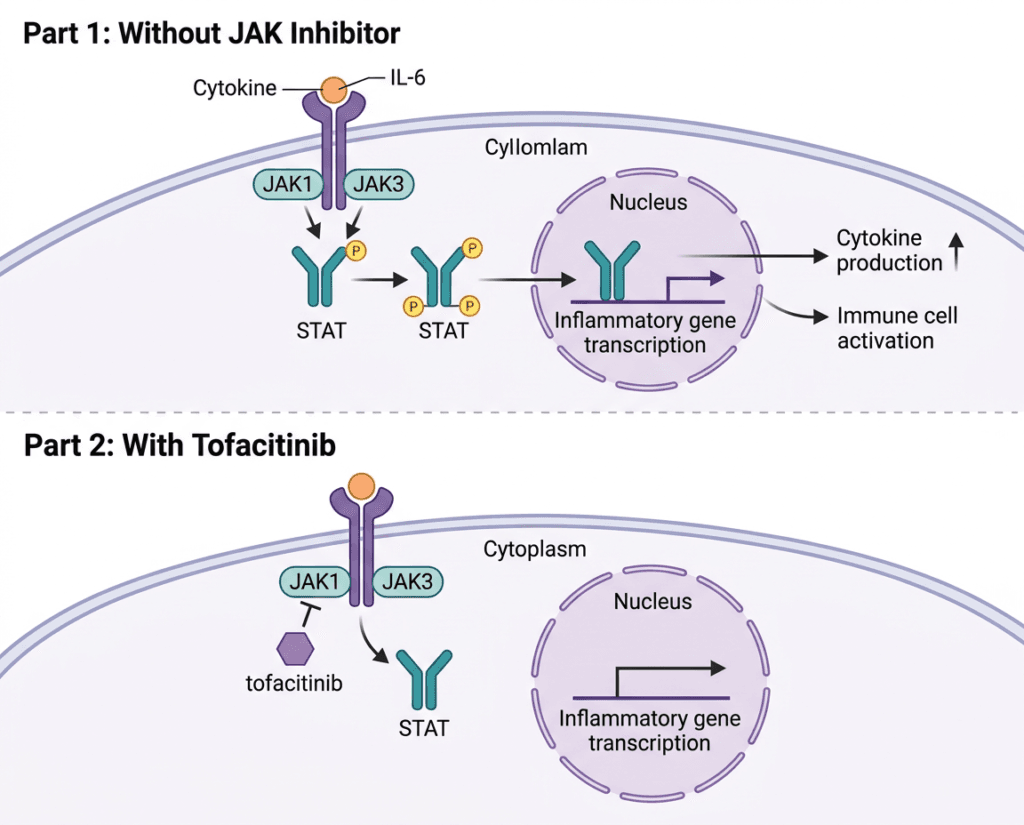
    The essentials: Xeljanz (tofacitinib, Pfizer) was the first-in-class oral JAK inhibitor approved in the world, receiving FDA approval in November 2012 for rheumatoid arthritis. Five indications now: moderate to severe rheumatoid arthritis (RA), psoriatic arthritis (PsA), ulcerative colitis (UC), ankylosing spondylitis (AS), and polyarticular course juvenile idiopathic arthritis (pcJIA). Mechanism: oral small-molecule inhibitor of JAK1, JAK2, JAK3, and to a lesser extent TYK2, blocking the intracellular signaling pathway that dozens of pro-inflammatory cytokines share. Xeljanz generated approximately $625 million in U.S. sales in 2025. The pivotal safety trial: ORAL Surveillance (NCT02092467), a mandated post-marketing Phase 3b/4 trial (n=4,362), found tofacitinib was associated with higher rates of MACE, malignancy, and all-cause mortality compared to TNF inhibitors in RA patients aged 50 and older with cardiovascular risk factors. This resulted in a boxed warning encompassing serious infections, mortality, malignancy, MACE, and thrombosis, and repositioned tofacitinib as a second-line option only after TNF inhibitor failure in RA and PsA. The FDA extended this class-level boxed warning to all JAK inhibitors. Generic entry: the FDA approved the first generic tofacitinib citrate from Ajanta Pharma in August 2025. Full generic competition is now underway. Current Xeljanz list price: approximately $5,000 to $6,000 per month for standard 5 mg twice-daily RA dosing. Expected generic price with multi-source competition: approximately $1,000 to $1,200 per month initially, declining further as competition deepens. The safety warning applies to generic tofacitinib identically to the brand. Generic availability does not make the drug safer for high-cardiovascular-risk patients.
    📚 About this series: the 2026 Loss of Exclusivity Watch This is the final post of HED’s 2026 Loss of Exclusivity series, tracking the ten major drugs losing U.S. exclusivity this year. The full series covers: Xolair (omalizumab)Pomalyst (pomalidomide)Opsumit (macitentan)Januvia/Janumet (sitagliptin)Simponi (golimumab)Mavenclad (cladribine)Gattex (teduglutide)Trintellix (vortioxetine)Briviact (brivaracetam) • Xeljanz (tofacitinib). Each post follows the same format: what the drug is and how it works, what the clinical evidence shows, who uses it and why, and what the entrance of competition means for patients, prescribers, and the market.

    When tofacitinib received FDA approval in November 2012, it was the first oral small-molecule disease-modifying antirheumatic drug approved in the United States in more than a decade and the first-in-class JAK inhibitor anywhere in the world. The approval was the culmination of a genuinely novel drug discovery effort: identifying a target inside the immune cell rather than outside it, designing a molecule small enough to cross cell membranes and block the enzyme, and demonstrating that blocking this enzyme could match the efficacy of the injectable biologics that had dominated inflammatory disease treatment for the preceding decade.

    The JAK inhibitor class built on the Xeljanz foundation quickly became one of the most scientifically exciting and clinically contested drug classes in modern medicine. The excitement came from oral administration, rapid onset, broad efficacy across multiple autoimmune diseases, and a reversible mechanism that offered a different risk-benefit profile from continuous biologic immunosuppression. The controversy came from a mandatory post-marketing safety trial, ORAL Surveillance, whose results landed in 2021 and fundamentally reshaped how the entire class is prescribed.

    The FDA concluded, based on its completed review of the ORAL Surveillance trial data, that there is an increased risk of serious heart-related events such as heart attack or stroke, cancer, blood clots, and death with tofacitinib, and required a boxed warning for major adverse cardiovascular events, mortality, malignancy, and thrombosis.

    Xeljanz generated approximately $625 million in U.S. sales in 2025, down substantially from its peak, with the revenue decline driven by both the prescribing restrictions that followed the safety warning and the early entry of generic competition. The first generic tofacitinib was approved by Ajanta Pharma in August 2025. As of 2026, full generic entry is underway, with prices expected to fall approximately 80%, mirroring the trajectory seen with JAK inhibitor generics in international markets.

    This final post in the 2026 LOE series covers tofacitinib’s path from first-in-class JAK inhibitor to a heavily scrutinized drug now entering a generic market, the JAK-STAT pathway it targets, what the ORAL Surveillance data actually says and what it does not say, what it means to prescribe or take tofacitinib in the context of those safety findings, how it compares to the newer and more selective JAK inhibitors that followed it, and what the generic transition means for patients who have been well-controlled on it for years.


    What Tofacitinib Treats: Five FDA-Approved Indications

    Tofacitinib is FDA-approved for five indications. The breadth of that indication portfolio reflects the JAK-STAT pathway’s central role across multiple immune-mediated inflammatory diseases: the same molecular bottleneck drives inflammation in RA synovium, psoriatic joints, ulcerative colitis mucosa, and the axial skeleton in ankylosing spondylitis.

    Rheumatoid arthritis is the primary indication and the one with the deepest evidence base. Since the ORAL Surveillance safety update in December 2021, tofacitinib is specifically indicated for adults with moderate to severe active RA who have had inadequate response or intolerance to one or more TNF blockers. It is no longer a first-line option for RA.

    Psoriatic arthritis follows the same post-TNF-failure positioning. Tofacitinib is approved for adults with active PsA who have had inadequate response or intolerance to one or more TNF blockers.

    Ulcerative colitis is approved at a higher induction dose (10 mg twice daily for the induction phase, then 5 mg twice daily maintenance, or 10 mg maintenance in patients who do not achieve adequate control), making the UC indication pharmacologically distinct from RA and PsA in terms of dose management.

    Polyarticular course juvenile idiopathic arthritis (pcJIA) extends the approved population to children aged 2 years and older, one of the few JAK inhibitor indications in a pediatric population.

    Ankylosing spondylitis received its U.S. approval in 2021, positioning tofacitinib as an oral alternative to the TNF inhibitor and IL-17 inhibitor biologics that had previously been standard for biologic-eligible axial spondyloarthritis patients.


    The JAK-STAT Pathway: How Tofacitinib Works

    To understand tofacitinib’s mechanism and why blocking it suppresses inflammation so broadly, it helps to understand the JAK-STAT signaling pathway, one of the most fundamental communication systems in the immune cell.

    When cytokines bind to their receptors on the surface of immune cells, they trigger a cascade of intracellular signaling events. The first step after receptor activation is the cross-phosphorylation of Janus kinase (JAK) proteins, which are bound to the intracellular portion of the cytokine receptor. There are four JAK family members: JAK1, JAK2, JAK3, and TYK2. Different cytokine receptors pair different JAK family members; the specific JAK pair activated determines which downstream signaling molecules are engaged.

    Once activated, JAKs phosphorylate STAT proteins, signal transducers and activators of transcription. Phosphorylated STATs form dimers, translocate to the nucleus, and directly activate transcription of genes involved in immune cell proliferation, survival, differentiation, and cytokine production. The result is rapid amplification of the inflammatory signal that began at the cell surface.

    Tofacitinib exerts its mechanism by inhibiting intracellular nonreceptor tyrosine kinase JAK enzymes. It inhibits JAK1, JAK2, JAK3, and to a lesser extent TYK2. In cellular settings where JAK kinases signal in pairs, tofacitinib preferentially inhibits signaling by heterodimeric receptors associated with JAK3 and JAK1, with functional selectivity over receptors that signal via pairs of JAK2.

    Inhibition of JAK1 and JAK3 blocks signaling through the common gamma chain-containing receptors for several cytokines, including interleukin-2, -4, -7, -9, -15, and -21. These cytokines are integral to lymphocyte activation, development, proliferation, and function. Rather than targeting one cytokine extracellularly the way a biologic monoclonal antibody does, tofacitinib enters the cell and blocks a signaling enzyme that multiple cytokine pathways share. The breadth of that blockade is both the source of its efficacy across multiple diseases and the mechanistic explanation for some of its safety concerns.

    JAK pair inhibitedCytokines affectedClinical relevance
    JAK1/JAK3 (primary targets)IL-2, IL-4, IL-7, IL-9, IL-15, IL-21Lymphocyte activation and proliferation; adaptive immunity modulation
    JAK1/JAK2IL-6, IL-10, IL-11, IFN-alpha, IFN-betaAcute phase response, inflammatory signaling, innate immunity
    JAK2/TYK2IL-12, IL-23T-helper cell differentiation; relevant in psoriasis and IBD
    JAK1/TYK2Type I interferonsAntiviral defense; relevant to infection risk

    The ORAL Surveillance Story: What the Data Actually Shows

    No discussion of tofacitinib in 2026 can be complete without a thorough and honest account of ORAL Surveillance. It is the single most consequential clinical trial in the history of the JAK inhibitor class and the source of the boxed warning that now governs every tofacitinib prescription.

    What the trial was: ORAL Surveillance (NCT02092467) was a Phase 3b/4 open-label, randomized post-marketing safety study mandated by the FDA. The trial enrolled 4,362 patients with moderate to severe rheumatoid arthritis on methotrexate background therapy, all aged 50 years or older and with at least one additional cardiovascular risk factor. Patients were randomized to tofacitinib 5 mg twice daily, tofacitinib 10 mg twice daily, or a TNF inhibitor (adalimumab in North America, etanercept elsewhere).

    What the primary endpoint was: Non-inferiority of tofacitinib to TNF inhibitors for two co-primary endpoints: major adverse cardiovascular events (MACE, defined as cardiovascular death, myocardial infarction, and stroke) and malignancy (excluding non-melanoma skin cancer). The pre-specified non-inferiority margin was an upper bound of 1.8 for the hazard ratio confidence interval.

    What the results showed: ORAL Surveillance failed to demonstrate non-inferiority of tofacitinib to TNF inhibitors for both MACE and malignancy. Tofacitinib was associated with numerically higher rates of MACE and malignancy than TNF inhibitors in this high-cardiovascular-risk population.

    At the FDA-approved 5 mg twice-daily dose, the number needed to harm was 567 patient-years for MACE and 276 patient-years for malignancy, translating to one additional MACE per approximately 113 patients and one additional cancer per approximately 55 patients treated with tofacitinib instead of a TNF inhibitor over a five-year period. Cancer risk was higher in patients over age 65 (HR 1.70; 95% CI 1.00 to 2.90) than in younger patients (HR 1.36; 95% CI 0.85 to 2.17).

    The critical limitations that honest interpretation requires:

    First, ORAL Surveillance enrolled a deliberately high-risk population, patients aged 50 and older with established cardiovascular risk factors. The trial lacked a group that was neither a JAK inhibitor nor a TNF inhibitor, meaning it can only compare tofacitinib to TNF blockers, not to placebo or to the underlying disease-related risk. The results therefore quantify the difference in risk between tofacitinib and TNF inhibitors in high-risk patients, not the absolute risk in a typical tofacitinib patient population.

    Second, the FDA’s decision to extend the boxed warning to all patients and all JAK inhibitors, not just the high-risk RA population in ORAL Surveillance, was a policy judgment that has been debated in the rheumatology community. Real-world registry data from the Corrona registry, comparing the safety of tofacitinib to other biologics in a broader patient population, found no differences in MACE, serious infection events, malignancy, or death, representing some of the longest-term real-life safety data available for tofacitinib.

    Third, the 10 mg twice-daily dose showed more pronounced safety signals than the 5 mg dose, specifically for pulmonary embolism and all-cause mortality. The 10 mg dose is not approved for RA or PsA; its use is limited to the ulcerative colitis induction period. The class warning effectively applied findings from a dose used in RA only in the trial to clinical contexts where that dose would never be used.

    The honest clinical summary: ORAL Surveillance demonstrated a real safety signal for cardiovascular events and malignancy in a high-cardiovascular-risk population of RA patients aged 50 and older when comparing tofacitinib to TNF inhibitors. That signal is clinically meaningful for patient selection. It does not characterize the risk-benefit profile in all patients across all indications, and the magnitude of risk in lower-risk patients is substantially less certain.


    The Safety Profile: What the Prescribing Information Requires

    The Xeljanz prescribing information contains one of the most extensive boxed warning sections in rheumatology, encompassing six distinct categories of serious risk. The infection screening requirements parallel those for the biologic TNF inhibitors discussed in Post 5 of this series on golimumab and the Simponi LOE: tuberculosis screening before initiating, hepatitis B screening, and updated vaccination status are all required. Live vaccines are contraindicated during tofacitinib therapy.

    Safety categoryDetailsClinical guidance
    Serious infections (boxed warning)Increased risk of bacterial, fungal, viral, and opportunistic infections including tuberculosis. Risk is elevated with concomitant immunosuppressives.Screen for latent TB before initiating. Evaluate for active infection before each refill. Hold tofacitinib during active serious infection.
    Mortality (boxed warning)Higher rate of all-cause mortality including sudden cardiovascular death compared to TNF blockers in ORAL Surveillance RA patients.Use only after failure of TNF inhibitor in RA and PsA. Avoid in patients at high cardiovascular risk unless no suitable alternatives exist.
    Malignancy (boxed warning)Higher rates of lymphoma and lung cancer with tofacitinib versus TNF blockers. Risk increased in patients 65 and older, current or past smokers, and those with known malignancy risk factors.Avoid in patients with known malignancy other than treated non-melanoma skin cancer. Consider alternatives in patients with significant cancer risk factors, especially current or past smokers over 65.
    MACE (boxed warning)Higher rate of MACE (cardiovascular death, MI, stroke) versus TNF blockers in ORAL Surveillance, particularly in patients 65 and older, smokers, and those with cardiovascular risk factors.Use with caution in patients with cardiovascular disease. Avoid in patients at high CV risk unless no suitable alternatives are available.
    Thrombosis (boxed warning)Increased incidence of pulmonary embolism, venous thrombosis, and arterial thrombosis, primarily at the 10 mg twice-daily dose.Use with caution in patients with risk factors for VTE. Promptly evaluate patients reporting signs of DVT or PE.
    Herpes zoster reactivationRates of herpes zoster higher with tofacitinib than with TNF inhibitors.Ensure zoster vaccination before starting tofacitinib where possible. Monitor during treatment.
    HyperlipidemiaDose-dependent increases in total cholesterol, LDL, and HDL.Monitor lipid levels 4 to 8 weeks after initiating. Manage dyslipidemia per standard clinical guidelines.
    AnemiaHemoglobin decreases observed; avoid initiating in patients with hemoglobin below 9 g/dL.Monitor CBC during treatment.
    GI perforationsCases of GI perforation reported, particularly in patients with Crohn’s disease or diverticulitis.Use with caution in patients at increased risk for GI perforations.
    Renal and hepatic impairmentDose reduction required in moderate renal impairment (eGFR 30 to 60 mL/min) or moderate hepatic impairment. Avoid in severe impairment.Assess renal and hepatic function at baseline and periodically.

    How Tofacitinib Compares to the Newer JAK Inhibitors

    Tofacitinib’s approval opened the door to a JAK inhibitor generation that has continued to evolve. Baricitinib (Olumiant), upadacitinib (Rinvoq), and filgotinib (Jyseleca, approved in Europe but not the U.S.) are more selective for specific JAK isoforms, primarily JAK1, compared to tofacitinib’s broader JAK1/JAK2/JAK3 inhibition.

    AgentPrimary targetKey indicationsSelectivity profileSafety class warning
    Tofacitinib (Xeljanz)JAK1/JAK3RA, PsA, UC, AS, pcJIABroad: inhibits JAK1, 2, 3Full boxed warning (class)
    Baricitinib (Olumiant)JAK1/JAK2RA, alopecia areata, COVID-19Preferential JAK1/JAK2Full boxed warning (class)
    Upadacitinib (Rinvoq)JAK1-selectiveRA, PsA, AS, AD, UC, Crohn’sHighest JAK1 selectivity in classFull boxed warning (class)

    The theoretical advantage of JAK1 selectivity is that JAK3 inhibition disrupts common gamma chain cytokine signaling (IL-2, IL-7, IL-15) more dramatically and may contribute to a broader immunosuppressive effect that is not necessary for anti-inflammatory benefit in most autoimmune diseases. Whether this translates to meaningful real-world safety differences between agents in the class is still being studied. The FDA extended the class-level boxed warning to all JAK inhibitors in 2021 based on ORAL Surveillance findings, pending further evidence from the class.

    For patients: the arrival of generic tofacitinib does not make it the automatic choice over newer, still-branded JAK inhibitors. The prescribing decision should still be driven by individual patient characteristics, cardiovascular risk, prior treatment history, specific indication, and comorbidities, with the rheumatologist or gastroenterologist making a risk-stratified recommendation. What the generic does mean is that tofacitinib becomes far more accessible for patients in whom it is the appropriate choice and for whom cost has been a barrier.


    The Generic Entry: What Has Already Happened

    The primary composition-of-matter patent for tofacitinib expired in December 2025. In August 2025, the FDA approved the first generic tofacitinib citrate from Ajanta Pharma, Ltd., marking the first generic entry into the Xeljanz market.

    As of 2026, full generic entry is underway. Multiple manufacturers have filed ANDAs for generic tofacitinib tablets and extended-release tablets (Xeljanz XR). The immediate-release 5 mg and 10 mg tablets are the highest-volume products; the extended-release 11 mg once-daily tablet has its own separate patent profile and may follow a slightly different generic timeline.

    As a small molecule, Xeljanz is far more straightforward to replicate than the monoclonal antibodies used in similar indications. Unlike the biologics covered in this series, golimumab (Simponi) and omalizumab (Xolair), which require complex manufacturing, stability verification, and specialized storage, generic tofacitinib tablets are produced through conventional pharmaceutical chemistry and distributed through standard pharmacy channels. This raises the prospect of rapid substitution, particularly in healthcare systems under cost pressure.

    The current Xeljanz list price is approximately $5,000 to $6,000 per month for standard 5 mg twice-daily RA dosing. At approximately 80% price erosion, generic tofacitinib would reach approximately $1,000 to $1,200 per month initially, falling further as competition deepens. For health systems globally where JAK inhibitors have often been reserved for patients with access to payer-negotiated or government-reimbursed pricing, generic availability may meaningfully expand treatment reach.

    Pfizer’s response to the LOE includes a branded copay assistance program. As with most specialty drug LOE events in this series, commercial copay assistance for insured patients slows but does not prevent market conversion, with the main beneficiaries of the generic being uninsured patients, Medicare patients, and health systems negotiating formulary contracts.


    What Patients Currently on Xeljanz Should Know

    If you are currently taking Xeljanz and your disease is well controlled, the generic transition is clinically straightforward. Generic tofacitinib citrate is the same molecule, at the same dose, with the same mechanism. Your disease-modifying benefit, your infection risk, and your safety monitoring requirements are unchanged by the switch from brand to generic.

    What does change is cost, in your favor, as formularies transition to preferring the lower-cost generic. Expect formulary notifications about generic tofacitinib in 2026 and into 2027. When that notification arrives, discuss it with your rheumatologist or gastroenterologist at your next visit, not as a cause for alarm, but to confirm your dose and monitoring schedule remain appropriate.

    If you are in the high-cardiovascular-risk population that ORAL Surveillance studied, aged 65 or older with cardiovascular risk factors, or a current or past smoker, the prescribing conversation with your rheumatologist should specifically address whether tofacitinib remains the best option for you given the ORAL Surveillance findings, or whether a TNF inhibitor might be more appropriate for your individual risk profile. Generic availability does not change the safety data. It does not make the drug safer for high-risk patients. The boxed warning applies to the generic exactly as it applies to the brand.

    For patients newly diagnosed with RA, PsA, or AS: the label now requires demonstrating inadequate response or intolerance to at least one TNF blocker before starting tofacitinib. The generic’s arrival does not change that positioning. It remains a drug for the second-line and later autoimmune treatment setting.

    For related HED coverage on other JAK inhibitor approvals and autoimmune disease treatment developments in 2026, see our post on the Simponi (golimumab) LOE and the Immgolis biosimilar litigation and our post on Fasenra (benralizumab) receiving a new indication for hypereosinophilic syndrome.


    📌 A note on the completed series This post closes out HED’s 2026 Loss of Exclusivity Watch, a 10-post series covering drugs that generated over $17 billion in combined annual U.S. sales now entering the competitive generic and biosimilar market. The series spanned four therapeutic areas and three drug modalities: small molecules (sitagliptin, cladribine, vortioxetine, brivaracetam, tofacitinib, macitentan), a peptide biologic (teduglutide), and injectable biologics (golimumab, omalizumab, pomalidomide). What runs through every post — from Xolair’s interchangeable biosimilar to generic cladribine’s patent invalidation to Xeljanz’s generic entry — is the same fundamental tension in pharmaceutical markets. The periods of exclusivity that fund drug development are real and often necessary. The prices those exclusivity periods produce are frequently out of reach for the patients who need the drugs most. And the generic and biosimilar transitions that eventually bring prices down are complicated, incomplete, and slower in the U.S. than in most other developed health systems. The 2026 patent cliff does not resolve that tension. But for millions of patients currently priced out of Januvia, Trintellix, Mavenclad, Briviact, and Xeljanz, it moves the needle in a meaningful direction.

    Sources

    Xeljanz FDA approval: FDA approves tofacitinib for rheumatoid arthritis. FDA.gov. November 2012.

    FDA boxed warning update (December 2021): FDA requires warnings about increased risk of serious heart-related events, cancer, blood clots, and death for JAK inhibitors. FDA.gov. December 2021.

    First generic tofacitinib approval (Ajanta Pharma, August 2025): ANDA Drug Approval Database. FDA.gov.

    Patent expiry and generic pricing: XELJANZ patent and generic information. DrugPatentWatch. | The next pharma patent cliff: how 2026 to 2032 will reshape revenue. Labiotech. March 2026.

    ORAL Surveillance trial registration: NCT02092467. ClinicalTrials.gov.

    ORAL Surveillance primary publication: Ytterberg SR et al. Cardiovascular and Cancer Risk with Tofacitinib in Rheumatoid Arthritis. NEJM. 2022;386(4):316–326. doi:10.1056/NEJMoa2109927.

    ORAL Surveillance NNH analysis: JAK inhibitors and black box warnings: what is the future for JAK inhibitors? PMC10615860.

    Lancet Rheumatology editorial (FDA class warning debate): FDA expands JAK inhibitors warning: going beyond the data? Lancet Rheumatology. 2021.

    Corrona registry real-world safety data: Curtis JR et al. Real-world comparative risks of herpes virus infections in tofacitinib and biologic-treated patients with rheumatoid arthritis. Annals of the Rheumatic Diseases. 2021. PMID 34185363.

    Tofacitinib mechanism (StatPearls): Tofacitinib. StatPearls. NCBI.

    JAK-STAT pathway review: JAK-STAT Signaling Pathway. PMC8440069.

    Tofacitinib JAK selectivity in RA: Tofacitinib Suppresses Several JAK-STAT Pathways in RA In Vivo. Frontiers in Immunology. 2021.

    JAK inhibitor selectivity comparison: Molecular Modeling Insights into Upadacitinib Selectivity. PMC8778839.

    Baricitinib FDA approval: FDA approves baricitinib for moderately to severely active rheumatoid arthritis. FDA.gov.

    Upadacitinib FDA approval: FDA approves upadacitinib for moderate to severe rheumatoid arthritis. FDA.gov.

    Latent TB screening: Testing for Latent TB Infection. CDC.

    Herpes zoster: Herpes Zoster. StatPearls. NCBI.

    Xeljanz prescribing information: XELJANZ (tofacitinib) Prescribing Information. Pfizer.

    NIAMS disease overviews: Rheumatoid Arthritis | Psoriatic Arthritis | Ankylosing Spondylitis | Juvenile Arthritis

    NIDDK ulcerative colitis: Ulcerative Colitis. niddk.nih.gov.

    HED internal references: LOE Post 5: Simponi (golimumab) | Fasenra HES approval post

    Patient resources: Arthritis Foundation | Crohn’s and Colitis Foundation | Pfizer RxPathways patient assistance | Good Days Patient Assistance

    Disclaimer: Health Evidence Digest provides general information about FDA approvals, loss of exclusivity events, and health research for educational purposes. This content is not a substitute for professional medical advice. Tofacitinib carries a boxed warning for serious infections, mortality, malignancy, major adverse cardiovascular events, and thrombosis. Decisions about initiating, continuing, or transitioning from brand-name to generic tofacitinib must be made in close collaboration with a board-certified rheumatologist or gastroenterologist who can assess the patient’s individual cardiovascular risk, infection history, and overall benefit-risk profile. Never stop a DMARD without medical guidance.
  • Briviact Is the Better-Tolerated Descendant of One of Epilepsy’s Most Prescribed Drugs. Its Generics Are Already in Pharmacies. Here Is What the SV2A Science Behind It Actually Shows and What the LOE Means for 3.4 Million Americans With Epilepsy.

    Briviact Is the Better-Tolerated Descendant of One of Epilepsy’s Most Prescribed Drugs. Its Generics Are Already in Pharmacies. Here Is What the SV2A Science Behind It Actually Shows and What the LOE Means for 3.4 Million Americans With Epilepsy.

    The essentials: Briviact (brivaracetam, UCB) is an oral antiseizure medication (ASM) approved in February 2016 for adjunctive treatment of focal (partial-onset) seizures in patients aged 1 month and older. It is available as tablets (10 mg, 25 mg, 50 mg, 75 mg, 100 mg), an oral solution (10 mg/mL), and an intravenous solution. Mechanism: SV2A (synaptic vesicle protein 2A) inhibitor. Brivaracetam shares its mechanism class with levetiracetam (Keppra) but binds SV2A with 15 to 30 times higher affinity and penetrates the brain faster. At therapeutic doses it is predicted to occupy more than 80% of SV2A in the human brain. The key clinical differentiation from levetiracetam: substantially lower rates of behavioral and psychiatric side effects (irritability, aggression, mood disturbance), the most clinically significant limitation of levetiracetam in practice. Briviact generated approximately $652 million in U.S. sales in 2025. Generic status: generics are already entering the U.S. market. UCB’s own patient-facing materials acknowledge this directly. At least one full FDA approval for generic brivaracetam was issued as early as June 2022 (Sunshine Lake Pharma); twelve companies have filed for generic approval; five tentative approvals exist. Brand list price: approximately $650 to $800 per month for 100 mg twice daily. Expected generic price with multi-source competition: $50 to $100 per month. Phase 3 pivotal trials: approximately 38 to 42% of patients achieved a 50% or greater reduction in seizure frequency at 100 mg per day. Statistically significant seizure reduction was demonstrated even in patients who had failed five or more prior antiseizure medications. Critical prescribing caution: brivaracetam and levetiracetam should not be co-administered at therapeutic doses. Both compete for the same SV2A binding site, reducing brivaracetam efficacy. Cross-taper required when transitioning.
    📚 About this series: the 2026 Loss of Exclusivity Watch This is Post 9 of HED’s 2026 Loss of Exclusivity series, tracking the ten major drugs losing U.S. exclusivity this year. The full series covers: Xolair (omalizumab)Pomalyst (pomalidomide)Opsumit (macitentan)Januvia/Janumet (sitagliptin)Simponi (golimumab)Mavenclad (cladribine)Gattex (teduglutide)Trintellix (vortioxetine) • Briviact (brivaracetam) • Xeljanz (tofacitinib). Each post follows the same format: what the drug is and how it works, what the clinical evidence shows, who uses it and why, and what the entrance of competition means for patients, prescribers, and the market.

    Epilepsy is one of the most common serious neurological conditions in the world. Approximately 3.4 million Americans live with active epilepsy, and roughly 150,000 new cases are diagnosed each year in the United States alone. For the majority of patients, antiseizure medications manage the condition well enough to allow normal daily functioning. For about one-third, however, seizures remain inadequately controlled despite multiple medication trials, a population with enormous unmet need and, for many, a daily reality shaped by unpredictable neurological events that affect their ability to drive, work, care for their families, and move through the world safely.

    Briviact (brivaracetam), developed by the Belgian biopharmaceutical company UCB, was FDA-approved in February 2016 for the adjunctive treatment of focal (partial-onset) seizures in patients aged 1 month and older. It belongs to the same drug class as levetiracetam (Keppra), one of the most widely prescribed antiseizure medications globally, but is not the same drug. Brivaracetam displays higher selectivity and affinity for synaptic vesicle protein 2A (SV2A) in the brain than levetiracetam. That distinction in receptor pharmacology translates into meaningful clinical differences, particularly in the behavioral and psychiatric side effect profile that has long been levetiracetam’s most significant clinical limitation.

    Briviact generated approximately $652 million in U.S. sales in 2025. Generics are already entering the U.S. market. UCB’s own patient-facing website acknowledges this directly, stating that patients may notice generic versions of Briviact becoming available because the medicine’s patent is expiring.

    The LOE story for brivaracetam is less dramatic than some others in this series: no litigation standoff, no manufacturing CRL, no biosimilar complexity. Generics are arriving. For patients currently on Briviact at brand-name prices, the cost relief is real and the transition should be clinically straightforward. But to understand what is being preserved when a patient transitions to generic brivaracetam, and why the drug’s specific receptor pharmacology was worth developing in the first place, requires going inside the science of SV2A, one of the more unusual drug targets in all of neurology.


    What Epilepsy Is and Why Focal Seizures Are the Focus

    Epilepsy is defined by the International League Against Epilepsy as a disease characterized by at least two unprovoked seizures occurring more than 24 hours apart, or one unprovoked seizure with a high probability of further seizures based on brain imaging or other factors. Seizures are the visible manifestation of abnormal, synchronous electrical activity across networks of neurons, either a localized discharge that remains focal or one that spreads to involve the entire brain.

    The classification of seizure types has clinical importance because different seizure types respond to different drug mechanisms, and because the experience of a seizure is highly variable depending on where in the brain the discharge originates:

    Seizure typeOriginCommon experienceKey treatment consideration
    Focal onset (aware)Localized cortical region, consciousness preservedStrange feelings, déjà vu, unusual smells or tastes, repetitive movements, emotional changesBrivaracetam, levetiracetam, lacosamide, lamotrigine, carbamazepine
    Focal onset (impaired awareness)Localized region, consciousness affectedAutomatisms (lip smacking, hand movements), confusion, amnesia for the eventSame class options; seizure impact on daily function significant
    Focal to bilateral tonic-clonicFocal onset spreading to both hemispheresConvulsions, loss of consciousness, post-ictal fatigueMultiple agents; drug-resistant disease common
    Generalized onsetBoth hemispheres simultaneously from onsetAbsence, myoclonic jerks, tonic-clonic episodesDifferent drug profile; some focal ASMs ineffective

    Brivaracetam is indicated for focal (partial-onset) seizures specifically. It is not approved for generalized epilepsy syndromes such as juvenile myoclonic epilepsy or absence epilepsy in the same way as some broader-spectrum agents. This specificity matters when evaluating its place in the treatment landscape.

    The one-third of epilepsy patients with drug-resistant disease, defined as failure of two adequate trials of appropriately chosen and tolerated antiseizure medications, face a different clinical and quality-of-life reality from those who achieve seizure freedom early. For this population, the ongoing search for better-tolerated, more effective adjunctive agents is the difference between driving and not driving, working and not working, independent living and supervised care.


    The SV2A Target: What It Is and Why It Matters

    The mechanism shared by both levetiracetam and brivaracetam is one of the more scientifically unusual in clinical neuroscience. Both drugs bind to synaptic vesicle protein 2A (SV2A), a protein embedded in the membrane of synaptic vesicles inside neurons. Understanding what SV2A does, and why binding to it controls seizures, requires a brief look at how synaptic transmission works.

    Neurons communicate at synapses by releasing neurotransmitters into the synaptic cleft. These neurotransmitters are stored in small membrane-bound packages called synaptic vesicles. When an action potential arrives at the presynaptic terminal, voltage-gated calcium channels open, calcium flows in, and the vesicles fuse with the presynaptic membrane to release their contents into the cleft in a process called exocytosis.

    SV2A is a transmembrane glycoprotein expressed in virtually all neurons throughout the central nervous system. It contributes to calcium-sensitive exocytosis of transmitters through interaction with synaptotagmin, vesicular transport, stabilization of vesicular neurotransmitter loading, and regulation of calcium sensitivity. In practical terms: SV2A is part of the molecular machinery regulating how readily vesicles release neurotransmitter in response to neuronal activity.

    In epilepsy, the problem is neuronal hyperexcitability: networks of neurons that fire too synchronously and too readily, creating the electrical storm of a seizure. By modulating SV2A, levetiracetam and brivaracetam dampen the readiness of vesicles to release neurotransmitter during high-frequency neuronal firing, selectively reducing the excessive synaptic transmission that characterizes seizure activity without broadly suppressing normal neuronal communication.

    Both drugs bind selectively to SV2A with at least 100-fold higher affinity compared to SV2B and SV2C, the two related isoforms. This selectivity for the A isoform is thought to be central to the antiseizure effect, since SV2A is expressed in excitatory glutamatergic and inhibitory GABAergic neurons throughout the brain while SV2B and SV2C have more restricted distributions.


    What Makes Brivaracetam Different From Levetiracetam

    This is the central clinical pharmacology question, because levetiracetam has been generically available since 2008 and costs only a few dollars per month. If brivaracetam were simply levetiracetam with a slightly different structure, its development and $652 million in annual sales would be difficult to justify. The evidence says it is meaningfully different in three ways.

    First: substantially higher SV2A affinity. Brivaracetam is a selective, high-affinity SV2A ligand with 15 to 30 times higher affinity than levetiracetam. Based on its affinity and pharmacokinetic parameters, at therapeutic concentrations brivaracetam is predicted to occupy more than 80% of SV2A in the human brain. Higher receptor occupancy at therapeutic doses means more complete target engagement, which may translate into efficacy at lower doses and in patients who have shown partial or incomplete response to levetiracetam.

    Second: faster and more complete brain penetration. Brivaracetam has high lipid solubility and rapid brain penetration, with engagement of SV2A within minutes of administration. Levetiracetam’s brain penetration is slower. This pharmacokinetic difference is particularly relevant for intravenous use in acute seizure management, where speed of action matters, and may help explain why brivaracetam can work in some patients where levetiracetam does not achieve adequate SV2A occupancy.

    Third: a more favorable behavioral side effect profile. This is the most clinically significant differentiation from a prescriber and patient perspective. Levetiracetam has a well-established adverse effect profile involving irritability, aggression, mood disturbance, and behavioral changes, sometimes severe enough to require drug discontinuation. The mechanism behind this behavioral toxicity is not fully elucidated but is thought to involve off-target effects beyond SV2A.

    Brivaracetam’s exceptional selectivity for SV2A and its higher affinity suggest it exhibits superior clinical tolerability compared to levetiracetam. The increased possibility of behavioral abnormalities associated with levetiracetam has driven clinical interest in brivaracetam as an alternative with a cleaner receptor profile.

    In clinical practice, the most common reason a neurologist prescribes brivaracetam over levetiracetam is either a patient with prior levetiracetam intolerance due to behavioral effects, or a patient with inadequate seizure control on levetiracetam who the clinician believes may achieve better SV2A occupancy with the higher-affinity compound.

    There is one important prescribing caution arising from this relationship: the two drugs should not be used concurrently. Brivaracetam’s efficacy is reduced when levetiracetam is co-administered, because levetiracetam competes with brivaracetam for the same SV2A binding site. The clinical trials that evaluated brivaracetam efficacy excluded patients on concomitant levetiracetam from the efficacy analysis for exactly this reason.


    The Clinical Evidence: Three Pivotal Phase 3 Trials

    Brivaracetam’s FDA approval was supported primarily by three randomized, double-blind, placebo-controlled Phase 3 trials: N01252 (NCT00490035), N01253 (NCT00464269), and N01358 (NCT01261325), all evaluating adjunctive brivaracetam at doses of 50 to 200 mg per day in adults with uncontrolled focal seizures despite one to two existing antiseizure medications.

    The primary endpoint across the pivotal trials was the percentage reduction over placebo in baseline-adjusted focal seizure frequency per 28 days during the 12-week treatment period.

    TrialNDoses testedSeizure frequency reduction versus placebo (100 mg/day)50% responder rate (100 mg/day)Notes
    N01252approximately 40020, 50, 100 mg/daySignificant at 100 mgapproximately 40%Conducted in Europe and India
    N01253approximately 4005, 20, 50 mg/daySignificant at 50 mg (reduction 12.8%, p equals 0.025)Dose-dependent improvementLower doses; 50 mg minimum effective
    N01358approximately 76850, 100, 200 mg/daySignificant at 100 and 200 mg/dayapproximately 38 to 42% at 100 to 200 mg/dayLargest pivotal trial; established dose range

    Source: Klein P, Schiemann J. A review of the pharmacology and clinical efficacy of brivaracetam. PMC5783144. 2018.

    The 50% responder rate, the proportion of patients achieving at least a 50% reduction in seizure frequency, is the benchmark most commonly used in clinical practice to assess whether an antiseizure medication is working meaningfully for an individual patient. Rates of approximately 38 to 42% at the 100 mg dose are consistent with what would be expected from an active adjunctive agent in a refractory focal epilepsy population.

    The drug-resistant patient data is particularly informative. In patients with five or more previous antiseizure medications, a highly refractory population, the percentage reduction over placebo in 28-day adjusted focal seizure frequency was 18.1% for 100 mg per day (p equals 0.006) and 19.8% for 200 mg per day (p equals 0.004). Demonstrating statistically significant seizure reduction in patients who have already failed five or more previous medications is clinically meaningful, even if the absolute reduction is modest. For this population, any additional seizure control represents a real change in safety and quality of life.

    A later Phase 3 study in adult Asian patients (EP0083) confirmed these findings across a different population: the percentage reduction over placebo was 24.5% (p equals 0.0005) for 50 mg per day and 33.4% (p less than 0.0001) for 200 mg per day. The 50% responder rate was 19.0% for placebo, 41.1% for 50 mg, and 49.3% for 200 mg per day.


    The Safety Profile

    Brivaracetam’s safety profile is a key part of its clinical story, and the comparison to levetiracetam is front and center.

    Safety itemDetailsClinical guidance
    Somnolence and fatigueMost common adverse events; dose-dependent; occurred in approximately 15 to 25% of patients at therapeutic doses versus approximately 8 to 10% with placebo.Counsel patients to avoid driving or operating heavy machinery until individual CNS effects are established. Often improves with continued treatment.
    DizzinessCommon, dose-dependent; reported in approximately 10 to 12% at 100 to 200 mg/day.Same caution regarding driving and machinery. Usually mild.
    Behavioral and psychiatric effectsSubstantially less common than with levetiracetam. Irritability, aggression, and mood disturbance reported at rates more comparable to other adjunctive antiseizure medications.Monitor for mood changes, especially in patients with prior psychiatric history. Lower behavioral burden than levetiracetam is a key clinical differentiator.
    Suicidal behavior and ideationClass-level FDA warning for antiseizure medications: increased risk of suicidal thoughts and behavior.Monitor all patients on antiseizure medications for emergence of new or worsening depressive symptoms, suicidal thoughts, or unusual behavioral changes.
    Drug interactions: CYP2C19 inhibitorsBrivaracetam is metabolized by CYP2C19. Strong inhibitors (fluconazole, fluvoxamine) may increase brivaracetam plasma concentrations.Reduce brivaracetam dose by half when co-administered with strong CYP2C19 inhibitors.
    Drug interactions: rifampinStrong CYP3A4 and CYP2C19 inducers (rifampin) can reduce brivaracetam levels by up to 45%.Consider increasing brivaracetam dose when co-administered with rifampin or other strong inducers; monitor seizure control.
    Drug interactions: levetiracetamConcurrent use not recommended. Both compete for SV2A binding, reducing brivaracetam efficacy.Cross-taper required when transitioning from levetiracetam: taper levetiracetam down while titrating brivaracetam up. Do not co-prescribe at therapeutic doses.
    Renal impairmentDose adjustment not required for mild to moderate impairment based on renal function alone.Use with caution in severe renal impairment; monitor closely.
    PregnancyAnimal studies showed adverse developmental effects at high exposures. Human teratogenicity risk not fully established.Discuss contraception and pregnancy planning with all patients of reproductive potential. Encourage pregnancy registry enrollment.
    Abrupt discontinuationAs with all antiseizure medications, abrupt discontinuation risks seizure recurrence and status epilepticus.Taper gradually when discontinuing. Never stop brivaracetam abruptly without medical supervision.

    The behavioral tolerability advantage over levetiracetam deserves emphasis. Levetiracetam-induced irritability and aggression, sometimes called “Keppra rage” in patient communities, is not a trivial side effect. It affects family functioning, occupational performance, and quality of life, and is the most commonly cited reason for levetiracetam discontinuation in clinical practice. Brivaracetam’s cleaner SV2A selectivity appears to substantially reduce this risk, making it a genuinely preferred option for patients with prior behavioral side effects on levetiracetam.


    The Patent and Generic Landscape: What Has Already Happened

    Unlike several other drugs in this series, Briviact’s generic transition is not a future event. It is already underway.

    UCB won a patent litigation decision in 2023, with a federal judge upholding the validity of U.S. Patent No. 6,911,461 covering the brivaracetam compound and blocking generic copies until 2026. That protection has now expired. The FDA has approved a generic version of Briviact, and UCB’s own materials acknowledge that patients may see generic versions appearing at their pharmacy.

    Twelve different companies have filed for generic approval of Briviact. The manufacturers that have received or are pursuing FDA approval include Aurobindo, Lupin, MSN Laboratories, Zydus Pharmaceuticals, and Sunshine Lake Pharma, among others. Five tentative approvals exist for generic brivaracetam indicating near-term availability, and Sunshine Lake Pharma received a full FDA approval on June 9, 2022, among the first generic approvals for this compound.

    With multiple generic manufacturers in the market, the price trajectory follows the standard antiseizure generic pattern: 70 to 85% reductions from brand-name pricing over 12 to 24 months as competition deepens. Briviact’s current list price runs approximately $650 to $800 per month for 100 mg twice daily. Generic brivaracetam is expected to settle at $50 to $100 per month with multi-source competition established.

    UCB’s response to the LOE includes a branded patient loyalty program. UCB’s own Briviact savings card page states that even as generic options become available, patients may choose to stay on branded Briviact, and that without specific written instructions pharmacies may automatically dispense a generic version. This is a standard brand retention strategy: copay assistance programs that make the brand financially competitive with the generic at the point of care for commercially insured patients, while the payer bears the higher system-level cost. It slows but does not prevent market conversion.


    Where Brivaracetam Fits in the 2026 Epilepsy Treatment Landscape

    The antiseizure medication landscape is one of the most crowded in neurology, with more than 30 approved agents in the United States. The SV2A class represents one of the most established modern mechanisms: levetiracetam became a first-line agent for many epilepsy syndromes after its 1999 approval, and brivaracetam has carved out a complementary niche as the higher-affinity, better-tolerated successor.

    The key positioning questions for a neurologist in 2026:

    Is brivaracetam preferable to levetiracetam as first-line adjunctive therapy for focal epilepsy? The clinical evidence supports brivaracetam’s tolerability advantage, particularly the reduced behavioral side effect burden. However, levetiracetam has decades of real-world safety data, an even broader approved indication range, and costs pennies per day as a generic. Many neurologists use levetiracetam first and reserve brivaracetam for patients who develop behavioral side effects or need a switch.

    Is generic brivaracetam bioequivalent to Briviact? Yes. The FDA bioequivalence standard ensures that approved generic brivaracetam delivers the same active ingredient at the same concentration with the same pharmacokinetic profile as the brand. The clinical effect, SV2A binding, seizure suppression, and tolerability profile, is preserved in the generic.

    What about the interaction with levetiracetam? This is the most important practical management point for transitions. If a patient is switching from levetiracetam to brivaracetam or generic brivaracetam, the two should not be co-prescribed at full doses. A structured cross-taper, reducing levetiracetam while introducing brivaracetam, is the appropriate approach, managed by the treating neurologist.

    The arrival of affordable generic brivaracetam has a particular public health significance for the drug-resistant epilepsy population. Patients cycling through multiple agents in search of seizure control have historically faced barriers to accessing newer, better-tolerated antiseizure medications due to cost and formulary restrictions. With generic brivaracetam entering the market at a fraction of Briviact’s brand price, prescribers have more flexibility to choose the agent best suited to a patient’s tolerability profile rather than the agent most easily covered by their insurance formulary.


    What Patients Should Know

    If you are currently taking Briviact and your seizures are well controlled: nothing in the generic transition changes the clinical effect of your medication. Generic brivaracetam contains the same active ingredient, at the same dose, with the same pharmacokinetics. If your pharmacy substitutes the generic and you experience any perceived change, whether in tablet appearance, packaging, or tolerability, contact your neurologist. Changes in perception of medication effect are sometimes real and sometimes related to factors unrelated to the drug itself; either way, they are worth reporting.

    If you are switching from levetiracetam due to behavioral side effects: generic brivaracetam, now broadly available and significantly less expensive than brand Briviact, may be the option that has been cost-prohibitive for you in the past. Discuss this specifically with your neurologist, not just as an inquiry about a brand-name drug, but as a request to evaluate whether generic brivaracetam is now a realistic option given its changed cost profile.

    If you are managing epilepsy in a child: brivaracetam is approved for patients aged 1 month and older. The availability of an oral solution formulation (10 mg/mL) is particularly relevant for young children or patients with swallowing difficulties. Confirm with your pediatric neurologist whether generic versions of both the tablet and oral solution formulations are available and appropriate for your child’s dosing needs.

    One final reminder that applies to every patient on any antiseizure medication: never stop or reduce the dose of brivaracetam without medical guidance. Abrupt discontinuation of antiseizure medications risks seizure recurrence, including status epilepticus, regardless of how long the patient has been seizure-free.

    For related HED coverage on neurological drug LOE events and CNS approvals in 2026, see our post on Mavenclad (cladribine) losing its MS dosing regimen patents and what the science behind selective immune reconstitution actually shows, and our post on the FDA approval of Ocrevus (ocrelizumab) for pediatric relapsing-remitting MS.


    Sources

    Briviact FDA approval: FDA approves brivaracetam for partial-onset seizures. FDA.gov. February 2016.

    Patent litigation and LOE timing: UCB Wins Patent Order Blocking Copies of Briviact Epilepsy Drug. Bloomberg Law. August 2023. | Top 10 Drugs Losing U.S. Patent Protection in 2026. FDCELL. March 2026.

    Generic availability: Generic Briviact Availability. drugs.com. Updated May 7, 2026. | BRIVIACT patent and generic information. DrugPatentWatch.

    UCB patient acknowledgment of LOE: Briviact Savings Card and Patient Support. briviact.com.

    SV2A mechanism and brivaracetam pharmacology: Klein P, Schiemann J. A review of the pharmacology and clinical efficacy of brivaracetam. PMC5783144. 2018.

    SV2A allosteric modulation structural basis: Mechanisms Underlying Allosteric Modulation of Antiseizure Medication Binding to SV2A. PNAS. 2025. doi:10.1073/pnas.2510239122.

    Brivaracetam brain penetration and SV2A occupancy: Nicolas JM et al. Brivaracetam, a selective high-affinity SV2A ligand with preclinical evidence of high brain permeability and fast onset of action. Epilepsia. 2016;57(2):201–209. PMID 26663401.

    SV2A differential interaction (brivaracetam vs. levetiracetam): Wood MD et al. Evidence for a differential interaction of brivaracetam and levetiracetam with SV2A. Epilepsia. 2017.

    Phase 3 pivotal trial program: Klein P, Schiemann J. PMC5783144.

    N01252 trial registration: NCT00490035. ClinicalTrials.gov.

    N01253 trial registration: NCT00464269. ClinicalTrials.gov.

    N01358 trial registration: NCT01261325. ClinicalTrials.gov.

    Drug-resistant patient subgroup analysis: Villanueva V et al. Effect of Number of Previous Antiseizure Medications on Efficacy and Tolerability of Adjunctive Brivaracetam. Advances in Therapy. 2021.

    Asian patient Phase 3 trial (EP0083): Inoue Y et al. Efficacy, safety, and tolerability of adjunctive brivaracetam in adult Asian patients. Epilepsia Open. 2024. PMC11145603.

    Brivaracetam versus levetiracetam behavioral tolerability: Comparison of Effectiveness of Brivaracetam and Levetiracetam for Post-Traumatic Seizure Prophylaxis. PMC11588607.

    FDA antiseizure medication suicidality warning: Information on Antiepileptic Drugs (AEDs) and Suicidality. FDA.gov.

    Levetiracetam StatPearls: Levetiracetam. StatPearls. NCBI.

    Epilepsy StatPearls: Epilepsy. StatPearls. NCBI.

    CDC epilepsy data: Epilepsy Data and Statistics. CDC.

    Briviact prescribing information: Briviact (brivaracetam) Prescribing Information, Schedule V. UCB, Inc.

    Pregnancy registry: North American AED Pregnancy Registry. epilepsyregistry.org.

    Patient resources: Epilepsy Foundation | American Epilepsy Society | UCB patient support: myuCARE

    Disclaimer: Health Evidence Digest provides general information about FDA approvals, loss of exclusivity events, and health research for educational purposes. This content is not a substitute for professional medical advice. Epilepsy management requires individualized assessment by a board-certified neurologist. Antiseizure medications should never be stopped or adjusted without medical supervision. Drug pricing information reflects figures at time of publication and is subject to change.
  • Trintellix Is Not Just Another SSRI for MDD. Its Mechanism Touches Six Serotonin Receptors and Has Demonstrated Cognitive Benefits That Other Antidepressants Have Not. Now Its Core Patent Expires and What Happens Next Matters for Millions of Patients.

    Trintellix Is Not Just Another SSRI for MDD. Its Mechanism Touches Six Serotonin Receptors and Has Demonstrated Cognitive Benefits That Other Antidepressants Have Not. Now Its Core Patent Expires and What Happens Next Matters for Millions of Patients.

    The essentials: Trintellix (vortioxetine, Lundbeck/Takeda) is an oral antidepressant with a multimodal mechanism of action, approved in September 2013 for adults with major depressive disorder (MDD). It is not an SSRI. It simultaneously inhibits the serotonin transporter (SERT) and acts as an agonist, partial agonist, or antagonist at five distinct serotonin receptor subtypes: 5-HT1A (full agonist), 5-HT1B (partial agonist), 5-HT3 (antagonist), 5-HT7 (antagonist), and 5-HT1D (antagonist). The clinical differentiation: vortioxetine produces antidepressant and anxiolytic effects comparable to SSRIs and better-tolerated than SNRIs, while demonstrating a direct pharmacological benefit on cognitive function (processing speed, working memory) that duloxetine and SSRIs have not shown in controlled trials. The cognitive benefit is real and pharmacologically independent of mood improvement, but effect sizes are modest (standardized effect size 0.24 to 0.35 after MADRS adjustment). Current list price: approximately $514 per 30-day supply. Generic timeline: the core compound patent (U.S. Patent No. 7,144,884) expired June 17, 2026. A six-month pediatric exclusivity period extends effective market protection to approximately February 2027. As of June 2026, the FDA has not issued final generic approval for vortioxetine; three tentative approvals exist (Alembic, Lupin, and others), which convert to final approvals when exclusivity ends. Generic launches are expected in early to mid-2027 at prices 70 to 85% below current list price.
    📚 About this series: the 2026 Loss of Exclusivity Watch This is Post 8 of HED’s 2026 Loss of Exclusivity series, tracking the ten major drugs losing U.S. exclusivity this year. The full series covers: Xolair (omalizumab)Pomalyst (pomalidomide)Opsumit (macitentan)Januvia/Janumet (sitagliptin)Simponi (golimumab)Mavenclad (cladribine)Gattex (teduglutide) • Trintellix (vortioxetine) • Briviact (brivaracetam) • Xeljanz (tofacitinib). Each post follows the same format: what the drug is and how it works, what the clinical evidence shows, who uses it and why, and what the entrance of competition means for patients, prescribers, and the market.

    Major depressive disorder is the leading cause of disability worldwide. An estimated 280 million people live with depression globally, and in the United States alone, approximately 21 million adults experienced at least one major depressive episode in the past year. Despite decades of drug development, treatment outcomes remain deeply unsatisfying for a large proportion of patients. About one-third of people with MDD do not achieve adequate response after trying multiple antidepressants, a population so large and so poorly served that it has its own clinical designation: treatment-resistant depression.

    Even among patients who do respond to antidepressants, a significant and underappreciated problem persists: cognitive impairment. Depression is not only a disease of mood. Patients consistently report difficulties with concentration, memory, processing speed, and executive function, symptoms that often persist even after mood has improved on conventional antidepressant therapy. This cognitive dysfunction in depression is one of the most significant contributors to functional impairment, disability, and reduced quality of life in patients who are otherwise considered treatment responders.

    Vortioxetine is a novel antidepressant with multimodal activity that provides improvements in cognitive function alongside antidepressant and anxiolytic effects. In head-to-head comparisons it has been found to be one of the most tolerable options for MDD and demonstrates a direct cognitive benefit that comparators including duloxetine have not replicated in controlled trials.

    Trintellix (vortioxetine), developed by Lundbeck and commercialized in the U.S. by Takeda, was FDA-approved in September 2013. The current list price is approximately $514 for a 30-day supply. A 2021 study of Medicare beneficiaries on antidepressants found 16.6% had cost-related medication nonadherence, and separate analyses have linked antidepressant nonadherence to more hospitalizations, more emergency room visits, and higher total medical costs, meaning high out-of-pocket costs can worsen the very condition these medications are meant to treat.

    The core patent expired June 17, 2026. With pediatric exclusivity extending effective protection to approximately February 2027, generic vortioxetine is expected to reach U.S. pharmacies in early to mid-2027 at 70 to 85% below current list price.


    What Major Depressive Disorder Is and Why It Remains So Hard to Treat

    Major depressive disorder is diagnosed when a person experiences at least five of nine specific symptoms for two weeks or longer, with at least one of those symptoms being either depressed mood or loss of interest or pleasure. The other diagnostic criteria include changes in weight or appetite, sleep disturbances, psychomotor changes observable by others, fatigue, feelings of worthlessness or excessive guilt, difficulty thinking or concentrating, and recurrent thoughts of death or suicidal ideation.

    What this clinical description obscures is the heterogeneity of the disease in practice. Two patients who both meet criteria for MDD may have almost entirely different symptom profiles: one with profound psychomotor slowing, hypersomnia, and appetite increase; another with insomnia, agitation, and severe cognitive dysfunction. The neurobiological mechanisms driving these different phenotypes are not identical, which helps explain why no single antidepressant works for all patients and why treatment often requires multiple trials.

    The antidepressant treatment landscape has been dominated since the late 1980s by SSRIs, fluoxetine, sertraline, escitalopram, paroxetine, and subsequently by SNRIs such as venlafaxine and duloxetine. These drugs block the reuptake transporters for serotonin, and in the case of SNRIs, norepinephrine, increasing the available concentration of these neurotransmitters in the synaptic cleft. They are effective for many patients, reasonably well tolerated, and generically available at very low cost.

    The unmet need they leave behind is twofold: the treatment-resistant patients who do not respond, and the responders who achieve better mood but not better thinking. Vortioxetine was specifically designed to address the second of these gaps, and the clinical evidence suggests it does so in a meaningful way.


    The Science: What Makes Vortioxetine’s Mechanism Different

    Most antidepressants approved over the past three decades have a single primary mechanism: blocking one or two neurotransmitter transporters. Vortioxetine does something fundamentally different. It simultaneously acts on multiple serotonin receptor subtypes while also blocking the serotonin transporter, creating what pharmacologists call a multimodal mechanism of action.

    Vortioxetine is a 5-HT3, 5-HT7, and 5-HT1D receptor antagonist, a 5-HT1B receptor partial agonist, a 5-HT1A receptor full agonist, and an inhibitor of the serotonin transporter (SERT), leading to modulation of neurotransmission in several systems simultaneously. This multimodal activity is considered responsible for the antidepressant and anxiolytic effects and the improvement of cognitive function observed with vortioxetine.

    SERT inhibition — blocking the serotonin reuptake transporter, just as SSRIs do — is the foundation. It increases serotonin availability in the synapse.

    5-HT1A receptor full agonism activates receptors on serotonergic neurons in the raphe nuclei, increasing serotonin firing and release. SSRIs do not directly activate 5-HT1A; they increase serotonin, which then stimulates 5-HT1A indirectly. Vortioxetine’s direct agonism augments this effect.

    5-HT3 receptor antagonism is arguably the most pharmacologically interesting element. 5-HT3 receptors are ion channels located on inhibitory interneurons throughout the brain. When activated, they inhibit the release of multiple neurotransmitters including serotonin, dopamine, norepinephrine, and acetylcholine. Blocking 5-HT3 removes this inhibitory brake on multiple neurotransmitter systems simultaneously, which may explain the pro-cognitive effects of vortioxetine.

    5-HT7 receptor antagonism regulates circadian rhythms, sleep architecture, and learning and memory processes. Blocking these receptors enhances serotonin release and affects glutamatergic neurotransmission in the hippocampus, a region critical for memory consolidation.

    The downstream consequence of this receptor profile is that vortioxetine increases not only serotonin but also dopamine, norepinephrine, acetylcholine, histamine, and glutamate in specific brain regions. Enhanced release of glutamate from increased pyramidal neuron activity could enhance long-term potentiation, neuronal plasticity, and memory formation. This is not theoretical: the cognitive benefit is measured and quantified in clinical trials with objective neuropsychological instruments.

    Receptor targetVortioxetine actionDownstream effect
    SERT (serotonin transporter)InhibitorIncreases synaptic serotonin: the SSRI foundation
    5-HT1A receptorFull agonistIncreases serotonin firing from raphe nuclei; anxiolytic effects
    5-HT1B receptorPartial agonistFurther increases serotonin, glutamate, acetylcholine, histamine release
    5-HT3 receptorAntagonistRemoves inhibitory brake on multiple neurotransmitters; key pro-cognitive contribution
    5-HT7 receptorAntagonistAffects circadian regulation, hippocampal glutamate, memory processes
    5-HT1D receptorAntagonistModulates serotonin autoreceptors; contributes to net serotonin increase

    The Clinical Evidence: Mood, Cognition, and What the Head-to-Head Data Shows

    Antidepressant efficacy

    Across the pivotal clinical trials, vortioxetine consistently outperformed placebo on the Montgomery-Asberg Depression Rating Scale (MADRS), the primary outcome measure for MDD trials. A systematic review and meta-analysis of 20 studies involving 8,547 participants found that vortioxetine outperformed placebo in response (RR 1.35; 95% CI 1.23 to 1.48; p less than 0.001), remission (RR 1.33; 95% CI 1.17 to 1.52; p less than 0.001), and cognitive function (SMD 0.34; 95% CI 0.16 to 0.52; p less than 0.001).

    Head-to-head comparisons with SSRIs and SNRIs require honest framing. Compared with SNRIs, vortioxetine had better tolerability (RR 0.90; 95% CI 0.86 to 0.94; p less than 0.001) but no significant difference in response or remission rates. Compared with SSRIs, vortioxetine showed no difference in response or remission. Vortioxetine is not more effective at treating depression symptoms than SSRIs or SNRIs. It is comparably effective and better tolerated than SNRIs. The clinical differentiation lies in what it does to cognition, not in superior mood outcomes.

    The cognitive benefit: what the evidence actually shows

    The cognitive evidence for vortioxetine is the most scientifically distinctive part of the drug’s story. The primary instrument used across trials to measure cognitive function was the Digit Symbol Substitution Test (DSST), a validated, objective neuropsychological test of processing speed, attention, and working memory.

    A meta-analysis across three randomized, double-blind, placebo-controlled 8-week trials of vortioxetine in MDD found that before adjustment for MADRS score, vortioxetine separated from placebo on DSST in all individual trials and statistically improved DSST performance versus placebo in meta-analysis (standardized effect size [SES] 0.35; p less than 0.0001). After adjustment for MADRS score, controlling for the possibility that cognitive improvement was simply a consequence of mood improvement, vortioxetine maintained DSST improvement with separation from placebo maintained in meta-analysis (SES 0.24; p less than 0.0001). By contrast, duloxetine failed to separate from placebo on DSST in either individual trials or meta-analyses. Vortioxetine statistically favored duloxetine on DSST after MADRS adjustment.

    The MADRS adjustment is the critical methodological point. A drug that improves mood will often improve cognition as a secondary consequence: patients think more clearly when they feel less depressed. By controlling statistically for the degree of mood improvement and still finding a cognitive benefit, the analysis establishes that vortioxetine’s cognitive effect has a direct pharmacological component beyond its antidepressant effect. Duloxetine, a widely used SNRI, did not demonstrate this.

    A separate meta-analysis of six placebo-controlled trials confirmed that vortioxetine significantly improved cognitive function compared with placebo as measured by both DSST and PDQ (Perceived Deficit Questionnaire, a patient-reported cognitive outcomes measure) scores, with improvements not related to vortioxetine dosage.

    Outcome measureEffect versus placeboEffect versus duloxetineIndependence from mood improvement
    MADRS (depression severity)Significant (p less than 0.001)ComparableNot applicable
    DSST (objective cognitive processing)Significant (SES 0.35; p less than 0.0001)Statistically superior (SES 0.16 favoring vortioxetine; p=0.04)Maintained after MADRS adjustment (SES 0.24)
    PDQ (patient-reported cognition)Significant improvementBetter than SNRIsDirect pharmacological component established
    Response rateRR 1.35 versus placeboComparable to SSRIs/SNRIs
    Remission rateRR 1.33 versus placeboComparable to SSRIs/SNRIs

    The honest framing: the cognitive benefit is real, statistically robust, and pharmacologically independent. But effect sizes are modest (SES 0.24 to 0.35 after adjustment). This is not a dramatic cognitive rescue. It is a meaningful but incremental advantage in processing speed and working memory that may translate to real functional improvement for patients who find cognitive symptoms particularly impairing.


    Where Vortioxetine Fits in the 2026 Antidepressant Landscape

    The MDD treatment landscape in 2026 is broader than it has ever been, and vortioxetine’s niche is more specific than its general antidepressant label implies.

    The first-line standard of care remains SSRIs, sertraline, escitalopram, fluoxetine, all generically available for under $20 per month. They work for a large proportion of patients and their cost-effectiveness at scale is excellent. SNRIs including venlafaxine and duloxetine are also generically available and appropriate for patients who need norepinephrine augmentation or have comorbid pain conditions.

    Vortioxetine’s specific clinical home is patients for whom cognitive symptoms are a prominent part of their depression, either the primary complaint or a residual symptom that persists after adequate mood response on prior treatment. The evidence supports a direct pharmacological role in improving objective processing speed and subjective cognitive function that other antidepressants including duloxetine have not demonstrated. This is where a prescriber would reach for vortioxetine rather than a less expensive SSRI alternative.

    The 2026 antidepressant landscape also includes newer entrants in adjacent spaces. Esketamine (Spravato), approved for treatment-resistant depression, targets the glutamate system through NMDA receptor antagonism. Auvelity (dextromethorphan/bupropion), approved for MDD and now also for Alzheimer’s agitation, also targets NMDA receptors. Gepirone (Exxua), an azapirone approved in 2023, is a selective 5-HT1A agonist. None overlap directly with vortioxetine’s specific receptor profile, and none are positioned for the cognition-focused use case in the same way.

    The comparison that matters most for payers and formulary decision-makers is vortioxetine against the cheap SSRIs. Once generic vortioxetine is available, priced at 70 to 85% below the current list price, the formulary calculus changes and patients who have been prescribed Trintellix at $500 per month can access the same molecule for $30 to $50.


    The Patent Timeline: When Generics Will Actually Arrive

    The core compound patent, U.S. Patent No. 7,144,884, expired June 17, 2026. A six-month pediatric exclusivity period follows, extending to approximately December 17, 2026. However, accounting for the specific pediatric study completion timing and the precise triggering conditions for exclusivity, the effective protection extends to approximately February 2027, which is the date used by most legal and pharmaceutical analysts as the practical entry window.

    While Trintellix’s Orange Book patent listings extend as far as March 2032, federal courts have ruled that the latest-expiring patents do not cover the use generic manufacturers are seeking approval for, which is treating MDD rather than the specialized cognitive impairment or adverse-event management methods those later patents claimed. The patents stretching to 2031 and 2032 do not block generic vortioxetine tablets approved for MDD. The only enforceable barrier to generic entry is the core compound patent and the pediatric exclusivity.

    As of June 2026, the FDA has not issued final approval for a generic version of Trintellix, though three tentative approvals exist. Tentative approval means the FDA has determined the applications are approvable but cannot grant final approval while exclusivity protections remain active. When pediatric exclusivity expires in approximately February 2027, those tentative approvals convert to final approvals and manufacturers can launch.

    Manufacturers with tentative approvals include Alembic, Lupin, Macleods, Sandoz, Sigmapharm, and Zydus, each of which filed ANDAs and participated in the patent proceedings. First-to-file status in Hatch-Waxman litigation may entitle one or more challengers to 180 days of market exclusivity, meaning for six months after the first generic launch only the first filer can sell generic vortioxetine. After that window, the full field enters and prices typically fall sharply.

    Patients and prescribers should expect generic vortioxetine availability in U.S. pharmacies beginning in early to mid-2027, with prices expected to fall 70 to 85% below Trintellix’s current list price within 12 to 18 months of multi-generic competition.


    The Safety Profile

    Vortioxetine’s tolerability profile is one of its clinical selling points. It avoids several side effects common to other antidepressant classes, while introducing its own characteristic profile.

    Safety itemDetailsClinical guidance
    NauseaMost common adverse event; reported in approximately 21 to 32% of patients across trials, dose-dependent, most prominent in the first 1 to 2 weeks.Taking with food reduces severity. Starting at 5 mg and titrating to target dose may improve tolerability. Usually resolves within 2 weeks of continued treatment.
    Sexual dysfunctionLess common than with SSRIs, a clinically meaningful advantage for many patients. However, decreased libido, delayed orgasm, and erectile dysfunction have been reported.Discuss openly before initiating. The comparative advantage over SSRIs in this domain is meaningful for patients who have discontinued prior antidepressants due to sexual side effects.
    Suicidality (boxed warning)Class-level FDA boxed warning for all antidepressants: increased risk of suicidal thinking and behavior in children, adolescents, and young adults in short-term studies. Not indicated in pediatric patients.Monitor closely during the first weeks of treatment, particularly in patients aged 18 to 24. Clinical benefit in adults 25 and older outweighs risk.
    Serotonin syndromeRisk when combined with other serotonergic drugs: other antidepressants, tramadol, certain migraine medications, linezolid.Do not use with MAOIs or within 21 days of stopping an MAOI. Allow 14 days after stopping vortioxetine before starting an MAOI. Educate patients about serotonin syndrome symptoms.
    Discontinuation syndromeAbrupt discontinuation can cause dizziness, sensory disturbances, irritability, anxiety, and confusion.Taper gradually when discontinuing; titrate down over 2 to 4 weeks. Never stop abruptly.
    HyponatremiaLow sodium, primarily in older adults on diuretics: a class effect of SSRIs and SNRIs also seen with vortioxetine.Monitor sodium levels in at-risk patients, especially elderly patients on diuretics.
    Abnormal bleedingIncreased risk of GI bleeding, particularly when combined with NSAIDs, aspirin, or anticoagulants, from serotonin’s role in platelet function.Caution with concurrent anticoagulant or antiplatelet use.
    WeightWeight-neutral in clinical trials. A meaningful advantage compared to TCAs, mirtazapine, and some atypical antipsychotics used as augmentation agents.Reassure patients who have experienced weight gain on prior antidepressant therapy.
    SleepVortioxetine does not significantly impair sleep architecture and may be beneficial for certain sleep disturbances associated with depression, a consequence of its 5-HT7 antagonism and circadian effects.Can generally be taken at any time of day; morning dosing may be preferred to minimize any activating effects.

    The comparative tolerability data from meta-analyses is clinically important: vortioxetine showed better tolerability than SNRIs, with fewer discontinuations due to adverse events, while showing comparable tolerability to SSRIs. For patients who have discontinued duloxetine or venlafaxine due to side effects, including nausea, sweating, blood pressure elevation, or discontinuation symptoms, vortioxetine offers a mechanistically different profile worth considering.


    What the Generic Arrival Means for Patients

    The significance of generic vortioxetine for the MDD patient population is both economic and clinical. At $466 to $576 per month, Trintellix is out of reach as a sustainable long-term therapy for uninsured patients and represents a substantial burden for those with high-deductible insurance plans. Cost-related medication nonadherence in antidepressants has been directly linked to worse clinical outcomes including more hospitalizations and higher total healthcare costs.

    Depression is not a disease where medication gaps are clinically neutral. Stopping an antidepressant prematurely is associated with relapse risk, and the period immediately following discontinuation carries elevated suicide risk in some patients. A drug that is too expensive to continue consistently is not just an economic problem. It is a clinical hazard.

    When generic vortioxetine becomes available in early to mid-2027, the cost profile shifts dramatically. Patients currently maintained on Trintellix who have been managing significant cost-sharing will have access to the same molecule at a price comparable to other generic antidepressants. Prescribers who have been reluctant to start Trintellix due to prior authorization requirements and formulary friction will face a different landscape. And patients who have heard about the cognitive benefits but could not access the drug financially will have a realistic path to trying it.

    For patients currently on Trintellix who are responding: nothing changes clinically in 2026. The drug is available, and payer formularies have not yet shifted to generic alternatives because none exist. In early to mid-2027, when your formulary sends a notification about transitioning to generic vortioxetine, the medication will be therapeutically identical to what you are taking today. The active ingredient, the dose, the mechanism, and the clinical effects are the same. A brief conversation with your prescriber at your next visit is appropriate, not a reason to delay transition.

    If you are experiencing a mental health crisis, contact the 988 Suicide and Crisis Lifeline by calling or texting 988.

    For related HED coverage on newer antidepressant and psychiatric drug approvals in 2026, see our post on Auvelity receiving its second FDA approval for agitation in Alzheimer’s disease and our coverage of the FDA’s psychedelic drug program accelerations, including psilocybin for treatment-resistant depression.


    Sources

    Trintellix FDA approval: FDA approves vortioxetine to treat major depressive disorder. FDA.gov. September 2013.

    Patent expiry and litigation timeline: U.S. court issues decision in Trintellix patent litigation. Lundbeck press release. news.cision.com. October 1, 2021. | Trintellix Patent Expiration Date and Generic Timeline. LegalClarity. April 2026.

    Federal Circuit non-infringement ruling: H. Lundbeck A/S v. Lupin Ltd, No. 22-1194 (Fed. Cir. 2023). A&O Shearman. January 2026.

    Generic availability (current): Generic Trintellix Availability. drugs.com. Updated June 11, 2026.

    Trintellix pricing: Trintellix (vortioxetine) prices. MedicalNewsToday. 2026.

    Cost-related nonadherence in antidepressants: Reus VI et al. Cost-related medication nonadherence among Medicare beneficiaries with depression. JAMA Psychiatry. 2021. PMID 33739377.

    Vortioxetine mechanism (StatPearls): Vortioxetine. StatPearls. NCBI.

    Multimodal mechanism — receptor specifics: Stahl SM. Modes and nodes explain the mechanism of action of vortioxetine: blocking 5HT3 receptors enhances release of serotonin, norepinephrine, and acetylcholine. CNS Spectrums. 2015.

    Cognitive effects meta-analysis (primary, PMC 2016): Vieta E et al. The Effects of Vortioxetine on Cognitive Function in Patients with MDD: A Meta-Analysis of Three Randomized Controlled Trials. PMC5091829.

    Cognitive effects meta-analysis (2022): Li J et al. Effect of Vortioxetine on Cognitive Impairment in Patients with Major Depressive Disorder: A Systematic Review and Meta-analysis. Int J Neuropsychopharmacol. 2022;25(12):969. PMC9743961.

    Efficacy versus SSRIs/SNRIs meta-analysis: Systematic Review and Meta-Analysis of Vortioxetine for MDD in Adults. PMC9263295.

    Cognitive dysfunction in depression review: Cognitive dysfunction in MDD. PMC6416141.

    Treatment-resistant depression: Treatment-Resistant Depression. StatPearls. NCBI.

    MDD StatPearls: Major Depressive Disorder. StatPearls. NCBI.

    SSRIs: Selective Serotonin Reuptake Inhibitors. StatPearls. NCBI.

    SNRIs: Serotonin-Norepinephrine Reuptake Inhibitors. StatPearls. NCBI.

    Serotonin syndrome: Serotonin Syndrome. StatPearls. NCBI.

    Trintellix prescribing information: Trintellix (vortioxetine) Prescribing Information. Takeda Pharmaceuticals.

    NIMH MDD statistics: Major Depression. NIMH.

    WHO depression fact sheet: Depression. WHO.

    Esketamine FDA approval: FDA approves esketamine nasal spray (Spravato) for treatment-resistant depression. FDA.gov.

    988 Suicide and Crisis Lifeline: 988lifeline.org.

    HED internal references: Auvelity Alzheimer’s agitation approval post | FDA psychedelic drug program post

    Patient resources: National Alliance on Mental Illness (NAMI) | Mental Health America | 988 Suicide and Crisis Lifeline | SAMHSA National Helpline: 1-800-662-4357

    Disclaimer: Health Evidence Digest provides general information about FDA approvals, loss of exclusivity events, and health research for educational purposes. This content is not a substitute for professional medical advice. Depression is a serious medical condition requiring individualized diagnosis and treatment by a qualified clinician. Decisions about antidepressant therapy, including transitions between brand-name and generic medications, should be made in consultation with a prescribing psychiatrist, primary care physician, or other qualified mental health provider. Never discontinue an antidepressant without medical guidance. If you or someone you know is experiencing a mental health crisis, contact the 988 Suicide and Crisis Lifeline by calling or texting 988.
  • Gattex Costs More Than $700,000 a Year and Is the Only Drug That Asks the Intestine to Grow Back. Its Pediatric Exclusivity Just Expired. Here Is What the Science Behind This Remarkable and Remarkably Expensive Therapy Actually Shows.

    Gattex Costs More Than $700,000 a Year and Is the Only Drug That Asks the Intestine to Grow Back. Its Pediatric Exclusivity Just Expired. Here Is What the Science Behind This Remarkable and Remarkably Expensive Therapy Actually Shows.

    The essentials: Gattex (teduglutide, Takeda) is a GLP-2 analog approved for adults and children aged 1 year and older with short bowel syndrome (SBS) who are dependent on parenteral nutrition. Mechanism: teduglutide binds GLP-2 receptors on subepithelial myofibroblasts and enteric neurons, triggering paracrine release of growth factors that increase villus height, crypt depth, intestinal blood flow, and barrier integrity. The net result is increased absorptive surface area and reduced need for intravenous nutrition support. FDA approval: December 21, 2012 for adults; extended to pediatric patients aged 1 year and older in subsequent approvals. Last pediatric exclusivity expired May 16, 2026. Seven patent litigation cases have been filed by generic challengers. The STEPS pivotal trial: 63% of patients achieved at least a 20% reduction in parenteral nutrition volume at 24 weeks versus 30% with placebo (p less than 0.001). Long-term extension data: 16 of 134 patients (approximately 12%) achieved complete parenteral nutrition independence after a mean of 89 weeks of teduglutide treatment. Annual cost: exceeds $700,000 for adults at current list price. Cost-effectiveness modeling has found that teduglutide does not meet traditional cost-effectiveness thresholds except in subpopulations achieving maximum benefit. Mandatory colonoscopy surveillance: colonoscopy within 6 months before initiating Gattex and every 5 years thereafter is required due to the theoretical risk of accelerating growth of pre-existing colorectal polyps or neoplasia. Note on regulatory pathway: teduglutide is a recombinant 33-amino acid peptide. Follow-on products may proceed via biosimilar aBLA or via 505(b)(2) NDA or ANDA pathways depending on the FDA’s regulatory classification, a determination that may differ for individual manufacturers.
    📚 About this series: the 2026 Loss of Exclusivity Watch This is Post 7 of HED’s 2026 Loss of Exclusivity series, tracking the ten major drugs losing U.S. exclusivity this year. The full series covers: Xolair (omalizumab)Pomalyst (pomalidomide)Opsumit (macitentan)Januvia/Janumet (sitagliptin)Simponi (golimumab)Mavenclad (cladribine) • Gattex (teduglutide) • Trintellix (vortioxetine) • Briviact (brivaracetam) • Xeljanz (tofacitinib). Each post follows the same format: what the drug is and how it works, what the clinical evidence shows, who uses it and why, and what the entrance of competition means for patients, prescribers, and the market.

    There is a small corner of clinical medicine where patients survive on bags of liquid nutrition delivered directly into a vein, every night, sometimes for the rest of their lives. A pump. A central line catheter tunneled under the skin. Hours tethered to an IV pole before they can sleep. The condition is called intestinal failure, and for patients with short bowel syndrome, it is not a temporary inconvenience. It is the permanent consequence of having lost so much of their small intestine that what remains cannot absorb enough nutrients to sustain life.

    Short bowel syndrome (SBS) is a rare disorder with known physical, psychosocial, and economic burdens and significant morbidity and mortality. Many individuals with SBS require long-term home parenteral nutrition (PN). The most common etiologies in adults are Crohn’s disease and mesenteric ischemia. Intestinal anatomy and remnant bowel length are prognostic for parenteral nutrition dependency, and achieving enteral autonomy confers a meaningful survival advantage.

    Gattex (teduglutide) is unusual even by orphan drug standards because its mechanism is not suppression, replacement, or blockade. It asks the intestine to grow. Teduglutide is a GLP-2 analog that reduces dependence on parenteral nutrition in patients with SBS by promoting enterocytic proliferation and increasing absorptive surface area. A drug that literally stimulates the remnant intestinal lining to expand, absorb more, and, for a meaningful fraction of patients, allow the eventual reduction or elimination of intravenous nutritional support. That is a fundamentally different therapeutic proposition from most drugs in medicine.

    Gattex was approved by the FDA on December 21, 2012 for adult patients with SBS dependent on parenteral support, and later expanded to include pediatric patients aged 1 year and older. Its last pediatric exclusivity expired on May 16, 2026. Seven patent litigation cases have been filed by generic challengers, indicating strong commercial interest in launch. No follow-on product has yet been approved.

    This post covers what short bowel syndrome and intestinal failure actually are, why teduglutide’s GLP-2 mechanism is scientifically distinctive, what the STEPS pivotal trial and long-term extension data show, what the mandatory colonoscopy surveillance requirement means and why it exists, the cost and access reality of a drug exceeding $700,000 per year, and what the LOE means for a patient population that is both tiny and profoundly treatment-dependent.


    What Short Bowel Syndrome Is and What Living With It Looks Like

    The small intestine in a healthy adult measures roughly six to seven meters in length. It is the primary site of nutrient and fluid absorption, where digested food crosses from the gut lumen into the bloodstream and where fats, proteins, carbohydrates, vitamins, and minerals are taken up to sustain every organ and process in the body.

    SBS in adults is characterized by the European Society for Clinical Nutrition and Metabolism as the clinical condition associated with a remaining small bowel in continuity of less than 200 cm. When that much intestine is absent, either surgically removed or non-functional, what remains cannot absorb enough to sustain the person without supplemental support. The result is intestinal failure.

    SBS can develop at any age and from multiple causes:

    CausePopulationNotes
    Crohn’s disease with repeated resectionsAdultsCumulative surgical bowel loss over years of disease; most common adult SBS etiology
    Mesenteric ischemiaAdults, often olderVascular occlusion leading to extensive bowel necrosis; often acute and catastrophic
    Volvulus (intestinal twisting)Any ageCan occur in neonates (midgut volvulus) or adults
    Necrotizing enterocolitis (NEC)Premature neonatesLeading cause of SBS in pediatric populations; premature gut tissue undergoes inflammatory necrosis
    Gastroschisis and congenital abnormalitiesNeonatesCongenital bowel defects requiring extensive resection at birth
    Trauma or radiation enteritisAdultsLess common; direct physical injury or radiation damage to bowel

    The clinical consequences of intestinal failure are multisystemic. Patients must receive total parenteral nutrition (TPN), intravenous delivery of all macronutrients, micronutrients, electrolytes, and fluids. Home PN typically requires 10 to 16 hours of infusion per night through a central venous catheter. The catheter is a permanent source of risk: central line-associated bloodstream infections (CLABSIs) are a leading cause of morbidity and death in this population. Long-term PN also causes parenteral nutrition-associated liver disease, cholestatic damage that can progress to cirrhosis and liver failure over years, particularly in children. It is this PN dependence that is responsible for the majority of morbidity and mortality associated with SBS, including catheter infections and PN-induced cholestatic liver dysfunction.

    In the United States, the prevalence of SBS-associated intestinal failure requiring home PN is estimated at roughly 10,000 to 15,000 adults and several thousand children. It is genuinely rare, which is why Gattex received orphan drug designation and why its development took decades from the initial discovery of its target hormone.


    The Science: What GLP-2 Does and Why Teduglutide Was Engineered the Way It Was

    The story of teduglutide begins with a discovery made in the 1990s about a gut hormone most people have never heard of: glucagon-like peptide-2 (GLP-2).

    GLP-2 is a 33-amino acid peptide secreted by L-cells in the distal small intestine and colon in response to food intake. It acts as a trophic hormone for the intestinal epithelium. When researchers administered GLP-2 to mice, the results were striking: GLP-2 produced a 50% increase in small bowel weight, significantly taller villi, and deeper crypts, with no effect on other organs. This identified GLP-2 as a specific intestinal growth factor and immediately suggested therapeutic potential for intestinal failure.

    The problem with using native GLP-2 as a drug is its half-life: approximately 7 minutes. The enzyme DPP-4, the same dipeptidyl peptidase-4 that sitagliptin (covered in Post 4 of this LOE series) inhibits, rapidly cleaves and inactivates native GLP-2 in circulation. A drug with a 7-minute half-life would require continuous intravenous infusion, not a practical therapeutic option.

    A single amino acid substitution, replacing glycine with alanine at position 2, renders teduglutide resistant to DPP-4 degradation, extending its half-life from approximately 7 minutes to approximately 2 hours. This single amino acid change is the molecular engineering that made teduglutide viable as a once-daily subcutaneous injection rather than a continuous infusion.

    The mechanism through which GLP-2 and teduglutide promote intestinal growth is indirect: GLP-2 receptors are not expressed on intestinal epithelial cells themselves. Instead, GLP-2 binds receptors on subepithelial myofibroblasts and enteric neurons, triggering paracrine release of growth factors that promote villus growth, crypt proliferation, barrier repair, and reduced inflammation.

    The downstream effects are multiple and coordinated: teduglutide reduces accelerated gastric emptying and gastric hypersecretion, increases intestinal blood flow, promotes the growth of enterocytes, increases villus height and crypt depth, improves intestinal barrier function, and accelerates the process of intestinal adaptation. The sum of these effects is an intestinal lining that is structurally larger, better perfused, and more functionally capable of absorbing fluid and nutrients, meaning the same length of remnant bowel can do more work than it could before teduglutide.


    The STEPS Trial and Clinical Evidence

    STEPS (Study of Teduglutide Effectiveness in Parenteral Nutrition-Dependent Short Bowel Syndrome) was the pivotal Phase 3 trial that supported Gattex’s 2012 FDA approval. It enrolled 86 adult patients with SBS-associated intestinal failure dependent on parenteral nutrition, randomizing them to teduglutide 0.05 mg/kg/day subcutaneous injection or placebo for 24 weeks.

    OutcomePlaceboTeduglutide 0.05 mg/kg/daySignificance
    Achieved at least 20% PN volume reduction at Week 2430% of patients63% of patientsp less than 0.001
    Mean PN volume reductionapproximately 2 liters per weekapproximately 4.4 liters per weekStatistically significant
    Patients achieving at least 1 day/week reduction in PN days27%54%Statistically significant
    Villus height increaseNot significantSignificant increaseStructural intestinal growth confirmed
    Plasma citrulline increaseSignificant increaseCitrulline as biomarker of functional enterocyte mass

    Source: Jeppesen PB et al. Teduglutide reduces need for parenteral support among patients with short bowel syndrome with intestinal failure. Gastroenterology. 2012;143(6):1473–1481. doi:10.1053/j.gastro.2012.09.007.

    The 20% PN volume reduction threshold used as the primary endpoint was specifically chosen because it represents a clinically meaningful reduction in infusion time and catheter infection risk. Reducing PN by 20% or more translates to roughly 1 to 2 fewer infusion nights per week for some patients, which has measurable quality-of-life implications.

    Long-term extension data told a more complete story about what the drug can achieve over time. A post-hoc analysis of the teduglutide clinical trial program, including two Phase 3 trials and their extension studies, revealed that 16 of 134 patients (approximately 12%) gained complete oral or enteral autonomy from nutritional support after a median of 5 years of previous PN dependence, after a mean duration of 89 weeks of teduglutide treatment. Complete PN independence can occur later in the course of therapy, even after one to two years of administration, meaning that patients and clinicians who see partial benefit early should not discontinue prematurely before the full adaptive potential of the intestine has been realized.

    Complete PN independence is the most profound outcome in SBS management: a patient who no longer needs nightly IV nutrition, no longer requires a central line catheter, and can eat and drink without fear that what they consume cannot sustain them. Achieving it in 12% of a population that has been PN-dependent for a median of 5 years is a clinically meaningful milestone, even if the majority of patients achieve meaningful PN reduction rather than full independence.


    The Colonoscopy Requirement: Why It Exists and What It Means Clinically

    This is the safety element most distinctive to teduglutide and the one most directly tied to its mechanism.

    Because teduglutide stimulates intestinal epithelial cell proliferation, it also theoretically accelerates the growth of any pre-existing neoplastic or pre-neoplastic tissue. GLP-2 analog activity on intestinal crypts is not selective between normal mucosa and polyps. The FDA’s response to this theoretical risk is mandatory surveillance: colonoscopy of the entire colon with removal of polyps should be performed within 6 months prior to initiating Gattex therapy and every 5 years thereafter, or more frequently as clinically indicated.

    The practical implications for patients are significant. In SBS patients, many of whom are older adults with multiple comorbidities, a history of extensive GI surgery, and significant differences in intestinal anatomy, colonoscopy preparation and procedure carries higher procedural risk than in the average screening population. The discussion of whether colonoscopy surveillance is feasible and appropriate for a given patient should be part of the informed consent process before initiating teduglutide.

    Importantly, the clinical trial data showed that polyp rates on teduglutide were not dramatically elevated compared to placebo: a pilot study found the occurrence of polyps was similar before and after treatment and included only low-grade dysplastic lesions. The surveillance requirement is precautionary rather than based on an established excess malignancy signal. Nonetheless, it is mandatory per the prescribing information and should not be deferred.


    The Safety Profile

    Safety itemDetailsClinical guidance
    Colorectal neoplasia (warning)Potential for accelerated polyp or neoplasia growth due to GLP-2 intestinal proliferative mechanism. Colorectal polyps identified in clinical trials.Colonoscopy within 6 months before initiating; every 5 years during therapy or more often as clinically indicated. Discontinue in patients with active GI malignancy.
    Fluid and electrolyte disturbancesImproved intestinal absorption can alter fluid and electrolyte balance rapidly, particularly in patients concurrently receiving PN.Monitor fluid and electrolyte balance carefully when initiating therapy. PN volumes may need reduction within weeks. Over-absorption leading to fluid overload is possible, particularly in patients with cardiac or renal comorbidities.
    Intestinal obstructionCases reported; may reflect underlying SBS anatomy or the effect of increased intestinal motility and tone.Evaluate for obstruction if symptoms develop. Temporary discontinuation may be required; permanent discontinuation if obstructive symptoms recur.
    Biliary and pancreatic diseaseCholecystitis, cholangitis, cholestasis, and pancreatitis reported in post-marketing experience.Discontinue if these complications develop. Monitor for symptoms especially in patients with prior biliary disease.
    Stoma output changesPatients with stomas may experience significant increases in stoma output with improved absorption.Monitor stoma output; adjust hydration and PN accordingly.
    Acceleration of underlying GI diseaseIn patients with residual GI disease such as Crohn’s, the trophic effect could theoretically accelerate underlying pathology.Clinical judgment required; monitor for exacerbation of underlying disease.
    Cardiac comorbidityFluid retention risk relevant in patients with heart failure or reduced cardiac function.Use with caution; careful monitoring of fluid status required.
    Renal impairmentDose reduction to 0.025 mg/kg once daily required in patients with moderate to severe renal impairment (eGFR below 60 mL/min/1.73m²).Check kidney function at baseline and monitor during therapy.
    Injection site reactionsCommon: redness, pain at the site of subcutaneous injection.Rotate injection sites.

    The Cost Reality: When a Drug Exceeds $700,000 a Year

    The current list price for adult dosing of teduglutide exceeds $700,000 per year. For pediatric patients, weight-based dosing produces lower daily doses and somewhat lower annual costs, but still reaches hundreds of thousands of dollars.

    To contextualize this against the condition it treats: home parenteral nutrition itself is extremely expensive. Annual PN costs for an SBS patient in the United States range from approximately $150,000 to $300,000 or more per year depending on volume, complexity, and frequency of infusions. The economic case for teduglutide hinges on whether reducing PN dependence produces cost savings that offset the drug’s price.

    Published cost-effectiveness modeling is sobering. Seidner et al. found that teduglutide does not meet traditional cost-effectiveness thresholds as a treatment for PN reduction in adult SBS patients compared with standard intestinal rehabilitation. Subpopulations demonstrating maximum benefit could represent cost-saving scenarios, and teduglutide becomes economically reasonable only if its cost is substantially reduced.

    In practice, coverage decisions vary substantially by payer. Many commercial insurers cover teduglutide with prior authorization and documented PN dependence. Medicare and Medicaid coverage exists but may require appeals and documentation of medical necessity. For the approximately 12% of treated patients who achieve complete PN independence, the economic calculus shifts dramatically: eliminating the cost of home PN entirely changes the math. For the majority who achieve meaningful PN reduction without full independence, the system is paying more than $700,000 per year for a benefit that is real but falls short of the most transformative outcome.

    Takeda’s patient support program provides access and financial assistance navigation for eligible patients. The Oley Foundation, which specifically serves home PN and tube-fed patients, and the National Organization for Rare Disorders are the primary patient community resources.


    The Generic and Follow-On Landscape: Why This LOE Is Unique

    Gattex’s LOE story has a wrinkle that distinguishes it from both the small-molecule generics (sitagliptin, cladribine) and the biologics (golimumab, omalizumab) in this series. Teduglutide is a recombinant 33-amino acid peptide, which places it in a regulatory category that the FDA has approached differently for different manufacturers over time.

    Under the Biologics Price Competition and Innovation Act (BPCIA), large biologics follow the biosimilar aBLA pathway. However, for small peptides, the FDA has also permitted 505(b)(2) NDAs and in some cases standard ANDA pathways where clinical bridging studies can establish equivalence without a full biosimilar data package. The specific pathway for any given teduglutide follow-on product will depend on the FDA’s classification determination for that application. This regulatory ambiguity is not unique to teduglutide: the FDA has published guidance on peptide drug products noting that these determinations are made on a product-by-product basis.

    Multiple generic or follow-on manufacturers have filed Paragraph IV patent challenges against Gattex, with seven patent litigation cases filed in total. Two cases remain active. The specific patents challenged cover composition of matter, manufacturing processes, and methods of treatment. The patient population is small enough, and the specialty care infrastructure required to manage SBS complex enough, that competitive launch dynamics here will look nothing like the broad retail pharmacy competition seen with sitagliptin or cladribine.

    For patients currently on Gattex: access through Takeda’s specialty pharmacy network will continue unaffected by the LOE. Any formulary transitions to a follow-on product, when they eventually occur, should be managed through the gastroenterology or intestinal rehabilitation team overseeing the patient’s SBS care, not handled at a retail pharmacy level.


    What This Means for Patients and Their Families

    Short bowel syndrome and intestinal failure exist in a medical ecosystem that most people, including most physicians, have never directly encountered. Patients are managed at specialized intestinal rehabilitation programs at academic medical centers, with multidisciplinary teams including gastroenterologists, dietitians, pharmacists, nurses, and surgeons. The complexity of managing fluid balance, central line care, PN formulation, and the monitoring requirements for teduglutide means that this drug is never managed casually.

    For patients currently on Gattex who are responding: treatment should not be discontinued without a specialist’s guidance. The intestinal adaptation that teduglutide has supported may regress over weeks to months after stopping. The colonoscopy surveillance requirement is mandatory throughout treatment, not optional.

    For patients or families newly diagnosed with SBS and learning about treatment options: the conversation about teduglutide belongs at a center with intestinal rehabilitation expertise. The drug’s complexity, from the colonoscopy prerequisite to the fluid monitoring to the PN dose adjustments triggered by improving absorption, requires a team that manages this routinely. The Oley Foundation maintains a provider directory and connects SBS patients with peer support networks.

    For pediatric patients: the expanded approval to children as young as 1 year old, and the long-term case reports of children weaned from PN dependence with teduglutide, represent a genuinely hopeful development in a disease where neonatal-onset SBS has historically carried sobering long-term outcomes.

    For related HED coverage on other pediatric gastroenterological approvals and rare disease drug access, see our post on Linzess (linaclotide) expanding its approval to children as young as 2 years old for functional constipation and our post on Hepcludex (bulevirtide), the first FDA-approved treatment for hepatitis delta, both covering the rare disease treatment access landscape in 2026.


    Sources

    Gattex FDA approval: FDA approves teduglutide for short bowel syndrome. FDA.gov. December 21, 2012.

    Gattex prescribing information: Gattex (teduglutide) Prescribing Information. Takeda Pharmaceuticals. 2024.

    Patent expiry and generic interest: GATTEX Loss of Exclusivity. DrugPatentWatch.

    GLP-2 discovery and teduglutide engineering: Drucker DJ et al. The Discovery of GLP-2 and Development of Teduglutide for Short Bowel Syndrome. ACS Pharmacology and Translational Science. 2019. doi:10.1021/acsptsci.9b00016.

    GLP-2 mechanism review: GLP-2 and intestinal adaptation. PMC6720278.

    DPP-4 and incretin system: Ahrén B. DPP-4 Inhibition and the Path to Clinical Proof. Frontiers in Endocrinology. 2019. PMC6593050.

    STEPS pivotal trial: Jeppesen PB et al. Teduglutide reduces need for parenteral support in patients with short bowel syndrome with intestinal failure. Gastroenterology. 2012;143(6):1473–1481. doi:10.1053/j.gastro.2012.09.007. PMID 22982184.

    Long-term PN independence data: Drucker DJ et al. ACS Pharmacology and Translational Science. 2019.

    SBS epidemiology and PN dependence: Winkler M, Tappenden K. Epidemiology, survival, costs, and quality of life in adults with SBS. Nutr Clin Pract. 2023;38(S1):S17–S26. doi:10.1002/ncp.10964. | Siddiqui MT et al. Short-bowel syndrome: epidemiology, hospitalization trends, in-hospital mortality, and healthcare utilization. JPEN. 2021;45(7):1441–1455. doi:10.1002/jpen.2051.

    Cost-effectiveness modeling: Seidner DL et al. Cost-effectiveness of teduglutide in adult patients with SBS. JPEN. 2020. PMC7307185.

    Gattex cost reference: Gattex (teduglutide) prices and financial assistance. MedicalNewsToday. June 2025.

    SBS StatPearls: Short Bowel Syndrome. StatPearls. NCBI.

    Total parenteral nutrition: Total Parenteral Nutrition. StatPearls. NCBI.

    PN-associated liver disease: Parenteral Nutrition-Associated Cholestasis. PMC6547003.

    Mesenteric ischemia: Mesenteric Ischemia. StatPearls. NCBI.

    Necrotizing enterocolitis: Necrotizing Enterocolitis. StatPearls. NCBI.

    Crohn’s disease: Crohn’s Disease. NIDDK.

    Orphan drug program: Orphan Drug Act. FDA.gov.

    BPCIA biosimilar pathway: Biosimilars. FDA.gov.

    CLABSI infections: Central Line-Associated Bloodstream Infections. CDC.

    NIDDK SBS overview: Short Bowel Syndrome. NIDDK.

    HED internal references: LOE Post 4: Januvia/sitagliptin | Linzess pediatric approval post | Hepcludex hepatitis delta post

    Patient resources: Oley Foundation | National Organization for Rare Disorders | Gattex patient support

    Disclaimer: Health Evidence Digest provides general information about FDA approvals, loss of exclusivity events, and health research for educational purposes. This content is not a substitute for professional medical advice. Short bowel syndrome and intestinal failure require management by specialized multidisciplinary intestinal rehabilitation teams. Decisions about initiating, continuing, or transitioning from teduglutide therapy should be made in close collaboration with a gastroenterologist or intestinal rehabilitation specialist experienced in SBS management. Drug pricing information reflects estimates at time of publication and is subject to change.
  • Mavenclad Takes 20 Days of Pills to Deliver Two Years of Multiple Sclerosis Protection. Its Patents Were Just Ruled Invalid and Generics Launched Earlier Than Anyone Expected. Here Is What the Science Behind This Unusual Therapy Actually Shows.

    Mavenclad Takes 20 Days of Pills to Deliver Two Years of Multiple Sclerosis Protection. Its Patents Were Just Ruled Invalid and Generics Launched Earlier Than Anyone Expected. Here Is What the Science Behind This Unusual Therapy Actually Shows.

    The essentials: Mavenclad (cladribine tablets, EMD Serono) is the first and only FDA-approved MS treatment that provides two years of proven disease control with a maximum of 20 days of oral tablet-taking across the entire two-year treatment cycle. Approved in March 2019 for relapsing-remitting MS (RRMS) and active secondary progressive MS (SPMS) in patients with inadequate response to or intolerance of an alternate MS therapy. Mechanism: selective immune reconstitution therapy (SIRT). Cladribine is a synthetic purine nucleoside analogue that preferentially depletes B cells and T cells, particularly memory B cells, while largely sparing innate immune cells. This produces durable disease control without continuous immunosuppression. Revenue: Mavenclad generated sales of approximately €1.2 billion in 2025, with North American revenue of €635 million. The patent story: an appeals court upheld a decision by the U.S. Patent Office invalidating two of the dosing regimen patents protecting Mavenclad. Generic launches arrived in December 2025, roughly 10 to 11 months earlier than Merck KGaA anticipated. Merck guided for no U.S. Mavenclad sales from March 2026 onward amid generic competition. Generic pricing: approximately $15,000 to $22,000 per annual treatment course versus brand-name list price of approximately $99,500. CLARITY trial primary endpoint: 57.6% reduction in annualized relapse rate with cladribine 3.5 mg/kg versus placebo (0.14 vs. 0.33; p less than 0.001) at 96 weeks. CLARITY Extension: clinical benefits from the two-year treatment course may be maintained for at least four years in the majority of patients. Boxed warning: embryo-fetal toxicity. Contraception required during treatment and for 6 months after the last dose in both male and female patients.
    📚 About this series: the 2026 Loss of Exclusivity Watch This is Post 6 of HED’s 2026 Loss of Exclusivity series, tracking the ten major drugs losing U.S. exclusivity this year. The full series covers: Xolair (omalizumab)Pomalyst (pomalidomide)Opsumit (macitentan)Januvia/Janumet (sitagliptin)Simponi (golimumab) • Mavenclad (cladribine) • Gattex (teduglutide) • Trintellix (vortioxetine) • Briviact (brivaracetam) • Xeljanz (tofacitinib). Each post follows the same format: what the drug is and how it works, what the clinical evidence shows, who uses it and why, and what the entrance of competition means for patients, prescribers, and the market.

    Multiple sclerosis is the most common acquired neurological disease of young adults, affecting roughly one million people in the United States and 2.9 million worldwide. It is a disease that primarily strikes in the prime of life, with most patients receiving their diagnosis between the ages of 20 and 40, and the prospect of decades of progressive disability shapes every treatment decision from the moment of diagnosis.

    Most MS therapies require continuous, ongoing treatment. You take the pill daily, or inject yourself weekly, or receive an infusion every month or every six months, indefinitely. The therapy suppresses disease activity while you are taking it; stop taking it, and the disease typically returns.

    Mavenclad (cladribine tablets) is the first and only FDA-approved treatment for relapsing-remitting MS and active secondary progressive MS that provides two years of proven efficacy with a maximum of 20 days of oral treatment over a two-year period. Patients take cladribine tablets for a handful of days during two treatment weeks in Year 1, and the same in Year 2, a total of no more than 20 days of actual tablet-taking across the entire two-year treatment cycle. Then, for many patients, no further treatment is needed for at least the following two years.

    That is genuinely unlike anything else in the MS formulary. And it is possible because of the biology of what cladribine does inside lymphocytes, a mechanism that produces durable disease control not through continuous immunosuppression, but through something closer to an immune system reset.

    Mavenclad generated sales of approximately €1.2 billion in 2025, with North American revenue of €635 million. Then came a dramatic turn. An appeals court upheld a decision by the U.S. Patent Office invalidating two of the dosing regimen patents that had been protecting Mavenclad from generic competition. Generic launches arrived in December 2025, roughly 10 to 11 months earlier than Merck KGaA had anticipated, and Merck’s guidance for 2026 assumed no U.S. Mavenclad sales from March onward amid generic competition.

    This post covers the science behind cladribine’s mechanism, what the pivotal CLARITY trials showed, where it fits in the MS treatment landscape, and what the patent invalidation and early generic entry mean for patients and prescribers.


    What Multiple Sclerosis Is and Why Relapsing Forms Are the Target

    MS is a chronic autoimmune disease in which the immune system attacks myelin, the protective sheath surrounding nerve fibers in the brain and spinal cord, and over time the nerve fibers themselves. The resulting nerve damage disrupts signals between the brain and body, producing a wide spectrum of symptoms: fatigue, walking difficulty, cognitive problems, vision loss, sensory disturbances, spasticity, bladder dysfunction, and pain.

    Relapsing-remitting MS (RRMS) is the most common form at diagnosis, affecting approximately 85% of newly diagnosed patients. It is characterized by discrete episodes of neurological worsening (relapses or attacks) followed by periods of partial or complete recovery. Inflammation is the dominant driver of damage in the relapsing phase.

    Active secondary progressive MS (SPMS) develops in a proportion of RRMS patients over time, transitioning from a relapsing pattern to steady, ongoing accumulation of disability with or without superimposed relapses. The FDA approved cladribine specifically for SPMS patients who still have active inflammatory disease, a distinction that matters because not all SPMS patients benefit from anti-inflammatory therapies.

    Primary progressive MS (PPMS) involves steady neurological decline from onset, without relapses, and is a distinct biological entity. Cladribine is not indicated for PPMS.

    Cladribine’s mechanism, selectively depleting the lymphocytes that drive MS inflammation, is most relevant in the relapsing disease context, where adaptive immune cells (B cells and T cells) are the primary drivers of the inflammatory cascade responsible for relapses and new MRI lesion formation.


    The Science: What Cladribine Does and Why 20 Days Generates Years of Effect

    Cladribine is a synthetic purine nucleoside analogue, a molecular mimic of deoxyadenosine, one of the building blocks of DNA. Understanding why it works in MS requires understanding why lymphocytes are unusually vulnerable to it.

    The main mechanism of action is the induction of a cytotoxic effect on lymphocytes, leading to long-term depletion of peripheral T and B cells. To produce its effects, cladribine must be phosphorylated inside the cell by deoxycytidine kinase (DCK) to its active triphosphate form. Here is the key to cladribine’s selectivity: DCK is expressed at high levels in lymphocytes, far higher than in most other cell types. When cladribine enters a lymphocyte, DCK phosphorylates it into the active form, which then accumulates intracellularly, impairs DNA synthesis and repair, and triggers apoptosis (programmed cell death). Cells that express low levels of DCK, including most cells of the innate immune system such as neutrophils and monocytes, cannot efficiently activate cladribine and are therefore largely spared.

    This biochemical selectivity produces a clinically important profile: cladribine preferentially depletes lymphocytes without a major impact on innate immune cells. Within the lymphocyte compartment, it depletes B cells more profoundly and durably than T cells.

    Memory B cells, the long-lived immune cells that carry immune memory and drive antigen-specific inflammation, repopulate very slowly after depletion. Unlike immature and mature B cell populations, memory B cells repopulate mostly via germinal center activity, leading to selective long-term loss of peripheral blood memory B cells that may persist for 18 months or longer. In a real-world longitudinal study, after two months CD19 B-lymphocytes were reduced by approximately 85%, CD4 T-lymphocytes by approximately 50%, and CD8 T-lymphocytes by approximately 40% of baseline levels. After 12 months, CD19 B-lymphocytes had largely reconstituted, while CD4 and CD8 T-lymphocytes remained depleted at approximately 40% and 30% of baseline levels respectively.

    Lymphocyte populationDepletion at Month 2Reconstitution at Month 12Key clinical relevance
    CD19+ B cells (total)approximately 85% reductionLargely reconstitutedDeep early depletion of cells implicated in MS pathogenesis
    Memory B cells specificallyMarked depletion (comparable to alemtuzumab)Very slow; may remain depleted 18 months or longerProlonged memory B cell depletion may underlie durable efficacy
    CD4+ T cellsapproximately 50% reductionRemain approximately 40% depleted at 12 monthsSlower recovery; contribute to ongoing disease suppression
    CD8+ T cellsapproximately 40% reductionRemain approximately 30% depleted at 12 monthsLess selectively depleted than B cells
    Innate immune cells (neutrophils, monocytes)Largely sparedNot applicablePreserves first-line infection defense

    Source: Baker D et al. Cladribine treatment of MS is associated with depletion of memory B cells. J Neurol. 2017;264:2052–2060. PMC5937883.

    This pattern, deep early depletion of pathogenic lymphocytes followed by gradual immune reconstitution, is the basis for cladribine’s classification as a selective immune reconstitution therapy (SIRT). As a SIRT, cladribine acts as a short-term immunosuppressant rather than a long-term maintenance immunosuppressive. The hypothesis is that depleting autoreactive lymphocytes and allowing the immune system to reconstitute from a cleaner baseline creates a durable window of reduced inflammatory disease activity, without requiring continuous immunosuppressive therapy.


    The CLARITY Trials: What the Clinical Evidence Shows

    The pivotal clinical program supporting Mavenclad’s approval was the CLARITY trial and its extension, together comprising the most comprehensive dataset for oral cladribine in MS.

    CLARITY was a Phase 3, multicenter, randomized, double-blind, placebo-controlled trial enrolling 1,326 patients with RRMS. Patients were randomized to cladribine tablets at cumulative doses of 3.5 mg/kg or 5.25 mg/kg body weight, or placebo, administered as short-course annual treatment over 96 weeks.

    Outcome at 96 weeksPlaceboCladribine 3.5 mg/kgCladribine 5.25 mg/kg
    Annualized relapse rate0.330.140.15
    ARR reduction versus placebo57.6% (p less than 0.001)54.5% (p less than 0.001)
    Patients relapse-freeapproximately 60%approximately 80%approximately 79%
    T1 Gd+ lesion reductionapproximately 86%approximately 87%
    Active T2 lesion reductionapproximately 74%approximately 77%
    Sustained disability progressionSignificantly reduced versus placebo for both doses

    Source: Giovannoni G et al. A Placebo-Controlled Trial of Oral Cladribine for Relapsing Multiple Sclerosis. NEJM. 2010;362:416–426. doi:10.1056/NEJMoa0902533. CLARITY trial, NCT00213135.

    The MRI data was particularly striking. MRI-measured disease activity was greatly reduced by both doses, with significantly greater proportions of patients remaining lesion-free in cladribine groups versus placebo across all lesion types.

    CLARITY Extension was designed to answer the durability question, the most important unknown for any induction therapy. Among patients who had received active cladribine in CLARITY and then received only placebo in the extension, a substantial proportion remained free of relapse and MRI disease activity for at least an additional two years. The CLARITY Extension data demonstrated that in a majority of patients, the clinical benefits of cladribine 3.5 mg/kg given in Years 1 and 2 may be maintained for at least four years, with decisions on further treatment based on monitoring during this period. This durability is the clinical core of the cladribine story: a drug that requires 20 days of tablets and then maintains efficacy for four or more years in a meaningful proportion of patients is a fundamentally different treatment proposition from anything else in MS therapy.


    Where Cladribine Fits in the MS Treatment Landscape

    The MS disease-modifying therapy landscape in 2026 is one of the most complex in all of neurology. Broadly, DMTs divide into two strategic categories: maintenance therapies and induction therapies.

    Maintenance therapies require continuous ongoing treatment to suppress disease activity. Stopping them typically leads to return of disease activity. Examples include interferon betas, glatiramer acetate, natalizumab, ocrelizumab, and ofatumumab.

    Induction therapies (or immune reconstitution therapies) aim to achieve durable remission through a time-limited course of treatment that fundamentally alters the immune landscape. Cladribine and alemtuzumab are the two primary examples currently approved for MS. Neither requires indefinite continuous dosing if disease control is achieved.

    The regulatory positioning of Mavenclad in the U.S. reflects a second-line designation: it is generally recommended for patients who have had an inadequate response to, or are unable to tolerate, an alternate MS drug. In practice, it tends to be used in patients with higher disease activity, either those who have failed a first-line agent or those presenting with highly active disease who require high-efficacy therapy from the start.

    Therapy typeExamplesDosingDisease activity levelKey consideration
    Moderate-efficacy maintenanceInterferons, glatiramer acetate, dimethyl fumarateDaily, weekly, or biweekly, indefinitelyLow to moderateLower side effect burden; lower efficacy ceiling
    High-efficacy maintenanceNatalizumab, ocrelizumab, ofatumumabMonthly or biweekly injections/infusions, indefinitelyModerate to highHigh efficacy; ongoing immunosuppression
    Induction/immune reconstitutionCladribine, alemtuzumabShort course over 2 years, then monitorHigh or highly activeDurable remission possible; distinct safety profile
    S1P receptor modulatorsSiponimod, ozanimod, fingolimodDaily oral, indefinitelyModerate to highCardiac monitoring at initiation; rebound risk on discontinuation

    The ORACLE-MS study extended cladribine’s evidence base to patients at their first clinical demyelinating event, the earliest stage of MS diagnosis, showing that cladribine tablets significantly reduced the risk of clinically definite MS compared with placebo. This evidence base is relevant for neurologists seeing patients at initial presentation, though the approved U.S. indication remains restricted to relapsing forms with prior inadequate response.


    The Safety Profile

    Cladribine’s safety profile reflects its mechanism: a drug that depletes lymphocytes will affect the immune system’s ability to fight infections and carries a malignancy risk that requires ongoing attention.

    Safety itemDetailsClinical guidance
    LymphopeniaDose-dependent reduction in lymphocyte counts is expected and is part of the mechanism. Grade 3 lymphopenia occurred in approximately 25% of patients at the 3.5 mg/kg dose; Grade 4 in 0.7%.Lymphocyte counts must be measured at baseline and during treatment. Do not initiate Year 2 treatment if lymphocyte count has not recovered to the specified threshold.
    Serious infectionsIncreased risk due to lymphocyte depletion, including opportunistic infections and reactivation of latent viruses.Screen for active infections before initiating. Vaccination status should be reviewed and updated at least 4 to 6 weeks before treatment.
    Herpes zosterZoster infections occurred at higher rates in cladribine-treated patients than placebo in clinical trials.Consider prophylactic antiviral therapy. Patients should be vaccinated against varicella-zoster if not immune before starting cladribine. Live zoster vaccine is contraindicated once treatment begins.
    MalignancyIncreased risk of malignancy is a class concern for immune reconstitution therapies. A signal was observed in longer-term datasets.Not recommended in patients with current malignancy. Ongoing cancer screening recommended. Risk-benefit discussion required.
    Embryo-fetal toxicity (boxed warning)Cladribine is teratogenic and genotoxic based on animal studies. May cause fetal harm.Effective contraception required during treatment and for 6 months after the last dose in both female and male patients. Pregnancy testing required before each treatment cycle. Not for use during pregnancy or breastfeeding.
    Renal impairmentDose adjustment required in patients with moderate-to-severe renal impairment (CrCl below 60 mL/min). Not studied in severe hepatic impairment.Assess renal function before initiating.
    Live vaccinesContraindicated during treatment due to immunosuppression.Update all live vaccines before treatment. No live vaccines during the cladribine treatment course.

    The teratogenicity boxed warning creates contraception requirements for women and men of reproductive potential extending 6 months after the last dose, reflecting the genotoxicity concern.


    The Patent Story: How Generics Arrived Early

    Mavenclad’s patent situation is one of the most significant stories in the 2026 LOE landscape, not because it followed the expected course, but because it did not.

    Merck KGaA held multiple patents protecting cladribine tablets for MS, including patents covering specific dosing regimens. Multiple generic manufacturers, including Apotex, Aurobindo, and Accord/Intas, filed Paragraph IV certifications challenging those patents as invalid or not infringed. Merck pursued litigation to defend them.

    An appeals court upheld a decision by the U.S. Patent Office that two dosing regimen patents for Mavenclad were invalid. Apotex received full FDA approval for its generic version of cladribine tablets, with the first generic launches arriving in December 2025, roughly 10 to 11 months earlier than Merck had anticipated.

    In the Merck versus Apotex case, the court invalidated specific claims of U.S. Patent No. 7,713,947 and U.S. Patent No. 8,377,903, both covering cladribine dosing regimens for treating MS. The claims were found invalid as obvious under 35 U.S.C. § 103, following the Federal Circuit’s binding ruling in Merck Serono S.A. v. Hopewell Pharma Ventures, Inc. in 2025. The court found that the specific dosing regimen claimed in the patents was an obvious extension of what skilled practitioners would have arrived at from prior art, not a novel inventive step warranting patent protection.

    This outcome has implications beyond Mavenclad. It demonstrates that method-of-use patents, covering how a drug is dosed rather than what the drug is, face a higher obviousness hurdle when the underlying molecule and its general clinical use are already known. Cladribine had been used in medicine for decades before Mavenclad’s development for MS; the composition-of-matter patent on the molecule had long expired. The only protection Merck had was the MS dosing regimen, and the Federal Circuit concluded that regimen was obvious.

    The Merck KGaA versus Aurobindo Pharma case, involving three patents covering cladribine treatment regimens for MS, closed February 2, 2026, after 1,116 days of litigation. Multiple additional ANDA filers are in the pipeline, and the competitive generic landscape for cladribine tablets is expected to expand through 2026 and into 2027.


    The Pricing and Access Reality

    Brand-name Mavenclad costs approximately $99,500 per annual treatment course at list price. Generic cladribine tablets are currently priced at approximately $15,000 to $22,000 per course, though pricing is still stabilizing as additional manufacturers enter.

    A discount of 75 to 85% off list price is significant. For uninsured patients or those in health systems where list price matters, the difference between $100,000 and $15,000 to $22,000 per year represents a transformative access change.

    For commercially insured patients, the calculation is more nuanced. Brand Mavenclad may actually cost less than generic at the point of care because of manufacturer copay assistance programs. With insurance plus EMD Serono’s copay assistance program, many commercially insured patients pay $0 to $25 per course. This dynamic, where originator copay assistance makes the brand cheaper for insured patients while the system-level cost remains high, is a familiar feature of the specialty pharmaceutical market and partly explains why payer pressure rather than patient demand drives generic conversion in high-cost specialty drugs.

    For uninsured patients, Medicare patients who cannot benefit from commercial copay assistance, and patients in markets without robust insurance coverage, generic entry is materially impactful. The MS patient advocacy community has long flagged Mavenclad’s price as an access barrier, and the generic arrival, even at $15,000 to $22,000, is a meaningful step toward broader reach, particularly as generic competition deepens and prices decline further.

    What patients currently on Mavenclad should know: generic cladribine tablets are bioequivalent to Mavenclad. The active ingredient, the dose, and the clinical mechanism are identical. A formulary switch from brand to generic cladribine is therapeutically equivalent. As always, confirm the transition with your neurologist, particularly to ensure that the monitoring schedule and contraception requirements are not disrupted during a coverage or formulary change.


    What This Means for the MS Treatment Landscape

    Mavenclad’s generic availability matters beyond the economics of a single drug. The MS treatment landscape has historically been dominated by drugs requiring indefinite continuous use, with patient adherence, injection burden, infusion logistics, and continuous immunosuppression as consequences. An affordable short-course oral induction therapy opens a clinical and economic niche that previously existed but was priced out of reach for many patients and health systems.

    For neurologists managing MS patients: the arrival of generic cladribine creates a moment to revisit whether any patients who have been hesitant due to cost could now access this therapy. Patients with highly active MS who have not responded adequately to first-line agents, and who value the induction treatment model over continuous daily therapy, are the clearest candidates for this conversation.

    For patients with MS who have been following the Mavenclad story: the fundamental science behind cladribine, selective immune reconstitution, durable memory B cell depletion, and a finite treatment course rather than indefinite therapy, is unchanged by the patent invalidation. The pill that cost $100,000 per year and the pill that costs $15,000 to $22,000 per year are the same molecule, with the same mechanism, producing the same clinical effect. The landscape has changed; the biology has not.

    For related HED coverage on MS treatment advances in 2026, see our post on the FDA approval of Ocrevus (ocrelizumab) for relapsing-remitting MS in pediatric patients aged 10 and older, which covers the OPERETTA 2 trial data and the comparison between ocrelizumab and fingolimod in the pediatric setting.


    Sources

    Mavenclad FDA approval: FDA approves cladribine tablets for relapsing forms of multiple sclerosis. FDA.gov. March 29, 2019.

    Merck KGaA LOE impact statement: Merck KGaA signals end of Mavenclad’s blockbuster era. FirstWord Pharma. March 5, 2026.

    Generic cladribine availability: Generic Mavenclad Availability. drugs.com.

    Generic pricing: Cladribine 2026: What Patients Need to Know. Medfinder. March 2026. | How to Save Money on Cladribine in 2026. Medfinder. May 2026.

    Patent invalidation (Apotex case): Merck vs. Apotex: Cladribine MS Patents Ruled Invalid as Obvious. PatSnap Eureka. February 2026.

    Patent litigation (Aurobindo case): Merck KGaA vs. Aurobindo Pharma: Cladribine MS Patent Dispute Closes. PatSnap Eureka. March 2026.

    CLARITY trial primary publication: Giovannoni G et al. A Placebo-Controlled Trial of Oral Cladribine for Relapsing Multiple Sclerosis. NEJM. 2010;362:416–426. doi:10.1056/NEJMoa0902533.

    CLARITY trial registration: NCT00213135. ClinicalTrials.gov.

    CLARITY Extension: Giovannoni G et al. Safety and efficacy of cladribine tablets in patients with RRMS: results from the CLARITY extension. Mult Scler. 2018;24:1594–1604. PMID 29307230.

    Memory B cell depletion mechanism: Baker D et al. Cladribine treatment of MS is associated with depletion of memory B cells. J Neurol. 2017;264:2052–2060. PMC5937883.

    SIRT classification: Baker D et al. Potential mechanisms of action related to the efficacy and safety of cladribine. Multiple Sclerosis and Related Disorders. 2019. PMID 31362145.

    Lymphocyte reconstitution kinetics: Comi G et al. Changes in lymphocytes, neutrophils and immunoglobulins in year-1 cladribine treatment. Multiple Sclerosis and Related Disorders. 2021.

    ORACLE-MS (clinically isolated syndrome): Leist TP et al. Effect of Oral Cladribine on Time to Conversion to Clinically Definite MS. JAMA Neurol. 2014;71(10):1278–1286. doi:10.1001/jamaneurol.2014.1947.

    Cladribine StatPearls: Cladribine. StatPearls. NCBI.

    MS overview: Multiple Sclerosis. StatPearls. NCBI.

    Interferon betas: Interferon Beta. StatPearls. NCBI.

    Alemtuzumab FDA approval: FDA approves alemtuzumab for multiple sclerosis. FDA.gov.

    Lymphopenia: Lymphopenia. StatPearls. NCBI.

    Herpes zoster: Herpes Zoster. StatPearls. NCBI.

    Mavenclad prescribing information: Mavenclad (cladribine) tablets Prescribing Information. EMD Serono.

    National MS Society disease types: Types of MS. nationalmssociety.org.

    Patient resources: National Multiple Sclerosis Society | Can Do MS | EMD Serono Mavenclad patient support

    Disclaimer: Health Evidence Digest provides general information about FDA approvals, loss of exclusivity events, and health research for educational purposes. This content is not a substitute for professional medical advice. Multiple sclerosis treatment decisions, including the choice of disease-modifying therapy and transitions between brand-name and generic products, should be made in close collaboration with a board-certified neurologist specializing in MS. Patients must follow all pregnancy prevention and monitoring requirements associated with cladribine therapy.
  • Simponi Has Been Treating Rheumatoid Arthritis, Psoriatic Arthritis, Ankylosing Spondylitis, and Ulcerative Colitis for 15 Years. Its Biosimilars Are Caught in Litigation. Here Is What the Science Shows and Why This LOE Story Is Playing Out Differently.

    Simponi Has Been Treating Rheumatoid Arthritis, Psoriatic Arthritis, Ankylosing Spondylitis, and Ulcerative Colitis for 15 Years. Its Biosimilars Are Caught in Litigation. Here Is What the Science Shows and Why This LOE Story Is Playing Out Differently.

    The essentials: Simponi (golimumab, Janssen/Johnson and Johnson) is a fully human anti-TNF-alpha monoclonal antibody approved for four indications: moderately to severely active rheumatoid arthritis (RA) in combination with methotrexate; active psoriatic arthritis; active ankylosing spondylitis; and moderately to severely active ulcerative colitis (UC) in patients who have had an inadequate response to prior therapy. Simponi Aria is an IV formulation approved for RA only. Simponi generated $1.19 billion in U.S. sales in 2025. Clinical basis: the GO-series Phase 3 trials (GO-FORWARD for RA, GO-RAISE for AS, GO-REVEAL for PsA) and the PURSUIT program for UC. ACR20 response at Week 14 in GO-FORWARD: 55.1% with golimumab 50 mg plus methotrexate versus 28.4% with placebo plus methotrexate. Five-year persistence: 69.8% of patients on golimumab as first-line therapy remained on treatment at Year 5 across all three arthritis indications. Why this LOE is different from others in this series: two biosimilar candidates exist, but both face significant obstacles as of mid-2026. AVT05 (Alvotech/Teva) received a Complete Response Letter from the FDA in November 2025 for manufacturing deficiencies at Alvotech’s Reykjavik facility; resubmission is planned. Immgolis and Immgolis Intri (golimumab-sldi, Bio-Thera/Accord) received FDA approval on May 15, 2026, making them the first approved biosimilars to Simponi and Simponi Aria — but commercial launch is currently blocked by a preliminary injunction motion Janssen filed on May 6, 2026. A hearing is expected August to September 2026. The practical result: no golimumab biosimilar is commercially available in the U.S. as of mid-2026, and the timeline for market entry remains uncertain.
    📚 About this series: the 2026 Loss of Exclusivity Watch This is Post 5 of HED’s 2026 Loss of Exclusivity series, tracking the ten major drugs losing U.S. exclusivity this year. The full series covers: Xolair (omalizumab)Pomalyst (pomalidomide)Opsumit (macitentan)Januvia/Janumet (sitagliptin) • Simponi (golimumab) • Mavenclad (cladribine) • Gattex (teduglutide) • Trintellix (vortioxetine) • Briviact (brivaracetam) • Xeljanz (tofacitinib). Each post follows the same format: what the drug is and how it works, what the clinical evidence shows, who uses it and why, and what the entrance of competition means for patients, prescribers, and the market.

    The TNF inhibitor story is one of the most consequential chapters in modern medicine. Before etanercept launched in 1998, rheumatoid arthritis was a disease that reliably destroyed joints, disabled hands, ended careers, and shortened lives. The treatment options were methotrexate, sulfasalazine, hydroxychloroquine, and corticosteroids, agents that helped many patients but left a substantial proportion with progressive, irreversible damage regardless. The biological agents that followed — infliximab, etanercept, adalimumab, then golimumab (aka Simponi) — did not just improve outcomes. For many patients, they changed the entire trajectory of what the disease would do to them.

    Golimumab is a fully human TNF-alpha inhibitor approved for moderate-to-severe rheumatoid arthritis in combination with methotrexate, active psoriatic arthritis, active ankylosing spondylitis, and moderately to severely active ulcerative colitis in patients with an inadequate response to prior therapy. Simponi generated $1.19 billion in U.S. sales in 2025, making it one of the largest drugs in the TNF inhibitor class and one of the ten biggest LOE stories of 2026.

    But unlike most drugs in this series, Simponi’s transition to biosimilar competition is not proceeding on a simple timeline. As of mid-2026, no golimumab biosimilar is commercially available in the U.S. The first approved biosimilars, Immgolis and Immgolis Intri, received FDA approval on May 15, 2026 but are currently blocked from launch by active patent litigation. A second candidate, AVT05, received a manufacturing-related Complete Response Letter in November 2025 and is awaiting resubmission. Our dedicated post on the Immgolis approval covers the litigation and access timeline in full detail.

    This post covers what golimumab is and how it works, what the GO-series clinical trials showed across all four indications, what makes golimumab distinctive among TNF inhibitors, what the safety requirements mean in practice, and what the litigation-constrained biosimilar landscape means for patients and payers.


    What Golimumab Treats: Four Indications, One Mechanism

    Tumor necrosis factor-alpha (TNF-alpha) is a pro-inflammatory cytokine whose overexpression is implicated in the pathophysiology of several chronic immune-mediated inflammatory diseases. Golimumab is a transgenic anti-TNF monoclonal antibody that binds both soluble and transmembrane forms of TNF-alpha, preventing binding to its receptors and inhibiting downstream inflammatory activity. Understanding each approved indication separately matters because the patients who use golimumab for RA are clinically, demographically, and therapeutically quite different from those who use it for ulcerative colitis, even though the drug’s mechanism is the same.

    Rheumatoid arthritis (RA) is a chronic autoimmune disease in which the immune system attacks the synovial lining of joints, producing inflammation, pain, swelling, and, without adequate treatment, progressive joint destruction and disability. It affects roughly 1.5 million Americans, with a strong female predominance, and typically presents in middle age. TNF-alpha is one of the primary cytokines driving synovial inflammation in RA. Golimumab is approved for use with methotrexate in adults with moderate-to-severe active RA.

    Psoriatic arthritis (PsA) is an inflammatory arthritis that occurs in approximately 30% of people with psoriasis. It has a heterogeneous clinical presentation: peripheral joint inflammation, axial disease, enthesitis, and dactylitis can all occur. TNF-alpha is elevated in psoriatic joint tissue, making TNF inhibition effective for both the skin and joint manifestations.

    Ankylosing spondylitis (AS) and non-radiographic axial spondyloarthritis (nr-axSpA) are inflammatory conditions primarily affecting the spine and sacroiliac joints. Ankylosing spondylitis involves visible structural changes on imaging and can cause progressive spinal fusion; nr-axSpA involves active inflammatory disease without those radiographic changes. Both cause significant pain, stiffness, and functional impairment, and TNF-alpha is centrally involved in their pathogenesis. Golimumab is approved for both.

    Ulcerative colitis (UC) is a chronic inflammatory bowel disease affecting the colon and rectum. TNF-alpha is a key driver of mucosal inflammation in UC, and golimumab was the first subcutaneous TNF inhibitor approved specifically for UC in 2013, based on the PURSUIT trial program.


    The Science: What TNF-Alpha Is and Why Blocking It Works

    TNF-alpha is a cytokine produced primarily by macrophages and T cells. In acute inflammation, it serves important functions: coordinating immune responses against infections, activating neutrophil killing of bacteria, and initiating fever as part of the body’s defensive response. In autoimmune disease, however, TNF-alpha production becomes chronically dysregulated.

    In RA, the synovial tissue of affected joints is infiltrated by TNF-producing macrophages and activated T cells. The sustained high local concentrations of TNF-alpha drive ongoing inflammation, stimulate osteoclast-mediated bone erosion, and create a cycle of joint damage that continues even when the triggering event is long past. A similar dysregulated inflammatory loop operates in psoriatic arthritis, the spondyloarthropathies, and the bowel mucosa in ulcerative colitis.

    Golimumab is a fully human monoclonal antibody that binds to both the soluble and transmembrane bioactive forms of human TNF-alpha, preventing TNF-alpha from binding to its receptors and thereby inhibiting its biological activity. This dual binding distinguishes golimumab from etanercept, which only binds soluble TNF. The clinical relevance of transmembrane TNF binding is most apparent in inflammatory bowel disease: etanercept has shown less efficacy than monoclonal anti-TNF antibodies in Crohn’s disease, thought to relate at least in part to transmembrane TNF signaling in granuloma formation.

    Golimumab is a fully human antibody produced using transgenic mice with human antibody-producing genes, meaning the resulting antibody is entirely human in amino acid sequence. Infliximab is chimeric (part mouse, part human). Adalimumab is also fully human but was developed through phage display technology. Golimumab’s fully human structure theoretically reduces the risk of anti-drug antibody formation compared to chimeric antibodies, though immunogenicity in clinical practice varies across patients and is not reliably predicted by molecular origin alone.

    Golimumab is available in two formulations: Simponi (subcutaneous injection, 50 mg every 4 weeks for most indications, delivered via prefilled syringe or SmartJect autoinjector) and Simponi Aria (intravenous infusion, 2 mg/kg at weeks 0 and 4, then every 8 weeks, approved for RA only). The subcutaneous formulation allows self-administration at home.


    The GO-Series Clinical Trials: What the Evidence Shows

    Golimumab’s clinical development program was named the GO-series: GO-FORWARD for RA, GO-RAISE for ankylosing spondylitis, GO-REVEAL for psoriatic arthritis, and PURSUIT for ulcerative colitis. Each was a Phase 3 randomized, double-blind, placebo-controlled study with methotrexate as background therapy where applicable.

    Rheumatoid arthritis: GO-FORWARD

    GO-FORWARD enrolled 444 patients with active RA despite stable methotrexate therapy, randomizing them to placebo plus methotrexate, golimumab 50 mg plus methotrexate, golimumab 100 mg plus methotrexate, or golimumab 100 mg alone. The primary endpoints were ACR20 response at Week 14 and HAQ-DI improvement at Week 24.

    EndpointPlacebo plus MTXGolimumab 50 mg plus MTXGolimumab 100 mg plus MTX
    ACR20 at Week 1428.4%55.1%56.2%
    ACR50 at Week 1411.4%29.4%37.1%
    ACR70 at Week 143.4%17.6%20.0%
    HAQ-DI improvement 0.25 or greater at Week 2429.5%56.9%57.8%

    Source: Keystone EC et al. Ann Rheum Dis. 2009;68(6):789–796. GO-FORWARD trial.

    Clinical improvement was maintained through Week 104, with approximately 75% and 72% of patients randomized to golimumab 50 mg plus methotrexate and 100 mg plus methotrexate respectively achieving ACR20 response at two years. Radiographic data from GO-FORWARD also demonstrated that golimumab plus methotrexate inhibited structural damage progression compared to methotrexate alone, a finding reinforced in the GO-FURTHER IV study with Simponi Aria, where significant inhibition of radiographic progression was observed at weeks 24, 52, and 100.

    Ankylosing spondylitis and psoriatic arthritis

    GO-RAISE (ankylosing spondylitis) and GO-REVEAL (psoriatic arthritis) both demonstrated significant improvements in disease-specific outcome measures versus placebo, consistent with the established efficacy of TNF inhibitors in these conditions. A five-year pooled analysis of pivotal trial data including 2,228 patients with RA, psoriatic arthritis, and ankylosing spondylitis found golimumab retention rates at Year 5 were consistently high at 69.8% when used as first-line therapy, with no significant differences across the three indications. That five-year persistence figure is a meaningful real-world signal: patients who start golimumab tend to stay on it, suggesting sustained tolerability and ongoing benefit.

    Ulcerative colitis: the PURSUIT trials

    The PURSUIT program consisted of two trials: PURSUIT-SC (induction) and PURSUIT-Maintenance. In PURSUIT-SC, patients with moderate-to-severe UC despite conventional therapy were randomized to golimumab induction doses or placebo. Golimumab achieved significantly higher rates of clinical response and remission at Week 6, with response rates of approximately 55% for the 200/100 mg induction regimen versus 30% for placebo. In PURSUIT-Maintenance, patients who had achieved clinical response were randomized to golimumab 50 mg, golimumab 100 mg, or placebo every 4 weeks through Week 54. The 100 mg dose demonstrated maintenance of response significantly superior to placebo.

    Golimumab’s approval for UC gave the gastroenterology community a subcutaneous option with a once-monthly home administration schedule. For patients who can self-inject, the convenience profile has been a meaningful factor in treatment choice compared to infliximab, which requires IV infusion at an infusion center.


    How Golimumab Compares to Other TNF Inhibitors

    Five TNF inhibitors are approved in the United States for inflammatory arthritis and related conditions: etanercept (Enbrel), infliximab (Remicade), adalimumab (Humira), certolizumab pegol (Cimzia), and golimumab (Simponi/Simponi Aria). No definitive head-to-head randomized controlled trials compare all five; rheumatologists select based on route of administration, dosing frequency, specific indication, patient preference, and payer formulary.

    AgentTypeRouteFrequencyHalf-lifeNotable feature
    EtanerceptFusion protein (soluble TNF receptor)SCWeekly or biweeklyapproximately 4 daysOnly binds soluble TNF; less effective in IBD
    InfliximabChimeric monoclonal antibodyIV infusionEvery 8 weeks after loadingapproximately 9 to 12 daysFirst in class; broad indication history
    AdalimumabFully human monoclonal antibodySCEvery 2 weeksapproximately 14 daysMost prescribed biologic globally; extensive biosimilar competition now
    Certolizumab pegolPEGylated Fab fragmentSCEvery 2 or 4 weeksapproximately 14 daysNo Fc region; may be preferred in pregnancy
    GolimumabFully human monoclonal antibodySC or IVMonthly SC; every 8 weeks IVapproximately 12 to 14 daysOnce-monthly SC dosing; only SC TNFi approved for UC

    The once-monthly subcutaneous dosing frequency of Simponi is a meaningful differentiator for patient experience. Compared to adalimumab’s biweekly injections or etanercept’s weekly or biweekly schedule, monthly injections reduce the injection burden substantially for patients managing chronic disease long-term.


    The Safety Profile: What TNF Inhibition Means for Infection Risk

    All TNF inhibitors carry a boxed warning for serious infections and malignancies, and golimumab is no exception. Understanding what this means in practice requires context. TNF-alpha is part of the immune system’s first-line defense against intracellular pathogens, particularly mycobacteria and certain fungal organisms. Blocking TNF-alpha reduces the immune system’s ability to contain latent infections, which is why TB reactivation is the most clinically important pre-treatment safety check for all TNF inhibitors.

    In cases of reactivated latent tuberculosis, reactivation typically occurs within the first few months of treatment. Patients with latent tuberculosis should receive treatment with isoniazid or combination anti-tuberculosis agents before initiating any anti-TNF agent. Combining TNF-alpha inhibitor treatment with methotrexate or azathioprine further increases TB reactivation risk. Newer TNF inhibitors including golimumab have not been associated with a clearly increased TB risk compared to earlier agents adalimumab and infliximab, though ongoing surveillance continues.

    Safety itemDetailsClinical guidance
    Serious infections (boxed warning)Increased risk of bacterial, viral, fungal, and opportunistic infections, including fatal cases. Risk increases with concomitant immunosuppressives.Evaluate for active infection before each dose. Hold golimumab if serious infection develops; do not resume until resolved.
    Tuberculosis (boxed warning)Risk of reactivation of latent TB, including disseminated or extrapulmonary cases.Screen for latent TB with tuberculin skin test or IGRA before initiating. Treat latent TB before starting golimumab. Monitor during treatment.
    Malignancy (boxed warning)Lymphoma and other malignancies reported; hepatosplenic T-cell lymphoma cases reported primarily in adolescent and young adult males with IBD on concomitant immunosuppressives.Discuss cancer risk with patients, particularly those with existing risk factors. Not recommended in patients with known malignancy other than treated skin cancer.
    Hepatitis B reactivationReactivation of HBV in chronic carriers; some cases fatal.Screen all patients for HBV before initiating. Monitor HBV carriers throughout treatment and after discontinuation.
    Congestive heart failureNew onset or worsening; TNF inhibitors should not be used in patients with moderate-to-severe CHF (NYHA Class III/IV).Avoid in moderate-to-severe CHF. Use with caution in mild CHF; monitor for worsening.
    Demyelinating diseaseRare cases of new onset or exacerbation of demyelinating conditions including multiple sclerosis and Guillain-Barré syndrome.Avoid in patients with known demyelinating disease. Consider discontinuing if neurological symptoms develop.
    Drug-induced lupusAnti-double-stranded DNA antibodies and drug-induced lupus reported; resolves on discontinuation.Evaluate if lupus-like symptoms develop.
    Live vaccinesContraindicated during golimumab treatment.Update all vaccinations before initiating therapy. No live vaccines during treatment.
    Injection site reactionsCommon with SC formulation: redness, bruising, pain at injection site.Typically mild; rotate injection sites.

    The infection risk, while real, should be understood quantitatively. In pivotal trials, serious infections occurred at rates of approximately 2 to 6 per 100 patient-years in golimumab arms versus roughly 2 to 3 per 100 patient-years in placebo arms. The absolute individual patient risk in any given year is low, and the clinical benefit in controlling active inflammatory disease is substantial. The risk-benefit calculus is the domain of the prescribing rheumatologist or gastroenterologist who knows the patient’s full clinical picture.


    The Biosimilar Landscape: Approved But Not Yet Available

    This is where Simponi diverges sharply from most other drugs in this LOE series, and from the broader pattern of biologic LOEs like adalimumab (Humira), which saw dozens of biosimilars enter the U.S. market following its 2023 LOE.

    As of mid-2026, no golimumab biosimilar is commercially available in the United States. Two candidates exist, and both have been significantly delayed.

    AVT05 (Alvotech/Teva): AVT05 received its first global approval in Japan in September 2025 and a positive CHMP opinion in Europe the same month, where it is commercialized as Gobivaz. Alvotech’s BLA was accepted by the FDA in January 2025. On November 2, 2025, the FDA issued a Complete Response Letter for AVT05 citing manufacturing deficiencies identified during a pre-license inspection of Alvotech’s Reykjavik facility in July 2025. No other deficiencies were identified with the application. Alvotech has stated it expects to resolve the outstanding manufacturing issues and continues to work with the FDA toward bringing the biosimilar to U.S. patients.

    Immgolis and Immgolis Intri (golimumab-sldi, Bio-Thera/Accord): The FDA accepted Bio-Thera and Accord’s abbreviated BLA for BAT2506 in July 2025. On May 15, 2026, the FDA approved Immgolis (golimumab-sldi) and Immgolis Intri (golimumab-sldi) as the first-ever interchangeable biosimilars to Simponi and Simponi Aria respectively. However, on May 6, 2026, Janssen had filed a BPCIA complaint against Accord and Bio-Thera in the U.S. District Court for the District of Delaware, identifying 17 patents, and a preliminary injunction motion to block launch followed. A hearing is expected August to September 2026. Accord BioPharma’s planned launch target remains Q4 2026, contingent on the litigation outcome.

    The 17-patent listing signals an aggressive IP protection strategy. J&J has historically sought new patents for formulations, manufacturing methods, and treatment methods to extend market exclusivity beyond the initial core patent expiry. This approach has successfully delayed competitive entry across multiple biologic franchises.

    The combined effect of the Alvotech manufacturing CRL and the Janssen-Bio-Thera preliminary injunction is that Simponi will almost certainly enter 2027 with no biosimilar competitor commercially available in the U.S. That is a materially different outcome from what happened with adalimumab, where 37 biosimilar versions received FDA approval after its 2023 LOE, creating intense competitive pressure and dramatic price reductions for payers.

    For patients: the absence of a commercially available biosimilar does not change anything about Simponi’s availability or your current treatment. It does mean that the cost relief biosimilar competition typically delivers is delayed, possibly by a year or more.

    For a detailed breakdown of the Immgolis/Immgolis Intri FDA approval, the indication scope differences from Simponi’s full label, the interchangeability designation, and the full litigation timeline, see our dedicated post: The First Biosimilars to Simponi and Simponi Aria Just Got FDA Approval. Here Is What Immgolis and Immgolis Intri Are, What They Treat, and Why You Cannot Buy Them Yet.


    What This Means in the Broader TNF Inhibitor Market

    The TNF inhibitor class is experiencing a profound market transition that predates Simponi’s LOE and will continue long after its biosimilars eventually launch. Adalimumab’s LOE in 2023 has dramatically reshaped biosimilar economics. With over 30 biosimilars approved and competition fierce, list prices for adalimumab products in the U.S. have dropped substantially. That competitive pressure has forced payers to renegotiate the entire TNF inhibitor category, including drugs that have not yet lost exclusivity. Simponi’s net price to many payers has almost certainly been reduced relative to its list price as payers leverage the adalimumab biosimilar market to extract rebates from all originator biologics.

    For patients on golimumab who are well-controlled: this existing market pressure means J&J has ongoing incentive to keep Simponi competitively priced relative to adalimumab biosimilars. The delay in Simponi biosimilar entry does not mean payers are simply paying full list price. Formulary negotiations and rebate structures are continuously active even without a direct biosimilar competitor.

    For patients newly initiating TNF inhibitor therapy for RA, PsA, or AS: adalimumab biosimilars are now among the lower-cost biologic options and are increasingly preferred by many formularies. Whether golimumab offers a clinical advantage sufficient to justify a premium over adalimumab biosimilars is a question for your rheumatologist, who will weigh dosing frequency preferences, prior treatment history, and individual patient factors.

    For patients with ulcerative colitis: golimumab’s subcutaneous UC indication sets it apart. Adalimumab also has a UC indication, but infliximab IV remains the most established anti-TNF option in IBD. The gastroenterology community’s familiarity with golimumab in UC and the convenience of monthly subcutaneous dosing keeps it relevant even amid broader market pressure.


    What Patients Should Know Right Now

    If you are currently on Simponi and well-controlled, your treatment is unaffected by the LOE dynamics. The drug is available, Janssen is still manufacturing it, and your prescriber should be managing your care as usual. The absence of a commercially available biosimilar is, paradoxically, the most stable situation for a currently treated patient: there is no formulary switch coming in the near term.

    If you are facing cost barriers with Simponi: Janssen’s patient assistance program and specialty pharmacy support are the primary access pathways available now. The HealthWell Foundation, Patient Advocate Foundation, and The Assistance Fund also provide copay assistance for biologics in autoimmune disease.

    If you are being newly evaluated for a TNF inhibitor: the choice between golimumab and the available adalimumab biosimilars, which are often preferred by payers, should be made with your rheumatologist or gastroenterologist based on your specific disease, prior treatment history, and how your insurance formulary is structured.

    The biosimilar landscape for Simponi will clarify over the next 12 to 24 months as Alvotech addresses the manufacturing deficiencies cited in its CRL and as the Immgolis litigation works through the courts. When an approved, commercially available golimumab biosimilar does launch in the U.S., it will enter a market that already has strong biosimilar momentum from the adalimumab experience, meaning the conversion dynamics and price competition could move faster than they did for earlier biologic LOEs.

    For related HED coverage on how the BPCIA patent litigation process works and what it means when an approved biosimilar is blocked from launch, see our dedicated post on Immgolis and Immgolis Intri and our post on PONLIMSI and why biosimilar FDA approval does not automatically translate to patient savings.


    Sources

    Simponi FDA approval: FDA approves golimumab (Simponi). FDA.gov.

    Simponi Aria FDA approval: FDA approves golimumab (Simponi Aria). FDA.gov.

    Optum LOE overview: Blockbuster drug patent expirations in 2026 and what they mean. business.optum.com. April 2026.

    AVT05 CRL (Alvotech): Alvotech Provides Update on the Status of U.S. BLA for AVT05. GlobeNewswire. November 2, 2025.

    AVT05 CRL analysis: FDA Issues CRL for Alvotech’s Simponi Biosimilar AVT05. PearceIP. November 2025.

    BAT2506/Immgolis FDA approval and BPCIA litigation: FDA approves first interchangeable biosimilars to Simponi and Simponi Aria. FDA.gov. May 15, 2026. | Janssen Files First BPCIA Suit Over Simponi Biosimilar. BiologicsHQ. March 2026.

    HED Immgolis post: The First Biosimilars to Simponi and Simponi Aria Just Got FDA Approval. healthevidencedigest.com.

    Golimumab mechanism and indications (StatPearls): Golimumab. StatPearls. NCBI.

    TNF inhibitor safety overview (StatPearls): Tumor Necrosis Factor Inhibitors. StatPearls. NCBI.

    TNF-alpha biology: Tumor Necrosis Factor. StatPearls. NCBI.

    GO-FORWARD trial primary publication: Keystone EC et al. Golimumab in patients with active RA despite methotrexate therapy (GO-FORWARD). Ann Rheum Dis. 2009;68(6):789–796.

    GO-RAISE trial (ankylosing spondylitis): Inman RD et al. Efficacy and safety of golimumab in patients with ankylosing spondylitis (GO-RAISE). Arthritis Rheum. 2008;58(11):3402–3412.

    GO-REVEAL trial (psoriatic arthritis): Kavanaugh A et al. Golimumab in patients with active PsA (GO-REVEAL). Ann Rheum Dis. 2009;68(4):498–505.

    Five-year persistence data: Weinstein CLJ et al. Long-term golimumab persistence: five-year treatment retention data. Clin Rheumatol. 2023;42(12):3397.

    PURSUIT-SC and Maintenance trials: Sandborn WJ et al. Subcutaneous golimumab induces clinical response and remission in moderate-to-severe ulcerative colitis (PURSUIT). Gastroenterology. 2014;146:85–95.

    TB risk with golimumab: Cantini F et al. Tuberculosis risk with recently licensed TNF-alpha inhibitors. J Rheumatol Suppl. 2014. PMID 24789001.

    Latent TB testing before biologics: Testing for Latent TB Infection. CDC.

    Simponi prescribing information: Simponi (golimumab) Prescribing Information. Janssen Biotech.

    NIAMS disease overviews: Rheumatoid Arthritis | Psoriatic Arthritis | Ankylosing Spondylitis

    NIDDK ulcerative colitis: Ulcerative Colitis. niddk.nih.gov.

    Patient resources: Arthritis Foundation | Crohn’s and Colitis Foundation | Simponi patient support | HealthWell Foundation | Patient Advocate Foundation | The Assistance Fund

    Disclaimer: Health Evidence Digest provides general information about FDA approvals, loss of exclusivity events, and health research for educational purposes. This content is not a substitute for professional medical advice. Decisions about TNF inhibitor therapy, including golimumab, require individualized assessment by a board-certified rheumatologist, gastroenterologist, or other appropriate specialist, accounting for the patient’s complete medical history, infection risk profile, vaccination status, and concurrent medications. Never discontinue a biologic therapy without medical guidance.
  • Januvia Has Been One of the Most Prescribed Diabetes Drugs in America for Nearly 20 Years. At $600 a Month With No Generic, Millions of Patients Could Not Afford It. That Is Finally Changing in 2026.

    Januvia Has Been One of the Most Prescribed Diabetes Drugs in America for Nearly 20 Years. At $600 a Month With No Generic, Millions of Patients Could Not Afford It. That Is Finally Changing in 2026.

    The essentials: Januvia (sitagliptin, Merck) is an oral DPP-4 inhibitor approved in October 2006 for the treatment of type 2 diabetes as monotherapy and as add-on combination therapy. Nearly 8 million Januvia prescriptions were filled in the United States in 2022 alone. Combined franchise sales with Janumet and Janumet XR exceeded $2 billion annually as recently as 2023. Retail price without insurance: approximately $600 to $700 per month. Generic timeline: Merck’s core sitagliptin patent expires November 24, 2026. Settlement agreements with more than 21 generic manufacturers allow launches as early as May 2026 under certain conditions. A generic sitagliptin phosphate (Viatris/Watson Labs) was approved December 30, 2025. Additionally, Zituvio (sitagliptin free base, Zydus), a different chemical form of sitagliptin that is not substitutable for Januvia at the pharmacy counter but can be prescribed specifically, has been available at select specialty pharmacies for approximately $80 per month since its October 2023 FDA approval. Expected generic price once multiple manufacturers are in the market: 80 to 85% below brand list price, approximately $80 to $100 per month. Janumet generics expected by May 2026; Janumet XR generics by July 2026, per settlement terms. Cardiovascular safety: the TECOS trial (n=14,671) established cardiovascular non-inferiority to placebo (HR 0.98; 95% CI 0.89 to 1.08; p less than 0.001 for non-inferiority). Sitagliptin did not increase heart failure hospitalizations in TECOS, a finding that distinguishes it from saxagliptin within the DPP-4 class. Sitagliptin does not have cardiovascular or cardiorenal protective indications.
    📚 About this series: the 2026 Loss of Exclusivity Watch This is Post 4 of HED’s 2026 Loss of Exclusivity series, tracking the ten major drugs losing U.S. exclusivity this year. The full series covers: Xolair (omalizumab)Pomalyst (pomalidomide)Opsumit (macitentan) • Januvia/Janumet (sitagliptin) • Simponi (golimumab) • Mavenclad (cladribine) • Gattex (teduglutide) • Trintellix (vortioxetine) • Briviact (brivaracetam) • Xeljanz (tofacitinib). Each post follows the same format: what the drug is and how it works, what the clinical evidence shows, who uses it and why, and what the entrance of competition means for patients, prescribers, and the market.

    Type 2 diabetes is one of the most common chronic conditions in the United States. Roughly 38 million Americans have diabetes, and about 90 to 95% of those cases are type 2. Managing it requires lifelong medication for most patients, typically starting with metformin and expanding to one or more additional agents as the disease progresses. The medication decisions made at each step affect not just blood sugar numbers, but long-term risks of kidney disease, nerve damage, heart attack, stroke, and blindness.

    Januvia (sitagliptin) has been a cornerstone of type 2 diabetes management since its FDA approval in October 2006. Its combination of proven efficacy, low hypoglycemia risk, weight neutrality, and once-daily oral dosing made it a clinically attractive option for many patients. Nearly 8 million Januvia prescriptions were filled in the United States in 2022 alone, and its combined franchise with Janumet and Janumet XR generated over $2 billion in annual global sales as recently as 2023.

    Its major limitation has been cost. At $600 to $700 per month retail with no widely available true generic, affordability has been a significant barrier for the millions of patients who take it.

    That is changing. Merck’s core sitagliptin patent expires November 24, 2026, and settlement agreements with more than 21 generic manufacturers may allow generic sitagliptin to enter the market as early as May 2026 under certain conditions. Generic sitagliptin is expected to cost 80 to 85% less than brand-name Januvia once multiple manufacturers are competing.

    This post covers what sitagliptin is, how DPP-4 inhibition works at a molecular level, what the clinical evidence shows about its efficacy and cardiovascular safety (including a nuanced story about heart failure that is often misunderstood), where it fits in the 2026 diabetes treatment landscape, and what the arrival of generics means for patients who have been caught between a drug that works and a price that does not.


    A Brief History: How Sitagliptin Changed Diabetes Medicine

    When the FDA approved Januvia in October 2006, it introduced a genuinely new class of diabetes medication. DPP-4 inhibitors worked through a mechanism that none of the existing oral agents — metformin, sulfonylureas, thiazolidinediones — shared: they amplified the body’s own hormonal response to meals rather than directly stimulating insulin secretion or reducing insulin resistance.

    The clinical profile that emerged from trials was distinctive. Sitagliptin lowered blood sugar meaningfully but without causing hypoglycemia on its own, because its mechanism is glucose-dependent. It was weight neutral, a meaningful advantage over insulin and many other agents. It was well tolerated. And it came in a single once-daily pill with no food restrictions.

    Five DPP-4 inhibitors, including sitagliptin, vildagliptin, alogliptin, saxagliptin, and linagliptin, were approved by regulatory authorities and entered the market between 2006 and 2013. For a decade, DPP-4 inhibitors became one of the most commonly prescribed second-line diabetes medication classes in the world. Januvia, as the first and best-known entry, captured the largest share of that market.

    Merck generated roughly $50 billion in cumulative global Januvia sales over nearly two decades. The company has told investors it expects sales to drop substantially following generic launches, with research suggesting a drug’s price can fall as much as 20% when the first generic enters and as much as 85% after multiple alternatives are established.


    The Science: How DPP-4 Inhibition Works

    Understanding what sitagliptin does requires a brief explanation of the incretin system, one of the body’s core mechanisms for managing blood sugar after meals.

    When you eat, specialized cells in the small intestine release hormones called incretins, primarily glucagon-like peptide-1 (GLP-1) and glucose-dependent insulinotropic polypeptide (GIP). These hormones signal the pancreas to increase insulin secretion and, in the case of GLP-1, to suppress glucagon (the hormone that raises blood sugar). The incretin effect amplifies the body’s insulin response to a meal in a glucose-dependent way: it only activates significantly when blood sugar is actually elevated.

    The problem in type 2 diabetes is that this incretin response is blunted: both GLP-1 levels and the pancreatic response to incretins are diminished. And even what GLP-1 is released gets destroyed quickly. The enzyme dipeptidyl peptidase-4 (DPP-4) inactivates GLP-1 within minutes of its secretion. This was discovered in the 1990s, and it became the pharmacological rationale for DPP-4 inhibitors: block the enzyme that destroys GLP-1, and more of it survives long enough to do its job.

    Sitagliptin is a selective, competitive inhibitor of DPP-4. In patients with type 2 diabetes, a single dose produces DPP-4 inhibition for a full 24-hour period. After a meal or oral glucose load, this inhibition results in a two- to three-fold increase in circulating active GLP-1 and GIP, decreased glucagon concentrations, and increased responsiveness of insulin release to glucose.

    The glucose-dependence of this mechanism is the key to why sitagliptin rarely causes hypoglycemia on its own. Because GLP-1 and GIP only stimulate insulin when glucose is actually elevated, DPP-4 inhibition does not push insulin secretion when blood sugar is already in a normal or low range. The risk of hypoglycemia primarily arises when sitagliptin is combined with insulin or a sulfonylurea, agents that cause insulin release independent of glucose levels.


    What the Clinical Evidence Shows

    Glycemic efficacy

    Across clinical trials, sitagliptin as monotherapy or add-on therapy produces HbA1c reductions of approximately 0.5 to 0.8% from baseline. That is a moderate but clinically meaningful reduction, comparable to other agents in the DPP-4 class and positioned below the reductions achieved by GLP-1 receptor agonists, which typically deliver 1.0 to 1.5% or more at higher doses. An 18-week head-to-head trial of 800 patients with inadequately controlled type 2 diabetes on metformin found saxagliptin and sitagliptin produced similar HbA1c reductions, confirming that DPP-4 agents within the class are broadly equivalent on this endpoint.

    Clinical settingTypical HbA1c reductionNotes
    Monotherapyapproximately 0.6 to 0.8%Similar to other DPP-4 inhibitors
    Add-on to metforminapproximately 0.5 to 0.7%Most common clinical use
    Add-on to insulinapproximately 0.4 to 0.6%Allows insulin dose reduction in some patients
    Add-on to sulfonylureaapproximately 0.4 to 0.6%Increases hypoglycemia risk from the sulfonylurea; requires caution
    Triple therapy (metformin plus sulfonylurea)approximately 0.6 to 0.7%Established combination in guidelines

    The FDA approved Januvia for all of these uses. Janumet (sitagliptin 50 mg plus metformin) and Janumet XR were subsequently approved as fixed-dose combinations, simplifying the regimen for patients who need both agents. Generic Janumet is expected by May 2026 and generic Janumet XR by July 2026 per settlement terms, under certain conditions.

    Cardiovascular safety: the TECOS trial and what it established

    The TECOS trial (NCT00790205) was the FDA-required cardiovascular outcomes trial for sitagliptin. It enrolled 14,671 patients with type 2 diabetes and established cardiovascular disease, randomizing them to sitagliptin or placebo added to existing therapy. The primary outcome, a composite of cardiovascular death, nonfatal myocardial infarction, nonfatal stroke, or hospitalization for unstable angina, occurred in 11.4% of sitagliptin patients versus 11.6% of placebo patients (HR 0.98; 95% CI 0.89 to 1.08; p less than 0.001 for non-inferiority). Sitagliptin was cardiovascularly safe: it neither increased nor decreased the risk of major adverse cardiovascular events.

    Equally important was the heart failure finding. Sitagliptin did not increase the rate of hospitalization for heart failure. This distinguishes it within the DPP-4 class: saxagliptin in the SAVOR-TIMI 53 study showed a significant 27% increase in heart failure hospitalizations, which prompted the FDA to add a class-level heart failure warning to all DPP-4 inhibitors. That warning is on Januvia’s label, but the sitagliptin-specific TECOS data is reassuring. A re-adjudication of TECOS performed at the FDA’s request confirmed 224 heart failure hospitalization events in the sitagliptin arm and 239 in the placebo arm, numerically favoring sitagliptin. The class warning remains; the drug-specific evidence does not support the concern.

    What TECOS did not show is cardiovascular benefit. Sitagliptin does not reduce cardiovascular events the way SGLT2 inhibitors and GLP-1 receptor agonists have been proven to. For patients with established cardiovascular disease, heart failure, or chronic kidney disease, the proven cardiorenal protection of those drug classes is a clinically meaningful advantage that sitagliptin does not share.


    Where Sitagliptin Fits in the 2026 Type 2 Diabetes Landscape

    This is the most important clinical context for understanding the Januvia LOE story in 2026. Sitagliptin is losing exclusivity at a moment when the treatment paradigm around it has shifted significantly.

    The 2020s have been defined by two drug classes achieving benefits well beyond glycemic control. SGLT2 inhibitors (empagliflozin, dapagliflozin, canagliflozin) reduce cardiovascular mortality, hospitalizations for heart failure, and progression of chronic kidney disease, benefits established in landmark outcomes trials across large high-risk populations. GLP-1 receptor agonists (semaglutide, liraglutide, tirzepatide) reduce cardiovascular events, cause substantial weight loss, and in the case of semaglutide, have received FDA approval for both cardiovascular risk reduction and obesity management. The first oral non-peptide GLP-1 receptor agonist, Foundayo (orforglipron), received FDA approval in April 2026, adding a truly unrestricted oral GLP-1 option.

    In that landscape, where does a weight-neutral, cardiovascularly neutral oral agent fit?

    The answer is: a meaningful clinical niche that still covers millions of patients.

    Drug classCV benefit provenWeight effectHypoglycemia risk (mono)Kidney dosingOral option
    MetforminNo (but safe)Modest lossLowReduce in CKDYes
    DPP-4 inhibitors (sitagliptin)No, cardiovascularly neutralNeutralLowDose reduction needed (except linagliptin)Yes
    SGLT2 inhibitorsYes: CV, HF, kidneyModest lossLowReduced efficacy in advanced CKDYes
    GLP-1 receptor agonists (injectable)Yes (CV outcomes trials)Significant lossLowGenerally safe in CKDNo (most)
    GLP-1 receptor agonists (oral)CV trial ongoing for someSignificant lossLowGenerally safeYes (semaglutide with restrictions; orforglipron without)
    SulfonylureasNoWeight gainSignificantDose reduction neededYes
    InsulinNoWeight gainSignificantFlexibleNo

    Sitagliptin’s clinical home in 2026 is patients who need a second-line oral agent that is well tolerated, has no hypoglycemia risk as monotherapy, and does not require the complexity of a GLP-1 or the cardiorenal eligibility profile that SGLT2 inhibitors require. That covers a large portion of the type 2 diabetes population, particularly older patients with multiple comorbidities where weight loss is not a primary goal, patients who cannot tolerate GLP-1 gastrointestinal side effects, and patients managed primarily in primary care settings where combination injectable regimens may not be the first choice.

    The ADA Standards of Medical Care in Diabetes 2026 continues to recommend DPP-4 inhibitors as a reasonable option for patients who need additional glucose lowering with low hypoglycemia risk and no compelling indication for cardiorenal benefit.


    The Safety Profile

    Safety itemDetailsClinical guidance
    PancreatitisPostmarketing reports of acute pancreatitis, including fatal and non-fatal hemorrhagic or necrotizing cases. Causal relationship not definitively established.Discontinue immediately if pancreatitis is suspected. Do not restart. Not recommended in patients with a history of pancreatitis.
    Heart failure (class warning)FDA class-level warning based on saxagliptin data. Sitagliptin-specific TECOS data showed no increased heart failure risk.The class warning remains on the label but the sitagliptin-specific evidence is reassuring. Discuss with prescriber in patients with known heart failure risk factors.
    Severe joint painPostmarketing cases of severe and disabling arthralgia reported with DPP-4 inhibitors, including sitagliptin. Onset can occur months to years after initiation.Consider DPP-4 inhibitor as a possible cause of new-onset severe joint pain. Discontinue and reassess.
    HypoglycemiaLow risk as monotherapy. Higher risk when combined with insulin or sulfonylurea.If combined with insulin or a sulfonylurea, lower the dose of the partnering agent to reduce hypoglycemia risk when starting sitagliptin.
    Renal dosingSitagliptin is primarily renally excreted. Dose adjustment required for eGFR below 45 mL/min/1.73m².Standard dose 100 mg once daily; reduce to 50 mg for eGFR 30 to 45; reduce to 25 mg for eGFR below 30. Check kidney function at baseline and periodically.
    HypersensitivitySerious hypersensitivity reactions including anaphylaxis and angioedema reported postmarketing.Discontinue immediately; do not restart if a hypersensitivity reaction occurred.
    Bullous pemphigoidPostmarketing reports of bullous pemphigoid (a serious skin blistering condition) with DPP-4 inhibitors.Discontinue if bullous pemphigoid develops.

    The Generic Landscape: What to Expect in 2026 and 2027

    The sitagliptin generics story has two distinct threads.

    Zituvio (sitagliptin free base, Zydus): FDA-approved in October 2023. Zituvio contains sitagliptin in a different chemical form (free base rather than the phosphate salt used in Januvia). It is not bioequivalent to Januvia and cannot be automatically substituted by a pharmacist, but a prescriber can write a new prescription for it specifically. At select specialty pharmacies including Marley Drug, sitagliptin in this form has been available for approximately $80 per month. This is already an accessible option for patients who know to ask about it.

    True generic Januvia (sitagliptin phosphate): A generic version of Januvia was approved by Watson Labs (now Viatris) on December 30, 2025, as sitagliptin phosphate. Settlement agreements between Merck and at least 21 generic manufacturers allow launch as early as May 2026. The core Januvia patent expires November 24, 2026. When multiple generics are in the market, prices are expected to fall 80 to 85%, potentially to $50 to $100 per month.

    The scale of this LOE is significant. In Q1 2026, Merck’s Januvia/Janumet franchise generated $574 million, down 28% from $796 million in Q1 2025, with the decline attributed primarily to lower pricing in the U.S. and generic competition in international markets. The U.S. decline, when it arrives fully after the November patent expiration, will be steeper.

    For the broader healthcare system, the price reduction from Januvia’s LOE is among the most consequential access stories of 2026. Nearly 8 million Januvia prescriptions were filled in 2022. When per-prescription costs fall by 80 to 85%, the system-wide savings are in the billions of dollars annually, and millions of patients who have been cost-sharing or going without will have a path to affordable access.

    The Janumet and Janumet XR situation

    The Janumet fixed-dose combination has a slightly different patent picture. Merck’s patent covering the sitagliptin-metformin co-formulation expires in November 2026, but a separate patent on the co-formulation was defended successfully in litigation against Viatris, potentially giving Janumet XR additional protection. Settlement agreements nonetheless allow Janumet generics by May 2026 and Janumet XR generics by July 2026 under certain conditions.

    For patients on Janumet, the combination’s value is primarily simplicity: one pill instead of two. When both sitagliptin and metformin are available as inexpensive generics separately, the question of whether the combination tablet justifies any remaining price premium becomes less pressing.


    What This Means for Patients

    If you are currently taking Januvia and your blood sugar is well controlled, nothing about your clinical situation requires you to change anything immediately. Generic sitagliptin phosphate with FDA approval is therapeutically equivalent to Januvia.

    What to watch for: formulary notifications from your insurer, and conversations with your pharmacist about when generic sitagliptin becomes available on your plan’s formulary. Going from $600 a month to $80 to $100 a month for the same drug is not a minor convenience. For patients who have been managing this cost for years, it is a significant change in financial burden.

    If cost has already been an issue and you have been managing with partial doses, delayed refills, or skipping months: ask your prescriber or pharmacist right now about Zituvio or authorized generic sitagliptin at pharmacies that already offer it in the $80-per-month range. You do not need to wait for the November patent expiration to access a substantially lower-cost version of this drug.

    One practical note on renal dosing: generics will be available in all three strengths, 25 mg, 50 mg, and 100 mg, corresponding to the Januvia label. Patients with reduced kidney function who currently take a lower dose of Januvia should confirm that their generic prescription specifies the same strength. Dose substitution errors are a real dispensing risk when a drug transitions from brand to generic, and this is worth verifying at pickup.

    For related HED coverage on diabetes treatment advances in 2026, see our post on Awiqli, the first once-weekly basal insulin for type 2 diabetes, our post on Foundayo (orforglipron), the first oral GLP-1 receptor agonist with no food or water restrictions, and our post on Langlara, the third interchangeable insulin glargine biosimilar, and what it means for insulin access.


    Sources

    Generic sitagliptin timeline and pricing: Januvia (Sitagliptin) 2026 Availability, Prices and Tips to Find. Medfinder. April 2026.

    Merck patent settlements: Merck defends blockbuster Januvia franchise from patent challenge. Pharmaphorum. September 2022. | Merck prevails in high-stakes patent lawsuit against Viatris. Fierce Pharma. September 2022.

    Merck Q1 2026 financial results: Merck Form 8-K: Januvia/Janumet Q1 2026 revenues $574 million, down 28%. SEC.gov.

    Patent cliff overview: Blockbuster drugs face a massive patent cliff in 2026. Drug Discovery News. February 2026.

    DPP-4 mechanism (incretin system): Ahrén B. DPP-4 Inhibition and the Path to Clinical Proof. Frontiers in Endocrinology. 2019. PMC6593050.

    DPP-4 inhibitor class review: Role of DPP-4 Inhibitors in the Treatment Algorithm of T2DM. PMC6696077.

    DPP-4 inhibitors (StatPearls): Dipeptidyl Peptidase IV (DPP-4) Inhibitors. StatPearls. NCBI.

    GLP-1 biology: Glucagon-Like Peptide 1. StatPearls. NCBI.

    TECOS trial primary publication: Green JB et al. Effect of Sitagliptin on Cardiovascular Outcomes in Type 2 Diabetes. NEJM. 2015;373:232–242. doi:10.1056/NEJMoa1501352.

    TECOS trial registration: NCT00790205. ClinicalTrials.gov.

    TECOS heart failure re-adjudication: Scirica BM et al. Re-adjudication of TECOS with study-level meta-analysis of hospitalization for heart failure from CV outcomes trials with DPP-4 inhibitors. Clinical Cardiology. 2022. PMC9286326.

    Januvia FDA approval: FDA approves sitagliptin for type 2 diabetes. FDA.gov.

    Janumet FDA approval: FDA approves sitagliptin/metformin combination tablet. FDA.gov.

    Januvia prescribing information: JANUVIA (sitagliptin) Prescribing Information. Merck.

    Zituvio generic availability: Generic Zituvio Availability. drugs.com.

    ADA Standards 2026: Standards of Medical Care in Diabetes 2026. Diabetes Care. American Diabetes Association.

    SGLT2 inhibitors overview: SGLT2 Inhibitors. StatPearls. NCBI.

    Metformin: Metformin. StatPearls. NCBI.

    Sulfonylureas: Sulfonylureas. StatPearls. NCBI.

    Insulin: Insulin. StatPearls. NCBI.

    Pancreatitis: Acute Pancreatitis. StatPearls. NCBI.

    Hypoglycemia: Hypoglycemia. StatPearls. NCBI.

    Diabetic kidney disease: Diabetic Kidney Disease. NIDDK.

    CDC diabetes statistics: National Diabetes Statistics Report. CDC.

    Empagliflozin CV benefit: FDA approves empagliflozin to reduce risk of cardiovascular death. FDA.gov.

    HED internal references: Foundayo (orforglipron) FDA approval post | Awiqli once-weekly insulin post | Langlara interchangeable biosimilar insulin post

    Patient resources: American Diabetes Association | Merck Patient Assistance Program | NeedyMeds | Marley Drug (low-cost generics)

    Disclaimer: Health Evidence Digest provides general information about FDA approvals, loss of exclusivity events, and health research for educational purposes. This content is not a substitute for professional medical advice, diagnosis, or treatment. Decisions about diabetes medications, including switching from brand-name to generic sitagliptin, should be made in consultation with your prescribing clinician, who can account for your full medical history, current kidney function, and other medications. Drug pricing information reflects figures at time of publication and is subject to change.